Now then, the tale I have for you today is… a tale from Asakusa.
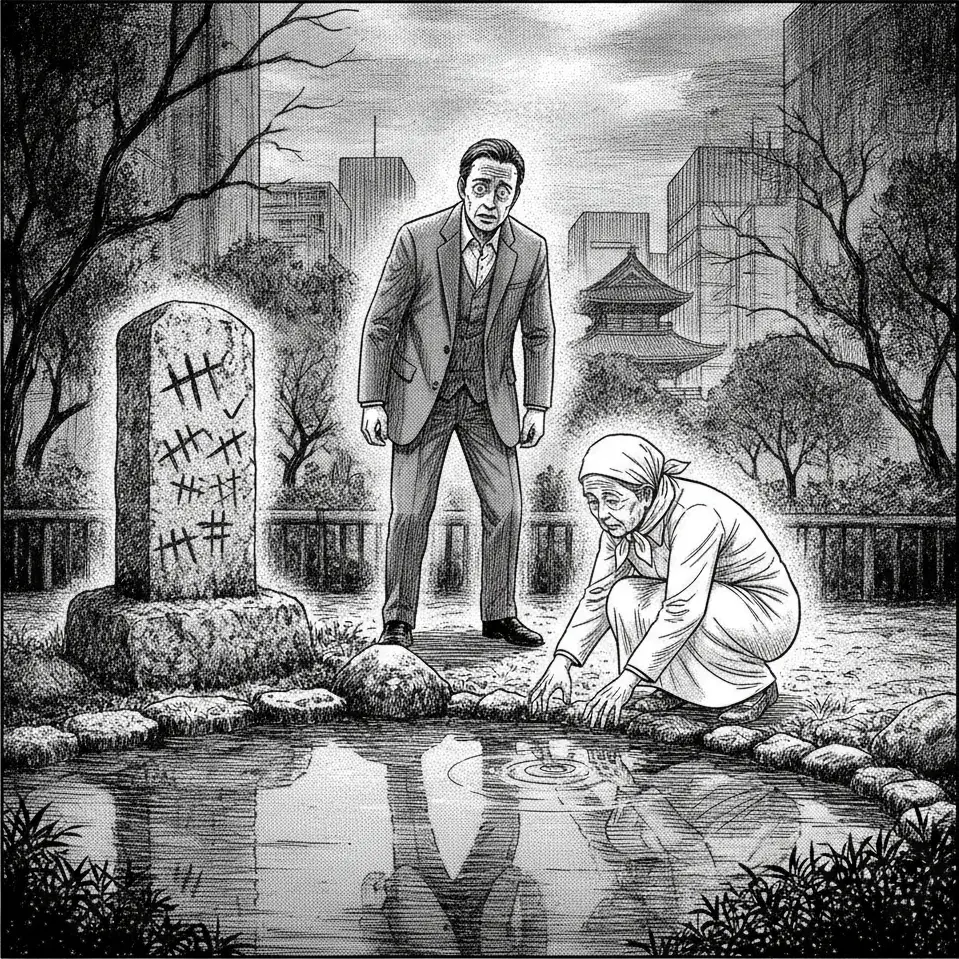
Just a short walk from Senso-ji — no more than five minutes on foot — there is a small park called Hanakawado Park. Those of you who know the area will be familiar with it, I'm sure. Tucked away inside that park sits a single man-made pond. They call it Ubagaike — the Old Woman's Pond.
In the light of day, it's nothing remarkable. Just the sort of pond you'd find in any park, anywhere. Carp gliding through the water, or so I'm told.
But the stone monument standing beside it… that carries a certain weight to it.
This is something I heard, and it goes back a very long way. In those days, the whole area was still known as Asajigahara — a marsh. Nothing but reeds shifting in the wind, a desolate stretch of wasteland where no one went. And in the middle of it all, a single ramshackle hut.
An old woman lived there alone.
She hung out a sign offering lodging to travellers. Pilgrims on their way to Senso-ji would lose their path, spot her light in the dark, and make their way to her door. The old woman would welcome them with a warm smile, set out a meal, lay down a bed, and tend to the weariness of the road.
And then, once the traveller had sunk into a deep sleep.
She would lift a heavy stone, and bring it down upon their head.
By some accounts, the number reached nine hundred and ninety-nine. There's no way to verify such a thing, of course — but that is how the story goes.
Then one night, the old woman's daughter came home, and she had brought a young traveller with her. It seemed the two had fallen for one another somewhere along the road. The daughter led him inside and introduced him to her mother.
The old woman smiled and welcomed him in.
The night deepened. The young man drifted off to sleep. The old woman took up her stone and drew close.
And then the daughter threw herself between them.
The stone came down on the daughter's head.
The old woman froze where she stood. She understood, in that moment, what she had done. The hands that had taken nine hundred and ninety-nine lives had now taken her own child's.
The following morning, the old woman walked alone to the pond nearby, and stepped into it, and did not come back.
No one witnessed it. It is simply the story that has come down to us.
And from that time on, they say, the pond came to be called Ubagaike.
As it stands, it reads like a folk tale. A stone monument erected for the repose of the dead, a park built over the ground, and that is the end of it.
Except… someone told me something that has stayed with me.
This person often passed by Hanakawado Park on the way home from work. Eleven at night, sometimes midnight.
One evening, walking past the pond, they noticed a figure crouching at the water's edge. It was dark and hard to make out clearly, but it looked like an old woman. Wrapped in something pale, perfectly still, staring down into the water.
They were still deciding whether to say something when they walked past.
And that was when the smell reached them.
Not the smell of earth. Something heavier, wetter than that. Not quite the smell of rot, not quite the smell of blood — more like the reek rising up from the bed of a marsh, from decomposing reeds, drifting up from somewhere far below.
It unsettled them badly enough that they walked home quickly, without looking back.
The next day, they passed by again in the daylight. They stood before the monument and were idly looking out over the water when something caught their eye — markings carved into the base of the stone.
On closer inspection, they were tally marks.
Five strokes, five strokes, five strokes… dozens upon dozens of them, scratched densely into the corner of the stone.
Nothing in the tourist guides mentions them. Nothing on the information boards. No one knows when they were carved, or who carved them, or what was being counted.
Whether you go and look for yourself, I'll leave entirely up to you.
But there is just one thing I'll say.
The old woman didn't stop at nine hundred and ninety-nine.