…Might I trouble you with something?
I cannot say with any certainty that this is true. It is only a story that has passed through several mouths before finding its way to this company. Whether you believe it or not, I leave entirely to your judgment — after you have heard it.
It concerns the Ginza Line.
That old route with the yellow carriages, running beneath the streets of Tokyo for nearly a hundred years now. From Shibuya to Asakusa, all underground. You will know it, I'm sure.
I am told it happened to a man — his name is not entirely clear to me. Only that he was in his thirties, and worked at some company or other.
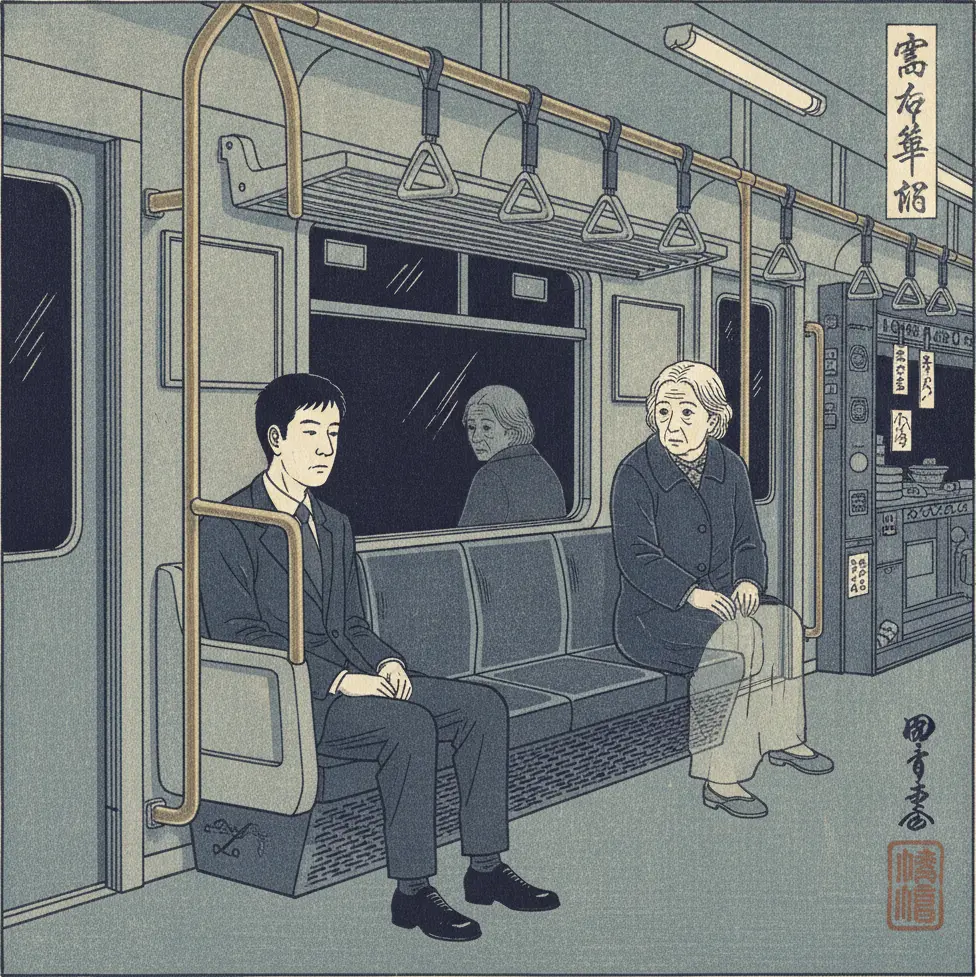
It was late at night, just before the last train. He had boarded the final car heading from Ueno toward Asakusa, alone. No one else in the carriage. A single fluorescent light flickering faintly overhead, and beneath it, only himself. Outside the windows, as one would expect — darkness. Nothing but black walls sliding past.
He had lost his mother, not long before this…
Just short of Asakusa, the train began to slow. Not a gradual deceleration — something quieter than that, more like drifting through water. And when he glanced, without thinking, out the window —
There was light. Along the side of the tracks, where there should have been only darkness.
A warm light. The colour of embers.
At first he thought it must be a maintenance worker's lamp. But it was not a single light. There were many. Lined up in a row — just like the lanterns along a covered shopping street.
The train slowed further, and he pressed his forehead to the glass to see. Cold, he said afterward. Strangely cold for the glass to be, given it was not the dead of winter.
There was something, unmistakably, beyond the tracks.
In a dim, corridor-like space, small shops stood in a row. There were signs, but he could not read them. Not that the characters were obscured — rather, when he tried to focus on them, his eyes seemed to slide away, and his mind refused to form them into words. There were people too. Walking. Their backs turned to him, moving slowly.
And then he saw her.
The back of a woman. A coat of deep navy blue, slightly old in its cut. Hair streaked with white, gathered at the nape of her neck. The moment he saw that figure, he said, his body stopped obeying him. He wanted to call out — but nothing came. As though his throat had frozen solid.
The woman's back was identical to that of his mother, who had died three months before. The same coat — the very coat he had placed in her coffin at the funeral.
The woman began, slowly, to turn around — and in that instant —
The train regained its speed, and the scene vanished behind him in a moment.
The train eased into Asakusa station. The doors opened. He sank down onto the platform and could not rise. When a station attendant came to him and spoke, he was unable to answer for some time, or so I have heard.
But there was one thing.
Later — quietly, as if to himself — he said it.
In the brief moment she had begun to turn, the profile he glimpsed… was smiling. Smiling as though she were glad.
Whether that frightened him, or broke his heart, even he could not say.
…What has become of him since, I have no way of knowing. Only that he has not been able to ride the Ginza Line since that night.
The old ones used to say: stare too long out the window of a night train, and something on the other side will stare back. Beneath the ground, there are roads that belong to the ground.
The lights over there are warm.
And it is precisely because they are warm, they say, that some people cannot find their way back.