…Please, allow me a moment of your time.
I cannot vouch for any of this. But it is a story I have heard more than once, from those who come to visit this shrine.
There is, they say, a certain building in Kabukicho. I cannot tell you exactly where. Only that it stands somewhere in the middle of the district, in the area where the neon bleeds and blurs most loudly, tucked away as if trying not to be noticed. From the outside, there is nothing remarkable about it. An aging tenant building. Its signage washed out by the brighter lights of whatever stands beside it. Most people pass without a second glance, or so I am told.
I have heard of a young man. His twenties. His name I do not know — let us call him Tanaka. That night, Tanaka had been drinking. It was past two in the morning. He had become separated from his friends, and found himself standing alone before that building. Whether he meant to use the restroom, or whether his feet simply carried him there, he himself could not say with any certainty, even afterward.
He passed through the automatic doors. A single fluorescent tube buzzed and flickered overhead. The corridor was empty. There was the smell of alcohol, and beneath it something else — something cloying, like flowers just beginning to rot. Tanaka told himself it was an air freshener. He pressed the button for the elevator. Whether he had business on the fourth floor, or knew someone in the building, I cannot say. Only that he pressed the button. That much, he was sure of.
The doors opened. He stepped inside. He pressed four.
And that, he said, was when things went wrong.
The elevator did not go up. The floor indicator began to move — slowly, downward. B1. B2. At first, Tanaka thought little of it, only wondering vaguely how deep the basement of such a building could go. The drink may have dulled him. He pressed the door-open button. Nothing. He pressed the button for the first floor. Nothing changed. The car simply continued its slow, steady descent.
It stopped at B4.
The doors opened.
Tanaka said he lost his voice entirely. He could not tell afterward whether he had been crying, or whether he had been breathing at all.
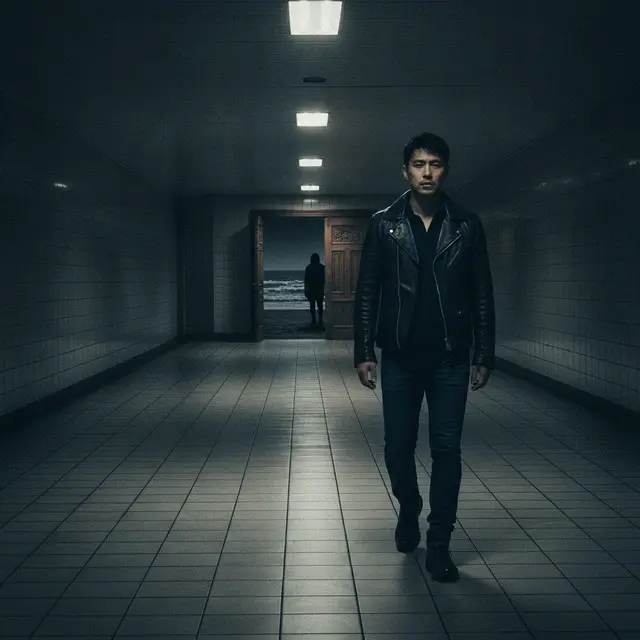
Beyond the doors was a corridor. The ceiling was low. Bare concrete. A single naked bulb hung from above. At the far end of the corridor, there was a chair. In the chair, there was a person.
Their head was bowed. Their face was not visible. They did not move — not even slightly. The bulb swayed, and so the shadows moved. And then Tanaka noticed.
The shadow did not match the body.
The figure sat motionless, head down. But the shadow — slowly, deliberately — was turning its head toward him.
Tanaka said he was running before he knew it. He threw himself through the elevator doors as they were closing and hammered the button for the first floor. This time it moved. When the doors opened, the fluorescent light buzzed again. He stepped outside. The neon was still loud. People were still walking. There was still sound.
Tanaka crouched down on the pavement and could not stand for some time.
I do not know much of what came after. Only that the person who told me this said Tanaka stopped going to work the following month. That he stopped answering his phone.
Whether that building still stands, I cannot say.
But there is one thing that stays with me.
A shadow requires light to exist. And so I find myself wondering — in that dim corridor, lit by a single swaying bulb, in which direction was that shadow turning its face?
…I would ask that you not think on it too deeply.