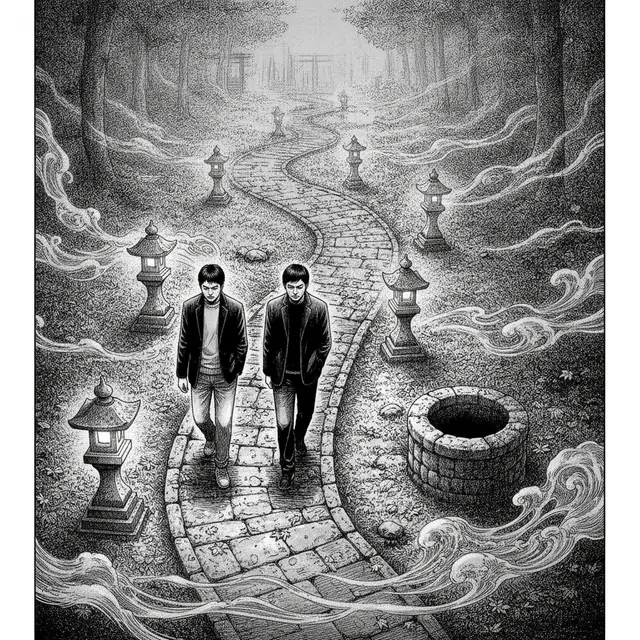
Can I tell you something?
It's a story from Gion. I can't vouch for any of it myself, so please — take it as nothing more than something I once heard.
The old teahouses and restaurants in that part of the city have centuries soaked into their walls. The latticed facades, the cobblestones, the paper lanterns burning low in the dark — people say those places wear a different face at night than they do by day. Not as a matter of atmosphere, either. Something far more literal than that, apparently.
A geiko told this story — said she'd heard it from a senior colleague, years before.
When that woman was still young, she was called to an engagement at one of the old teahouses. A handful of guests, sake flowing, the room full of noise and warmth. Late in the evening, she rose to excuse herself for a moment, and as she stood, her foot caught the edge of a tatami mat.
And then.
It shifted. Just slightly. The mat moved.
Everyone went quiet, they said. The laughter simply stopped.
She knelt and worked her fingers under the edge of the mat, and it lifted — smoothly, without resistance. A breath of cold air rose from below. It was the height of summer, deep into the night, and yet what came up felt like a winter morning. And with it, a sound. Not the drip and splash of water — something lower, something farther away. A slow, submerged shifting, as though something were swaying in the dark beneath them.
A well.
In the middle of the tatami room. Under the floor.
One of the guests peered down and murmured, almost to himself: "…The stonework is old. Very old." Even with a torch shone into it, the bottom couldn't be seen. The light seemed to dissolve partway down, swallowed before it could reach anything.
When they asked the proprietress why on earth there was a well in such a place, she said only: "I really couldn't say… it was here when I came." Nothing more than that. There are explanations people offer — water reserves in case of fire, the peculiarities of old construction — but why hide one beneath the floor of a banquet room? Why there, of all places?
Some time later, another story found its way around.
Elsewhere in Gion, further back along one of the narrower lanes, a restaurant was being renovated. When the workers broke open a storage closet, they found a well behind it. Long disused, the stone rim thick with moss, a wooden lid nailed shut over the opening. When one of the carpenters moved to pry the lid free, the foreman stopped him. Don't touch it. Why not, the man asked. Because the nails are wrong, the foreman said.
The lid had been nailed from the inside.
Not sealed from above to keep something in. Nailed from below, so it couldn't be opened from within.
The crew left early that day, I was told.
What became of that well — whether it's still there, sealed behind fresh plaster, or whether something else was done with it — I never found out. I didn't ask.
But sometimes, walking through Gion along those narrow stone lanes, I find myself thinking.
That beyond those latticed doors, beneath the tatami of some quiet room, something is there even now. Still. Swaying gently.
Waiting, at the bottom of cold water.