This is a story I heard about two years ago, from someone who knew someone I knew. There's no way to verify it — and yet it was strangely, unsettlingly specific.
Deep in the inner sanctuary of Kōyasan, there is said to be a well called the Mirror Well.
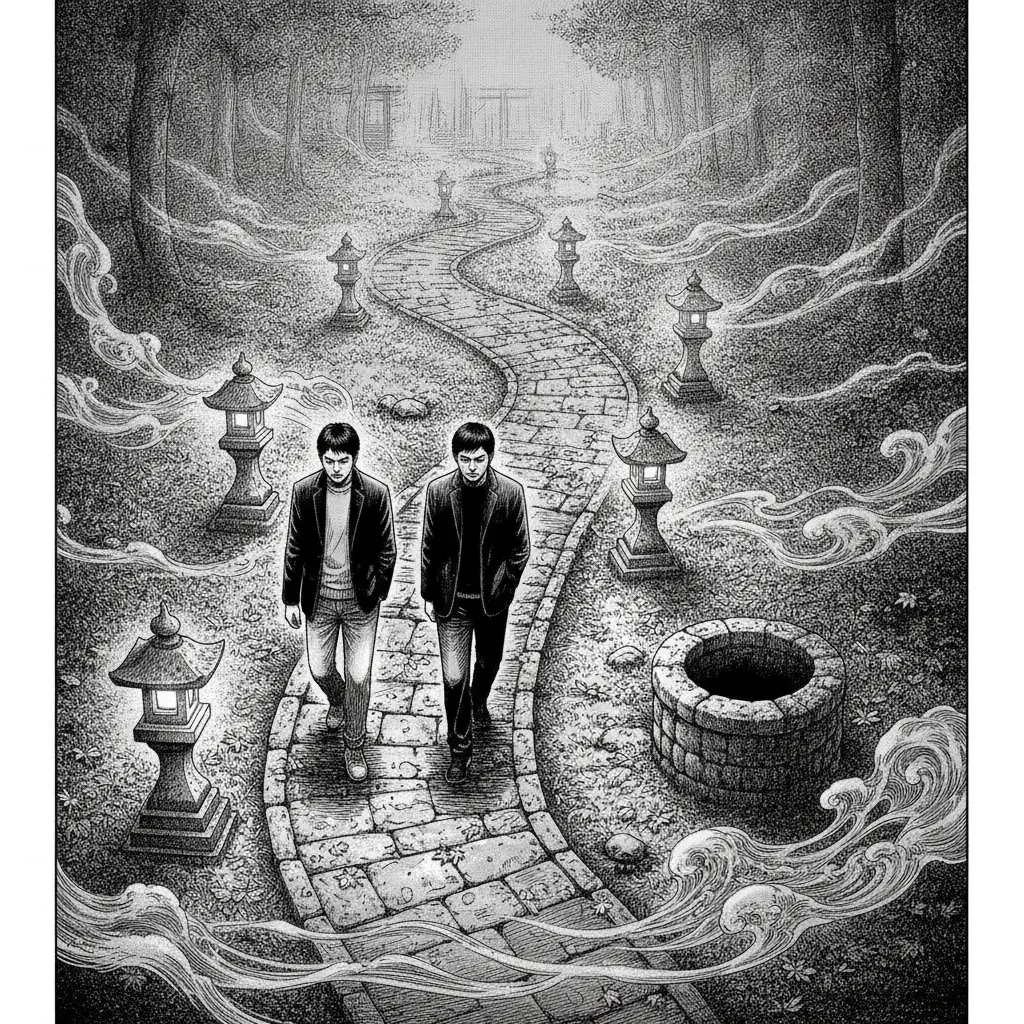
Just past the Nakahashi bridge, along the stone-lantern-lined approach, there stands a small hall. And in the shadow that hall casts — quietly, so very quietly — sits a little well of fitted stone. No signpost marks it. If you didn't know to look, you would walk right past.
The legend goes like this: anyone who peers into that well and sees no reflection of their own face in the water will be dead within three years.
You'll think it's the sort of legend you hear everywhere. I thought so too, at first.
The man in question was in his thirties and lived in Kyoto. I'll leave his name out of it — call him K. K hadn't gone to Kōyasan as a tourist. He'd accompanied a friend to a forty-ninth-day memorial service, and afterward they'd walked out to the inner sanctuary together.
It was late autumn, and the afternoon had grown old. Mist had begun to settle over the approach, and the lantern flames bled softly into it, blurred and indistinct. The air was cold, and K said the smell of rotting cedar needles clung to him the whole way.
K had heard about the well from his friend. So he thought — why not — and decided to have a look. Nothing more than idle curiosity.
He placed both hands on the stone rim and looked down.
The water was farther below than he'd expected. It was dark, and he could feel cold air rising from the depths against his cheeks. The surface was perfectly still. Not a ripple.
And there was no reflection.
His face simply was not there.
The water wasn't murky — that's the thing. It was clear. The stone walls of the well were reflected in it. The dim glow of the lanterns lay on the surface. But K's face, leaning out over the edge — that alone was absent.
He couldn't move for a moment. He told himself it was the angle, shifted his weight — left, then right. Still nothing. The water held only dark sky and drifting mist, swaying gently in silence.
His friend called from behind him: "What's wrong?" K laughed and said it was nothing, and stepped away.
That was all. On the train home, K told his friend what he'd seen. The friend said it was a coincidence, a trick of the light. K tried to believe that too.
Eight months later, K was hospitalized. The illness had no clear diagnosis — the doctors were baffled, or so I was told. The following spring, well before three years had passed, he died.
I heard this story from the friend. The friend told it this way: that he himself had looked into the well that day, and his own face had looked back at him clearly.
That was what he couldn't stop thinking about.
One last thing. According to the friend, when K lifted his face from the well, he said he'd glimpsed something in the water for just a moment. Not his own face. In place of his face, rising from somewhere far below, looking up — the face of someone else entirely.
There's no way to know if any of it is true. But the friend, they say, still cannot bring himself to go back to Kōyasan.