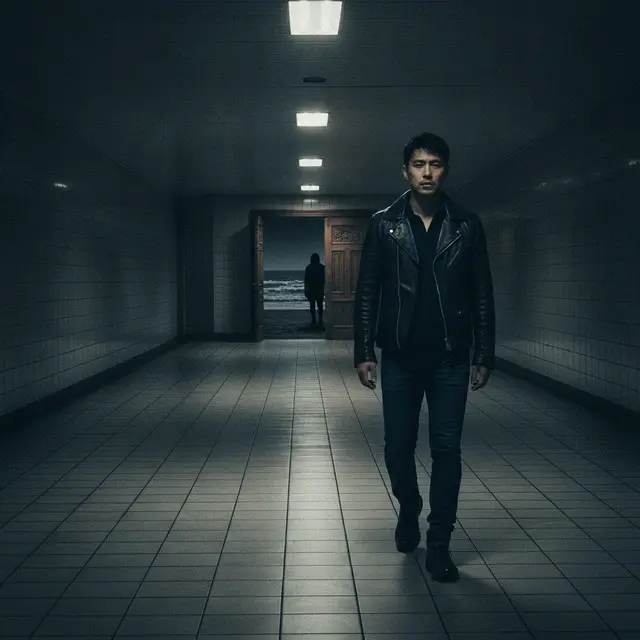
Well then. Let me tell you a story about Ikebukuro.
This is something I heard from someone else, so I can't verify it myself — whether it's true or not, I really couldn't say. What I can tell you is that this kind of story is making the rounds. Make of that what you will.
It happened last autumn, apparently. A man who worked somewhere in Ikebukuro. I won't give his name, but by all accounts he was an ordinary salaryman, rode the Marunouchi Line every day without a second thought.
That particular night he'd been working late, and there was less than an hour left until the last train. He'd come down to the platform when he realized, somewhere along the way, he'd lost his wallet. So he retraced his steps, wandering back and forth through the underground concourse. You know what Ikebukuro's underground is like — rail lines stacked on top of each other, corridors running every which way, the kind of place where even after years of daily use you'll suddenly think, wait, have I ever been down this way before? That night, searching for his wallet, he must have taken a wrong turn somewhere. Before he knew it, he was in a corridor he'd never seen.
Dim, it was. Hemmed in by bare concrete walls. The lighting wasn't the usual fluorescent white — instead, old fixtures cast a yellowish glow at even intervals along the ceiling. The floor tiles weren't the clean white ones you see in the station today, either. These were a dull, faded green, the kind from another era entirely. Each footstep rang out against them — clack, clack — the sound bouncing off the walls.
Strange, he thought. But his mind was still on the wallet, and he figured there had to be an exit somewhere ahead, so he kept walking.
After a while, the corridor opened up without warning.
There was a platform.
No barriers. No tape. No signage of any kind. Just an island platform, sitting there in the dark as though it had simply been forgotten. The rails were eaten through with rust. At the far end of the platform, the skeleton of an old sign still stood — the frame alone, stripped of whatever letters it had once held. Whether they'd fallen away over time or had never been there at all, there was no way to know.
It was silent, he said. Underground stations always have something — the distant rumble of a passing train, the hum of ventilation, some ambient noise you don't even notice until it's gone. Here, there was none of it. A silence so complete it pressed against the ears.
The man walked to the edge of the platform and looked down the track. The tunnel opened before him, black and wide.
And that was when he noticed.
Wind was coming from inside the tunnel.
The wind that moves through a subway tunnel is pushed ahead of an approaching train — that warm, stale gust carrying iron and dust. That was exactly what he felt. The wind that comes before a train arrives.
But there was no sound.
No sound of any train. Only the wind.
As the meaning of that slowly worked its way into his body, he found himself already running, he said. He bolted back the way he'd come, found a corridor he recognized, pushed through the ticket gates, and came up into the open air. The wallet had completely slipped his mind. It turned up the next day at the station's lost-and-found window, but by then that was the last thing he was thinking about.
Afterward, he heard through someone or other that in the years just after the war, there had been a section of the Marunouchi Line used as a temporary platform — and that structurally, traces of it remain to this day. But that it is completely sealed off, and no ordinary person should be able to get anywhere near it.
Which raises the question of how this man got in at all.
That part, no one seems to know. The man himself says he went back to look for that corridor and couldn't find it anywhere.
There is just one thing, though.
Wind blows because something is drawing near. Something that makes no sound as it comes.