…This is something I heard from someone else, mind you.
Kobe. Sannomiya. Do you know Tōmon Street?
That S-curved alley — people say that at night, without quite knowing why, your feet begin to slow. I've heard it mentioned here and there. I can't say I've confirmed it myself. Only that several people have told me something along those lines.
Apparently it happened to a friend of a friend.
Let's call him A. The night A walked through Tōmon Street alone was in February, close to the hour when one day tips into the next. He'd been drinking, and on his way back to Sannomiya station he cut through that alley to save time.
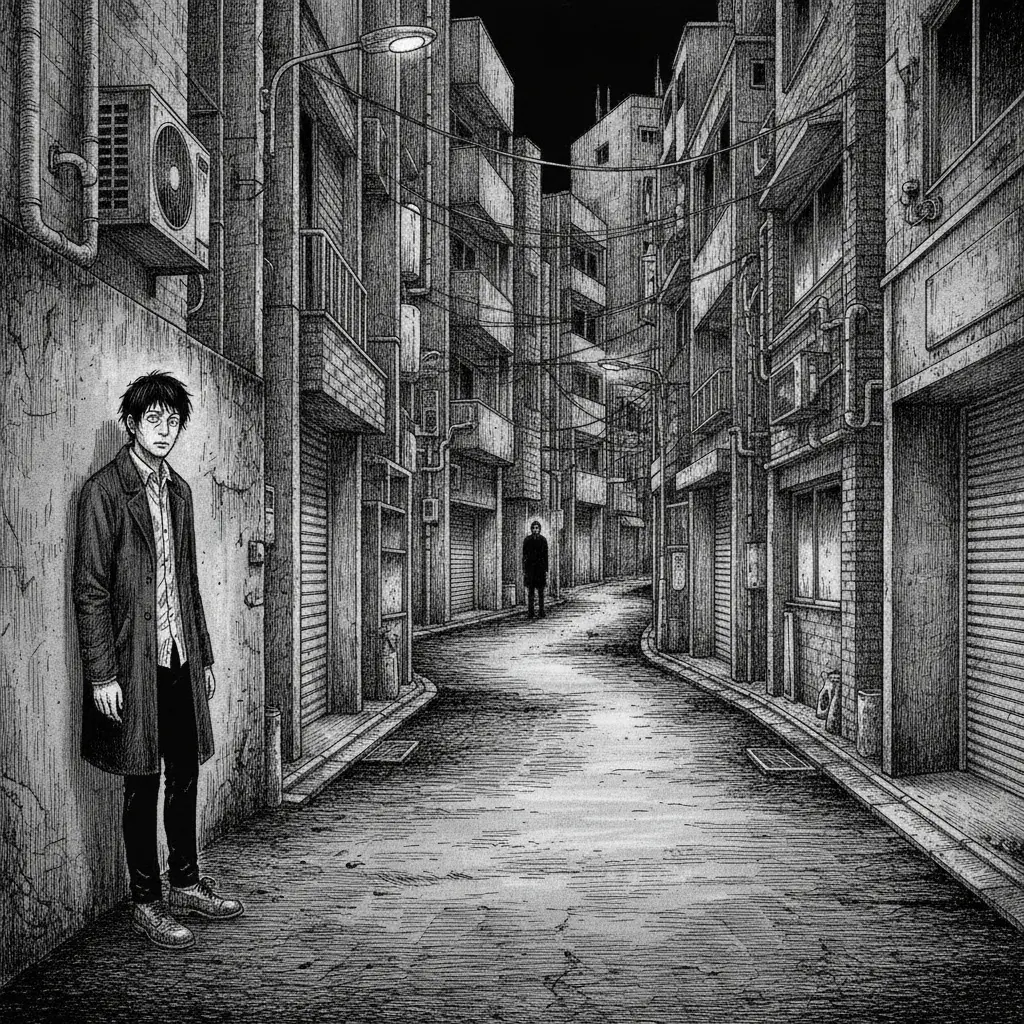
Near the entrance it was still all right. There was something like the dying glow of neon signs, and from a yakitori stall just pulling its shutters down came drifting smoke and the smell of fat. The feeling of a night in the entertainment district winding to its close, he said.
But as he went deeper into the S-curve, that changed.
The smell vanished. All at once.
Smoke, exhaust, the reek of alcohol — everything dissolved, and there was nothing left. Winter night air is cold and sharp on its own, but this was different from that. The way he described it was: nothing was coming in through the back of his nose. That particular way of putting it stayed with me.
And then, walking, he happened to glance down at his feet.
The cobblestones were wet. It hadn't rained. But the surface of the road was a damp, even black — wet from one edge to the other, uniformly, with no puddles, no drainage running through. Just a quiet, level dampness spread across everything.
That was when A first noticed.
He couldn't hear his own footsteps.
He was wearing leather shoes with heels, walking on cobblestones, and there was no sound. That dry, clean click-click-click had disappeared at some point without his realising.
He stopped. Stamped down hard. Nothing.
Something's wrong, he thought, and turned to look back — and the entrance he'd come through was no longer visible. He knew it was only the angle of the S-curve hiding it. He knew that. And still his legs locked.
He turned back around quickly and started to walk, and that was when he saw it.
At the far end of the alley, right around the next bend, someone was standing.
One in the morning, alone in that alley — that alone isn't so strange. But what A couldn't stop staring at was the way the figure was standing.
Back flat against the wall. Arms hanging straight at the sides. Facing forward. Not moving.
A said the alcohol left him in an instant.
He had no choice but to go closer, so he went closer. His footsteps still made no sound. He had no real sense of how fast he was moving.
When he was about five metres away, he could finally make out the face.
A man. Looked to be in his thirties. Eyes open, staring straight ahead. Standing perfectly still.
As A drew level and tried to pass, the man opened his mouth.
No sound came out.
But his lips moved. Slowly, deliberately, forming something.
A looked away and walked past quickly. He didn't look back.
He ran to the station. The next morning he asked someone who had come through that alley the night before whether they'd seen anyone standing at that corner. No one had.
This is the part that has stayed with me.
There's a story that the winding shape of Tōmon Street follows the outer edge of what was once a racetrack. In the early Meiji period, foreign residents opened a racecourse there; in time it became a proper facility, but it closed after only about five years. Restaurants and other establishments filled in after that, and eventually it became the entertainment district it is today.
More than a hundred years since then. Countless people, countless nights, layered into that alley one on top of another.
A still goes to Sannomiya, apparently. But he won't set foot in Tōmon Street.
When someone asked him why, he said only one thing.
…That he had started trying to read the man's lips.