…Would you mind listening, just for a moment?
I cannot say with any certainty that what I am about to tell you is true. Only — I have heard the same story, or something very like it, from several people who have come to this shrine. And so I thought I ought to pass it along, quietly, just as it was told to me.
It concerns the underground levels of Ikebukuro Station.
That station runs very deep, or so I am told. The passages fold over one another in layers, and even people who know the place well can lose their sense of where they are. Several visitors have mentioned, in particular, that the older corridors leading toward the west exit carry a different quality of air from the rest — something they could not quite name, but noticed all the same.
This is the story of a man. I do not know his name. What I was told is that it happened last autumn, sometime after one in the morning. He had caught the last train, but took a wrong turn in the connecting passage and found himself walking into one of the old underground tunnels on the west side.
Every other fluorescent tube was dark, he said. The walls were tiled, old stains blooming here and there across the surface, and a cold crept upward from the floor as though the ground itself were exhaling. There was a smell, too — the particular smell of deep underground places, something between soil and rust.
He decided to turn back. But by then, he could no longer tell which direction he had come from.
That was when he heard footsteps behind him.
…A dry, measured sound. Leather soles on tile. Not far away — ten paces, perhaps, just at his back. He turned around.
No one was there.
The corridor stretched away in both directions, empty. Fluorescent light, then shadow, then light again, and nothing but white tile walls running on into the dimness.
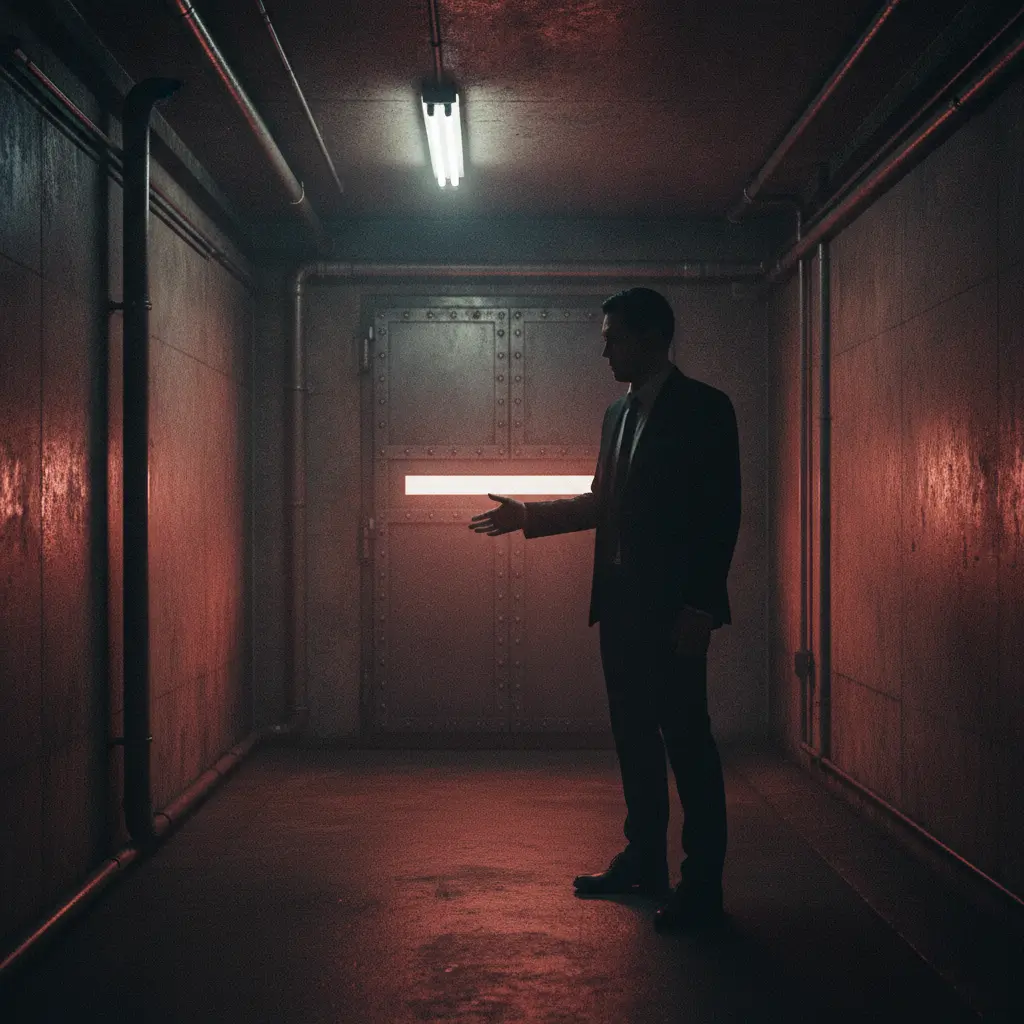
He kept walking, uneasy, and after a time he noticed a door ahead of him that he did not recognize. It was iron, heavy-looking, filmed with rust — and yet along its edge, for no reason he could explain, a thin line of light was leaking through.
He knew he should not go near it, he said. But the moment he saw that light, his body was already moving toward it. His feet were carrying him forward of their own accord, or so it felt.
After that, his memory stops.
When he came to himself, he was standing near a different ticket gate. He checked his watch: three hours had passed. His body felt fine. Only his left wrist was cold — deeply, strangely cold. When he touched it, the sensation was of something that had been gripped, held tightly, and only recently released.
Taken alone, one might suppose he had simply sat down somewhere from exhaustion and lost track of time. But there was something else he mentioned, something that stayed with the people who heard him.
Standing before that door, he said, he thought he heard voices through the gap where the light came through. Not words. Only many voices layered together, low, like a sound pressed up from somewhere far below.
There are old records that suggest this ground remembers the war. That tunnels dug as air-raid shelters may still lie somewhere beneath the city, sealed and unaccounted for. It is spoken of in whispers, and I offer it only as rumour.
…I would not recommend going to look for yourself.
I was told that the coldness in that man's wrist did not leave him for some time afterward. And then, after a certain night, he stopped speaking of the experience entirely.
Someone asked him why. He only shook his head, quietly, and said nothing.
…Whether something came back to him that he had not wished to remember. Or whether he had been asked, in some way, to forget.
That, I cannot say.