

The Hollow Graves of the Valley
AI AI-generated fiction — text, and any narration or images. Unrelated to any real events, people, organizations, or places.
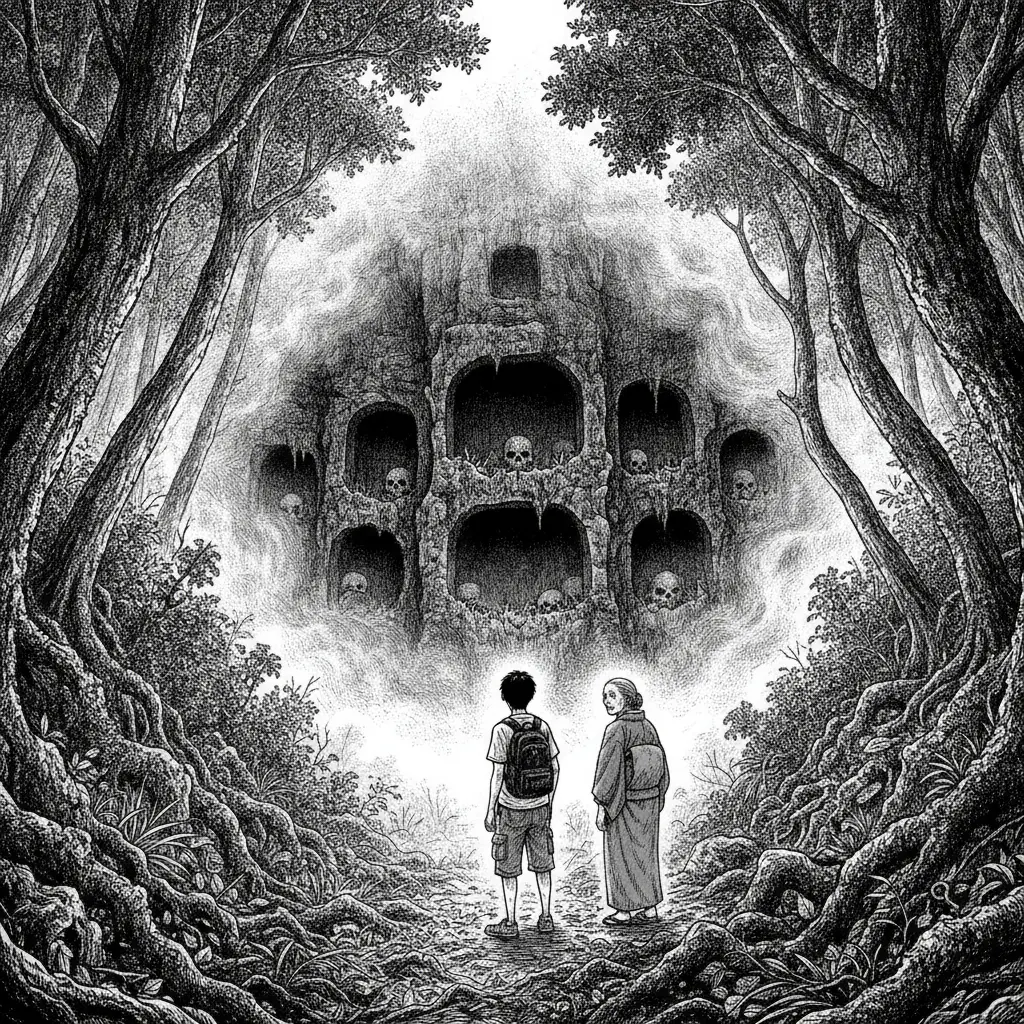
The mountains of Kamakura take on a particular dampness in summer. Sea winds strike the hills and die there, and the air that settles at the bottom of the valley hollows gathers the smell of leaf rot and moss and something else entirely, pressing itself against the skin of anyone who enters. Tourists make for Tsurugaoka Hachimangu and Hasedera; few bother to seek out the valley of the hollow graves. In that place, the stone niches carved by medieval warriors and monks still gape open along the cliff faces, cradling their bones through seven hundred years.
Tanaka Nozomu would come to regret choosing that valley as his research site — though he would only understand this later. On that morning in early July, walking away from Kamakura Station, he knew nothing yet. Nozomu was a graduate student specializing in cultural heritage preservation, and his master's thesis was titled "Transformations in Funerary Space during the Kamakura Period." On the recommendation of his supervisor, he had turned his attention to a small, secluded valley beyond the old mountain passes leading from Kita-Kamakura — a place that appeared on almost no tourist map. It had no fixed name. The older locals simply called it the valley of the hollow graves.
Leaving Kamakura Station, crossing Wakamiya-oji, and turning onto the road toward Yamanouchi, the noise of the town fell away almost immediately. Threading through narrow residential lanes, he emerged without warning where the concrete walls ended and a dense bamboo grove began. Even at midday the bamboo formed a canopy of dim green, and the moment Nozomu stepped inside, the temperature seemed to drop two or three degrees. His map application marked everything beyond this point as unconfirmed. He pressed on anyway, guided by a hand-drawn route memo he had received the day before from his senior colleague, Kawasaki.
Kawasaki had been in the same research lab until the previous year and had scouted the valley in advance. His message had been brief: "The preservation of the stone niches is remarkable. But you shouldn't linger." Nozomu had skimmed past the warning. He had a habit of losing track of time when absorbed in fieldwork — that was probably all Kawasaki meant.
Beyond the bamboo grove, the valley opened before him. Sheer cliffs pressed in from both sides, and along their faces, semicircular openings were set at irregular intervals. The hollow graves. The largest were deep enough to hold two tatami mats laid end to end, their interiors lined with the broken remnants of five-ringed stone towers and formless lumps of rock. The smallest were barely wide enough for a child to crawl inside, their walls still bearing the raw, unhealed marks of chisels. Nozomu raised his camera and opened his notebook. A thin channel of water ran along the valley floor, and its sound was the only sound. There was no wind.
The first two hours were pure fieldwork. He measured the dimensions of each niche, photographed the objects inside, and recorded the strata of the cliffs. The number of stone chambers exceeded his estimates — the southern face alone held seventeen. The northern face was denser still, and counting those hidden beneath overgrowth, the total might surpass thirty. It was an exceptional site. Writing figures into his notebook, Nozomu moved steadily deeper into the valley.
Sometime after midday, he noticed something wrong. The sound of the water had changed — or rather, it had not changed so much as multiplied. Beneath the water's voice, another sound had appeared. It was regular, yet its rhythm was unmistakably different from the stream's. It was the sound of something striking stone.
Nozomu stopped. Listening carefully, he could tell the sound came from deeper in the valley. Knock, knock, knock — steady, evenly spaced. He thought of construction work, or perhaps another researcher, and walked toward it. But as he advanced, the sound seemed to recede rather than grow closer. Then, some thirty meters on, the valley ended at a sheer wall of rock. The sound was coming from there. From inside the cliff.
The surface of the cliff bore chisel marks like all the others. But the marks directly in front of him were different in depth. Elsewhere the stone had been shaved evenly; here alone the marks spiraled inward, cut deeper and deeper toward a center. They looked like the traces of something trying to dig its way out from within. Nozomu pressed the shutter and wrote in his notebook: requires further examination. The sound, he realized, had stopped.
He left the valley that evening. Stepping out through the bamboo grove, the cicadas came rushing back all at once — and only then did he realize they had been entirely absent inside. In July, in Kamakura, a place without cicadas. He could find no explanation for it. He told himself he was simply tired, ate dinner at a small restaurant near the station, and returned to his lodgings.
The next morning, Nozomu called Kawasaki. He wanted a clearer answer about what "you shouldn't linger" had meant. But Kawasaki didn't answer. A message went unread. When Nozomu contacted the research office, he was told that Kawasaki had taken a leave of absence the previous month due to illness. There were also reports that he had been hospitalized, the administrative staff member added.
Hearing this, Nozomu felt a small seed of unease drop into his chest — and immediately smothered it. Kawasaki's condition had nothing to do with the valley. There was no causal link between ill health and surveying stone niches. He told himself this firmly, and set out for his second day of fieldwork.
He had planned to focus on the northern cliff face. Entering the valley at eight in the morning, the air felt heavier than the day before. He attributed it to humidity. The northern face received less sunlight than the southern, and its moss grew thick. He worked carefully, brushing the moss aside to examine the borders of each niche. Inside one of them, he found something he had not seen in any of the others.
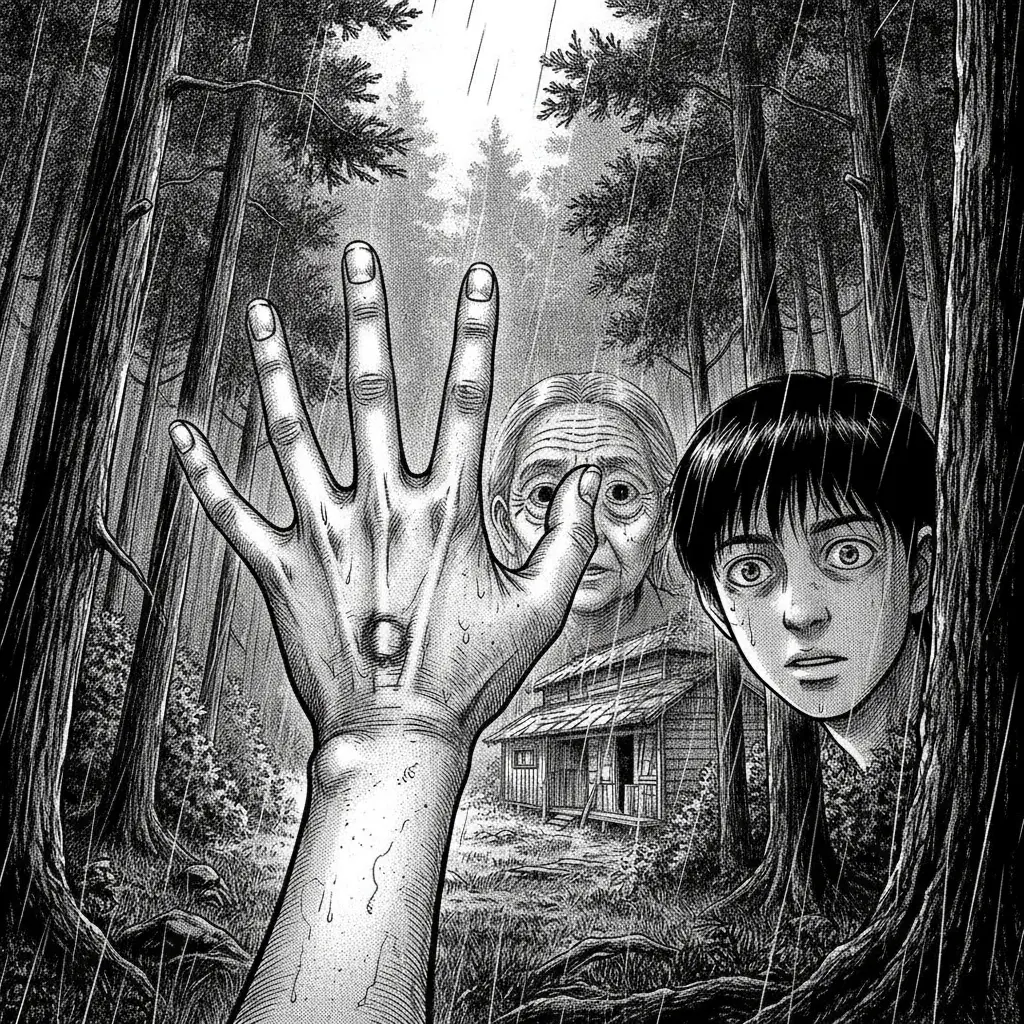
Handprints. Five of them, pressed into the stone wall as though with mud or clay, arranged in a row. The fingers splayed open like fans, and the part corresponding to the wrist pointed toward the back of the niche — as though someone crawling out from inside had clutched at the rim. Photographing them, Nozomu tried to determine whether these were later vandalism or genuine medieval traces. But as he studied them, the proportions began to trouble him. For an adult man's hand, the fingers were far too long and slender.
By midmorning he had found the same handprints in three separate niches. In each case they appeared at the same position on the inner wall, oriented in the same direction — wrist pointing inward, fingers fanning outward. While examining the fourth niche, he noticed something lying in the darkness at the back. His flashlight revealed a scrap of fabric. He drew it out: an old cord woven from hemp fiber, roughly a meter in length, one end tied in a knot. He sealed it in a bag, intending to show it to a specialist.
At noon, eating lunch and reviewing his notes, something nagged at him. Across two days he had examined twenty-four niches in total, and not one of them contained any trace of bone. Kamakura's hollow graves almost always retained some fragment of human remains. Here there was nothing — not a splinter. Did the absence of bone mean that many hands had disturbed the site over the centuries? Or had these chambers been dug for an entirely different purpose from the beginning?
That afternoon, Nozomu went to the deepest part of the valley. He stood again before the dead-end cliff and examined the spiral chisel marks more closely. From nearby, he could see that the pattern extended across the entire face. What appeared random at a distance was, on careful inspection, a spiral radiating outward from a single center. He began to sketch it. Partway through, he noticed that his fingertips were trembling faintly. He told himself it was simply the cold. The back of the valley was undeniably chilly.
Toward evening, as he was packing up to leave, he saw someone standing beside the water channel. An old woman. She wore a grey kimono and stood with her back to him. He called out — "Excuse me, I believe this area may be restricted to authorized personnel" — aware even as he said it that the phrasing was strange. She did not answer. He took a step closer. The ground at her feet was wet. It had not rained that day.
She turned slowly. Her face was old, but her eyes were young. No — not young, not old. They were eyes without age. She said nothing, only looked at him. Then she turned her face toward the cliff — toward the dead-end wall with its spiral marks. Nozomu tried to ask whether she knew something about this place, but no sound came. His throat was not closed; the words simply refused to take shape. She looked at him once more, then walked along the edge of the water channel and disappeared into the depths of the valley. She vanished before she reached the cliff.
Nozomu ran through the bamboo grove and out into the residential lanes. The cicadas crashed back over him like a wave. His legs were shaking. He returned to his lodgings, showered, left his dinner untouched, and lay down on the bed. Staring at the ceiling, he turned the woman over in his mind. Perhaps she was simply a local resident who had wandered into the valley. Perhaps her eyes had seemed strange only because he was exhausted. Perhaps she had not vanished — perhaps she had merely stepped outside his field of vision. But the wet ground at her feet, on a day without rain, he could not explain away by any means he tried.
The next morning, Nozomu intended to check out and leave. He had gathered nearly all the material he needed for his thesis. But over breakfast, reviewing the previous day's photographs on his laptop, one image stopped him. It was a shot of the spiral chisel marks. He had not noticed it when he pressed the shutter, but on the surface of the cliff there was a faint shadow — in the shape of a person. He had been the only one standing before the cliff, and the shadow's orientation was different from his own. Considering the position of the light source, the shadow fell from an impossible direction. It fell as though light were coming from inside the cliff.
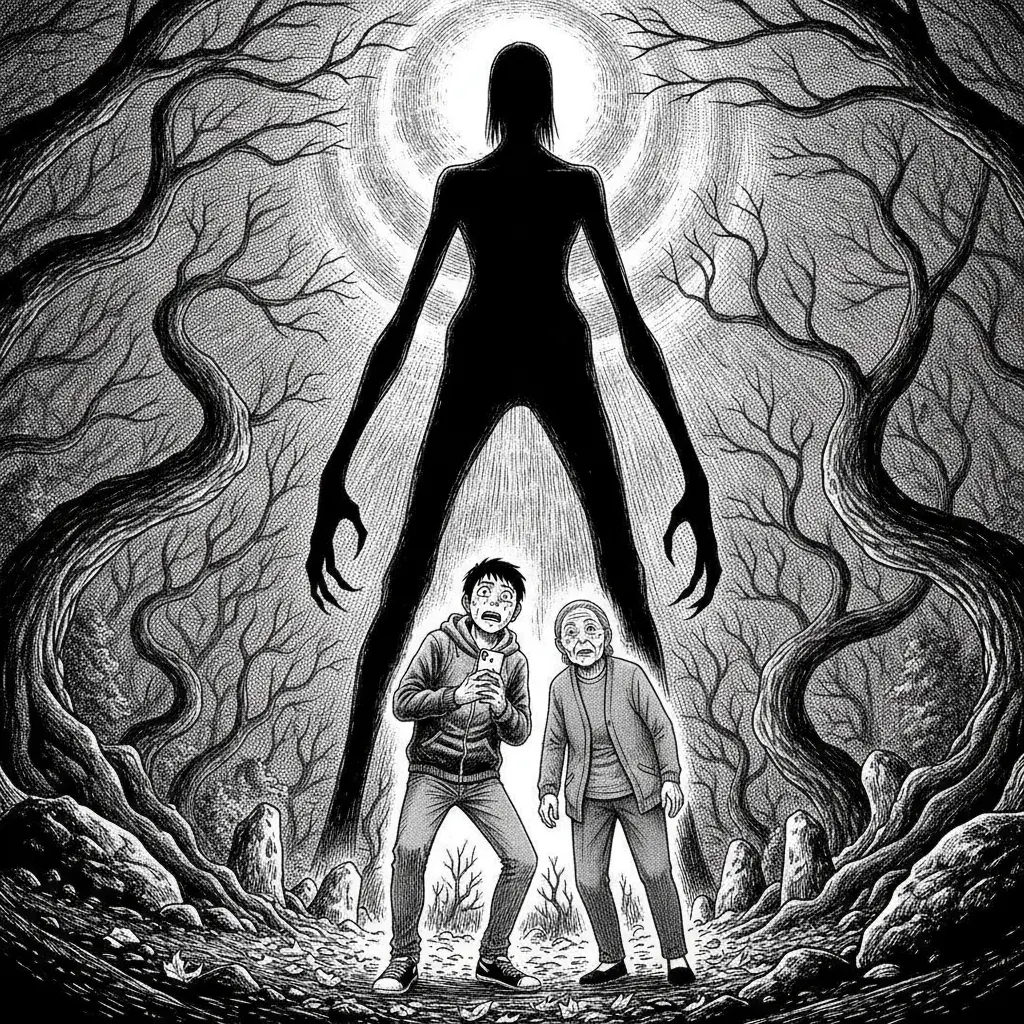
He enlarged the photograph. As the outline sharpened, there was no longer any doubt that it was a human silhouette — or nearly human. Something was wrong with it. The arms were too long. The proportions between hip and knee did not match a person's. Nozomu forwarded the image to his supervisor with the message: "What do you think this is?" No reply came.
That afternoon, he went back to the valley. The option of not going simply did not present itself to him. At the entrance to the bamboo grove, a voice called out from behind. He turned to find a man who appeared to be in his seventies, dressed for farm work — a local resident. "You're going in there?" the man said.
The man continued. "There are people who go into that valley and don't come back whole. Their bodies return, but something doesn't. What that something is varies from person to person. Some lose their voice. Some stop dreaming. Some forget the faces of the people they love." Nozomu asked what he meant. The man shook his head. "I don't know. Only this — it's been said for generations that the niches carved in that place were not made to hold the dead. It's the other way around. They were carved to contain something that was trying to get out from the inside."
Nozomu turned the man's words over in his mind as he stepped into the bamboo grove regardless. He told himself this would be the last time. One final look at the spiral cliff, and then he would go. Nothing more than that.
The valley was darker than the day before. Clouds had gathered. He walked quickly to the back and stood before the dead-end cliff. The same spiral marks. But today something was different. The surface of the cliff was faintly warm. He might have dismissed it as the summer heat, but this face received no direct sunlight — there was no reason for it to be warm. He pressed his palm flat against the stone. It was warm. And it was vibrating.
The vibration was irregular, yet not entirely random. Knock, knock, knock — the sound passed through the stone and into his hand. The same sound he had heard on the first day. But now it did not reach him through the air; it came directly through the rock, through his palm. He could not pull his hand away. When he tried, his fingertips seemed to adhere to the surface, as though the cliff were drawing them in.
He did not know how much time passed. When awareness returned, the valley had grown dark. He wrenched his palm from the cliff and felt pain. His hand was red. And on the surface of the cliff, a handprint remained — the same shape as those he had found on the inner walls of the other niches. Five fingers fanned open, wrist pointing inward. The only difference was that this one had been pressed from the outside.
He ran. Through the bamboo grove, through the residential lanes, all the way to the main road without stopping. Standing there, breathless, his phone rang. An unknown number. He answered. A man's voice — familiar, though he could not place it. "Did it find you?" the voice said. "If it finds you, you can't come back." The line went dead. He checked his call history. No number was recorded.
The following morning, Nozomu left Kamakura. Back in his apartment in Tokyo, he returned to work on his thesis. He had taken more than three hundred photographs in the valley. He began going through them one by one, and when he reached the shots from the second afternoon, he noticed something. He had photographed more than thirty niches along the northern cliff face — yet in every single image, the interiors were empty. Not empty of objects: empty of depth. Each chamber showed only a flat wall of stone, as though the niches had no interior at all. As though they were painted on.
He enlarged the images and examined them from every angle. The result was the same. But there was something that unsettled him more than this. Several shots had caught his own hand in the frame — inevitable during fieldwork. Yet the hand in the photographs was wrong. The fingers were too long. The proportions of the arm did not match a human being's.
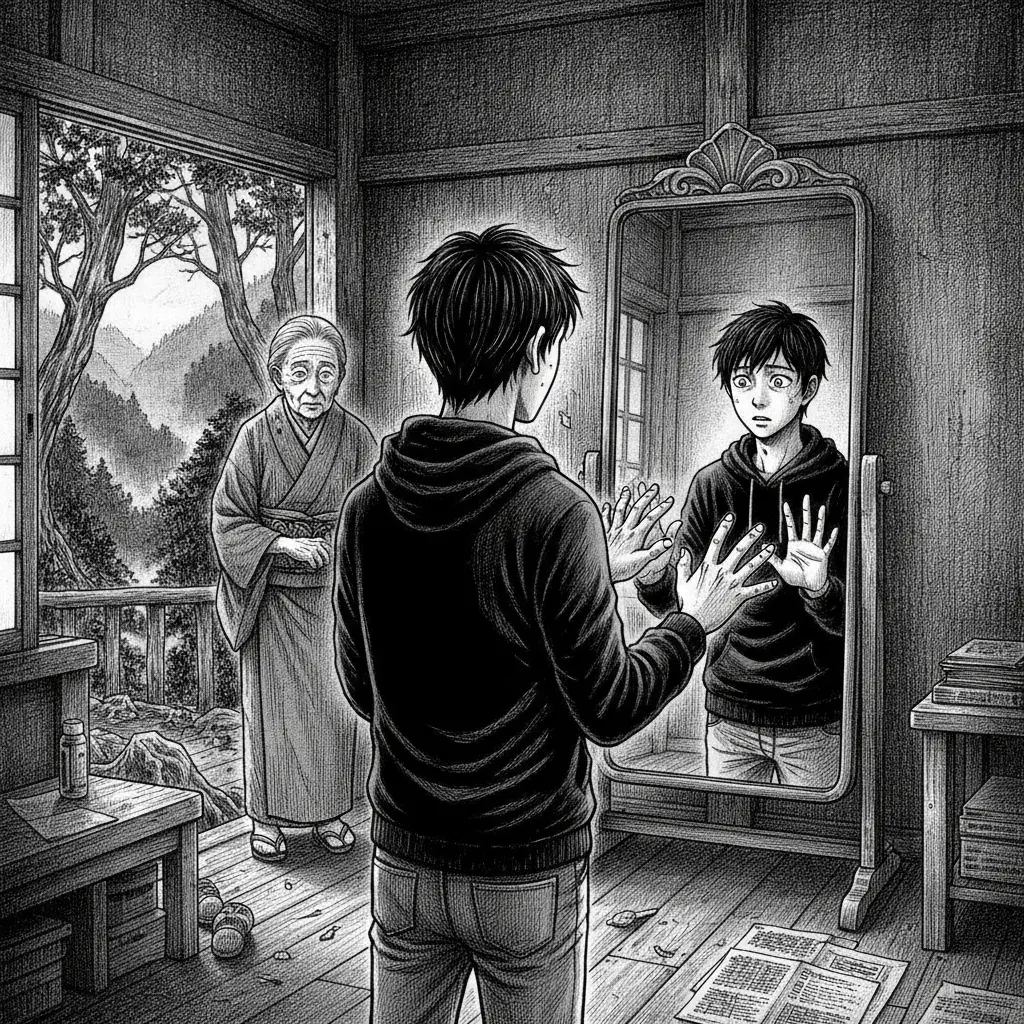
He stood before the mirror and looked at his hands. They were ordinary hands. Ordinary fingers, ordinary proportions. He could not reconcile what he saw in the mirror with what he saw in the photographs.
Opening the desk drawer, he found the hemp cord. The one he had pulled from the back of the niche. He had forgotten he'd brought it back to Tokyo. When he picked it up, it was dry, but strangely heavy. He tried to undo the knot. His fingers wouldn't respond — or rather, they moved, but when they touched the knot, they seemed to pass through it, as though the cord were not entirely there.
He put the cord back in the drawer and opened his laptop. He sent another message to Kawasaki: "Please tell me where you're hospitalized. I want to come and see you." After a while, a reply arrived from an account he didn't recognize. "Kawasaki cannot speak right now. But I will pass this on. You can still come back. However — you must not have left a handprint. Those who leave their mark on that cliff teach the place their shape. The place remembers you."
Nozomu read the message again and again. He had left a handprint on the cliff. That was certain. He thought again about the prints on the inner walls of the other niches. They were not the traces of something clawing its way out from within. They were the traces of people who had pressed their hands against the stone from the outside — drawn to it, or pulled toward it — and held them there. And those people had almost certainly never returned from the valley entirely whole.
In autumn, Nozomu went back to Kamakura once. Not because his submission deadline was approaching, but because of an urge he could not explain — a compulsion to see the valley one more time. He reached the entrance to the bamboo grove and stopped. He did not go in. From the threshold, the valley was as quiet as ever, the openings in the cliff face dark and waiting. Only the sound of water reached him. The cicadas were long past their season.
He stood there for ten minutes, then turned and walked away. As he left the bamboo grove behind, he looked down at his hands. On the palm of his left hand, a faint redness remained — there since the day he had pressed it against the cliff, never fading. A dermatologist had found no cause. Just a rash, he had been told.
On the train back to Tokyo, Nozomu opened his laptop. He pulled up his thesis file, and the screen showed the date of the last save. He was certain he had saved it two weeks ago. But the date displayed was yesterday. He opened the file. After the final paragraph, a single line had been added — words he had no memory of writing.
"The handprint is still there."
He deleted the line. Saved the file. The train passed through Yokohama Station. Outside the window, the light failed, and his reflection appeared in the glass. He looked at it for a long moment and could not move.
The face looking back at him was his own. But the eyes were the old woman's eyes. Ageless eyes. Eyes that pointed nowhere at all.