

The Voice from the Yagura
AI AI-generated fiction — text, and any narration or images. Unrelated to any real events, people, organizations, or places.
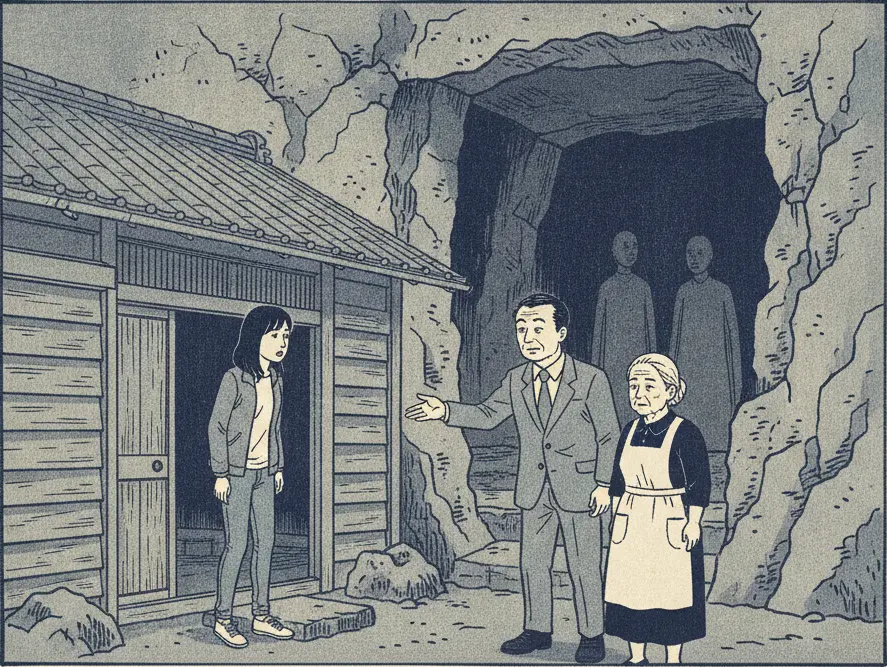
Tanaka Kana moved to Kamakura at the end of August.
She had decided in the spring to leave her editing job in Tokyo and make a go of it as a freelance writer. Half a year later, just as the work had begun to settle into a reliable rhythm, an old university friend named Sakamoto mentioned that there was a cheap place available in Kamakura. It was a low, single-story house tucked deep along a narrow lane in an area known as the Yagura Yato. A yato is a valley carved by erosion into the surrounding hills, and Kamakura is riddled with them, large and small. This particular one, the Yagura Yato, was named for what it contained: sheer rock faces honeycombed with horizontal burial chambers — yagura — cut into the stone during the Kamakura period.
The estate agent met Kana at the entrance to the valley. He was a man in his fifties, thick-necked and affable enough, but throughout his explanation of the property he never once looked toward the rock face.
"It stays cool in summer," he said. "Being down at the bottom of the valley, the air doesn't always move, but the stone keeps things cold."
Kana looked up at the cliff. Three rectangular openings were cut into the rock about three meters above the ground. Each entrance was neatly squared off, and the interiors were too dark to see into. Moss and mineral staining had formed intricate patterns across the surface — patterns that, for a moment, looked almost like faces — but Kana quickly looked away.
The rent was low. That was what decided it.
The house consisted of two adjoining Japanese-style rooms, a narrow kitchen, and a tiled bathroom. Beyond the veranda lay a small garden, and beyond the garden the ground ran directly to the base of the cliff. A faint dampness drifted constantly from the rock, and even in midsummer a thin film of moss clung to the garden stones. At first Kana found this moisture pleasant — something like the breath of old earth, so different from the dry apartment she had left behind in Tokyo.
For the first two weeks after moving in, Kana buried herself in work. Several deadlines had piled up, so she left the house only to buy groceries, spent her days at a desk on the veranda with her laptop, and went to bed early. The work went well. The quiet did more for her concentration than she had expected. Tourists never ventured this deep into the valley. The only sounds were the wind and, occasionally, the distant crossing bell of a train.
She first noticed something wrong in the second week of September.
It began with a sound. Around two or three in the morning, she heard something from the direction of the garden — a soft, deliberate pressure on the earth, as though something were walking. Kana woke and lay still in the darkness, holding her breath. A cat, she thought, or some small animal. She had heard that tanuki sometimes appeared in Kamakura's valleys. She thought about looking through the gap in the rain shutters, but found herself oddly reluctant to make the noise of unlatching them. In the end she went back to bed and fell asleep.
The same sound came the following night, at the same hour.
On the third night, Kana took a flashlight and stepped out onto the veranda. The garden was empty. Moss gleamed on the stones, and the cliff rose black and silent. The yagura openings were dark. There was no wind. When she turned the beam toward the rock face and the three chambers lit up, she thought she saw something move in the depths of the middle one.
Thought she saw. That was all. She told herself as much, went back inside, and locked the door.
The next morning she called Sakamoto. He laughed and said it was probably a tanuki or a badger, then paused and added, "Well, there are a lot of people buried in that area, so if it bothers you, put out a little Jizo statue." The word buried lodged in Kana's ear with a strangely physical weight.
Yagura are medieval ossuary chambers. Inside each hollowed recess, urns and five-ringed stone stupas were laid to rest. Kana had known this before she moved in. She had known it, and in daylight she had been able to receive it as a kind of historical atmosphere. But at night the same fact took on an entirely different texture.
October arrived, and the mornings and evenings turned sharply cold.
The bottom of the valley received little sun — direct light reached it for only a few hours in the morning, and even then it merely grazed the upper portion of the cliff without ever touching the garden. The stones on the veranda were cold underfoot. Kana fell into the habit of boiling water to warm herself during breaks from work. Around this time she began to dream.
In the dreams it was always raining. Kana stood alone at the bottom of the valley. When she looked up at the cliff, there were far more yagura openings than in reality — ten, twenty, perhaps more. And at the edge of each opening someone was sitting. She could not see their faces. Only silhouettes, knees drawn up to their chests, suspended in the rain. When Kana tried to speak, every one of them tilted their head at the same moment — the same angle, the same direction. The uncanny precision of it woke her every time.
The dream repeated itself, its details shifting slightly each night. On some nights the rain became mist. On others the number of silhouettes grew. One night, one of them rose and began to descend the cliff face — moving slowly, head downward, as though gravity had reversed itself, walking down the sheer rock as if it were a floor. When Kana woke from that dream she realized she had been making sounds. Her throat ached.
When she told Sakamoto, he said it was probably stress. "You've just gone freelance, you're in an unfamiliar place, living alone. Having strange dreams at a time like this is perfectly normal."
Kana wanted to believe him.
But what happened in the middle of October could not be explained by dreams.
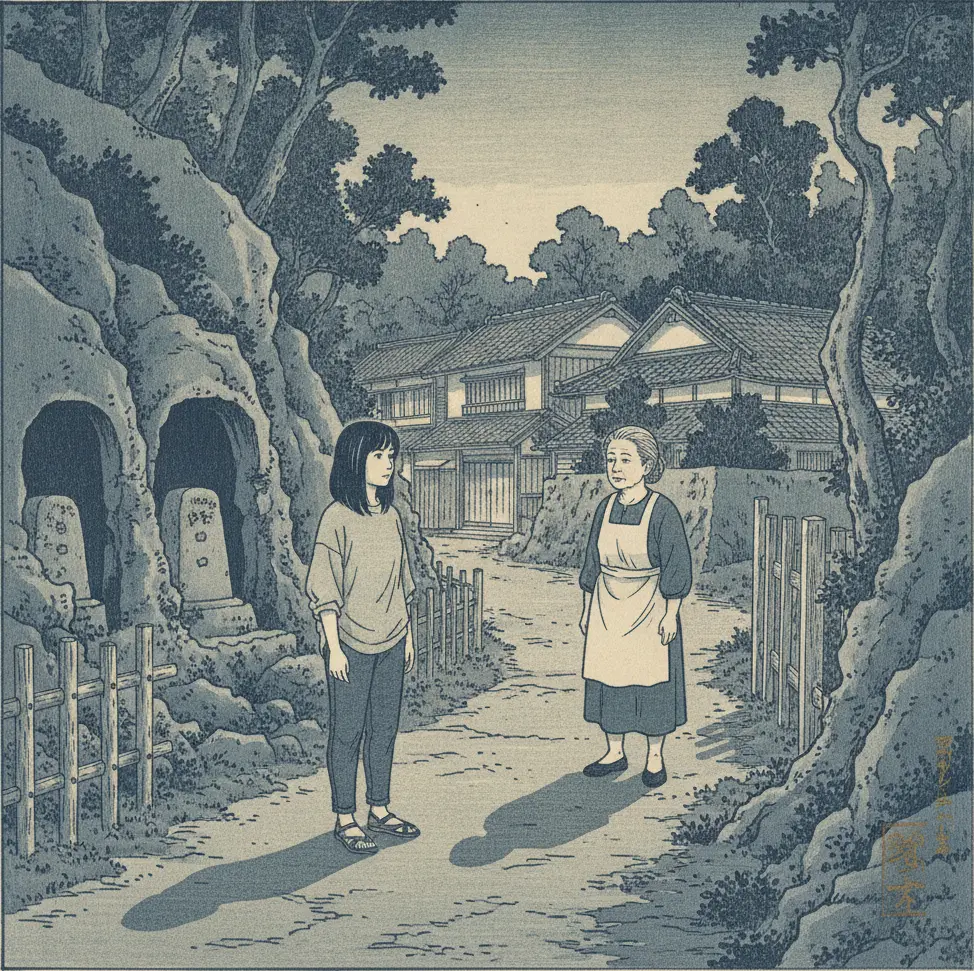
That afternoon she had worked until past noon, then walked to Tsurugaoka Hachimangu for a change of air. On her way back, as she reached the entrance to the valley, a woman came toward her along the path — a woman in her sixties, wearing a white apron. There were a few houses deeper in the valley, and Kana assumed she was a resident of one of them. The woman stopped when she saw Kana's face.
"You're living here," the woman said. It was not a question but a confirmation.
"Yes, in the bungalow at the end."
The woman studied Kana's face for a moment. Her eyes had the look of someone taking a careful measure.
"Don't go outside at night," the woman said. "And don't go near the cliff. Whatever you do."
"Why not?"
The woman did not answer. She looked past Kana's shoulder, toward the cliff, then brought her gaze back. "If something calls to you, don't answer," she said, as though repeating a rule she had long since memorized, and walked on.
Kana watched her go, then turned to look at the cliff. In daylight the yagura were nothing but holes in stone. They smelled of damp rock. There was nothing there.
That night Kana could not sleep.
After one in the morning, a sound came from the garden. Not the soft tread on earth she had heard before, but something lower — a slow grinding of stone against stone. Kana lay rigid under her blankets and listened. The sound continued at an even rhythm, neither approaching nor receding, simply present.
Then she heard the voice.
At first she could not make out what it was saying. It was not words so much as a succession of sounds. But as she strained to listen, she understood that it was calling a name. The syllables "ka-na" repeated themselves. "Kana, kana, kana." Low, without inflection, exhaled rather than spoken.
As she lay listening, Kana noticed something strange. The voice did not seem to be coming from outside. Or rather, it was coming from outside, and yet it felt as though it were resonating inside her skull — not in her ears but in her bones.
She got up, went to the kitchen, and drank a glass of water. That was all it took. The voice stopped.
The next morning she went out to the garden and found, at the base of the cliff, something that might have been footprints — not footprints exactly, but a trail of crushed moss, irregular and unreadable, impossible to attribute to a person or an animal. Kana photographed it, then checked the lock on the veranda door.
The problem was that the voice came back the following night, and the night after that.
The same repetition — "kana, kana" — began at the same hour each night. Unlike the first night, when she had fled to the kitchen, Kana now lay still and listened. In doing so she began to understand something of the voice's nature. It was not a single voice. The sounds overlapped, impossible to separate, but there was more than one of them. And the voices carried something that was not quite sadness — something closer to longing, or to waiting.
On the twentieth of October, Kana asked Sakamoto to come to Kamakura.
He arrived in the afternoon, walked through the house, stepped into the garden, looked at the cliff, and shone a flashlight into the yagura openings. "Ordinary stone chambers," he said. "There are small five-ringed stupas inside. The kind you see in textbooks."
They ate dinner together and Sakamoto left on the last train. That night there was no voice.
The following night there was no voice either.
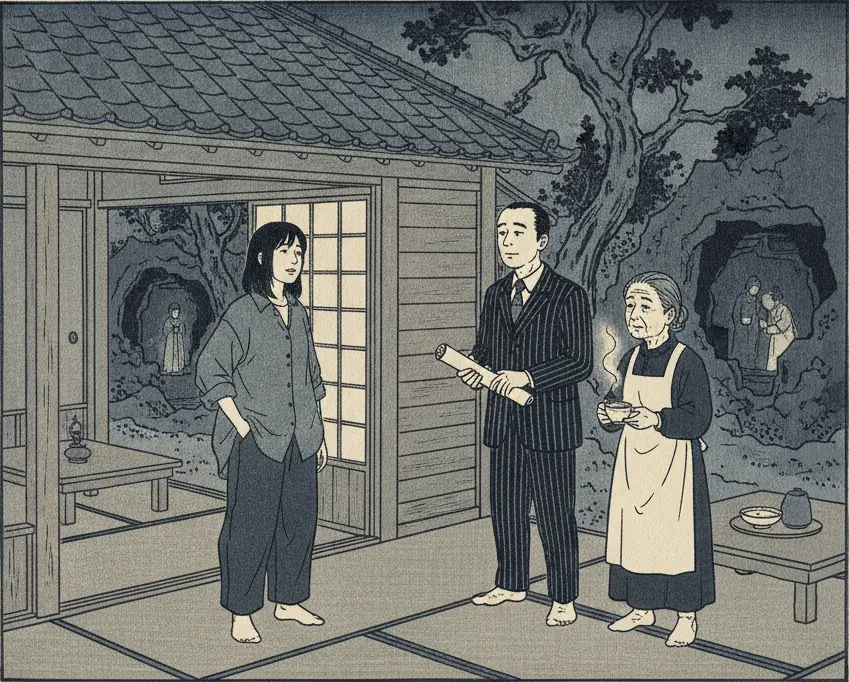
Kana felt a loosening of tension. Perhaps something had shifted when Sakamoto visited. Or perhaps talking with another person had steadied her enough to silence whatever auditory trick her mind had been playing.
But three nights later the voice returned, louder than before.
And this time it was not only her name.
"Kana, come out."
Kana stopped breathing.
"Kana, it's almost time."
The voice was low and without emotion. That was what made it so frightening. It was not screaming, not pleading — it was simply stating a fact. Almost time for what, Kana did not know. She did not want to know.
She turned on the light. The voice ceased.
She kept the light on for the rest of the night. In the morning, she decided to move out.
But as she packed her belongings, a strange awareness came over her. Since moving into this house, she had not been ill once. Back in Tokyo she had always caught a cold at the turn of each season, yet here her body had not faltered. Her work, too, had been consistently good — she had not missed a single deadline, and new commissions had been coming in steadily.
That has nothing to do with it, she told herself.
She called the estate agent and told him she intended to leave. He showed no surprise. "Understood," he said, and after a brief pause added, "The previous tenant left at the same time of year, as it happens."
"The previous tenant?"
"Yes. We do tend to see people leave in autumn."
"Why is that?"
He paused again. On the other end of the line, something shifted — a small, indistinct movement. "Hard to say," he replied. "There are things you can only know by living somewhere, I suppose."
She arranged a moving date and hung up.
That evening Kana decided to step out onto the veranda one last time. Most of her things were already in boxes, but the move was still two days away. She could not have said exactly what moved her to do it. Only that she felt, before leaving, a need to confirm something.
The sky was overcast and the moon was hidden. The cliff stood dark, and all three yagura openings gaped black. Kana went out without a flashlight. The garden stones were wet — not from rain, but from the constant seepage of moisture out of the rock, which kept the ground perpetually damp.
After she had been standing there for a while, something glowed in the depths of the middle opening.
It was less a light than a change in the darkness — a faint whitening, roughly the size and shape of a human face, hovering in the black interior.
Kana could not move.
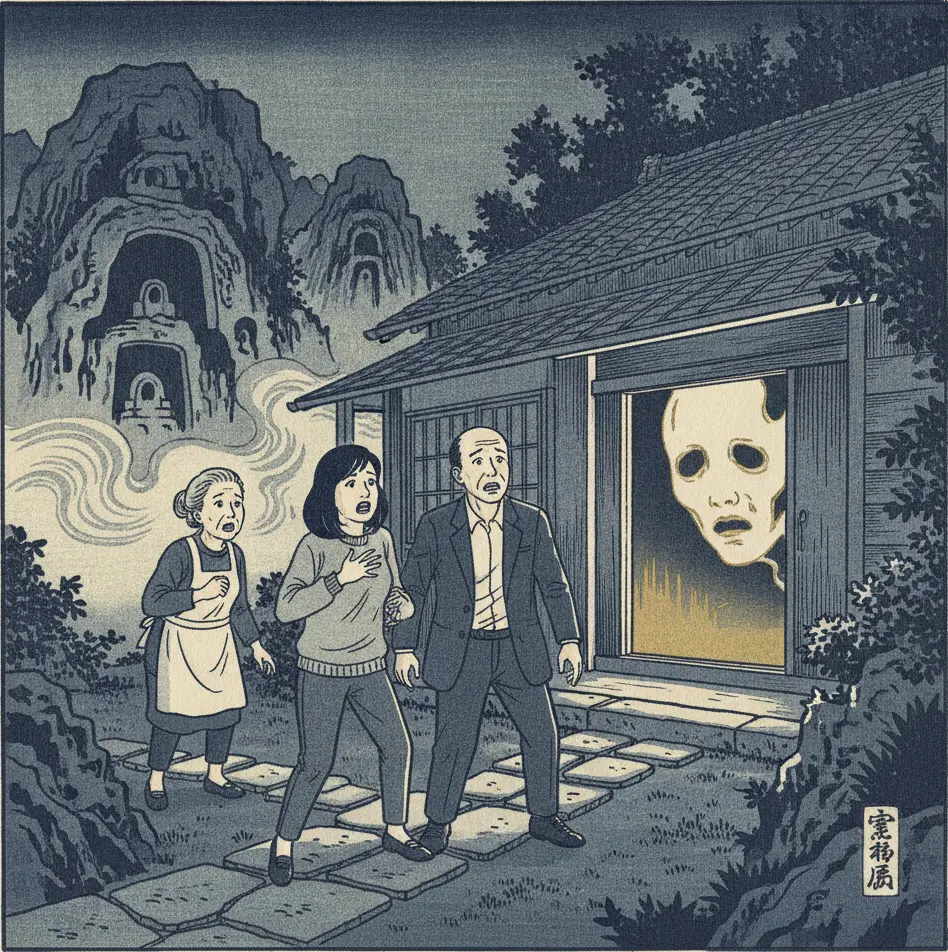
The white shape moved slowly. It drifted toward the entrance. And then Kana understood that it was a face. The features were indistinct — no clear eyes, no clear nose — but the outline of a face was there. And it was looking at her.
"Kana," said the voice.
This time it came from outside, unmistakably, from the direction of the cliff.
Kana did not answer. Not because she remembered what the woman had told her, but because she had no voice to give.
"Kana, come."
The white face did not move. It simply remained.
Kana took one step back. The veranda board creaked beneath her. The sound seemed to break something loose, and she turned, went inside, locked the veranda door, closed the rain shutters, and switched on every light in the house.
She thought about the white face many times afterward. Even after she had moved, lying in her new apartment staring at the ceiling, she turned it over in her mind. Perhaps it had been an animal's eyes catching some reflected light. Perhaps the mineral stains on the rock had arranged themselves into something face-like. Perhaps the voice had been auditory hallucination.
Any of those explanations was plausible enough.
But what Kana returned to on sleepless nights was not the white face.
On the morning of the move, while carrying boxes out to the car, she happened to glance at the garden. At the base of the cliff there was a small stone. It had not been there when she moved in — she was certain of that. It was round and white, about the size of a clenched fist, and something had been carved into its surface. Looking more closely, she saw that it was not writing but a face. A simple face rendered in plain, unadorned lines. Eyes, nose, and mouth — nothing more. An expression that held no expression at all.
Kana left the stone where it was.
Three weeks after settling into her new home, she received a message from an acquaintance in Kamakura. Someone new had moved into the bungalow in the Yagura Yato, the acquaintance mentioned in passing — a young woman, apparently a writer of some kind.
Kana could not speak for a moment.
That woman might be standing on the veranda tonight, looking up at the cliff. She might hear a voice in the small hours, calling her name.
There was nothing Kana could tell her. She could find no words that would be right. By leaving that house, had she escaped something? Or had she simply passed something on to the next person?
Was the stone still there at the base of the cliff?
Or had it already found its way into someone else's hands?
After she hung up, Kana looked down at her own palm.
She had not noticed it until that moment, but since the instant she heard the word writer, her right index finger had been tapping steadily against the surface of the desk. At an even rhythm. Without inflection. As though tracing out someone's name.