

The Handprints in the Back Alley
AI AI-generated fiction — text, and any narration or images. Unrelated to any real events, people, organizations, or places.
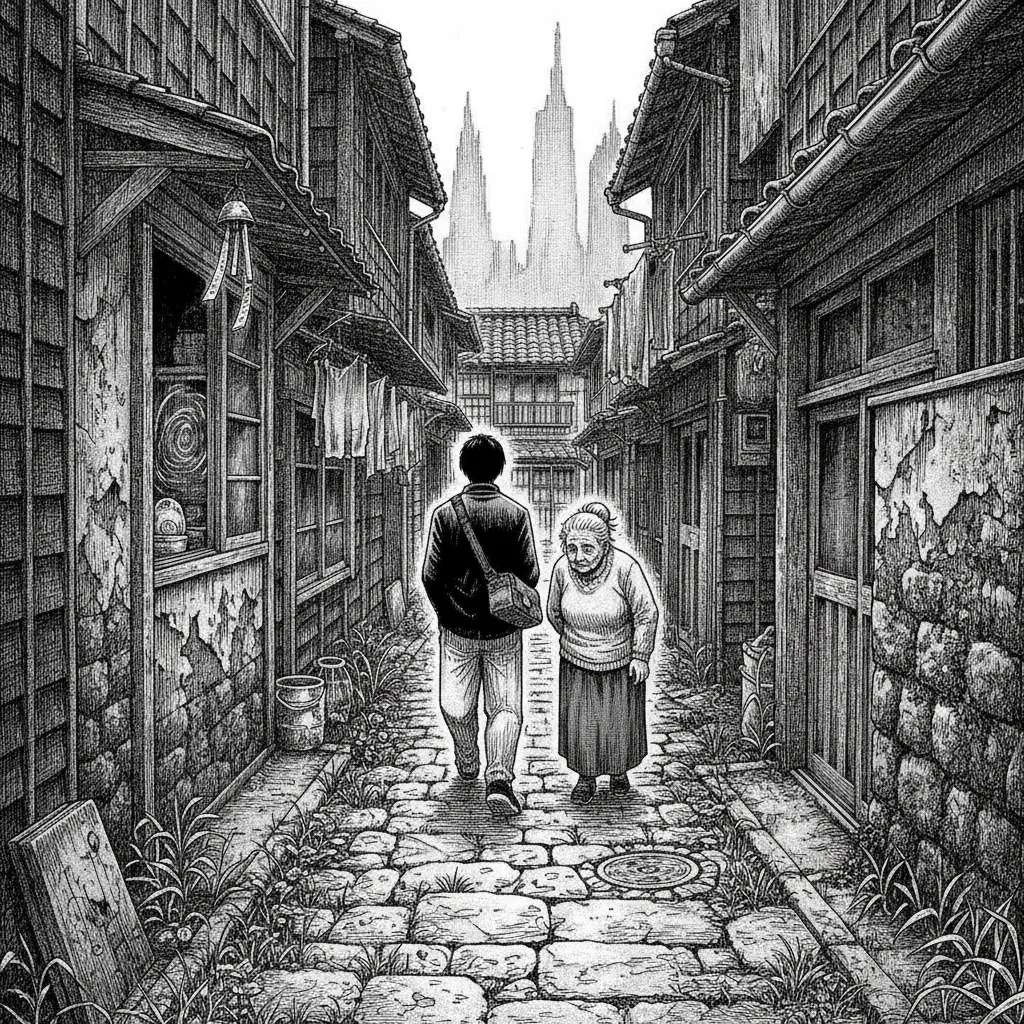
There is something about walking the back alleys of Yanaka that makes you feel you have stepped just slightly outside of time. Weeds pushing through the gaps in the cobblestones, wind chimes hanging from the eaves of old wooden houses, the smell of dashi drifting from someone's kitchen. Tokyo surrounds it on all sides, yet Yanaka alone has never quite shed its Showa-era skin. Shiina Saku (椎名朔), a photographer, had loved that quality — loved it, at least, is what he can only say now, looking back.
Saku had rented a room in Yanaka in the autumn of his thirty-second year. He had left his publishing job six months earlier to work as a freelance photographer, and though the work came in thin and his savings dwindled steadily, his morning walks through the streets of the Yanesen neighborhood were the one thing that gave his days any real weight. The room was on the second floor of a wooden apartment building west of Yanaka Cemetery, tucked a short way in from the path known as Hebi-michi. The landlady — an old woman named Shinoda Fumi (篠田ふみ), small and white-haired — had said one thing to him on the day he signed the lease: "Please don't go into the alley behind the building at night." Saku had let the words pass through him, the way you do with the idle cautions of the elderly.
There was indeed a narrow alley behind the apartment. It appeared on no map — barely wide enough for a single person to pass through, hemmed on both sides by earthen walls and wooden fences. The fences were rotting in places, and dark stains seeped through the plaster of the walls. Saku had walked the alley several times in daylight. About ten meters in, it bent to the left, and another twenty meters or so brought you to a dead end, sealed off by an old stone wall. Moss grew along the top of the wall, and if you touched it, a damp powder clung to your fingertips. There was nothing remarkable about it. At least, not in the daytime.
The first sign that something was wrong came in early November, the week the first cold winds of winter began to blow. Saku had been working until two in the morning, chasing a deadline, and stepped outside for air. He had meant to walk toward the cemetery, but on impulse turned toward the back alley instead. He had walked it so many times in daylight that he felt no fear of it at night. The alley swallowed him in darkness — there were no streetlights. He was reaching for his phone to switch on the torch when he noticed, somewhere in the depths of the alley, past the bend where nothing should have been visible, a faint light. An orange light, wavering. Like a candle, or a paper lantern.
Saku stopped. There were no houses beyond that bend. Only the dead-end wall, with no gap for any light to enter. And yet the light was there, trembling in the dark. Curiosity outran fear. The photographer's instinct moved his body before his mind could weigh the decision. He turned the corner — and the light vanished. Only the wall remained, floating pale in the blackness. He pressed the shutter. Later, reviewing the image on his monitor, he found something on the surface of the wall. A dark mark, roughly the size of a human palm — something that looked, unmistakably, like a handprint, pressed clearly into the stone at about waist height. It had not been there in the daytime.
He went back the next morning to look. The stain was still there. In the daylight, he told himself it was nothing — just a discoloration, a coincidence of shape that happened to resemble a hand. But as he turned to leave, he glanced down at the base of the wall and noticed an offering: a small dish of salt and a sprig of sakaki, nearly dried. Someone had been here recently. He thought to ask Shinoda about it, but she was out all day, and he did not see her.
From that night on, Saku began to dream. In every dream, he was walking the alleys of Yanaka. The streets were familiar, yet subtly wrong — the eaves too low, the gaps between the cobblestones too deep, the sky too narrow overhead. And always, someone was walking just behind him. Each time he tried to turn and look, his legs grew heavy and his neck locked in place. The presence behind him drew closer — not through footsteps, for there were none, but through a pressure that gathered against his back like a slow compression of air. The dream always ended in the same place: the dead-end alley, before the wall. He would wake there, every morning, with the back of his neck cold and damp.
A week passed. The sleeplessness and the slow accumulation of unease had begun to erode his concentration during the day. When he raised his camera on assignments, he kept sensing something extra in the corner of the viewfinder — one too many silhouettes, something moving at the far end of a lane. He would check, and there was never anything there. He told himself he was exhausted. He cut back his walks through Yanaka and tried to sleep earlier. Still the dreams came. Still the wall came. Still the pressure at his back came.
Then one night, for the first time, Saku managed to turn around inside the dream. All those nights of leaden legs and frozen neck, and on this night his body simply moved, easily, as though the resistance had never been there. Behind him, the alley was empty. He felt a rush of relief — and in that same instant, from ahead of him, from the direction of the wall, came a sound. Less a voice than a noise: wet and low, like a child growling deep in its throat. Saku looked at the wall. The handprints had multiplied. Not one now, but five, six, seven — prints of all sizes spreading across the entire surface. And down the center of the wall ran a single crack. The darkness inside it was absolute, and from it came a breath of air: rotting leaves, the ash of spent incense, and something else, something Saku had no name for.
He woke at three in the morning. He sat up in bed and stared at the dark ceiling for a long moment. Then, from outside the window, came a sound — faint and dry, like stone or wood being struck against something, irregular, recurring at random intervals as though whatever made it kept forgetting and then remembering. It came from the direction of the back alley. Saku rose and went to the window. He parted the curtain slightly. The entrance to the alley was visible from here, sunk in the darkness beyond the reach of any streetlight. Something was standing there.
It had the shape of a person. It was short — the height of a child. But the head was not a child's head. It was too large, the neck too thin, the shoulders set at a wrong angle. It did not move. It simply stood there — though whether stood is even the right word, he could not be certain — it simply existed there. Saku held his breath. For a moment he thought of reaching for his camera, but his body would not respond. He had no sense of how much time passed. Then, slowly, the thing began to move toward the far end of the alley. There were no footsteps. It slid, or floated, into the darkness and was gone. Saku could not bring himself to step away from the window until dawn.
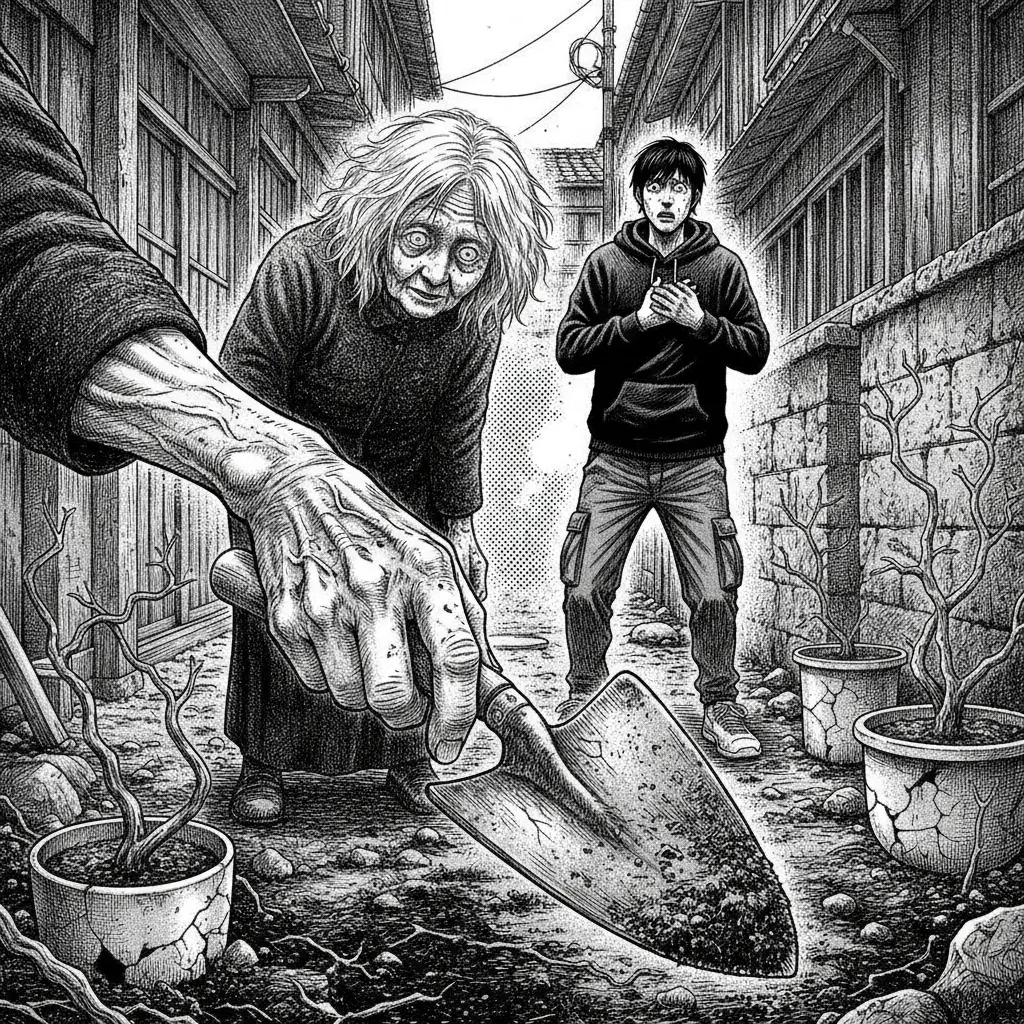
The next morning, he finally found Shinoda in the small garden in front of the building, working the dry soil of a withered pot. When he told her what he had seen the night before, she went still. After a long silence, she said only: "So you've seen it." The weight of those words chilled him. The phrasing — so you've seen it — carried within it the implication that seeing was something that could not be undone.
What the old woman told him was this. The back alley had existed since before the war. At its dead end, there had once been a small shrine — not to any local deity of Yanaka, but to something older, something nameless. In the chaos of the postwar years, the shrine was demolished and the wall built in its place, by someone who bought the land and made no offerings, performed no rites. Since then, something had been seeping out from behind that wall. Those who entered the alley at night would see it. Those who saw it would dream. Those who kept dreaming — here the old woman stopped. "Some people left," she continued quietly. "Some people couldn't." Saku did not ask what couldn't leave meant. He did not need to.
He decided to move out that same day. He would have his things packed within the week. But then he encountered a problem. As he sorted through his photographs, he realized that something appeared in all of them. Not only the photographs he had taken in Yanaka — in photographs from a different ward, taken the previous month. In photographs of a building in Minato Ward, taken a month before that. In the deep background of every single image, small and barely visible, was a shadow with a large head. He went through them one by one. It was there in photographs taken before he had decided to move, and equally present in a photograph taken after. Which meant —
Which meant it was already outside the alley. Or perhaps it had always been outside the alley.
Saku went to find Shinoda again, but when he reached her door it was locked. A folded piece of paper was tucked into the mail slot. It was not addressed to him — it appeared to be a letter meant for someone, though the outside was blank. He opened it. A single line, in the old woman's spidery hand: "That child never forgets a face it has once seen."
Saku returned to his room and began packing. He pushed things into boxes without care — camera, lenses, laptop, clothes. In the middle of it, something made him pause. He went back through every photograph he had taken since moving to Yanaka, and found that one image stood apart from all the others. A photograph taken on his very first day, after signing the lease with Shinoda, looking out the window of his new room down into the alley below. In that photograph, the shadow was not at the entrance to the alley. It was closer — between the alley entrance and the foot of the apartment stairs. Already inside the grounds.
That photograph had not been taken in November. It had been taken in September, on the first day Saku moved to Yanaka.
On moving day, Saku carried out the last of his boxes, took the key to his new apartment in hand, and stepped outside. The autumn light lay gently over the cobblestones of Yanaka. Fallen leaves drifted across the path, and somewhere a wind chime rang from the eaves of a house. It was a beautiful Yanaka morning, unchanged and serene. Saku began to walk without looking back. His new apartment was in Arakawa Ward, ten minutes or so from Yanaka by train. He rode the train, carried his things up to the new room, and opened the window.
An unfamiliar cityscape spread before him. Orderly residential streets, wide roads, a convenience store sign. The featureless face of Tokyo — nothing like Yanaka. Saku breathed in deeply. It was over, he thought.
That night, in the new room, he slept soundly for the first time. No dreams came. No wall came. No pressure gathered at his back. The next morning he woke feeling clear, opened the window, made coffee, and picked up his camera. He wanted to photograph the new light of a new place. He raised the viewfinder to his eye. The scene outside the window settled neatly into frame. He pressed the shutter and checked the monitor.
It was there.
In the farthest reaches of the scene outside the window, in the remotest background, barely visible — a small shadow, large-headed, thin-necked, its shoulders set at a wrong angle.
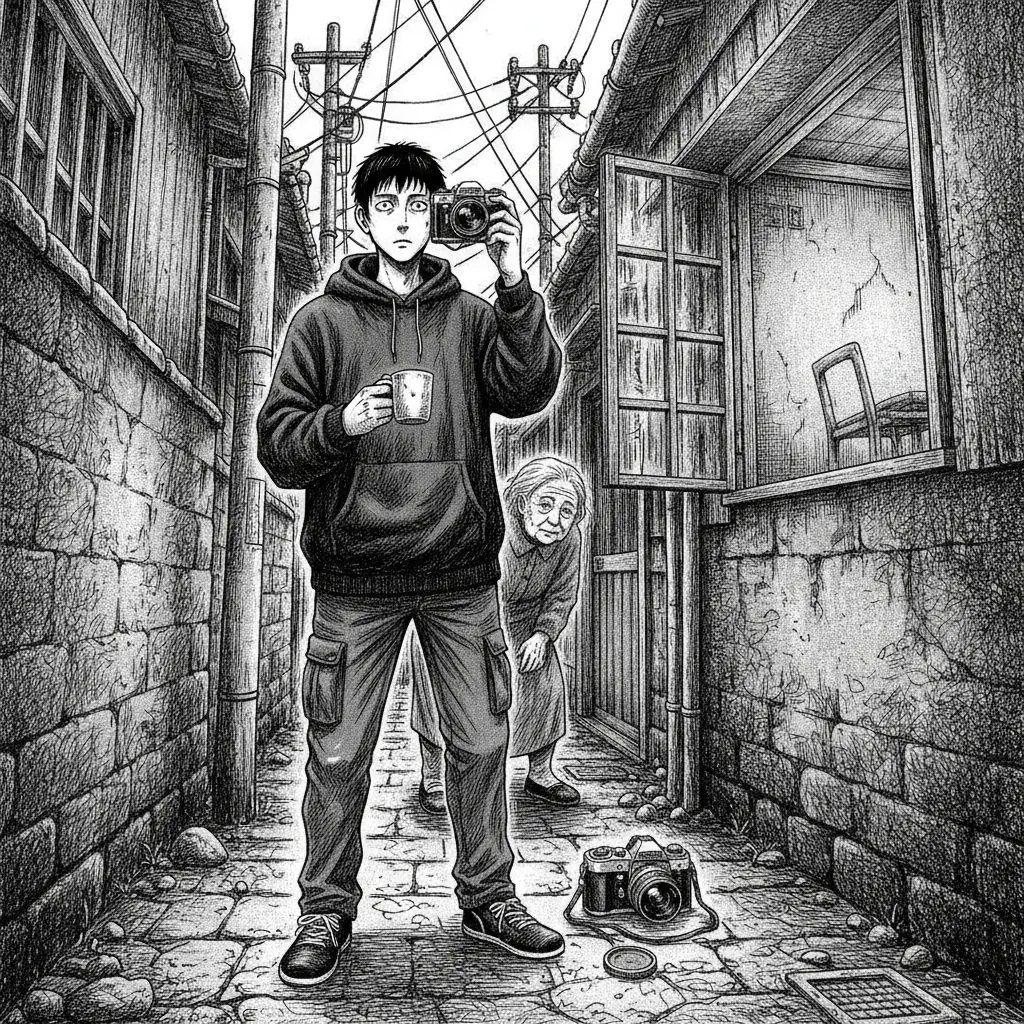
Saku set down the camera. He stood holding his coffee cup and could not move. After a moment, he raised the viewfinder again — this time turning away from the window, pointing the lens at the bare wall of the room. He pressed the shutter. He checked the monitor.
Only the white wall. No shadow.
He exhaled. He felt relief wash through him. The thing in the window had been a trick of the light, he told himself — dust on the lens, a shadow cast by a distant building. He turned back to the window and raised the camera again, this time taking care with the focus, pressing the shutter deliberately. He checked the monitor.
The shadow was a little closer than before.
As Saku stared at the image, the room seemed to go quiet around him — the sound of traffic outside, the ordinary noise of the neighborhood, all of it receding into a strange and sourceless silence. The surface of the coffee in his cup was trembling. He realized his hands were shaking.
He looked out the window directly, with his own eyes.
Nothing was there.
He looked at the camera monitor once more. The shadow was gone. The distant background held nothing but buildings and sky, as though nothing had ever been there at all.
Saku stood for a while with the camera in his hands. Then he lowered himself slowly onto the sofa and took a sip of coffee. It had gone cold. Outside the window, the ordinary morning of an unfamiliar neighborhood continued without interruption.
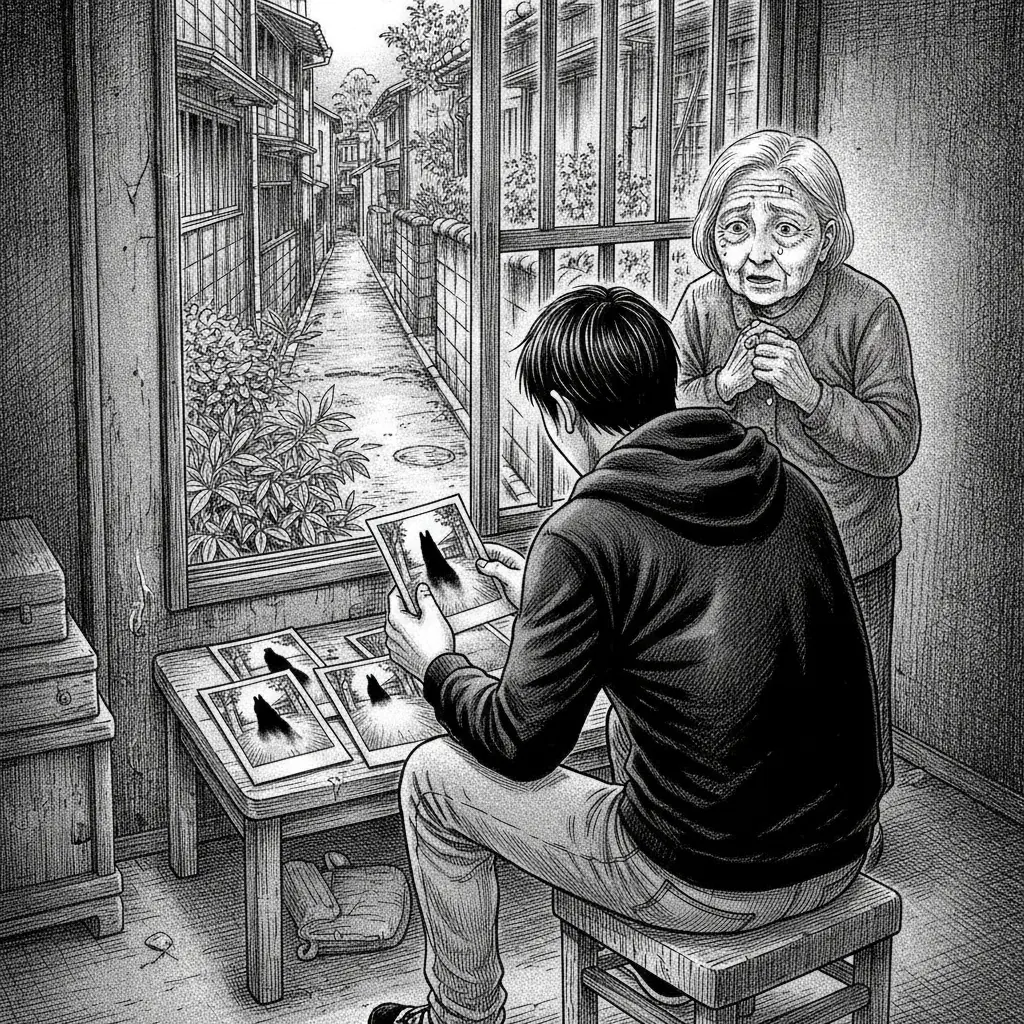
That afternoon, he found himself going back through all the photographs he had taken in Yanaka before the move. The shadow was present in every one. But in the photographs he had taken this morning, it was no longer there.
That was strange.
He photographed the window again. Nothing.
Again. Nothing.
Again.
Late into that night, Saku kept pressing the shutter, over and over. The shadow appeared in none of the photographs. Perhaps leaving Yanaka had severed something. He was beginning to think so — and then he found himself thinking again about the first photograph from that morning. The one where the shadow had been visible. And the second one, where it had been slightly closer.
He placed the two images side by side. He compared the position of the shadow in the first with its position in the second.
It had moved closer. And after that, it had stopped appearing.
Closer to what, exactly?
Saku looked up and scanned the room. White walls. Cardboard boxes. A coffee cup. His familiar belongings. Nothing was there.
Only the corner of the room, where the boxes cast their shadows, seemed darker than it should have been. Given the position of the light, there was no reason for that corner to be so dark. Saku stared into it. The darkness did not move. Nothing emerged from it.
But that night, he could not bring himself to sleep with his back to those boxes. And that night, again, he did not dream. The absence of dreams no longer felt like safety — it felt like evidence of something else entirely. Saku lay with his eyes open until dawn.
Outside the window, the quiet night of a neighborhood he did not yet know, far from Yanaka, went on and on.