

The Eyes of the Mask
AI AI-generated fiction — text, and any narration or images. Unrelated to any real events, people, organizations, or places.
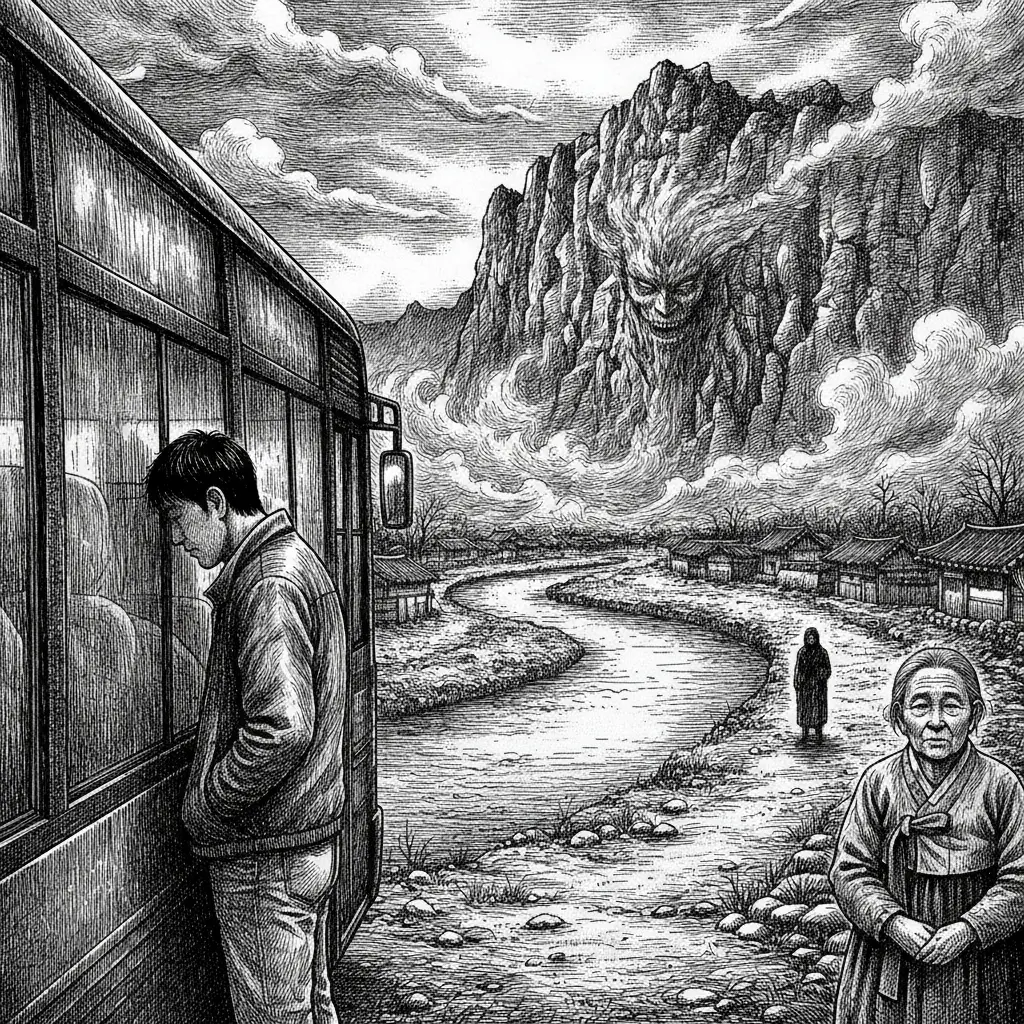
Minjun arrived at Hahoe Village for the first time on a late autumn afternoon. He rode the bus from downtown Andong along the riverside road, and after a long while the village's distinctive landscape opened before him — the Nakdong River curling around the settlement in a slow embrace. The water gleamed silver, and across the river the cliffs of Buyongdae stood in silence beneath an ash-colored sky. Minjun pressed his forehead against the window and stared at those cliffs. He could not gauge their height. The river ran soundlessly at their base, and for a moment the cliff's outline, blurred by thin mist, looked like an enormous face — then it was just rock again.
Minjun was a folklore researcher at an institute under the Cultural Heritage Administration. The purpose of this trip was to examine historical documents related to the Hahoe Byeolsingut Mask Dance at the local archive and to record oral accounts from the village elders. He was scheduled to stay a week. His lodgings were in a guesthouse converted from a traditional manor deep inside the village. The owner, an old woman named Yi, was spare with words and had small, watchful eyes. She showed him to his room with her back to him the whole way, and at the door said only, "Go to bed early." Minjun unpacked and opened the window. A row of old earthenware jars stood at the far end of the courtyard, and beyond them thatched rooftops continued in a line. Each time the wind swept over them, the dry reed grass made a dry, rasping sound.
Nothing happened that first evening. Minjun confirmed the archive's inventory, ate dinner, and walked the village lanes. The alleys between stone walls were sparsely lit, and fallen leaves had gathered on the earthen paths. He did not meet a single person. He told himself the village was simply that quiet. Back at the guesthouse he pulled the blanket over himself and lay down, and the sound of the river reached him — the Nakdong winding around the village, a low and continuous sound of water drawing over sand, coming from somewhere beyond the wall. He fell asleep to that sound.
On the morning of the second day, Minjun interviewed one of the village elders. The man's surname was Ryu, a distant descendant of the Pungsan Ryu clan, he said. He was in his mid-seventies, stooped at the shoulders, but his voice was clear. They spoke at length about the mask dance. The old man explained without hesitation the sequence and meaning of the Imugi mask, the Gaksi mask, the Yangban mask, and the Baekjeong mask. Then Minjun asked, as a matter of routine, whether there were other stories passed down in the village — oral traditions or taboos beyond the mask dance itself. The old man paused.
"What kind of mask story do you mean?"
Minjun explained it was a standard question. Every region tended to have its own taboos and folk beliefs tied to masks, and he was simply asking whether any existed here. The old man glanced toward the courtyard and spoke quietly.
"A mask is a face. Not the face of the person wearing it — the mask itself is the face. So you must be careful wherever a mask is hung. Don't stand in the direction a mask is looking. The elders used to say that."
Minjun put away his recorder and let the words pass through him. He noted it in his pad as an interesting folk belief. Don't stand in the direction a mask is looking. That was all.
On the afternoon of the third day, Minjun found an old mask in the archive's storage room. More precisely, it was a fragment of a mask. It sat in the corner of a shelf with a cloth sack draped over it; when he lifted the sack, he found half a mask underneath. The wood had darkened to a deep black, and traces of lacquer remained. The features were difficult to make out. Only the eyes were distinct — two holes bored wide open, facing directly forward. He asked a staff member what it was, and the young woman answered without much interest.
"Oh, that. It's old. I'm not really sure where it came from. It must have gotten mixed in with some donated items. It was never catalogued separately."
Minjun photographed the mask and sketched its dimensions. Judging by the wood's material and the way it had been worked, it was at least a hundred years old. Something brownish and dried clung to the edges of the eye holes; Minjun assumed it was old pigment. He replaced the sack and set it back on the shelf. Walking back, he kept returning to the image of those eye holes. The two empty openings felt as though they contained something — as though they were not truly empty. He told himself it was just his imagination.
That night, the dreams began.
In the dream, Minjun was walking the lanes of Hahoe Village. It was night, and moonlight lay across the tops of the stone walls. The alley was the same one he had walked in daylight, yet something was different. The greatest difference was the sound. During the day there had been the reed grass, the water, the wind; in the dream there was nothing. His feet met the earth without a sound. He could not hear his own breathing. In that silence he walked toward the river. When he reached the bank the water was there. The Nakdong was flowing, but strangely it made no sound — the river moved as though it were solid, visibly in motion yet utterly silent. And on top of the Buyongdae cliffs, there was something. He could not tell whether it was human. It simply stood there, looking down. He could not see its face. The fact that he could not see it left something heavier than fear settled in his chest. The dream cut off at that image.
Minjun woke at two in the morning. The room was quiet. The sound of the river came through the window — the same sound he always heard. But tonight it was slightly different. Instead of a low, even flow, it seemed to break off somewhere and then resume, like someone drawing breath to speak and then stopping. Minjun pulled the blanket tighter and closed his eyes again. Sleep did not come.
On the morning of the fourth day, Minjun asked the landlady, old Mrs. Yi, whether there were any unused ritual shrines or spirit houses in the village. She stopped setting the breakfast table and looked at him. Her expression was different from usual — measuring, as though she were weighing something.
"Why?"
"For my research. I'm surveying spaces connected to the Byeolsingut ritual."
She was quiet for a moment, then went back to arranging the table.
"There aren't any. They're all gone."
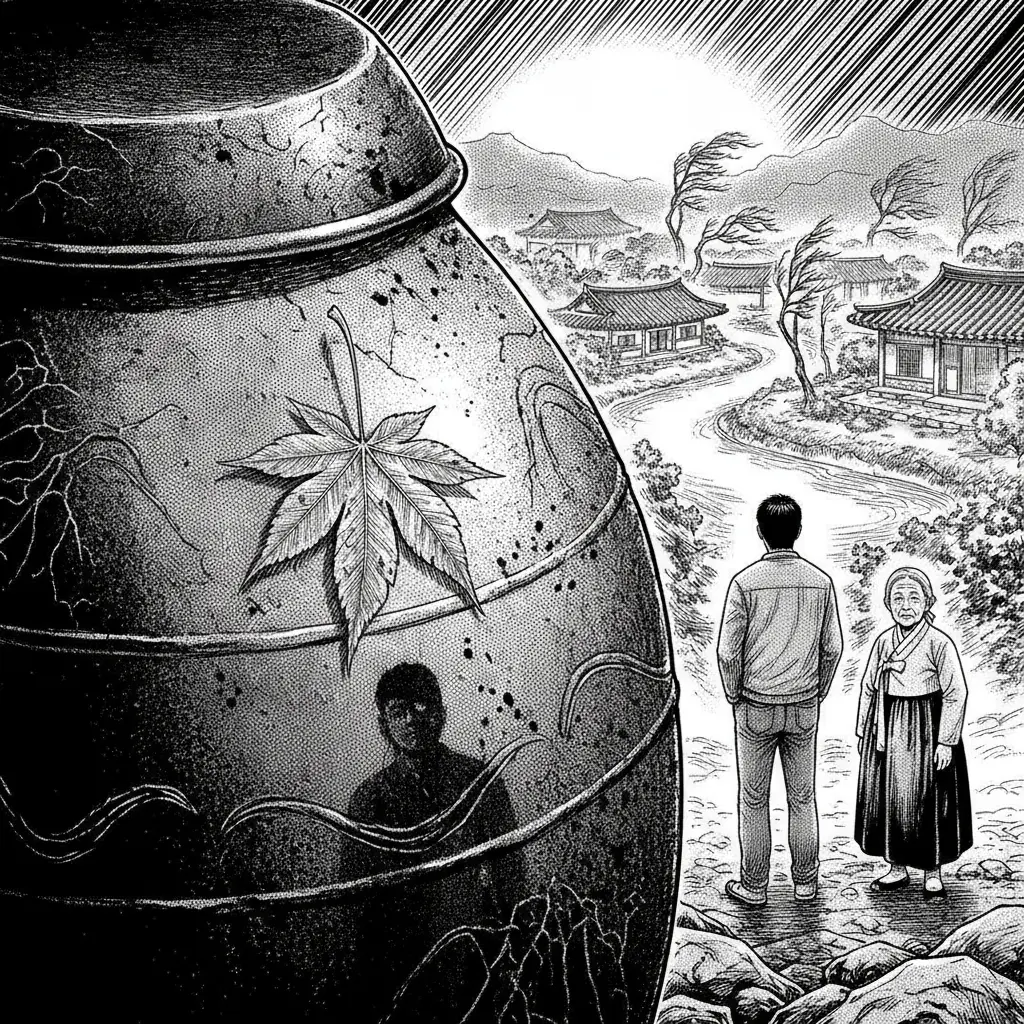
The phrasing was odd. The word for there aren't had shifted to they've been gone, and after that she said nothing more. Minjun did not press further. He ate his breakfast and looked out the window. A single fallen leaf rested on top of one of the earthenware jars in the courtyard. Morning light touched it. The leaf did not move. There was no wind that day.
In the afternoon Minjun went down to the riverbank. He walked near the small dock where the ferry was moored, then pulled the rope to call the boat across to the Buyongdae side. Crossing alone was against the rules, but the ferryman was on the other bank and came over when Minjun waved. Minjun climbed the narrow path through the pines to the top of the cliff. From the summit the village lay spread below him. The Nakdong curved around it in a clear taegeuk shape, holding the settlement in its bend. The thatched rooftops clustered together, and at the center of the village an ancient zelkova tree stretched its branches wide.
Minjun stood at the cliff's edge and took in the view. It was beautiful. And yet, alongside the beauty, something was wrong. The village was too quiet. Not a single person was visible. He told himself it was late autumn, that tourists were scarce — but people lived in that village, and there was not a wisp of smoke, not a single movement. He stood there for a long time. Then, from behind him, a sound. A branch snapping. He turned. Nothing between the pines. No wind. Yet the sound had been unmistakable.
When Minjun returned to the guesthouse, Mrs. Yi was standing in the courtyard. She looked at him and went inside without a word. He went to his room, sorted through his things, and took out his camera to review the day's photographs. There were shots of the riverbank, the path up to Buyongdae, and several wide views of the village taken from the cliff. He was scrolling through them when his hand stopped.
In one of the wide shots taken from the cliff, there was something wrong. Somewhere along the village lane, right beside the zelkova tree, a figure was standing. When Minjun had looked at that spot, there had been no one. But in the photograph, someone was there. The shape was not distinct. Something the size of a person stood with its back to the tree, and where its face should have been, there was only darkness. He tried to attribute it to shadow, but the photograph had been taken in full afternoon light. He enlarged the image. The more he enlarged it, the less defined the shape became. The area where the face should have been was simply a dark oval. And within that oval, in the place where eyes should have been, there were two small points of light.
Minjun set the camera down. His heart was beating fast. He had never taken a photograph like this. But rationally, there were explanations. The village had residents; one of them had simply been standing in the shade of the tree. The darkness where the face should be was a matter of the light's angle, and the bright points could have been the reflection off glasses, or the whites of someone's eyes. That was what he decided to think.
On the fifth day, before dawn, the dream came again.
This time it was different. In the dream Minjun was inside the archive's storage room. The lights were off, and the objects on the shelves were dim shapes in the dark. He was standing before the shelf where the half-mask had been. The cloth sack had been removed. The mask was there, just as before. Its two eye holes faced directly forward. Minjun looked at the mask, and the mask looked at Minjun. But this time something about the mask had changed. The eye holes were not empty. There was something inside them. He could not see it clearly in the dark, but it was moving. In the dream he tried to step back, but his feet would not move. The mask remained on the shelf and yet it seemed to be drawing closer — or rather, Minjun was being pulled forward. The eye holes grew larger. He felt that he knew what would happen if he passed through them, and at the same time he did not know at all. Both sensations existed simultaneously. The dream ended just before his face reached the holes.
Minjun woke drenched in sweat. It was four in the morning. The room was dark. The sound of the river came through the window. But tonight that sound was entirely different from before. Something else was woven into it — a low, rhythmic sound. Minjun listened carefully. It was breathing. Or something that closely resembled breathing. He could not tell whether it was coming from inside the room or from beyond the window. He turned on the light. The room was empty. The sound stopped.
That morning Minjun went back to the archive. He wanted to see the mask again. He went to the shelf where the half-mask had been, and found the cloth sack gone. The mask sat exposed on the shelf. Until yesterday it had been covered. He asked the staff member.
"Who took the sack off that mask?"
The young woman tilted her head.
"A sack? Was there a sack on that mask? I always thought it was just sitting there like that."
Minjun said he had clearly replaced the sack himself. The staff member looked flustered and said she didn't know. Minjun stood before the mask. It was the same as before. The eye holes faced directly forward. But today it was difficult to look at them. He could not hold his gaze steady on them. It was as though something inside the holes was drawing his eyes inward. He took one more photograph and left the storage room quickly.
Outside, he encountered the old man Ryu on one of the village lanes. The elder stopped when he saw Minjun.
"You don't look well."
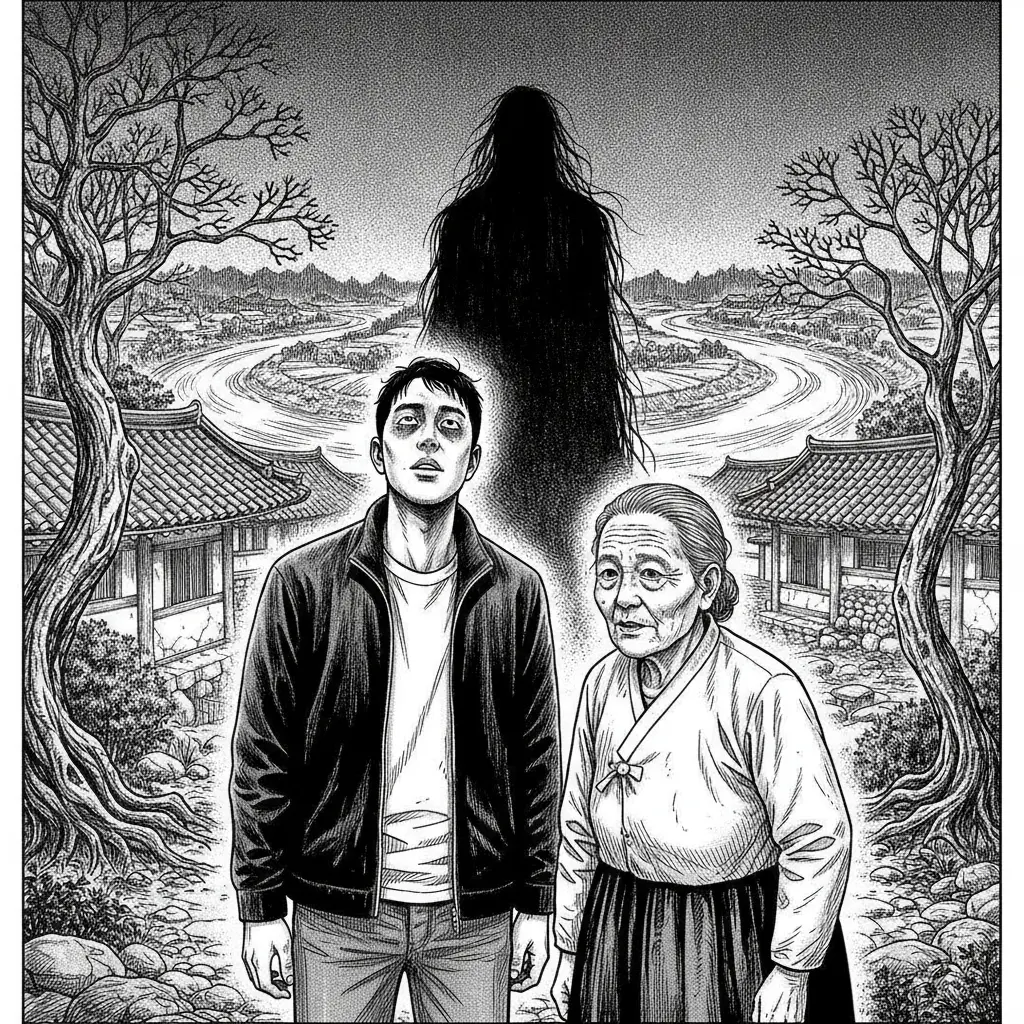
Minjun said he thought he hadn't slept properly. The old man studied his face for a long moment, then spoke.
"Have you been looking at the mask?"
Minjun said he had seen an old mask in the archive. The old man's expression hardened.
"Don't look at it too long. And especially not when you're alone."
When Minjun asked why, the old man stared into the middle distance for a moment and said:
"A mask is a face. But that mask is different. It isn't a mask that someone wears. It is a mask that wears."
Minjun tried to ask what he meant, but the old man had already turned and was walking away.
A mask that wears. The phrase did not leave him for the rest of the day.
On the sixth day, Minjun took out his notepad and wrote down everything that had felt wrong during this trip. The dreams, the sounds, the photograph, the old man Ryu's words, Mrs. Yi's manner. Listed out one by one, each had an explanation. The dreams were anxiety in an unfamiliar place. The sounds were the river carrying further at night. The photograph was lens distortion or a village resident. The old man's words were the transmission of folk taboo. But when he looked at them not one by one but all together, they seemed to point in a single direction. Minjun felt he knew what that direction was, and did not want to know.
In the afternoon he stood before the zelkova tree at the center of the village. It was an ancient tree, centuries old. Sacred rope had been tied around its lower trunk, and from the rope hung strips of old white cloth that stirred in the wind. Minjun looked up into the tree. Its branches reached toward the sky, nearly bare, the leafless limbs dividing the grey air above him. Then he remembered the image from the photograph. The figure had been standing right beside this tree. And the spot where Minjun now stood was precisely where that figure had been.
He looked down at the ground beneath his feet. Soil. Soil with fallen leaves. Nothing. And yet, from beneath the soles of his feet, from somewhere inside the earth, something reached him. Too faint to be called a vibration, too strange to be called warmth. Simply the feeling that something was there. Minjun walked away quickly.
On the way back to the guesthouse, Minjun made a decision. He would pack his things first thing in the morning and leave. The research could proceed well enough from the photographs and recordings he already had. There was no reason to stay longer. More precisely, he felt that he must not stay longer. He did not know where that feeling came from, but he did not want to ignore it.
That night, telling himself it was the last night, Minjun lay down early. The sound of the river came to him. Tonight it was quiet. He felt a small measure of relief. He closed his eyes, steadied his breathing, and reached for sleep.
In the small hours, something woke him. Not a sound. Light. Light was entering through the window. The direction was wrong for moonlight. The window faced the courtyard, and the light was coming from the courtyard. Minjun rose and went to the window.
Someone was standing in the courtyard.
In front of the earthenware jars. A shape the size of a person, standing still. The light was not coming from the shape itself; the shape simply stood there. Moonlight fell faintly across the courtyard. The shape was facing the window where Minjun stood. Where its face should have been, he could not see. No — he could see. He could see it, but he could not recognize it. Where the face should have been, there was something. Something that looked like wood. And in the place where eyes should have been, there were two holes.
Minjun stopped breathing.
The holes were not empty.
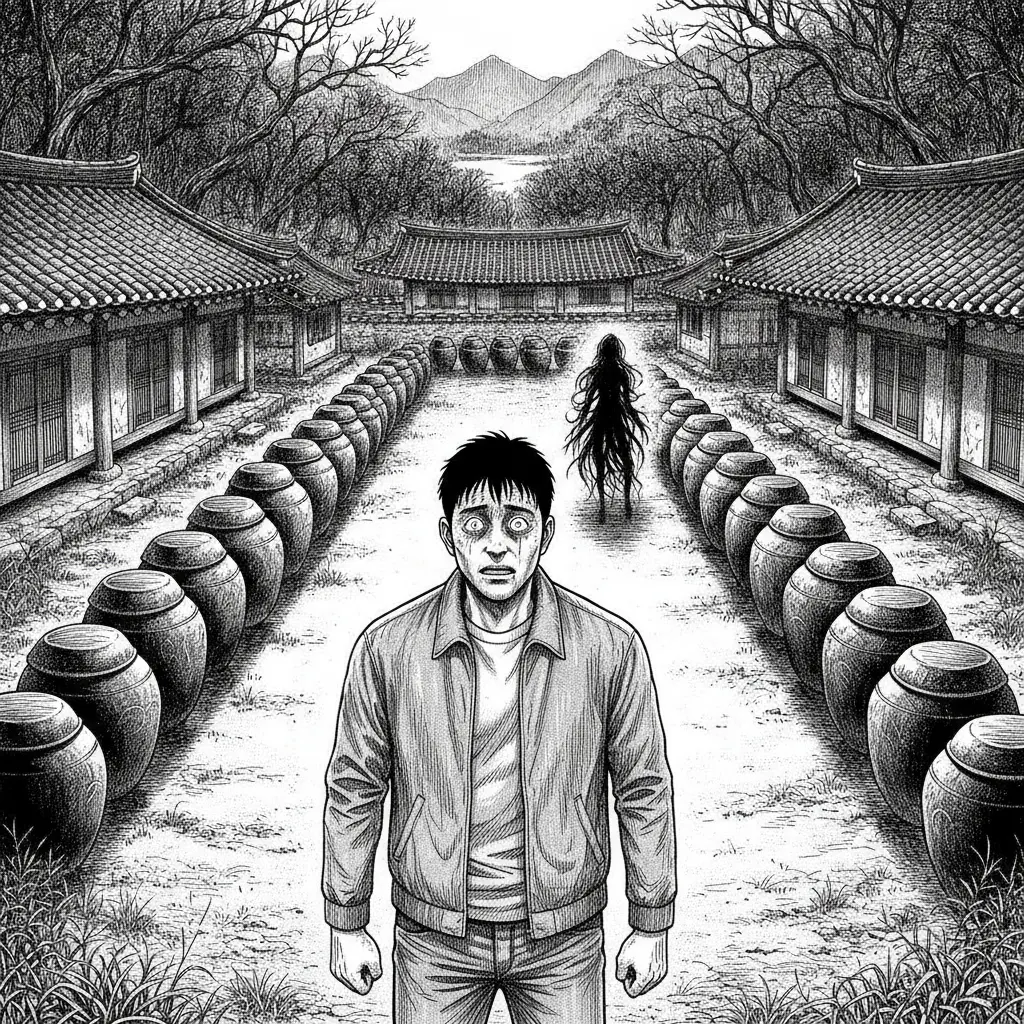
He closed his eyes. Then opened them. The courtyard was empty. Only the earthenware jars stood in their row. Moonlight rested on their lids. Nothing else. Nothing.
Minjun stepped back from the window. As he moved back, his heel came down on something on the floor. Something hard. He looked down.
A piece of wood. A piece of wood lacquered deep black. About the size of a palm. He picked it up. And he knew. It was the other half of the half-mask he had seen in the archive's storage room — the missing piece that, joined to the first, would make a complete face. There were no eye holes. Where the eyes should have been, eyes had been carved into the wood, but they had not been pierced through. They were sealed.
Minjun stood holding the piece for a long time. He could not understand how it had come to be inside the room. The door had been locked. The window had been shut. And yet here it was, on the floor.
Morning came. Minjun packed his things. He said goodbye to Mrs. Yi. She looked at his face and said nothing. She simply nodded. He did not know whether to take the wooden piece with him or leave it behind. In the end he stopped at the archive and handed it to the staff member. She took it and looked at it.
"Oh — where did this come from?"
Minjun said it seemed to have come from the storage room.
The staff member turned the piece over in her hands and carried it into the storage room. Minjun did not follow. He waited at the door. From inside he heard her voice.
"Oh — it fits perfectly."
At those words, Minjun turned and walked toward the bus stop. He did not look back. He knew he must not look back. He did not know why. He simply knew.
On the bus back to downtown Andong, Minjun looked out the window at the river. The Nakdong curved around Hahoe Village and fell away behind him. The Buyongdae cliffs came into view. There was nothing on top of them.
Then, as the bus left the village entirely behind and moved along the riverside road, Minjun looked down at his hands. His right hand — the one that had held the wooden piece. His palm was empty. Of course it was. He had given the piece to the staff member.
But something remained in the center of his palm. The impression left by the grain of the wood, pressed into his skin. A common enough thing. Hold something hard long enough and it leaves a mark.
Minjun looked quietly at the mark on his palm.
It was the shape of an eye.
The eye that should have been sealed was open, there in the hollow of his hand.