

Behind the Lattice
AI AI-generated fiction — text, and any narration or images. Unrelated to any real events, people, organizations, or places.
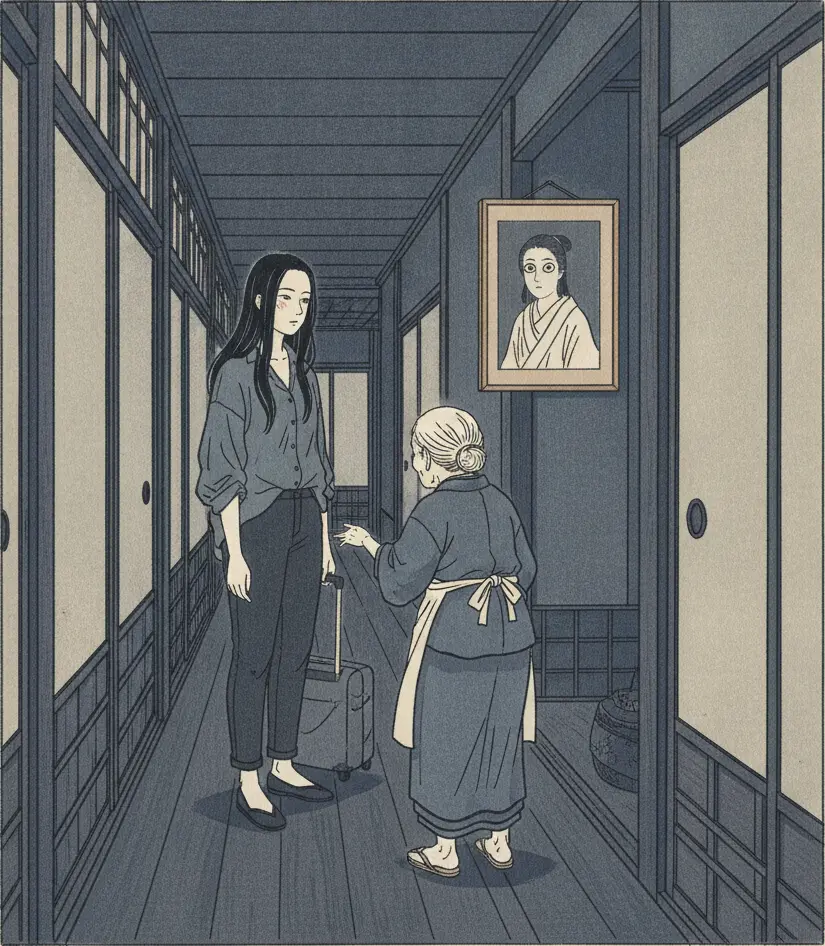
At the end of July, Nakamura Serina (中村芹奈) stepped off a bus at Kanazawa Station. The air clung to her skin, thick and warm, and even beneath the station's glass-vaulted ceiling she could feel that particular, hazy humidity that belongs to Hokuriku summers. Serina was a freelance writer based in Tokyo, and she had come to this city to research a series of articles on traditional geisha districts. She planned to stay four days, three nights. She had packed light — a single small rolling bag — and had reserved a room at a guesthouse near the Higashi Chaya district, one of the old machiya townhouses converted for travelers.
She watched the city drift past the bus window. They crossed the Saigawa bridge, passed through the Korinbo intersection, and at last the bus stopped at the Hashiba-cho stand. Following her map app on foot, she found herself walking along the embankment of the Asanogawa, where willows lined the bank and the evening light broke softly on the water. Five minutes brought her to the entrance of the Higashi Chaya district. A narrow stone-paved lane, two-story machiya on either side, their latticed facades standing in close rows. A few tourists still wandered here and there, but the hour was late enough that the light had begun to tilt, and the whole town seemed to be holding its breath.
Serina had always loved the dimness behind lattice screens. Someone had once told her — or perhaps she had simply come to believe it herself — that those evenly spaced vertical slats of wood were not meant to cut the outside world away, but to protect whatever lay within. The guesthouse called Tachibana-ya stood at the corner of a lane near the northern end of the district, marked by nothing more than a small wooden sign hanging beside an old lattice door. She pressed the intercom and waited. After a moment, a woman who appeared to be in her sixties appeared. Her white hair was gathered at the back of her head, and she wore an indigo-dyed apron. When Serina gave her name, the woman said simply, "I am Ono," and led her inside.
The room was on the second floor, at the far end of the hall — a small tatami space of perhaps three mats, with a window that looked out onto the tiled roof of the neighboring house and, beyond it, a thin gleam of the Asanogawa. A futon was folded in the closet. There was a low writing desk, and a single indirect lamp shaped like a paper lantern. The room held only what was necessary, but it was clean, and the scent of old wood filled it quietly. Serina unpacked and set her laptop on the desk. She planned to begin her interviews the following day. That evening she went to a nearby izakaya, ate fish from the Noto coast, drank one cup of local sake, and returned to the inn early. Before she fell asleep, she looked down from the lattice window at the stone lane below. In the thin light of the street lamp, she thought she saw someone standing there. A trick of the eye, she told herself. When she looked again, there was nothing.
The next morning Serina rose early and walked the district before the tourists arrived. The morning hours showed the street's true face. The stones were damp with night dew, and an old local resident moved slowly past the lattice doors. From somewhere inside one of the houses came the smell of dashi broth; in the distance, a wind off the Asanogawa stirred the willow branches. Serina carried her IC recorder and camera, moving through the lanes and documenting the details of the buildings — the patterns of the woodwork, the cracks in the paving stones. She noticed that the color of the wood grain in each lattice door was subtly different from the next. Over long years, rain and light and human hands had given each one its own particular shade.
On the third day of her research, Serina visited a small archive on the southern side of the district. A man in his seventies sat at the reception desk, and when she explained she was a journalist, he readily brought out old photographs and documents. Albums of sepia-toned images from the Meiji and Showa periods — group portraits of geisha, photographs of banquets and festivals. As she turned the pages, her hand stopped at one image. It appeared to be from the early Showa era: a photograph of the second floor of a teahouse. A woman in a white kimono leaned against the railing, facing the camera. Her face was narrow, her eyes unnervingly large, and her expression was impossible to read — it might have been a smile, or it might have been grief.
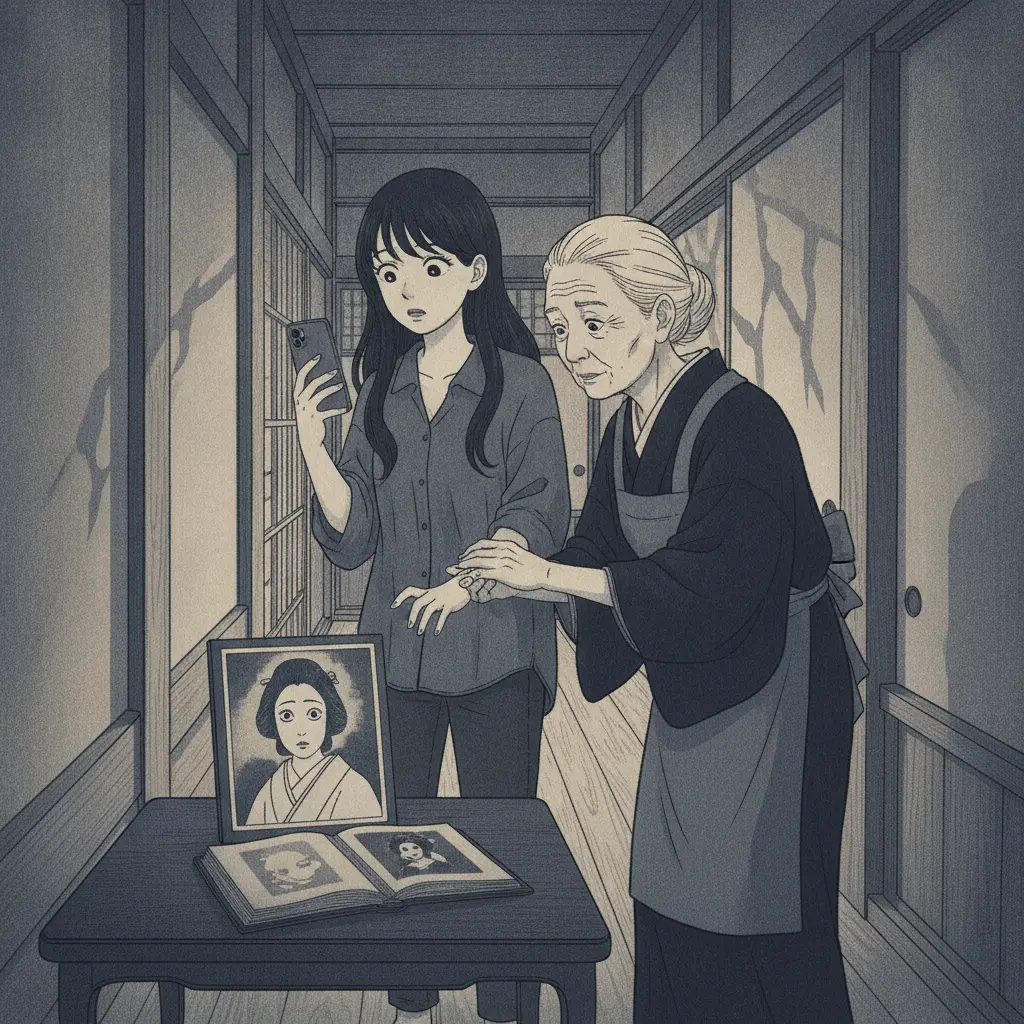
"Who is this woman?" Serina asked. The man paused before answering. "I'm afraid her name hasn't been preserved," he said. "Though this photograph — it was donated here more than once, and then went missing each time. I can't think where it would have come from." He tilted his head. Serina raised her phone to photograph it, but the man gently raised his hand. "We ask that visitors refrain from taking pictures," he said, though his eyes remained fixed on the image. Serina closed the album and left the archive. Outside, the midday sun was fierce, but something cold moved down her spine.
That evening, back at the inn, Serina sat at the writing desk and typed up her notes from the day. Insects called outside the window; somewhere in the distance the river murmured. Past midnight, she heard something in the hallway. The sound of old floorboards flexing. An old building settles at night, she told herself — the wood contracting in the cool. But the sound continued at a steady rhythm, slow and measured, like footsteps approaching one at a time. Serina held still and listened. The sound stopped just outside her room. She had the distinct sense of someone standing on the other side of the sliding door. She held her breath and stared at the fusuma. No shadow showed through the paper. Then the sound moved away again and faded into silence.
In the morning, she mentioned the sounds to the proprietress, Ono, who laughed and said, "Old houses make noise at night." But the laugh was slightly off, somehow stiff. Serina let it go and asked, "How long has this inn been here?" Ono was quiet for a moment. "It was a teahouse originally," she said at last. "From around the end of the Meiji period." She said nothing more. When breakfast was brought to the room, Serina noticed a small piece of paper on the tray. A folded square of white paper, with no name or address on the outside. She opened it. Inside, a single line had been written in brush ink: Please do not go up to the room at the far end of the second floor.
She had no idea who had left it. As far as she knew, there was one other guest at the inn — a middle-aged man — but she had never seen him. When she showed the paper to Ono, the proprietress's color changed. "I did not write this," she said, and took the paper with her into the back of the house. Serina finished breakfast and went out for the day's work. But all afternoon, that single line would not leave her. The room at the far end of the second floor — what did that mean? Her own room was at the far end of the second floor. Or was there something further still?
Walking through the district, Serina tried to reconstruct the layout of the inn in her mind. There should be another room beside her own. At the end of the hallway, there was always a closed fusuma — she had passed it every day for three days without once seeing it open. When she returned to the inn that afternoon, Ono was nowhere to be found. The front desk was empty; the kitchen was empty; the whole building felt uninhabited. Serina climbed to the second floor and stood before the fusuma at the end of the hall. She caught the smell of old wood, and beneath it something else — something faintly sweet, close to the smell of decay. She put her hand on the door.
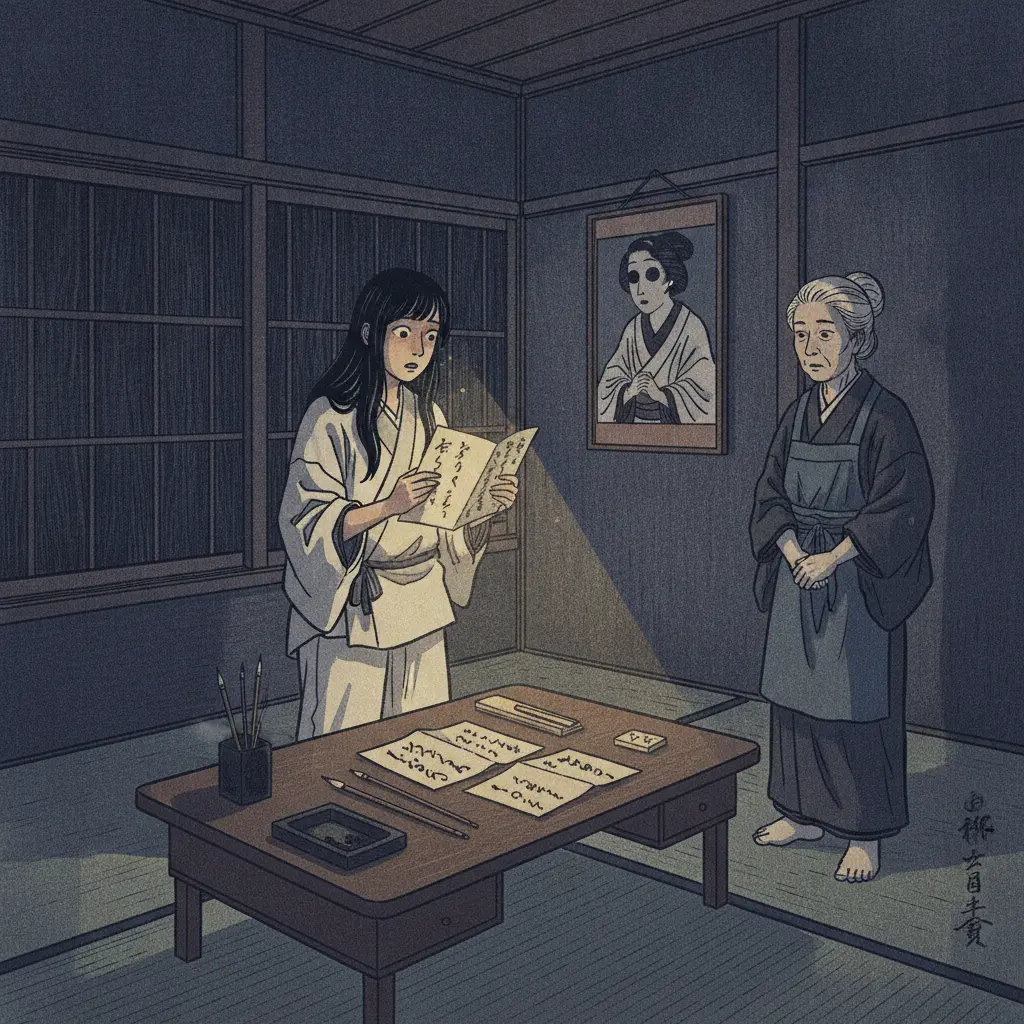
The room was about six tatami mats in size. The windows were shuttered, and despite the afternoon hour it was dark inside. Serina turned on her phone's flashlight. In the center of the room stood a writing desk, and on it lay an inkstone, a brush, and a bundle of letters. The letters were written in brush ink on old Japanese paper; the topmost envelope had been opened. Serina picked it up and read. The cursive script was difficult, but she could tell it was a love letter. The name on the address read: To Toyo. The sender's name read: Ine of Tachibana-ya. Serina set the letter back on the desk with trembling hands. Tachibana-ya was the name of this inn.
Beneath the bundle of letters lay a photograph. Black and white. A woman leaning against the railing of a teahouse's second floor, in a white kimono, looking at the camera with those unnervingly large eyes. It was the same photograph she had seen in the archive album the day before. But she had not been allowed to photograph it. The man had stopped her. So why was the same photograph here, in this room? Serina turned the light onto the bundle of letters. The date on the bottom letter was 1937. But the topmost letter had no date at all. In its place, the ink appeared not yet dry.
Serina raised her eyes slowly. Something was in the corner of the room. In the thin blade of light that fell through a gap in the shutters, she could see the hem of a kimono. Just the hem — white fabric, nothing more. She could not make herself turn toward it. Her body knew, without being told, that she must not. She backed out of the room into the hallway and slid the fusuma shut. Her hands were shaking; her legs barely carried her. She ran down the stairs and out through the front door into the lane. The stone pavement was solid under her feet. The sky above the Asanogawa was red with evening, and the only sound was the water.
She sat for a while on a bench by the river near the entrance to the district. The tourists had nearly all gone home; the willows swayed in the dusk wind. Serina breathed slowly and tried to arrange what she had seen into something reasonable. Old letters, an old photograph, the hem of an old kimono. It was natural for old things to remain in old buildings. Someone's belongings, left undisturbed in an unused room — that was all it needed to be. She tried to believe this. But the image of that topmost letter, its ink still appearing wet, would not leave her.
When she returned to the inn, Ono was there. Serina told her she had gone into the room. The proprietress went pale. "No one has entered that room for a very long time," she said, her voice faintly unsteady. When Serina mentioned the photograph, Ono looked down. "Ine of Tachibana-ya," Serina said. "Who was she?" After a long silence, Ono answered: "That was the name of the previous owner of this inn. She died in the early Showa period. I don't know the circumstances." Serina said, "The photograph was the same one I saw at the archive." Ono did not respond to this. She said only, "It might be best if you left early tomorrow," and withdrew into the back of the house.
That night, Serina could not sleep. She lay on the futon and stared at the ceiling. The hallway was silent. The whole inn was silent — more silent than it had any right to be, as though the building itself had stopped breathing. Past two in the morning, she scrolled through the photographs on her phone — the exterior of the inn, the stone lane, the lattice doors. One she had taken in the hallway, in front of the closed fusuma. A dark image, showing the door. She enlarged it. Through the paper of the fusuma, something was faintly visible. A shape like a human outline. Two dark points, like large eyes.
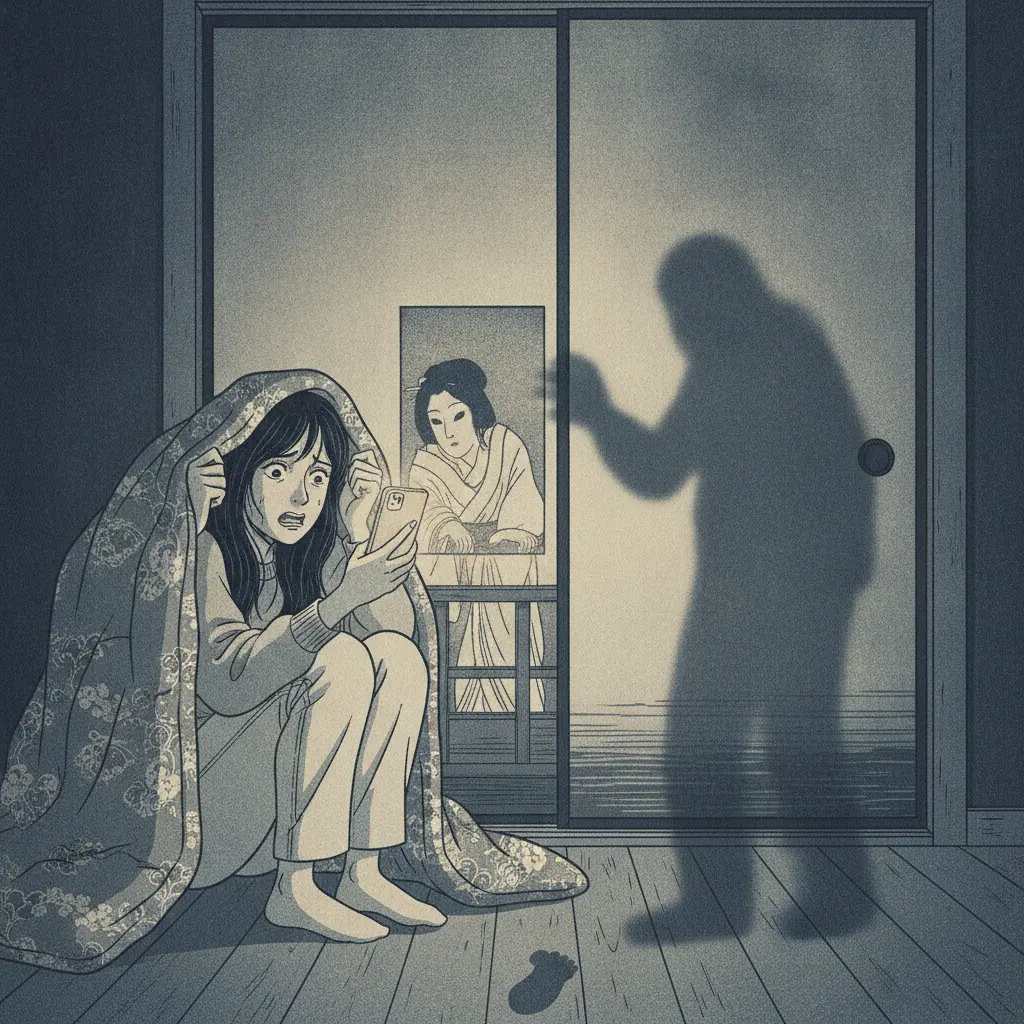
She tried to delete the photograph, but her hand would not move. Enlarged on the screen, the shadow still resolved into the figure of a woman leaning against a railing — white kimono, facing the camera. Serina turned the phone face-down and pulled the futon over her head. Her heart was beating fast. At that moment, the floorboard in the hallway creaked once. A single step. It stopped outside her room. This time, there was a shadow on the other side of the fusuma. Through the thin paper, a dark human outline stood perfectly still. Serina could not make a sound. The shadow did not move. One minute stretched like ten. Then the shadow thinned and was gone. Serina did not sleep again until dawn.
In the early morning, she packed her bag and left. Ono was at the front desk but did not meet her eyes. After settling the bill, as Serina stepped through the front door, the proprietress spoke quietly to her back. "Please don't take the photograph with you." Serina turned. "I don't have any photograph," she said — and then thought of her phone. Ono said nothing more.
On her way to Kanazawa Station, Serina passed once more through the lane of the Higashi Chaya district. The morning air was clear; the paving stones glittered with dew; the lattice doors glowed amber in the early sun. It was a beautiful street. It wore the face of a place where nothing had ever happened, and it stood there quietly. Serina did not slow her pace. When she passed in front of Tachibana-ya, she told herself not to look up at the second-floor window. But she looked. The window was closed. Behind the lattice, there was only darkness.
She slept on the Shinkansen. She dreamed of a tatami room on the second floor of a teahouse, where someone sat at a writing desk composing a letter. She could hear only the sound of the brush moving across paper; she could not see the writer's face. In the dream, Serina knew that the letter was addressed to her. When she woke, the mountains of Hokuriku were receding in the window. She took out her phone and opened the photograph of the fusuma from the night before. She enlarged it. The shadow was gone. The photograph was simply dark, and showed nothing at all.
She returned to her apartment in Tokyo. Days passed. She finished the article about the teahouse district and sent it to her editor. Ordinary life resumed. But one thing continued to trouble her. Each time she opened the drawer of her writing desk, she caught the smell of old paper — sweet and faintly cloying. She told herself it was her imagination. She checked the drawer and found it empty. Still the smell did not go away. One night she noticed it again and opened the drawer to find a single sheet of washi paper lying at the bottom. She did not recognize it. It was old and white, and a single line had been written on it in brush ink. The cursive script was difficult to read, but Serina could read it. The name in the address was her own.