

A Voice Sinking to the Bottom of the Canal
AI AI-generated fiction — text, and any narration or images. Unrelated to any real events, people, organizations, or places.

October in Otaru was the season when tourists receded like a withdrawing tide. The stone warehouses cast their shadows over the canal, and the water lay black as oil; at night, the amber glow of the streetlamps bled and dissolved into it. Miyashita Takumi (宮下拓海) had not come to this city for work, nor for sightseeing. He had come simply to run. A failure in Tokyo, the severing of a friendship, and the words his lover had left him with as she walked out the door — "You never see anything, do you" — he wanted distance from all of it. He boarded a train from New Chitose Airport and stepped off at Otaru Station. His lodging was an old inn along the canal, a building that had once belonged to a coal merchant, now converted into guest rooms.
The proprietress of the inn, Kuramiso-sou (倉見荘), was a woman of about sixty named Sagano (嵯峨野), and she said something peculiar at check-in. "If you walk along the canal at night, please don't look down into the water." When Takumi asked why, she pressed her thin lips together and said only, "It's an old local saying." He assumed it was part of the tourist atmosphere — Otaru was a port town, rich in folklore about the sea and the canal. He thought no more of it and was shown to a corner room on the second floor. Outside the window, the canal stretched away in a straight line, and the stone warehouses on the opposite bank hung upside down in the water below.
That night, Takumi could not sleep. The insomnia he had carried with him from Tokyo followed him here as well. When the clock passed one in the morning, he pulled on his coat and went outside. The October night air in Otaru was sharp as a blade, and his breath turned white. The promenade along the canal was deserted; the cobblestones gleamed with moisture. The streetlamps stood at even intervals, though one of them was flickering. Takumi walked slowly. He could smell the water — not the smell of the open sea, but the smell of water that had been enclosed, shut in.
He had walked about halfway along the canal when he noticed something reflected in the surface. Something white, separate from the glare of the streetlamps. At first he thought it was a piece of paper, or a plastic bag floating there. But when he drew closer, he saw that it was a face. A face looking up at him from beneath the water. The eyes were closed, and long black hair spread through the water around it. It appeared to be the face of a young woman. Takumi caught his breath and stopped. His first thought was that it was a body — someone drowned — and he looked around, but there was no one. When he looked back at the water, the face was gone. Not even a ripple remained.
The following morning, Takumi told the proprietress what he had seen. Sagano listened without changing her expression, pouring coffee as he spoke. "You saw something you were not meant to see," she said. "There are things that have sunk into this canal — not only objects, but something like the weight of people's souls. There are stories from before the war, from when this city prospered on coal and the port, of people who died in these waters." Takumi gave a thin smile. "Ghosts?" "Not quite ghosts," said Sagano. "It's more like a mirror. The surface of the water is a mirror, and sometimes it reflects the wrong things." He did not yet understand what she meant.
On the second night, Takumi was drawn back to the canal. He found it strange himself, but his feet carried him to the promenade without his willing it. The sky was overcast and the moon was hidden. The water was darker than the night before, as though it had no bottom at all. He rested his hands on the railing and looked down. At first, nothing was reflected there. But after perhaps thirty seconds of staring, it appeared again. This time it was not only a face. An entire scene had opened up beneath the water. The rows of stone warehouses were visible, but it was not the Otaru of today — the architecture was older, the clothing of the people in it belonged to the years before the war. And in that submerged city, people were running. As though fleeing something.

Takumi could not look away. The scene below was moving. Among the running figures was the pale-faced woman from before. She was not fleeing — she had stopped, and she was looking up at him. Looking up at him through the water, unmistakably. And then Takumi realized: her face resembled a face he had seen somewhere before. Not his lover's face. A face from a much older memory. A face like the one in an old black-and-white photograph he had been shown as a child, when his grandmother was still alive. A face like his grandmother's, when she was young.
A coldness moved through him — not quite fear, but something that resisted explanation. He had been told his grandmother was from Hokkaido, but he had never known the details. She had died when Takumi was ten, and his family had rarely spoken of the past. The woman in the water was moving her lips. He could hear nothing, but from the shape of her mouth he thought he could make out a single word. "Modore." Come back. Whether it meant return to somewhere, or turn back before it was too late, he could not tell.
From that night on, Takumi's sense of time began to come apart. He would think he had just finished breakfast and find that evening had already arrived. He would go out for a walk and come to himself standing in an alley he did not recognize. He had a map of Otaru, but he could not locate himself on it. He would be walking along Sakaimachi-dori (堺町通り) with its stone warehouses and find himself, without knowing how, on Ironai-odori (色内大通り); he would be at the northern end of the canal and then suddenly at the southern end. It was as though the city itself were moving him. When he returned to the inn, Sagano looked at him with something like worry. "You don't look well," she said. "It might be time for you to go home."
"I can't go home," Takumi said. The words came out with a naturalness that surprised even him. "Something is keeping me here." Sagano was quiet for a moment, then went to a back room and returned with an old photograph album. "This inn has stood on this spot since before the war," she said, opening it. "My predecessors kept records going back generations." The pages held black-and-white photographs from what appeared to be the early Showa period — the canal and its surroundings, laborers hauling coal, people standing before the warehouses. "Do you know this person?" she asked, pointing to one photograph.
A young woman stood in the picture, the canal behind her, looking directly into the camera. The moment Takumi saw her face, his hands began to tremble. It was the same face he had seen in the water. And it was almost identical to the face of his grandmother in her youth. "Her name was Miyashita Hana (宮下ハナ)," Sagano said quietly. "She died in the canal in 1939. She had been working in this area at the time. Whether it was an accident or her own choice, no one has ever known. You are the first person with the name Miyashita to have come here."

Something rang inside Takumi's ears — whether it was the sound of his own blood or the sound of water, he could not distinguish. Miyashita Hana. His own surname. He did not know what his grandmother's maiden name had been. He tried to call his father, but his phone had no signal. He asked to use the inn's landline, but when he lifted the receiver, there was nothing — not silence, but a low, muffled sound, like being submerged. Sagano said, "Tonight you'll want to go back to the canal again. But please, stay in your room tonight. Tonight is different."
Takumi went back to his room. He drew the curtains so he would not have to look at the canal below. He lay down on the futon, though sleep was out of the question. Deep in the night, a sound came from outside the window. Not the sound of water. Footsteps. Regular footsteps on the cobblestones. He realized they did not belong to one person when the number of them began to multiply — two, three, then ten or more. The footsteps did not pass by the window. They stopped in front of the inn. Takumi parted the curtain slightly and looked out.
People were standing on the promenade along the canal. A dozen, perhaps more. All of them in old-fashioned clothing. All of them facing toward him. In the light of the streetlamps, their faces were white and flat as shadows. At the front stood the woman — the one he believed to be Miyashita Hana. She alone was moving. Slowly, she walked toward the entrance of the inn. Takumi could not move. From beyond the door of his room came the sound of someone ascending the stairs. One step, then another. Footsteps in the corridor. Then, just outside his door, they stopped.
There was no knock. Only the smell of water seeping in through the gap beneath the door — cold, enclosed water filling the room. Takumi lay in the futon with his eyes shut. He could not run, could not cry out. What filled him was not fear. The only word for it was nostalgia. He remembered the smell of the tatami in his grandmother's house. A memory of being a small child, walking somewhere with his hand in hers. He thought he could understand now why she had never spoken of the past. There were things that could not be put into words. Things that had to be kept sunken, held down at the bottom of the water.
Before dawn, Takumi woke. The room was still. The smell of water had gone. The door was closed as he had left it. Outside, the canal lay quiet, and the promenade was empty. The morning in Otaru was beginning as though nothing had happened at all. A single crow called from the roof of a warehouse. Takumi opened the window. Cold morning air came in. The surface of the canal held the sky — grey, with just the faintest brightening at its edge. Nothing was reflected in the water. Nothing at all.
At breakfast, Sagano asked him nothing. Takumi said nothing either. Then he set down his chopsticks and asked, "Did someone come to my door last night?" Sagano paused before answering. "I wonder," she said. The way she said it made clear that it did not mean she didn't know. After the meal, Takumi packed his things. At checkout, Sagano pressed a small envelope into his hands. "Please take this. It was left in our keeping. My predecessor told me to give it to whoever came bearing this name." Inside the envelope was a single sheet of old writing paper, folded small.
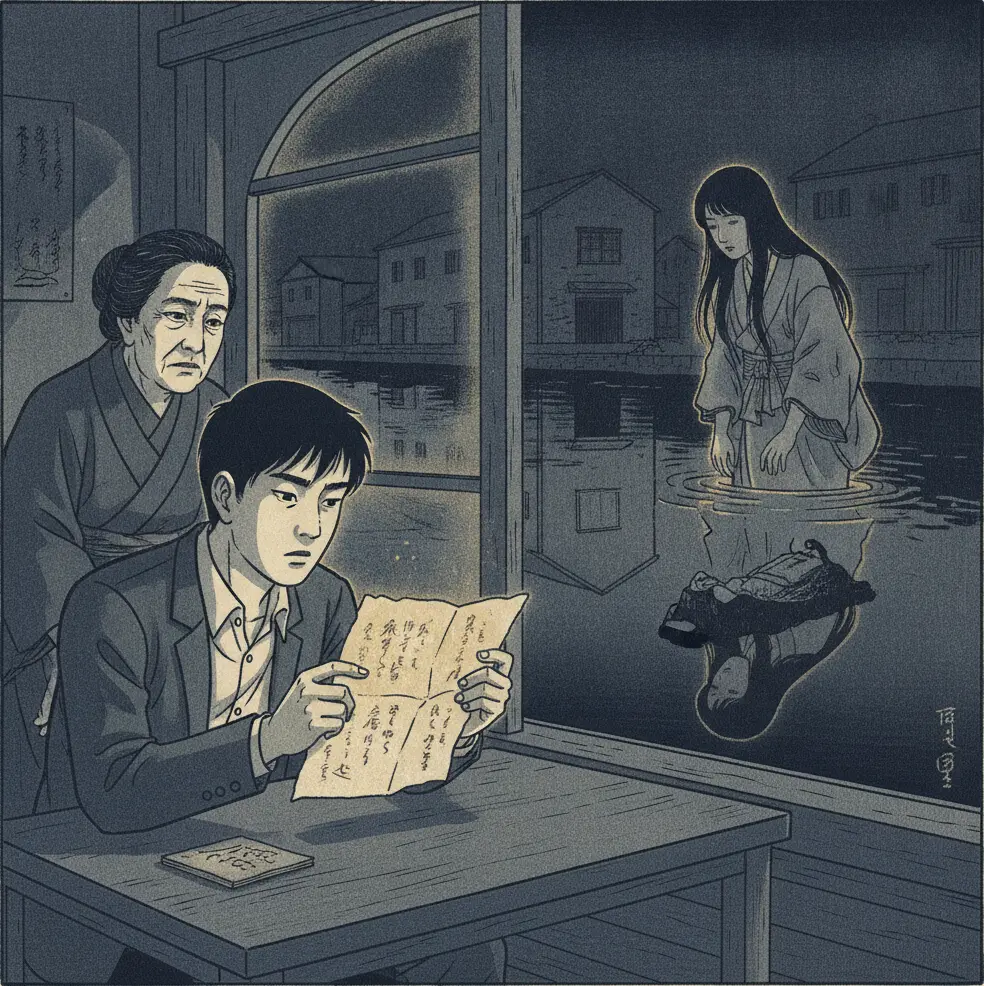
On the paper, in a trembling hand, a few short lines had been written. The language was formal and archaic, and Takumi had to work through it slowly, but when he did, this is what it said: "Do not fear what is reflected in the water. The water remembers. If forgetting is a sin, then perhaps remembering is its punishment. Only know this: what lies beneath the ground on which you now stand." There was no signature. The handwriting, Takumi thought, resembled his grandmother's. But he had no way to be certain.
He walked along the canal toward the station. On the cobblestone promenade, he paused and rested his hands on the railing and looked down at the water. Nothing was reflected there now. It was only water. But he knew now what he had not known before — that the surface was a mirror, and that a mirror sometimes chooses what it will show. When he was standing on the platform at Otaru Station, he called his father for the first time. The signal connected. "Dad," he said, "what was grandmother's maiden name?" There was a brief silence on the other end. "Why do you ask, all of a sudden?" his father said. "Just tell me." Another silence. Then his father said, "Miyashita. Her maiden name was Miyashita. She was from Otaru, in Hokkaido — I heard that something happened to her when she was young and she came to Tokyo, but no one ever knew the details."
The train arrived. Takumi boarded and took a seat by the window. As the train began to move, the canal came into view — the stone warehouses lining its banks, the water catching the light. The canal that travel brochures described as a romantic landscape. Takumi pressed his forehead to the glass and watched the receding water. Nothing was reflected in it. But he knew now that "nothing reflected" did not mean nothing was there. The water remembers. The water does not forget. What has sunk remains at the bottom, sunken. Even when people forget, the water alone remembers. And sometimes, the water shows what it holds — only when the right person comes, only then does it bring what lies at the bottom up to the surface.
The train gathered speed. The city of Otaru shrank in the window — the stone warehouses, the canal, the sky reflected in the water. Takumi closed his eyes. Behind his eyelids, the woman's face appeared. The face of Miyashita Hana. The face that resembled his grandmother's when she was young, a face from the bottom of the water. Her lips moved. "Modore." This time, he thought he understood the word a little better. It was not an instruction to go home. It may have meant remember. It may have meant: turn your awareness back toward the place of what has been forgotten. But whether that was salvation or a curse, Takumi still could not say. He suspected he would never know.
On the train bound for New Chitose Airport, Takumi read the letter once more. "The water remembers." He folded it and placed it in his breast pocket. Even back in Tokyo, he thought, the smell of this city's water would not leave him — coal and salt and the smell of time held still. The water of the Otaru Canal is flowing even now. No — canal water does not flow. It gathers. It simply gathers, and remembers. Everything that has ever sunk to its bottom. That night, from the window of his apartment in Tokyo, Takumi could see a river in the distance. The light of the streetlamps bled across the surface of the water. He reached for the curtain to draw it shut, and stopped. Something was beginning to appear in the water below.