

The Face in the Canal
AI AI-generated fiction — text, and any narration or images. Unrelated to any real events, people, organizations, or places.
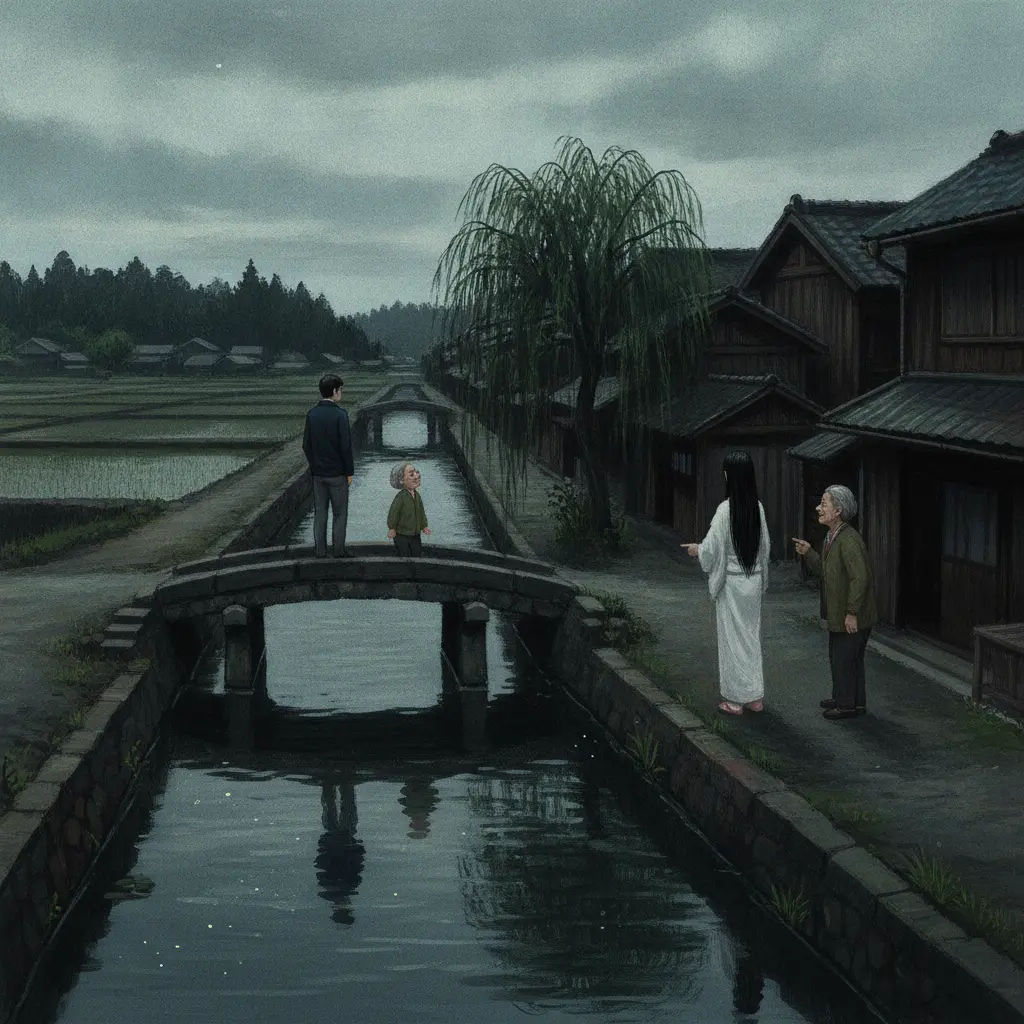
He had decided to go back to Yanagawa because his mother's seventh-year memorial was approaching. Murase Sakuya (村瀬朔也), thirty-four years old and working in advertising in Tokyo, had always felt something hard and small lodged deep in his chest whenever he thought of that city of water. His childhood home in Yanagawa was now looked after by his aunt and her husband, and the last time he had returned was for the funeral — six years ago already. He took the Shinkansen to Hakata and transferred to the Nishitetsu limited express, watching the landscape outside the window gradually flatten. Rice paddies spread wide, and in the distance a dark belt of windbreak trees appeared. It was the end of September, and the sky was a clear blue — though to Sakuya that blue seemed somehow thin, like the painted sky on a papier-mâché stage set.
When he stepped off the train at Yanagawa Station, that particular dampness settled against his skin. The smell of water, the smell of mud, and underneath it something of half-rotted vegetation — air like the inside of a living body. In the station forecourt, signs advertised the tourist punting boats, and a group of young foreign visitors laughed and took photographs. Sakuya watched them from the corner of his eye as he climbed into a taxi bound for his aunt's house. Through the window, the canals caught the late-afternoon light and gleamed with a dull sheen. Yanagawa's canal network traces its origins to the irrigation channels of the Edo period, stretching more than sixty kilometers in total, threading through the entire city like capillaries. As a child, Sakuya had believed that if you followed those waterways far enough, they would lead you somewhere else in the world entirely.
His aunt's house stood in a corner of the old quarter of the city. It was the house where his mother had grown up, and Sakuya himself had spent many summer holidays there as a boy. His aunt Umeko (梅子) came to the door as he arrived and said, "You came all this way — you've gotten thin, haven't you." She was sixty-eight, her back slightly curved now, but her eyes moved as quickly as ever. Over dinner, Umeko went through the arrangements for the memorial: notifying the temple, contacting relatives, organizing the offerings. Sakuya listened and nodded, his gaze drifting to the Buddhist altar at the far end of the room. His mother's portrait stood before the memorial tablet, and in the photograph she was smiling. Something about that smile felt slightly off from the expression he carried in his memory, and he looked away.
He woke early the next morning. Umeko was still asleep, and the house was quiet. He brewed tea in the kitchen and stepped out onto the veranda. The canal behind the house was visible from there, its surface barely moving in the morning mist — like a length of grey cloth laid flat. Within that stillness, a single thing moved. On the far bank, in the shadow of an old earthen wall, something white was standing. It had the shape of a person. Sakuya narrowed his eyes, but the mist made it impossible to see clearly. After a moment the mist shifted, and the white shape was gone. He drank his tea and told himself it had been a heron. White egrets often came down to the canals in this part of town. He had seen them often as a child.
The second day passed in a rush of preparations. He met with the head priest at the family temple, helped make phone calls to relatives, and in the evening walked with his aunt to a nearby flower shop. On the way back, passing along a narrow lane that ran beside one of the canals, Sakuya stopped. Someone was standing at the water's edge. A woman, seen from behind, dressed in white. Her hair was long, falling past her shoulders. She was too still to be a tourist, and she was no punting passenger. She stood looking down at the water. When Umeko said, "What is it?" Sakuya answered, "Nothing," and walked on. When he glanced back, the woman was gone. In the place where she had stood, faint ripples spread quietly across the surface of the canal.
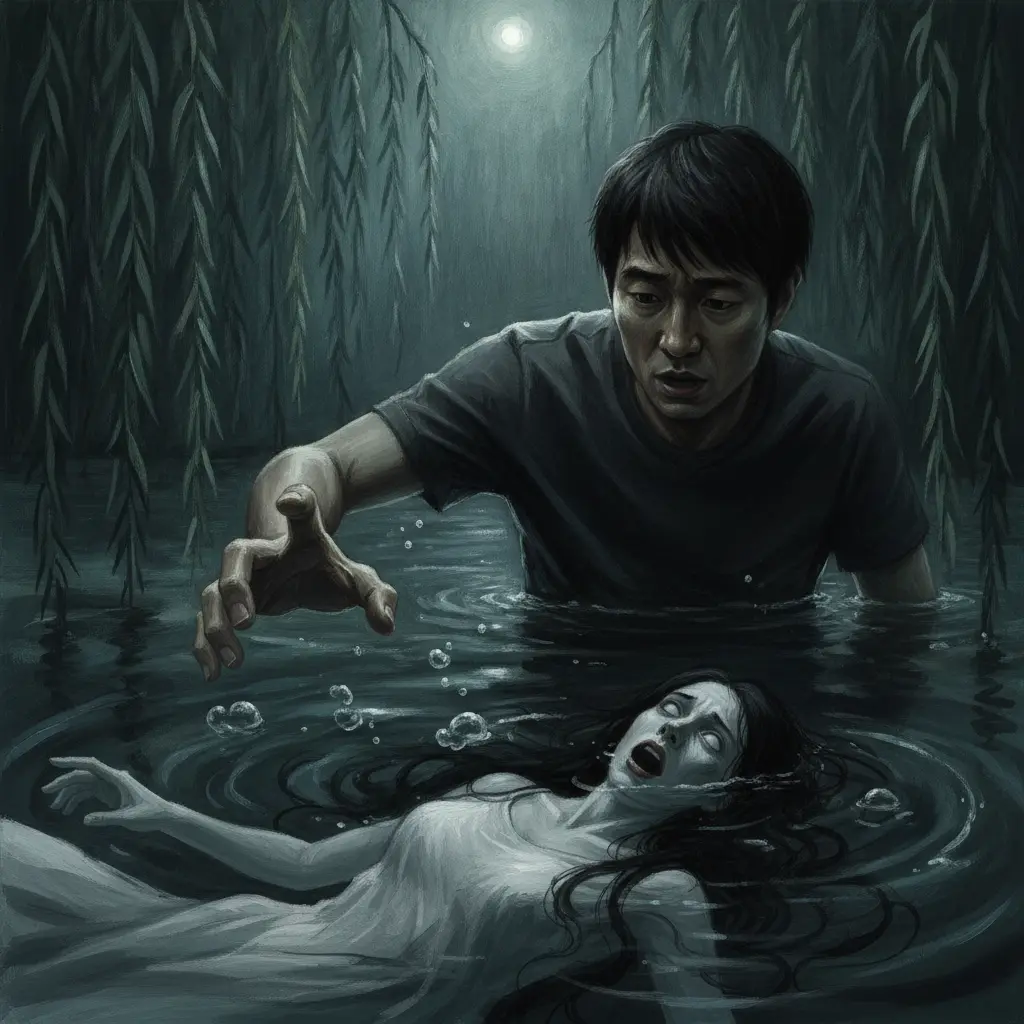
That night, Sakuya dreamed. In the dream he was still in Yanagawa, moving along a canal in a flat-bottomed boat, but there was no boatman. The waterway continued in a direction he didn't recognize, and the willows on both banks trailed their branches down to touch the surface. Eventually the boat emerged onto a wide expanse of open water. There Sakuya noticed something submerged beneath the surface. Something white. Something shaped like a person. Just as he leaned over the side to look more closely, the submerged shape turned its face upward. It was his mother's face. Her eyes were open. Her mouth was open. A voice came up through the water — words he could not make out. Bubbles rose. He woke. He was lying in his futon, his entire body damp with sweat.
On the morning of the third day, Sakuya decided to walk alone along the canals to clear his head. He chose not the northern stretch near Yanagawa Station where the tourists gathered, but the lanes at the edge of the old quarter, narrow paths beside waterways that only locals ever used. The September morning was cool. Water weeds grew thick in places along the canals, their green reflected in the surface. As he walked, a calico cat approached and fell into step beside him. It wore no collar. After a while it stopped abruptly and stood staring toward the water. Sakuya looked. A single point on the surface appeared to be rising slightly — something moving beneath the water, against the current, as though traveling in the wrong direction. A large fish, perhaps, or something else. The movement gradually receded, and the surface returned to its former stillness. The cat went on staring.
The memorial service was held on the fourth day. Throughout the sutra reading, Sakuya kept his eyes on his mother's portrait. She was smiling in the photograph. She was smiling, and yet something continued to catch at him. It took him several days to understand what it was. The smile was wrong. In his memory, when his mother smiled, her eyes narrowed and small hollows appeared in her cheeks. But in the portrait, only her mouth was smiling. Her eyes were not. Umeko had been the one to choose the photograph, he was fairly certain. He made a mental note to ask about it later, and joined the line for the incense offering. At the gathering afterward, Umeko's husband Yoshio (義雄), slightly drunk, said: "You know, Sakuya, there's something people have said around here for a long time. That certain people get called by the canals. Especially if you come back soon after losing someone close — the water remembers your face." Umeko told her husband sharply that this was no time for such talk. Sakuya laughed it off, but the words sank into him and settled there.
The fifth night was the strangest. Unable to sleep, Sakuya went out onto the veranda well past midnight. The moon was out. The surface of the canal reflected its light in silver. He stood watching, caught by the beauty of it, and then noticed a figure on the far side of the water. Not in the shadow of the earthen wall this time — it was standing right at the canal's edge, among the reeds on the bank. A woman in white. This time she was not facing away. She was facing him. Even in the moonlight, her face was not visible. But he could see that something hung in her hair — a thin ornament, or perhaps water weed. Sakuya tried to call out, but no sound came. Slowly, the woman took one step toward the canal. Her foot entered the water. No sound. Another step. The water reached her knees. She descended as though sinking, and her figure disappeared beneath the surface. Not a single ripple formed. Sakuya gripped the veranda post and could not leave that spot until dawn.
The next morning, Sakuya told his aunt what he had seen. Umeko listened to the end without interrupting, then was silent for a long time. Finally she said, "Let me ask you one thing. Did you see her face?" Sakuya said he had not. Umeko let out a small breath. "Good," she said. "Good that you didn't." She offered nothing more. When Sakuya pressed her — "What do you mean?" — she said, after a pause: "There's always been a saying around here, that something lives in the water. It isn't evil, exactly. But those who see its face are drawn to the water. Your mother, too." Then she closed her mouth. Sakuya forgot to breathe. "My mother too?" Umeko said nothing.
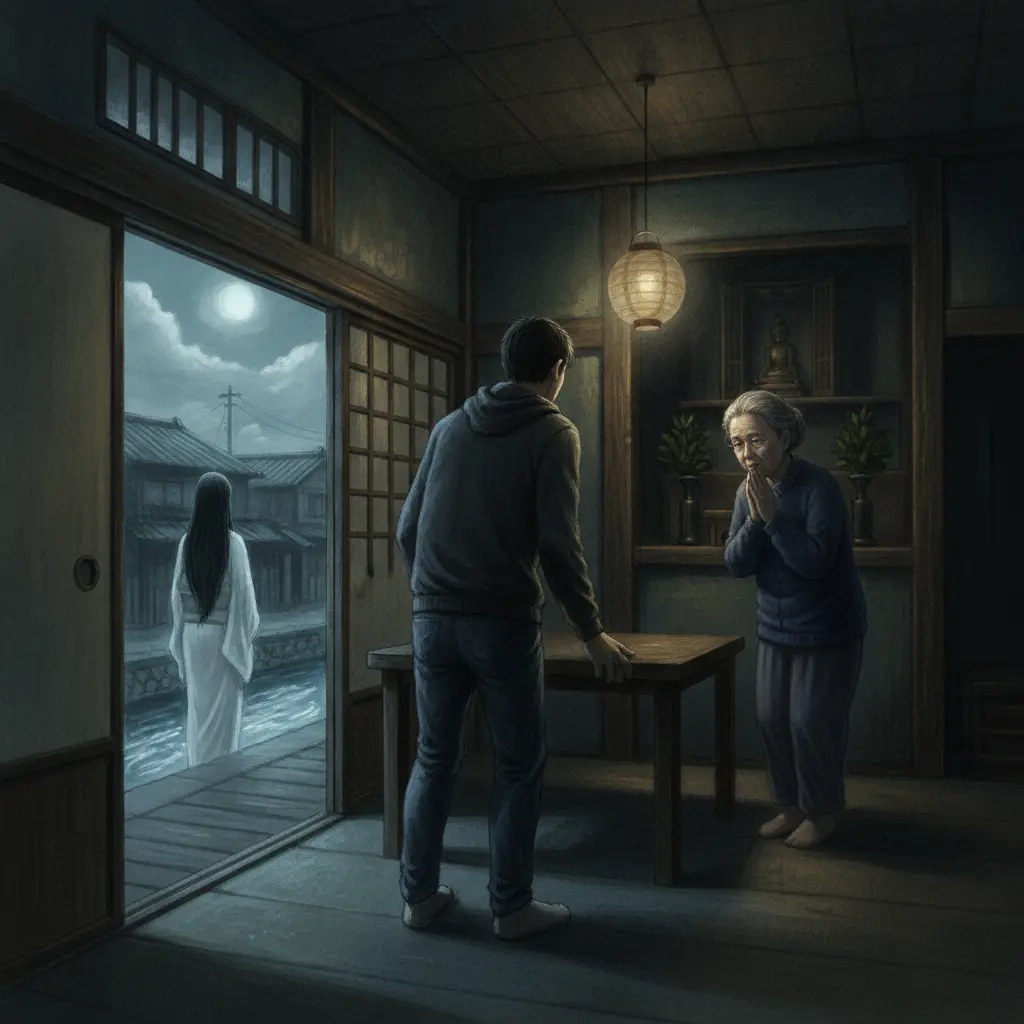
Murase Sumiko (村瀬澄子), Sakuya's mother, had died six years ago in autumn. The cause of death had been recorded as heart failure. She had been alone in the family home in Yanagawa, found in the morning by Umeko, lying on her back on the futon with a peaceful expression on her face. There had been nothing unusual, Umeko had said at the time. But now Umeko's words were rearranging themselves in Sakuya's mind. Something that lives in the water. Those who see its face are drawn to the water. Your mother, too. He stood up. "Did my mother see its face?" he asked. Umeko, still facing the altar, gave a small nod. "When?" "The summer of the last year you visited. After you went back to Tokyo, she started spending time at night looking out toward the canal. Just staring. As though something were pulling at her." Sakuya's hands began to tremble.
What Umeko said next remade everything. "Sakuya — the week before you came back this time, one of the neighbors said they'd seen something white at the edge of the canal. Every night, they said. Before you arrived. As though it were waiting." Sakuya felt his body temperature drop by a single degree. Everything he had seen over the past days suddenly took on a different meaning. The white shape across the canal, the woman's back at the water's edge, the feet walking into the water, the soundless submersion — he had assumed all of it had begun after his arrival. But if it had been waiting before he came. If it had already known him. Yoshio's words — the water remembers your face — landed in the pit of his stomach with an entirely different weight.
He thought: I should leave. And yet, strangely, his body would not comply. He knew he wanted to return to Tokyo, but whenever he picked up his phone to check train times, he found himself closing the screen without looking. When he went for a walk, his feet turned naturally toward the canals. He became conscious of this on the morning of the seventh day. He had been standing at the water's edge, looking down at the surface, when the thought came to him: how long had he been here? He remembered leaving the veranda. He had no memory of putting on his shoes. He looked down. He was barefoot. Standing on the asphalt, barefoot. And wet. The soles of his feet were wet. The canal was still three meters away.
That evening, Sakuya told his aunt he would leave the following morning. Umeko said simply, "I see," and after a brief pause added, "Don't look at the canal tonight." That night, Sakuya closed the wooden shutters over the windows and pulled the futon up over his head. He could not sleep. He heard water. The sound of the canal flowing was not something you normally heard from inside the house, but that night he heard it clearly — a soft, rhythmic lapping, coming from beyond the paper screen. Gradually, he realized the sound was growing louder. It was getting closer. Coming from the direction of the veranda. The sound stopped just outside the screen. Sakuya held his breath. A shadow fell across the white surface of the paper. The shape of a person. Standing. Simply standing. Doing nothing. Sakuya closed his eyes.
He did not know how long he lay like that. When he became aware again, it was morning. The screen was bare. The veranda was dry. He packed his things, said a brief goodbye to his aunt, and called a taxi. Umeko came as far as the gate. "Take care," she said. Nothing more. As the taxi pulled away and her figure grew small in the rear window, Sakuya remembered something. On the morning of the seventh day, standing barefoot at the canal's edge, he had looked down and seen his own face reflected in the water. He had seen it clearly. But had it been his face? The mouth had been smiling. The eyes had not. He had seen that face somewhere before.
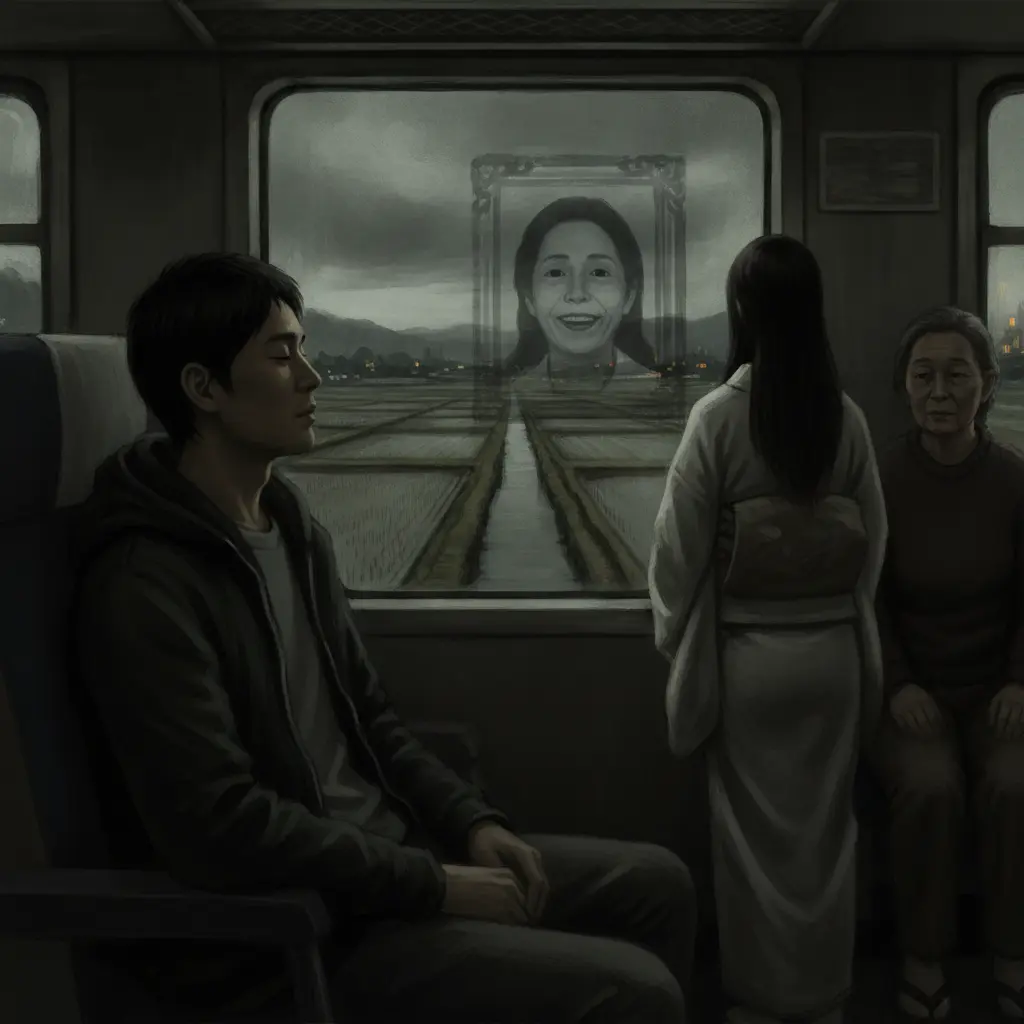
The Nishitetsu train carried him away, and the rice paddies and canals slid past the window and fell behind. Sakuya closed his eyes. He thought about his mother's portrait. The mouth smiling, the eyes not. The unease he had felt the first time he saw that photograph. The portrait Umeko had chosen. What had Umeko seen in that photograph when she chose it? And on his mother's last night, lying on her back on the futon — Umeko had said her face wore a peaceful expression. Sakuya turned this over quietly in his mind. What kind of expression was peaceful? Might it have been the kind where the mouth is smiling and the eyes are not? The train gathered speed, and the Hakata skyline began to appear beyond the window.
Back in Tokyo, Sakuya returned to his ordinary life. He went to work, ate his meals, slept. He tried not to think about Yanagawa. But about ten days later, he woke in the night to find himself not in his bed but standing on the floor. Barefoot. The apartment floor was cold beneath him. The clock read three in the morning. He had no idea how he had come to be standing. Then, almost without thinking, he checked the soles of his feet. They were wet. In his Tokyo apartment, on his own floor, the soles of his feet were wet. The water was warm. The temperature of river water.
He looked toward the balcony window. The curtain was moving. There was no wind. He walked toward it. Something was pressing against the glass from outside. Water marks. The shape of a hand — a water mark in the shape of a hand — on the outside of the glass. Sakuya could not move. A fifth-floor balcony. A handprint in water on the outside of the glass. He backed away slowly until his shoulders touched the wall. The curtain moved again. Beyond the window there was only darkness. Nothing visible. Nothing at all visible.
Somehow, not being able to see was the most frightening thing of all.
The next morning, Sakuya called his aunt. The phone rang and rang. No answer. It rang through again in the afternoon. Finally, late that evening, someone picked up. But the voice that came through was not Umeko's. It was a young woman's voice. "Hello," it said. Sakuya asked, "Is this Aunt Umeko?" A silence followed. Then the voice said quietly: "I'm by the canal right now." Sakuya said, "Who is this?" There was no reply. Instead, from the other end of the line, came the sound of water. A soft, rhythmic lapping. Slow at first, but growing — steadily, unmistakably — louder.