

The Yellow-Green Raincoat on the Fog Road
AI AI-generated fiction — text, and any narration or images. Unrelated to any real events, people, organizations, or places.
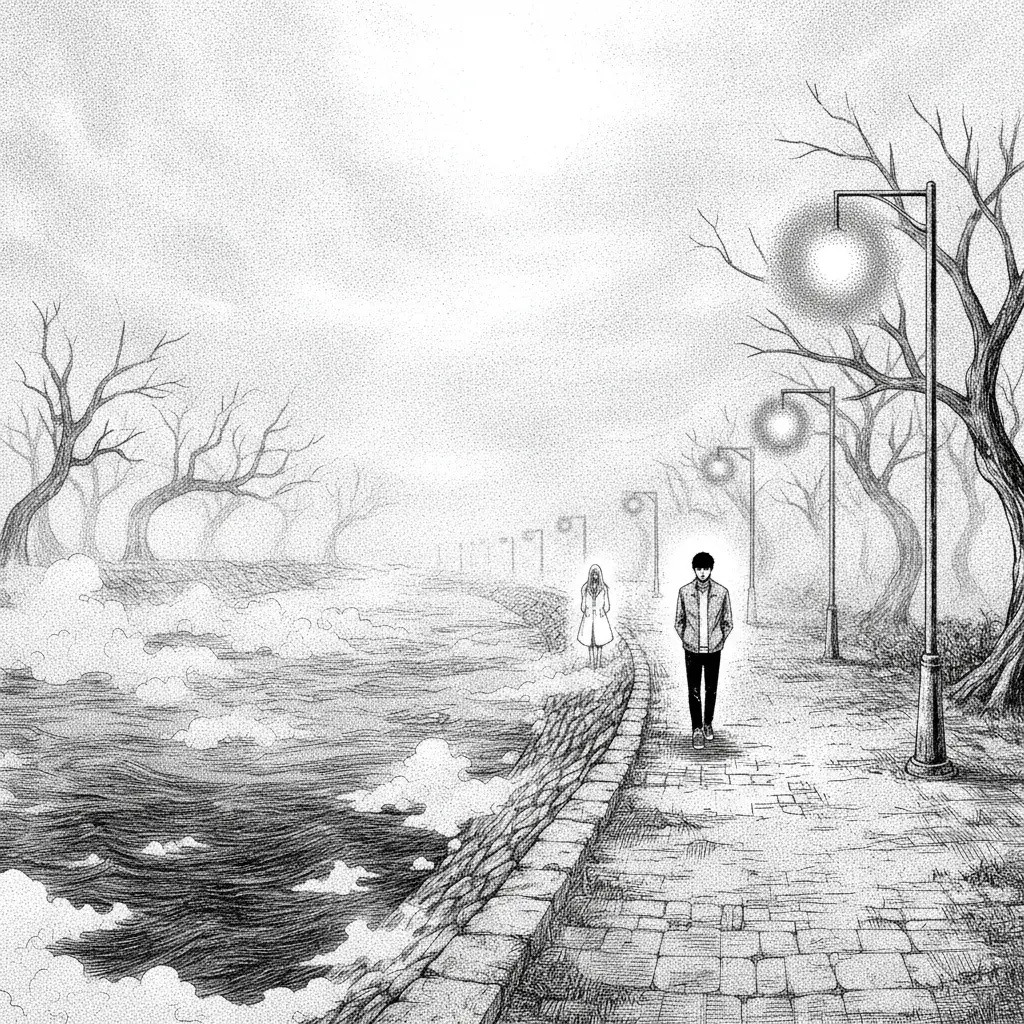
The Soyang River always held fog within itself. When the water settled toward sleep, white breath rose from the surface and spread across the embankment path, and the glow of the streetlamps bled softly through it. People called the path the fog road. It had no official name. It was simply what the people who lived nearby had always called it, naturally, over the years. Anyone who had grown up in Chuncheon had walked that path at least once, and anyone who had walked it had a story about turning to look behind them. They could never explain why. They only said that they just turned around.
Jeongsu was thirty-two years old, and he had come back to Chuncheon for the first time in three years. What his life in Seoul had left him was a chronic headache, two boxes of belongings, and a single letter of resignation from his last employer. On the first night back in his hometown, he unpacked in the villa near the Soyang River where he had lived as a child and looked out the window. The fog had already settled. The lights on the far bank seemed to tremble, and the outline of the embankment path was dissolving into a pale grey membrane. He had the feeling that something old was waiting for him, but he put it down to exhaustion.
The following morning, Jeongsu went outside under the pretense of running errands. Walking the fog road was an old habit. The narrow footpath that ran along the top of the Soyang River embankment was all there was to it. The river flowed to the left, and to the right stood a reed bed and a few willow trees. Spring was nearly over. The willow leaves were just beginning to shed their yellow-green, and the reeds had not yet grown into the fullness of summer, standing as bare stalks. A shallow fog still lay over the river. Even when the morning sun came in at an angle, the fog did not fully lift. Stretches where the light caught the surface of the water and made it glitter alternated with stretches where the fog turned everything ashen.
Jeongsu walked slowly. The particular dampness of Chuncheon, which he had forgotten during his years away, seeped through his clothes. It was a smell he had not known in Seoul. The wet-earth smell, the green rawness of the reeds, and something sweet yet cold that belonged to the river itself. He breathed in deeply. It was not unpleasant. For a moment, the noise of Seoul, the fluorescent lights, his former manager's voice — all of it seemed to recede. He sat down on a worn wooden bench near the middle of the footpath. Someone had carved letters into the back of the bench with a ballpoint pen. The marks had aged into the grain of the wood. He leaned in to read them, but they were too faint to make out. Perhaps a name, perhaps a date. He could not tell.
From that evening onward, Jeongsu walked the fog road every day. Once in the morning, once in the evening. He handled the business of looking for work and reaching out to acquaintances during the daylight hours, and when the sun began to tilt he went out to that path without fail. It took fewer than three days for the habit to take hold. The evening fog was different from the morning fog. It was thicker, and it moved more slowly. When the fog that rose from the river spilled over the embankment and pushed into the footpath, it was as though the air below his ankles had been packed with white cotton. The streetlamps were out in places. Lit stretches and dark stretches alternated, and in the dark ones only the sound of his own footsteps confirmed that he existed.
On the fifth evening, Jeongsu saw the woman for the first time.
It was near the far end of the footpath, at the point where the way narrowed toward the Soyang Dam. Precisely at the boundary between a lit stretch and a dark one, the woman was standing. She was wearing a yellow-green raincoat. It was not raining. She was facing the river, her back to him, so he could not see her face. Her hair was long. In the fog, only the yellow-green of the raincoat stood out with any clarity. Jeongsu paused briefly, then walked on. There was nothing strange about it. People came out to walk at all hours. Only the fact that she was wearing a raincoat on a dry evening, and the fact that she stood without moving, only staring at the river — these things nagged at him in some small way. He passed her. In the moment of passing, the smell of the river suddenly thickened. Something sweet and cold drove itself deep into the back of his nose. Without meaning to, he held his breath.
The next evening she was in the same spot. Same place, same posture, same raincoat. Again there was no rain. Jeongsu did not slow his pace. He walked on and glanced sideways as he passed. He caught sight of the woman's face. She was turned toward the river, so he saw only half of it, but that was enough. Her face was pale. Though it was a spring evening at dusk, there was no warmth in her face at all. Her lips were slightly parted, as though she were about to say something, or perhaps simply breathing. It was only after Jeongsu had passed that he allowed himself to breathe again.
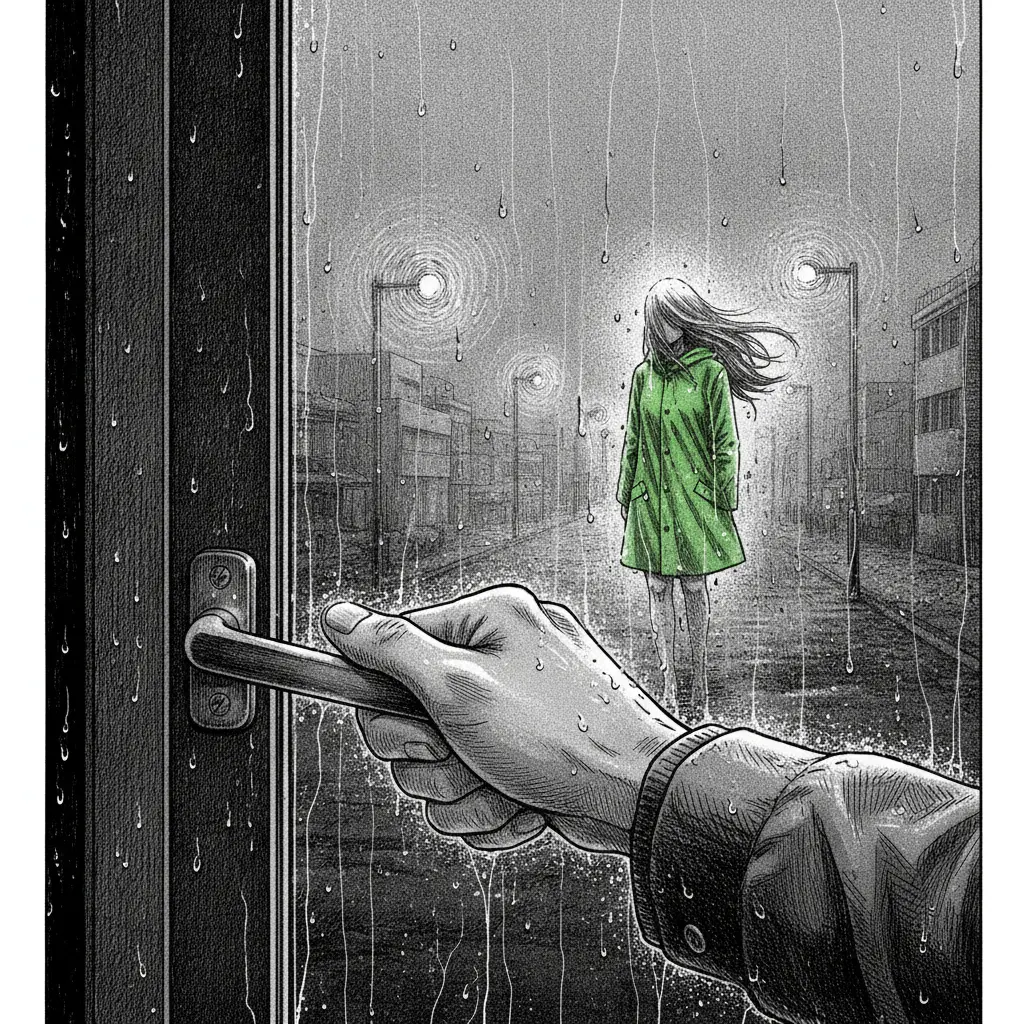
That night he opened the window of the villa and looked down at the river. The night fog was thicker than the evening fog. The glow of the streetlamps along the embankment path bled yellow through it. Somewhere among those lights, there seemed to be something yellow-green. Or perhaps not. In fog, anything could take the shape you were looking for. He closed the window. Sleep did not come easily.
Three more days passed. The woman was in the same spot every evening. Jeongsu tried to convince himself that she was simply a local resident who came out for a walk out of habit. There were people who wore raincoats even when it was not raining. There were people who liked to stand and look at the river. The problem was that she was always in the same posture, always facing the same direction. And every time Jeongsu passed that spot, she did not turn her head. Not when his footsteps drew near, not as he passed, not as they faded. He turned to look back once. She was still facing the river. The sight of her from behind — the long hair, the silhouette of the yellow-green raincoat standing in the fog — frightened him in a way he could not explain. It was something different from the mere unease of a stranger standing nearby. It was more like the feeling that something was there which should not be.
On the tenth evening, it rained. A thin spring rain. Jeongsu took an umbrella and went out to the fog road. The sound of rain falling on the river and the sound of it falling on the footpath mingled together. The fog was there that evening too. Even in the rain it did not lift. If anything, the fog in the rain felt more viscous. The air seemed to cling to his mouth. He walked. The boundary point drew near. He could see where the lamplight met the dark. The woman was not there.
Jeongsu noticed that he felt both relieved and strangely hollow, and found this odd in himself. Of course she was not there. It was raining. But standing at that spot and looking down at the river, he noticed for the first time the shape of the terrain at the boundary point. The slope between the footpath and the river was unusually steep there. There was a railing — an old iron railing, rusted, the paint flaking away in patches. Below the railing the river was visible. The surface of the water, mixed with fog and rain, looked like a dark mirror. Jeongsu gripped the railing. It was cold. And then, in the fog above the river, he saw something. A shape. Something that looked like the shape of a person was standing in the fog over the water. Or floating. He could not tell whether its feet touched the surface or not. The fog covered the lower part of the shape entirely.
Jeongsu rubbed his eyes. He told himself it was the rain getting into them. When he looked again, the shape was gone. There was only fog and raindrops over the river. He left the spot. His pace quickened, and when he reached the villa he locked the door behind him. That night the headache was bad. He told himself the chronic pain had simply flared up. He took two painkillers and fell asleep. He dreamed. He dreamed he was walking the fog road. In the fog, a figure in a yellow-green raincoat was walking ahead of him. He tried to stop but his feet would not. The figure drew closer and closer. Then it stopped, and began to turn its head. Jeongsu woke from the dream. It was three in the morning. His heart was beating fast. He tried not to look out the window, but in the end he looked. The fog was thick. The streetlamps were dim. There was no yellow-green.
The next day, Jeongsu brought up the woman for the first time with someone who lived in the neighborhood — an older woman who had lived there for many years. He asked whether she had ever seen a woman in a yellow-green raincoat standing near the fog road along the Soyang River. The woman paused. The pause meant something. It was not a simple pause for thought. It was the pause of someone making a decision. She spoke carefully. She said there had been an accident there, a long time ago. A young woman, she said. Near the end of spring. She said nothing more than that. When Jeongsu pressed her, she changed the subject. The look in her eyes was the look of someone who had decided not to speak.
That evening Jeongsu did not go out to the fog road. Instead he went out once during the day and looked at the boundary point in daylight. In the light of day there was nothing remarkable about it. A worn railing, a sloped embankment, the flowing river. But at the base of the railing, in the earth of the slope, there was something. At first he thought it was rubbish. When he got closer he saw it was a scrap of fabric. Yellow-green fabric. Faded and worn, but unmistakably yellow-green, caught in the grass on the slope below the railing. It was old. How old he could not say. He did not touch it. He only looked. Then he turned and went back.
That night, lying in bed, he thought it through properly for the first time. The woman he had seen every evening for more than ten days. The woman who wore a raincoat when it was not raining. The woman who stood in the same spot, in the same posture, always facing the river. And on the night it rained — the one night a raincoat would actually have been needed — she was not there. He turned this reversal over in his mind for a long time. She appeared in a raincoat when there was no rain, and vanished when there was. What that meant. He tried to stop thinking about it. The thinking would not stop.
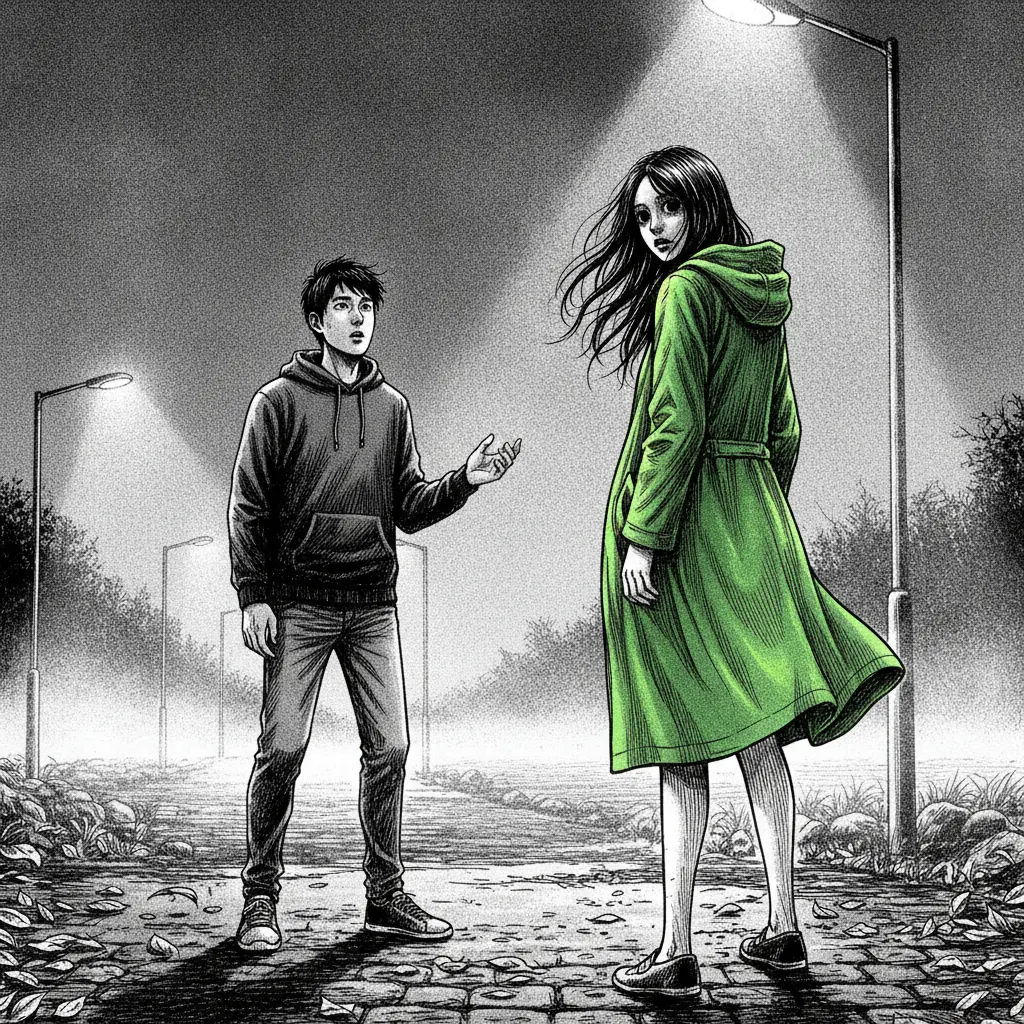
Two days later, Jeongsu went out for his evening walk again. He did not know why. He simply went. The fog was thick. The sky was clear, but the fog over the river was thick. The boundary point drew near. The place where lamplight met darkness. The woman was there. Yellow-green raincoat. Long hair. Facing the river. This time Jeongsu stopped. And he spoke to her. Excuse me, he said. His voice came out smaller than he had expected. The woman did not respond. He took one step closer. Excuse me, he said again. The woman slowly turned her head.
The moment he saw her face, Jeongsu went rigid where he stood.
It was not that she had no face. She had a face. She had eyes, a nose, a mouth. But the direction her face was turned was wrong. The degree to which her neck had rotated was wrong. Her shoulders had not moved, but her neck had turned too far. Further than a human neck can turn. And her eyes were looking at Jeongsu. He knew that those eyes were looking at him. But there was nothing in them. No light. None of the faint moisture and reflection and movement that exists in the eyes of a living person. They were like glass. No — colder than glass. Like water. Like river water.
Jeongsu ran. He ran through the fog toward the nearest streetlamp. His feet caught on the uneven surface of the path but he did not fall. He did not look back. He heard only footsteps. Only his own. No other footsteps behind him. But this brought no comfort. The absence of footsteps was not proof that nothing was following. He reached the villa and locked the door. He stood there gasping. He tried not to look at the window.
A sound came from the direction of the window. It was not rain. There was no rain. It was not wind. It was simply the sound of something making contact with the glass. Very lightly, once. Jeongsu did not move from where he stood. The sound did not come again. After a long time he walked slowly to the window. He did not open the curtain. He stood there with the curtain closed. He had the feeling that something was pressing against the glass on the other side of the curtain. A hand. He had the feeling that a hand was pressed against it. He did not open the curtain.
The following morning, Jeongsu opened the window. There was something on the glass. A faint mark on the surface of the pane, like frost that had formed and faded. A mark the size of a palm, in the shape of a palm. On the outside surface of the glass, not the inside. His villa was on the third floor. There was nothing outside the window that could serve as a foothold. Jeongsu looked at the mark for a long time. The number of fingers was right. Five. The size looked like a woman's hand. At the lower edge of the palm, faintly, there was something that looked like the trace of a wrist. And the direction in which the wrist trace extended was not downward. It was upward. As though whatever had pressed against the glass had not reached up from below, but had drifted down from above — from the direction of the fog, from the direction of the river — and come to rest there. Jeongsu closed the window.
He packed his things. Two boxes. The same two boxes he had arrived with. He packed during the day and intended to leave before evening. But when the packing was done he looked out the window one more time. He could see the Soyang River. Fog was already rising over the water. The sun had not yet set, but the fog was already coming. The fog over the river was not white. Catching the light of the setting sun, it was faintly red. And somewhere in that red fog, somewhere over the river, there seemed to be something yellow-green. Jeongsu narrowed his eyes. It was there. Unmistakably yellow-green. It was not moving. It was simply there, in the fog over the river.
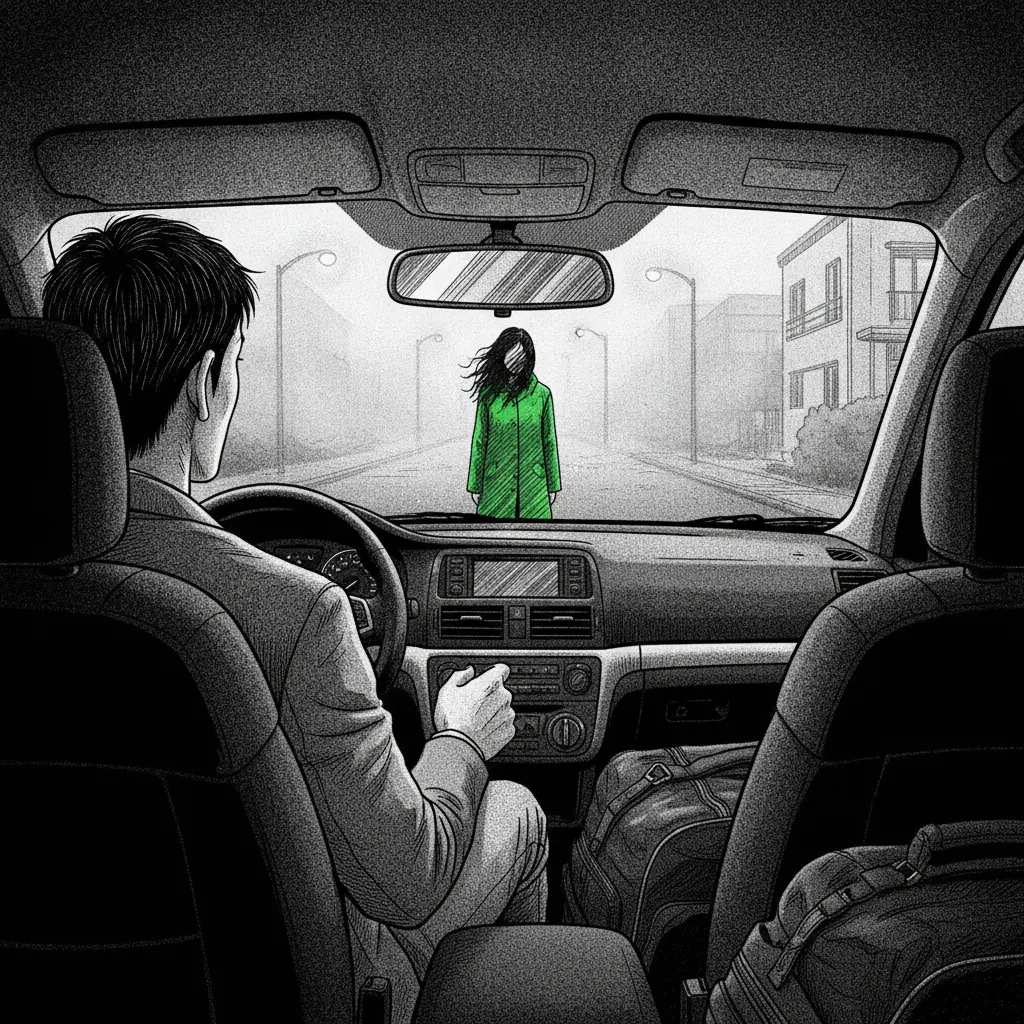
Jeongsu carried his boxes out of the villa. He loaded them into the car. He started the engine. And before pulling away, without knowing he was going to, he looked in the rearview mirror. The fog road was in the mirror. The streetlamps glowed dimly. Fog covered the path. And on the fog road in the rearview mirror, a woman in a yellow-green raincoat was standing. This time she was not facing the river. She was facing his car. She was turned toward him. And the spot where she stood was not the footpath. It was the road. The road in front of the villa he had just left.
Jeongsu drove. He pressed the accelerator. He did not look in the rearview mirror again. As he made his way through the center of Chuncheon and turned onto the national highway, he did not look back once. Out on the highway heading toward Seoul, he turned on the radio for the first time. He needed sound. He needed a human voice. Music came from the radio. He drove and listened. Chuncheon fell away behind him. The Soyang River fell away. The fog road fell away.
But on the national highway, passing through a tunnel, the tunnel was bright inside. Yellow lights lined it in a row. Jeongsu felt the tension leave him for the first time as he drove through it. There was no fog. There was no river. He exhaled. And in the moment he emerged from the tunnel, fog rushed at the windshield. Mountain fog. The fog that clung to the hillside beyond the tunnel exit was covering the highway. Jeongsu slowed down. He turned on the wipers. He could not see well ahead in the fog. He drove slowly, waiting for it to clear.
Then, in the fog ahead, he saw something.
Yellow-green.
Jeongsu hit the brakes. The car stopped. The fog thinned. There was nothing on the road. Just the highway. A guardrail, asphalt. No yellow-green. He sat there for a long time. No cars came from behind. There were none ahead either. Only fog.
Jeongsu started driving again. He never returned to Chuncheon after that. He never brought up the Soyang River. On days when the fog was thick, he did not open his windows. That was enough. It had to be enough. Only one thing remained: from that time on, whenever he caught sight of yellow-green in any fog — whether from inside a car or on foot — he always stopped. He stopped and looked. And until he had confirmed that it was not yellow-green after all, he did not move forward.
The fog over the Soyang River is thickest at the end of spring. In that season when the water has grown warm and the air is still cold, the fog that rises from the surface crosses the embankment and covers the paths and moves through the city. No one knows how far that fog travels. And no one knows what it carries with it.