

What the Gotjawal Calls
AI AI-generated fiction — text, and any narration or images. Unrelated to any real events, people, organizations, or places.
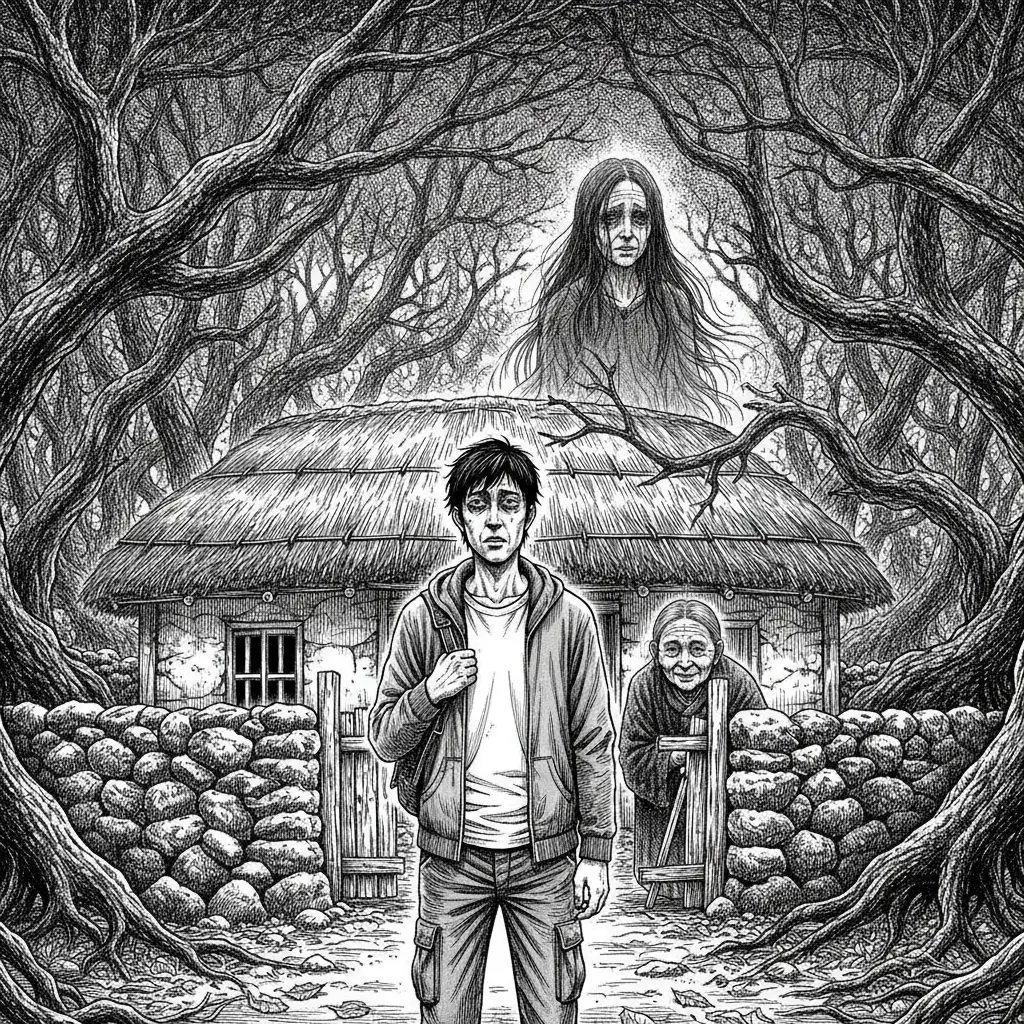
Hyeonsu had come to Jeju for one reason only: to run. After his life in Seoul had come apart — the broken engagement, the lost job, and his mother's death all arriving within the same month, one after another — he could no longer bear the smell of familiar things. The smell of the subway, of convenience stores, of the hallway outside his studio apartment. Everything reeked of the wreckage he'd left behind. A friend mentioned a small farmhouse out in Hanjeon-myeon that he could borrow, and Hyeonsu seized on it. There was nothing else left to seize.
The house was older than he'd expected, and lonelier. It sat deep inside the village, far from the road, and from the point where the pavement ended and the gravel began, the Gotjawal pressed close on either side. The forest the Jeju people called Gotjawal was unlike any forest Hyeonsu had known. The way the trees forced themselves up through the volcanic rock looked less like growth permitted by the earth and more like something that had torn its way through by force. The roots didn't embrace the boulders — the roots and the boulders were in the process of consuming each other. Even in daylight, the interior was dark. Light entered differently here. Not filtering in, but placed carefully, only where it had been allowed.
The first few days he simply slept. Twelve hours at a stretch, sometimes fourteen. No alarm, no curtains drawn, just his body taking what it demanded. He dreamed almost nothing, and was grateful for it. When he woke, he could see the edge of the Gotjawal through the window, and he could hear birdsong, and the sound of wind. It was a kind of quiet he had never encountered in Seoul — not the absence of sound, but a quiet in which every sound was exactly where it belonged. Inside that quiet, Hyeonsu found he could breathe again, a little.
On the fifth day, he walked into the forest for the first time. There was no particular reason. The gravel path in front of the house simply led toward the Gotjawal, and his feet followed. Near the entrance stood a wooden signpost that looked as though someone had put it there long ago; the lettering had nearly worn away and could not be read. The moment he stepped inside, the temperature changed. It was cooler than outside, and damper, and the smell was different — moss and rotting wood, and beneath those, something older still. Not soil, but something deeper than soil. Hyeonsu thought it must be rising from beneath the volcanic rock.
There was no real path. He followed the faint traces of where others had walked, but even those soon faded. He kept the direction he'd entered fixed in his mind, trying not to lose it. Sunlight fell through the trees at oblique angles now and then, and in those shafts something drifted — spores, perhaps, or dust, he couldn't tell. The basalt underfoot was thick with moss, and his feet slipped a little with each step. A turned ankle would be easy here.
He had been walking for perhaps an hour when he came to a small clearing — a place where the trees drew back enough to show a patch of sky. At its center sat a large piece of basalt with a surface so smooth it seemed unlikely to be natural, as though someone had worked it. But what caught his eye more than the stone were the objects resting on top of it: tangerine peel that looked as though it hadn't yet dried, a small ceramic cup, and the ash of something burned. Someone had been here recently. A village offering of some kind, he thought — he had read somewhere that Jeju had customs like this. The walk back seemed shorter than he remembered.
That night, he dreamed for the first time.
In the dream he was inside the forest, in a light that was neither day nor night. A sound came from somewhere — something between a human voice and the creaking of wood. He walked toward it. No matter how far he walked, it came no closer. Then the sound stopped, and right beside him — right beside his ear — he heard breathing. He turned his head. There was nothing. The dream ended there. When he opened his eyes it was three in the morning, and the darkness outside the window was absolute.
The next day he went back into the forest. Not because of the dream, he told himself. Just to walk. The air was good. He had intended not to go as deep as before, but his feet carried him there anyway. The clearing appeared again. The offerings on the basalt were still in place; the tangerine peel had begun to dry a little. He stood at the edge of the clearing and looked at them for a moment. That was when he felt it for the first time — a sense that something was wrong. He couldn't have explained it. There was nothing wrong with the offerings, nothing wrong with the forest. Only the feeling that he should not be standing in this spot. That he had entered somewhere he had not been invited.
He turned to leave. But the path back looked different from the way he remembered it. The arrangement of the trees didn't match. He was certain he was walking in the right direction, yet the trees around him were ones he hadn't seen before. He corrected his course. It was still wrong. Before panic could take hold — he forced his breathing to slow. He took out his phone. No signal, but the compass app still worked. He fixed north in his mind and walked methodically. Twenty minutes later, the gravel path appeared. When he stepped out of the forest, he realized he had been holding his breath.
That evening, on his way down toward the village, he encountered an old woman in front of a convenience store. He introduced himself as the outsider staying at the farmhouse, and she looked him over slowly, without a word.
"Have you been going into the Gotjawal?"
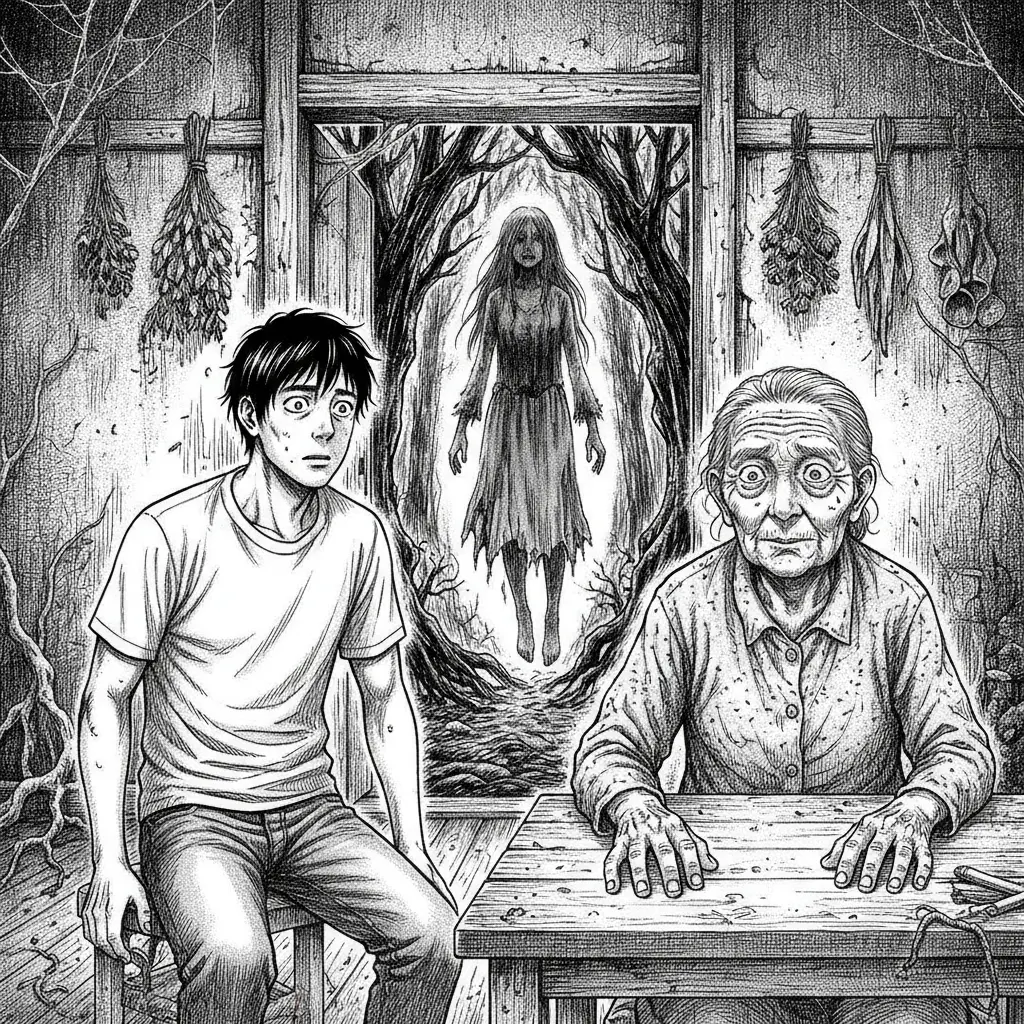
When he said yes, something shifted in her expression. Not fear, not pity — just the look of someone who already knew.
"That forest has a way of calling to people, since the old times. Especially people with a hole in them. People with an empty place. When someone like that goes in, the forest tries to fill it. In its own way."
Hyeonsu smiled and let it pass. Local folk belief, he thought. He thanked her and turned to go. She said one more thing behind him.
"Once it calls, it keeps calling. Each time, a little deeper."
He didn't look back.
That night the dream was sharper than before. The clearing again. The offerings on the basalt. But this time there was something else — a figure standing beside the stone. Its face was not visible. Slowly, the figure turned its head. Hyeonsu felt that it was his mother. Felt — that was the right word; he hadn't seen it, only felt it. The figure opened its mouth. No sound came. And yet Hyeonsu understood. He knew what it was saying. It was saying a name. His name.
He dreamed for three nights in a row. The same clearing each time, the same figure, the figure drawing a little closer each time. On the third night the figure extended its hand. He felt his own hand reaching out of its own accord, and at that moment he woke. He was soaked in cold sweat. Three in the morning. He looked out the window: no moon, and the edge of the Gotjawal stood like a solid black wall. Then — he rubbed his eyes — something glimmered faintly inside that darkness. Too slow to be fireflies, and too fixed in place. Not quite light, but an imitation of it.
For the first time, Hyeonsu thought about packing his things. Not returning to Seoul, exactly — just leaving this house. But by morning the resolve had blurred. He drank his coffee, looked out the window, listened to the birds, and the terror of the night before seemed overblown. Dreams were dreams. The light in the trees had been a trick of the eye. On such a beautiful morning, in such stillness — there was no reason to leave.
He only understood later how strange that was. That the decision to pack dissolved every morning. That when he resolved not to go into the forest, his feet went there first. That he had come to Jeju to escape, and now could not think of escaping from Jeju.
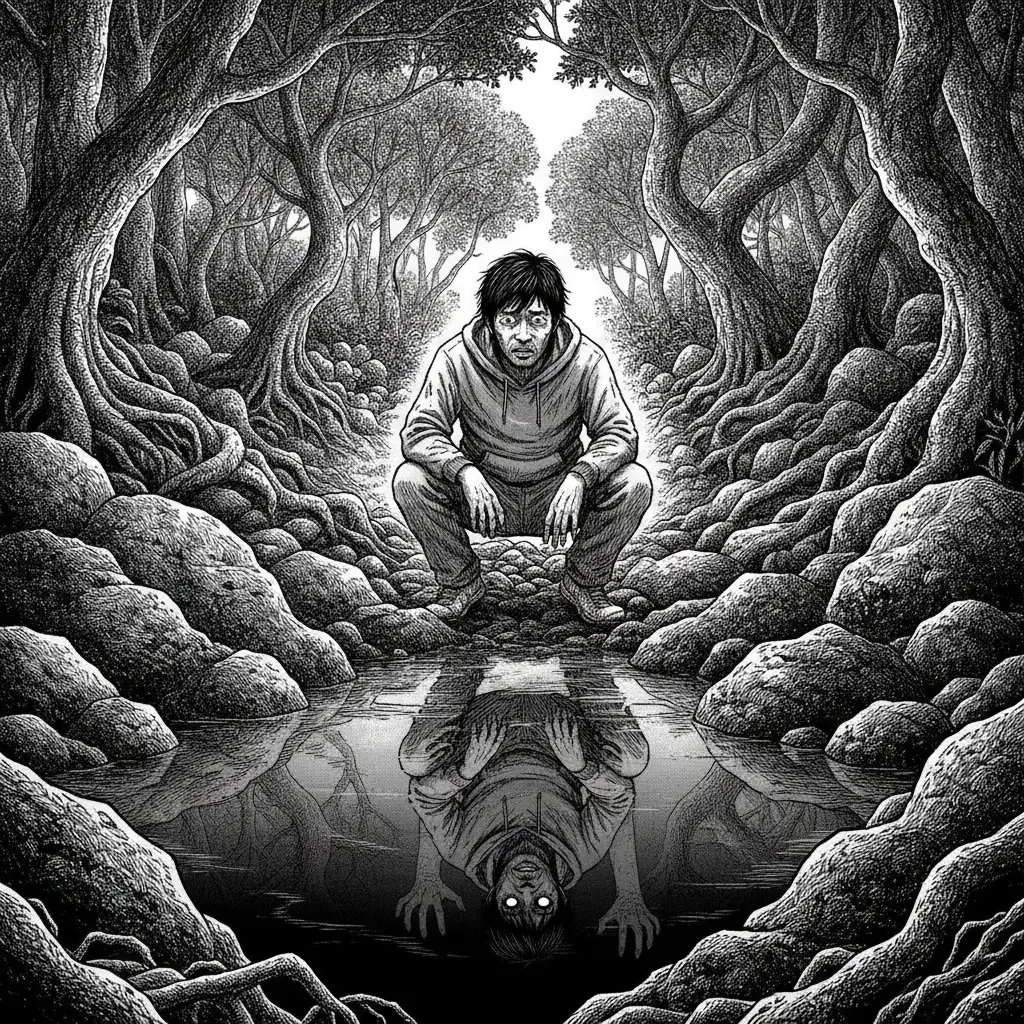
On the tenth day he went back into the forest. Deeper this time. Without meaning to. Past the clearing, and beyond. The interior of the Gotjawal was far quieter than the edges. No wind. No sound. The basalt underfoot grew larger, and the roots of the trees tangled more and more densely around it. From somewhere came the faint sound of water. He followed it. He found a place where water had pooled above a lava tube — a surface as flat and still as a mirror. He crouched before it and looked down.
His face looked back at him. But — wait. He blinked. The face in the water was not his. The outline was the same, but the expression was different. He knew he was wearing a look of shock; the face in the water was smiling. Slowly, unmistakably. Hyeonsu lurched to his feet and stepped back two paces. His heart hammered against his ribs. He looked again. This time his own face looked back — startled, pale.
He ran. Properly ran. He didn't think about direction. He only wanted distance. Branches tore at him, his foot caught on a rock and he went down, his knee split open and bled. He ran anyway. And then — the gravel path appeared. He dropped to his knees on the gravel and gasped for air.
Back at the house, he cleaned his knee and sat on the sofa for a long time, thinking. It had been an optical illusion. Reflections on water distort in strange ways. What had looked like a different expression was only the surface moving. But no matter how many times he told himself this, one thing would not be erased: the face in the water had been smiling. And that smile — it had not been unfamiliar. He had seen it somewhere before. He couldn't place whose smile it was, and that frightened him more than anything else.
That night he did not dream. Instead he woke at two in the morning — not because of any sound, but because something felt different. The air inside the house had changed. It was damper than it had been in the day, and colder. And there was a smell. Moss. Rotting wood. And beneath those, the older smell underneath. The smell of the Gotjawal. Inside the house. Hyeonsu got up and turned on the lights. Nothing. The windows were closed. The door was locked. And yet the smell was there.
He moved slowly through the room. Nothing. Then something caught his eye. On the floor there were marks — dark smears of what might have been mud or moss, trailing from the entrance toward the room. Like footprints. Like a person's footprints, except the shape was slightly wrong. The toes too long, or the proportions somehow off. Hyeonsu looked down at his own feet. He was wearing socks. The marks had been made by bare feet.
He did not sleep that night. He sat on the sofa with every light on, watching the door, waiting for morning. When morning comes, he told himself, I will pack my things. This time for certain.
Morning came. Hyeonsu packed. Or rather: he took out his bag with the intention of packing. Then his hands stopped. He felt it — not his will stopping, but his body stopping. He looked at his hands. They were holding the strap of the bag and doing nothing. He gave them a command: open the bag. They didn't. He commanded again, harder. Only then did his hands move — slowly, as though pushing through water — and open the bag.
In that moment he understood. Or believed he understood. The ten days of being pulled back into the forest, the resolutions that dissolved each morning, the fact that he had run and still come home — none of it had been a matter of will. Something was holding him. The old woman's words came back to him. A person with a hole in them. A person with an empty place. It wants to fill that place, in its own way.
And then something else connected. The smiling face in the water. The smile he had never been able to place. He closed his eyes. He pushed at the memory, forced it. And then it came. The smile was his own. His face when he had been happy. The first time he and his fiancée had traveled to Jeju together. The time he had taken a photograph with his mother. That face. The Gotjawal had shown it to him. His lost self. As its way of filling the empty place.
He put his things into the bag. Slowly, one by one. His hands did not resist. This time they didn't resist. That frightened him more than anything.
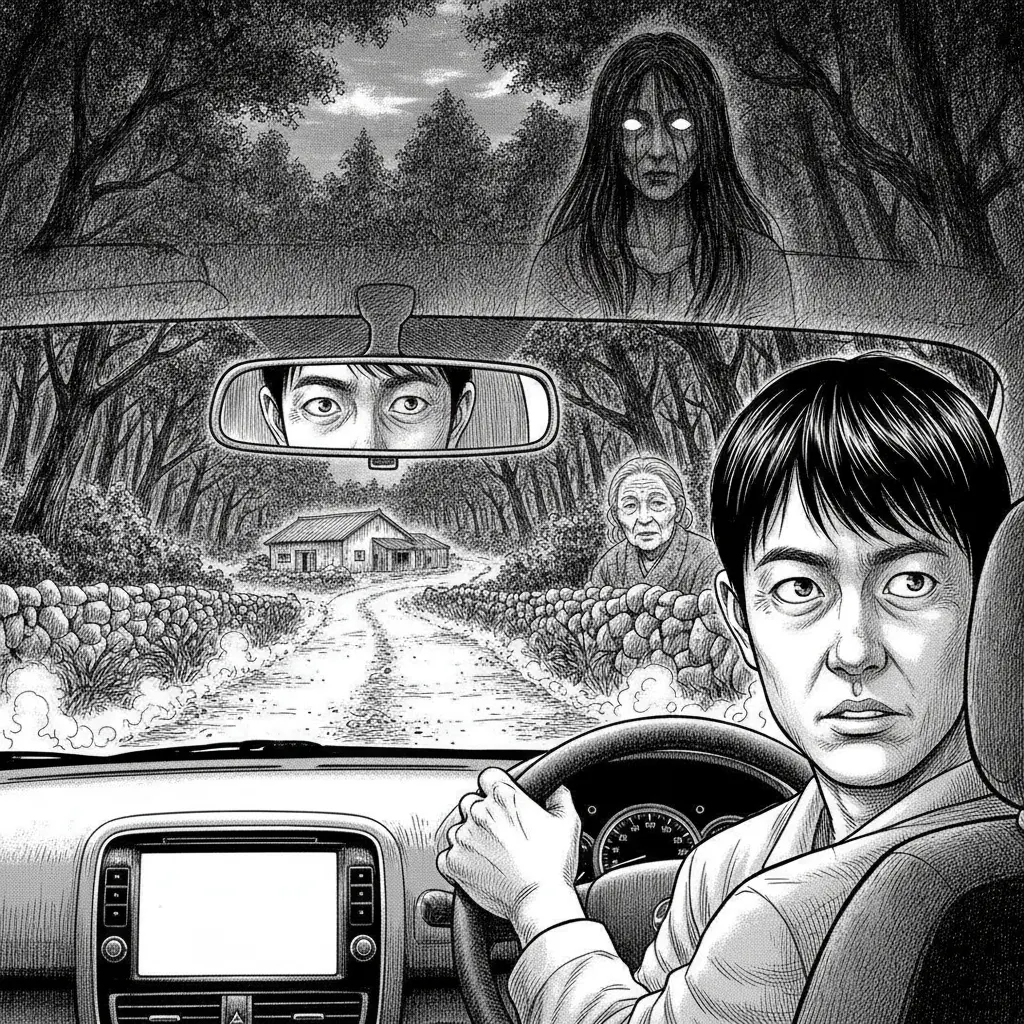
As he drove out along the gravel road, Hyeonsu glanced in the rearview mirror. The farmhouse was shrinking behind him. Behind it stood the Gotjawal — dense, dark, and still. He looked away from the mirror. He faced forward and drove.
At the airport he printed his boarding pass. Seoul Gimpo, departing in two hours. He sat in a café and drank coffee. His hands trembled slightly. Through the window, the Jeju sky was clear.
The plane lifted off. Jeju shrank below — a green island, black coastline, and inland the dense dark masses of green: the Gotjawal forests. Hyeonsu turned from the window. He was about to close his eyes when he stopped.
There was a notification on his phone. Photos taken a few days ago — an automatically generated memory album. He opened it without thinking. Images of the forest. Things he had photographed inside the Gotjawal. Trees, basalt, moss. And then — the clearing. The offerings on the stone. He was about to swipe past it when he stopped.
There was a person standing beside the basalt in the photograph.
Hyeonsu had been alone when he took that picture. He was certain he had been alone. The figure in the photograph was facing toward him, but the face was not visible. Not because of the light. The space where the face should have been was simply empty. And the figure's hand was raised — extended toward Hyeonsu, toward whoever was holding the camera, as though reaching out.
Hyeonsu closed the photo. He put the phone in his pocket. He looked out the window. Jeju was gone now, swallowed beneath the clouds.
He closed his eyes.
And in the moment of closing them, he felt it — in the darkness, faint but unmistakable. The tips of his fingers were warm. As though someone were holding them. He did not look down at his hands. He knew, without knowing why, that he must not look.
The plane flew north. Hyeonsu's hands rested in his lap. The air around them was cool. And very faintly, there was the smell of moss.