

The Figure on the Foggy Slope
AI AI-generated fiction — text, and any narration or images. Unrelated to any real events, people, organizations, or places.
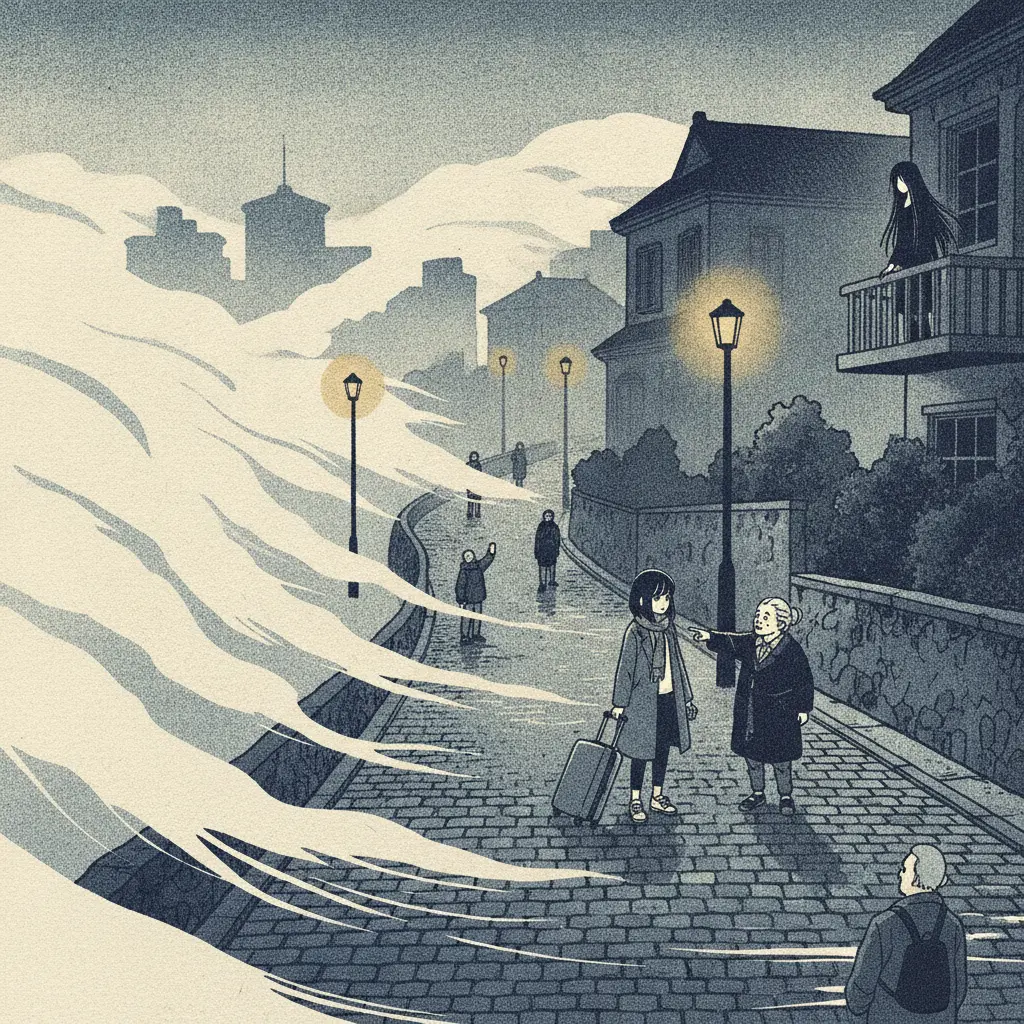
October in Nagasaki is the season when wind off the sea slicks the cobblestones wet. On the slopes of Higashiyamate, the fog thickens with particular intent as that season settles in. White mist rolling in from beyond the harbor pools each evening around the middle of the hill, bleeding the light from lantern-style streetlamps into soft halos, dissolving the edges of old Western-style houses into vagueness. Tourists call the scene "exotic" and lift their smartphones toward it, testing the feel of the stones beneath their feet as they climb and descend. It was at the very beginning of that season that Kirishima Kaho moved to the slope.
When Kaho left her publishing job in Fukuoka and decided to work as a freelance proofreader, choosing Nagasaki was half impulse. A memory had lingered in some corner of her mind since a single visit during her university years — that slope in Higashiyamate, the narrow lane of cobblestones and brick walls, the Western mansion standing partway up, the harbor lights that must be visible from its windows. Her stated reason for wanting to work somewhere away from the noise of the city was plausible enough, but the truth was that she had felt the quietness of that slope calling to her.
She rented a room in an old two-story building at the edge of the former foreign settlement in Higashiyamate. The structure had apparently begun its life as a Meiji-era Western mansion and been converted into rental housing, though traces of its origins remained in the window frames and the construction of the hallways. The young man from the real estate agency remarked that it was an unusual choice for a woman her age, and as he handed over the key, he offered a single caution. "Please be careful going down the slope at night. The steps are uneven." Kaho nodded and thought nothing of it — but later, whenever she turned the words over in her mind, she would remember how his gaze had slipped, just for a moment, toward somewhere else entirely.
The first week after moving in was consumed entirely by the effort of adjusting to life on a slope. Grocery runs, trips to the post office — everything required climbing or descending. The cobblestones grew treacherous in the rain, and on foggy nights the ground beneath her feet all but vanished. Even so, Kaho loved looking out at the slope in the morning light. Weeds pushed up between the stones, ivy wound along the brick walls, and the harbor glittered beyond the crest of the hill. The view was genuinely beautiful.
The trouble began about ten days after she moved in.
Kaho had been working late into the night on a manuscript. Outside the window, the fog had turned the air white, and the streetlamp's glow spread in a soft, wet circle. When she went to the kitchen for water after finishing, she found herself glancing out the window. The slope visible from the second floor was submerged in fog, its cobblestones barely discernible as pale shapes in the murk. Standing on those cobblestones was a figure.
It was past one in the morning. The figure stood at the middle of the slope, precisely where the streetlamp's light failed to reach. It appeared to be a woman. She wore dark clothing and stood with her back to the window. Kaho's first thought was that it was someone making their way home after a night of drinking. But the figure did not move at all. The fog shifted in the wind, the streetlamp flickered, and still the figure stood motionless as a stone carving. Kaho stepped back from the window, returned to her room, and got into bed. When she woke before dawn and checked the window again, the slope was empty.
The next day, Kaho walked the slope and the surrounding streets under the pretense of a stroll. In the daylight, a handful of tourists were on the hill, photographing and feeling the stones underfoot. Kaho walked to the spot where the figure had stood the night before. There was nothing remarkable about it — cobblestones, an old brick wall, trees growing thick on the other side of the wall. But when she stood in that spot, she felt something strange move through her spine. It was not quite cold. It was more like something beneath the surface of her skin contracting.
From that night on, Kaho's sleep grew shallow.
It was not that she could not sleep. If anything, she slept deeply. The problem was the dreams. Every night she stood in the same place. She was at the bottom of the foggy slope, looking up. The cobblestones stretched ahead of her, and at the top of the hill something waited. Even in the dream she could not see what it was — it had no clear outline, no fixed shape. And yet the dreaming Kaho walked toward it. No matter how many steps she took, the distance never closed. She woke each time drenched in sweat.
A week later, Kaho spoke with an elderly woman she had come to know at the grocery store at the bottom of the slope. The woman's name was Eguchi, and though she was nearly eighty, she was sharp and vigorous, and she said she had been born in this town and never left it. When Kaho mentioned she had moved to the Higashiyamate slope, the old woman paused before asking, "Which part of the slope?" When Kaho described the location, the old woman gave a small nod, then started to say something and stopped herself. "What is it?" Kaho asked. The old woman smiled and said, "Nothing at all." The smile was slightly wrong.
Kaho found herself thinking about the old woman and returned to the shop the following day. Eguchi was there but did not raise the subject herself. When Kaho brought it up again, the old woman considered for a moment before speaking. "There has always been someone who stands on that slope at night. Since long ago. My grandmother's time, too — there were stories." Kaho told her about the figure she had seen. The old woman's expression did not change. "It would have been better not to have seen it," she said. "And now that you have — do not speak to it. Whatever you do." With that, she changed the subject.
That night, Kaho resolved not to look out the window. But sometime after two in the morning, a sound in the hallway woke her. Old buildings creak — she told herself that, and yet she found herself already standing in the hallway, already looking out the window at the slope below.
The figure was there. Standing in the same spot, back turned in the same way. The fog was thinner tonight, and the outline was sharper than before. A woman in dark clothing. Long black hair. Perfectly still. Kaho held her breath and watched. A minute passed, then two. The figure did not stir. Then Kaho caught a glimpse of her own face reflected in the glass. She registered it, looked back at the slope.
The figure had turned to face her.
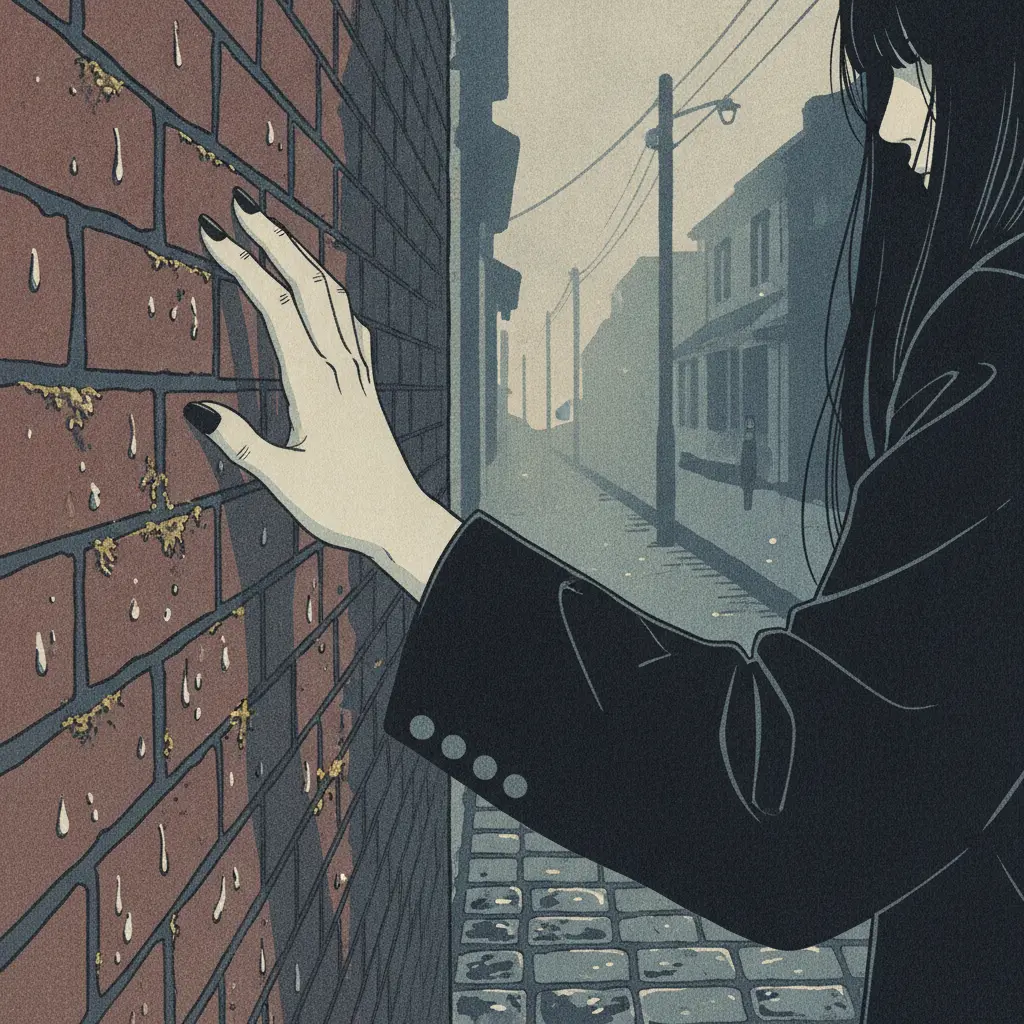
The distance was too great to make out a face. But there was no question — the upper body had turned toward the window. Kaho tried to step back and found she could not move her feet. The figure began to walk, slowly, across the cobblestones. Not up the slope — sideways, along the brick wall. When it reached the wall, it stopped. It stood facing the wall. That was all. Kaho remained frozen where she was until she realized, at some point, that the figure was gone. It had vanished without her noticing.
The next morning, Kaho could not sleep past noon.
Exhausted, she reasoned with herself. There was nothing strange about a person walking a slope at midnight. There were optical illusions, tricks of the light. But the old woman's words — do not speak to it — would not leave her. What kind of situation would lead to speaking? Did that mean there were circumstances in which one might come close enough to speak?
That afternoon, Kaho went to the library and looked into the history of Higashiyamate. She read through materials on the establishment of the foreign settlement, the Western-style architecture of the Meiji period, records pertaining to the slope. Most of it was written for tourists. But in one old volume of local history, she found a single paragraph that gave her pause. From the Meiji era through the early Showa period, the slope had been the site of multiple deaths of unidentified individuals. The causes were unknown. In each case, the body had been found near the brick wall at the middle of the slope. The record offered nothing more — no context before or after.
From that night on, Kaho began keeping a diary. If something was happening, she felt she ought to document it. But when she actually sat down to write, she did not know what to put. She had seen a figure. That was all. Was that sufficient grounds for fear? She began to doubt her own perceptions. The stress of moving, the solitude, the irregular sleep — these were the kinds of things that made people see strange things in the night.
But four days later, something changed.
That evening, Kaho had been out. She had eaten dinner with a woman her own age who lived nearby, at an izakaya at the bottom of the slope, and the night had run late. She was climbing the cobblestone slope alone. The fog was thin, but the stretches between streetlamps were dark, and the ground was difficult to see. She pressed each foot carefully against the stones as she climbed.
Partway up the slope, Kaho stopped.
Someone was standing in front of the brick wall. Back turned. Kaho's breath caught. What she had been watching through glass for days was now on the same slope, no more than ten meters away. Dark clothing. Long black hair. Motionless. Kaho began to ease herself backward. At that moment, the figure slowly turned around.
It had a face.
An ordinary woman's face. She appeared to be in her thirties. Pale skin, large eyes, a faint expression around the mouth — whether it was a smile or something else entirely, Kaho could not determine. The woman was looking at Kaho. Simply looking. She said nothing.
Kaho could not move. The old woman's words cycled through her mind. Do not speak to it. But the woman said nothing. She only looked. And there was something about that gaze that was unlike any gaze Kaho had ever felt directed at her. It had no depth. The pupils had no depth. They caught the light, but the light stopped at their surface, as though it had nowhere further to go.
She did not know how much time passed. When Kaho became aware of herself again, she was running up the slope. She ran and ran, threw herself into her room, and locked the door. Her back was soaked through. She crouched where she stood, gasping, her whole body shaking.
The next morning, Kaho called the old woman, Eguchi. The shop's number was posted on the wall. Eguchi answered immediately. When Kaho described the night before, the old woman was silent for a long moment. "Did you see her face?" she asked. Kaho said yes. Another silence. "Did you speak to her?" "No." "Did she say anything to you?" "Nothing." The old woman let out a small breath. "That is good," she said. "But," she continued, "now that you have seen her face, she may come again."
"What is it?" Kaho asked. "What is that thing?"
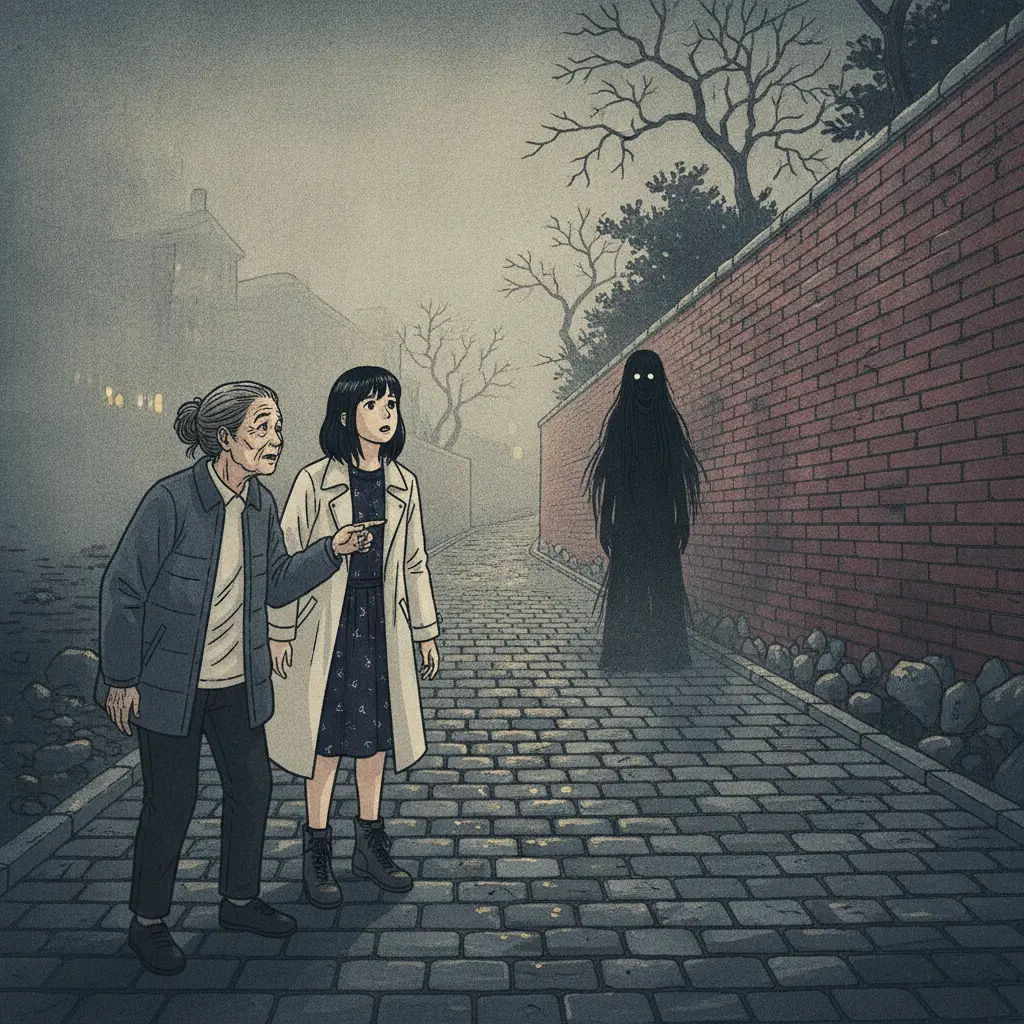
The old woman took her time before answering. "My grandmother used to tell a story," she said slowly. "Long ago, a woman died on that slope. A woman with no name, no known origin — she was found dead in front of that brick wall. When it happened, no one could say. But my grandmother said the woman had been unable to climb the slope. Something had prevented her from reaching the top, though she needed desperately to get there. And so she is still there, standing at the middle of the slope." The old woman paused. "My grandmother said never to speak to her. She said if you spoke to her, she would take you with her."
"Where?" Kaho asked.
"That, I don't know," the old woman said. "Only that those who spoke to her were found the next morning collapsed in front of that wall. Some were still alive, but they would not wake. Some of them died. The ones who did wake remembered nothing."
After she hung up, Kaho paced her room. She considered moving out. At the same time, she considered whether the old woman's story was worth believing at all. It might be nothing more than local folklore, legend. The figure on the slope at night might simply be a person — someone whose manner happened to be unsettling. Kaho swung back and forth between the rational part of herself and that contracting sensation beneath her skin.
That night, Kaho did not look out the window.
Two days passed without incident.
On the third night, she dreamed.
The slope again. The fog again. But this time it was different. Kaho was looking down from the top of the hill. At the bottom stood the woman, back turned. The dreaming Kaho watched that back in silence. Then the woman began to climb. One step, then another, pressing each foot into the cobblestones as she came. The dreaming Kaho could not move. The woman drew closer. The woman raised her face. And the face was Kaho's own.
She woke.
The room was dark. Kaho lay rigid in her futon, staring at the ceiling. Her heart was hammering. From outside the window, she thought she heard footsteps. The sound of feet on cobblestones. One step, then another, climbing the slope. She listened. The sound continued. It went on, and on, and passed in front of her room, and stopped at the entrance of the building.
Then came a knock at the door.
Once.
Twice.
Three times.
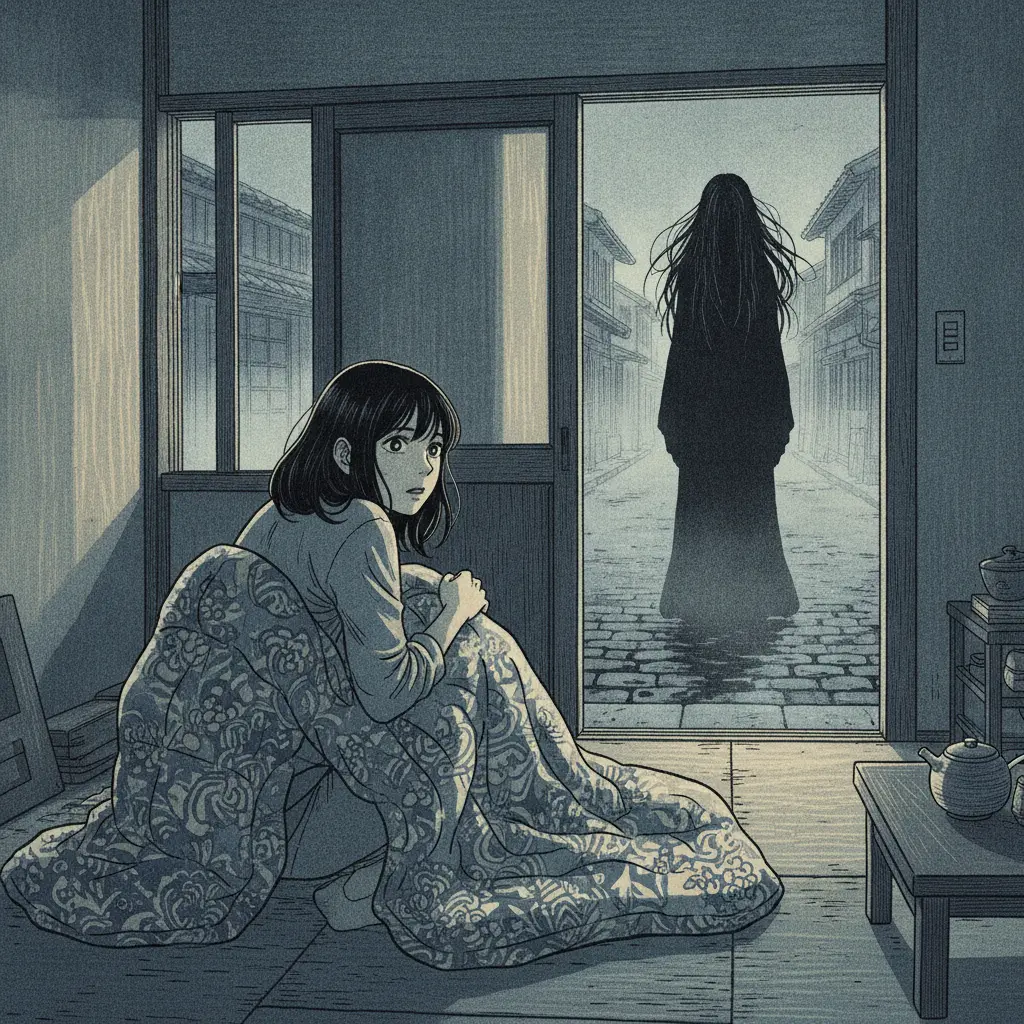
Kaho held her breath inside the futon. There was nothing there, she told herself. She tried to believe it. The knocking had stopped. A silence stretched out. She let her breath go slowly.
Then the floorboards of the hallway creaked.
Just outside her door.
Kaho could not make a sound. She could not move. A thin line of light from the hallway seeped in under the gap at the bottom of her door. Into that light, a shadow fell. Something was standing on the other side of the door. The shadow did not move. Kaho pulled the futon over her head and closed her eyes. Do not speak. That was the only thought she held.
She did not know how long it lasted. It might have been an hour. It might have been three. At some point, without knowing when, she found herself in morning light. Birds were singing. Sunlight through the window lay bright across the wall. Kaho slowly emerged from the futon and opened the door. The hallway was empty.
But on the hallway floor, there was a faint trail of mud.
Fine, dark mud — the kind that collects in the gaps between cobblestones. It led to the door of Kaho's room and ended there.
That same day, Kaho packed most of her belongings into cardboard boxes. She called a moving company and arranged for pickup the following week. She notified the real estate agency of her departure. She went down the slope to say goodbye to the old woman, Eguchi. Eguchi looked at her face and asked nothing. She said only, "Good." Kaho told her about the mud in the hallway. The old woman nodded. "You didn't speak?" "I didn't." "Then it is well." The old woman said nothing more.
On the last night before the move, Kaho allowed herself one final look out the window.
The slope was quiet. Thin fog drifted across it, and the streetlamp cast its light over the cobblestones. There was no figure. The space in front of the brick wall was empty. Kaho felt a small loosening of relief. She was reaching to close the window when something caught her eye — a pale, thin shape among the trees on the other side of the wall. Between the trunks, something white and narrow. Whether it was a human arm or a branch with something caught around it, she could not tell from that distance.
Kaho closed the window.
The next day, she left Nagasaki. She returned to an apartment in Fukuoka and resumed her work as before. She told no one about the slope in Higashiyamate. The dreams continued for a while — the foggy slope, the cobblestones, the woman's back receding into the mist. Gradually they faded. Three months passed, then six, and Kaho found she almost never dreamed of it anymore.
But one thing did not go away.
On the morning she left Nagasaki, Kaho stood before the entryway mirror to put on her shoes. Looking at her own reflection, she felt for just a moment that something was wrong. She could not identify what. The face was her face. The eyes, the nose, the mouth — all exactly as they had always been.
Only she could not be certain whether the depth behind her pupils was the same as it had been before.