

The Direction of the Alley in Yangnim-dong
AI AI-generated fiction — text, and any narration or images. Unrelated to any real events, people, organizations, or places.
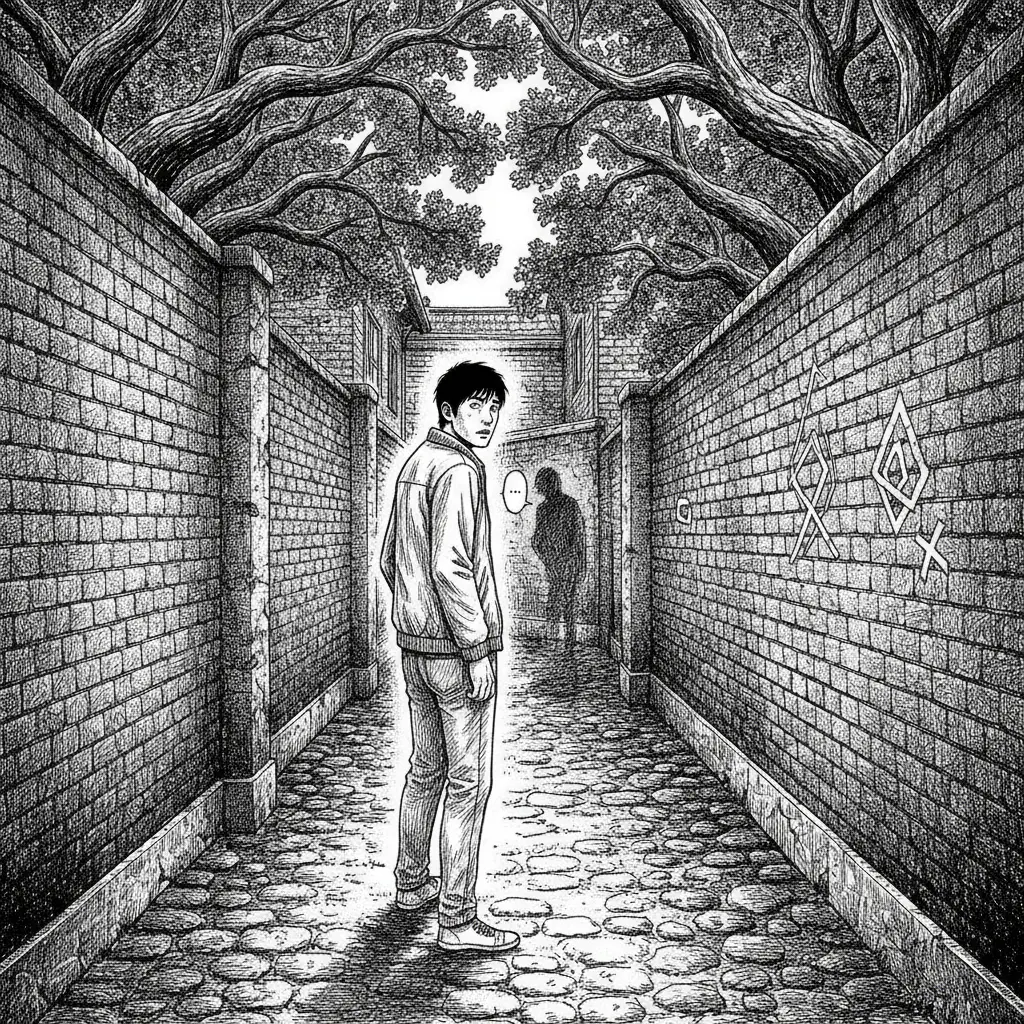
Yangnim-dong in mid-February is cold even in daylight. The tourist pamphlet had described it as "an alley where modern history breathes and lives," but what Jeong-u felt the first time he walked those streets was not breath — it was stillness. A sensation as though time had stopped, or perhaps as though time had never passed at all. The particular silence created by the narrow lanes and red-brick walls of 1920s missionary houses was so complete, so dense, that it was nearly impossible to believe the city center lay only a few blocks away.
Jeong-u was a freelance journalist on assignment for a magazine covering urban renewal projects. His editor had told him to "capture the present face of Yangnim-dong's historic alleys," and Jeong-u had booked two nights at a small guesthouse near the entrance to Penguin Village. When the elderly proprietress handed him his key at check-in, she added just one thing: "Please don't go too deep into the alleys after dark." Jeong-u let the words wash over him, taking them for the kind of worn caution that tourist neighborhoods always seemed to offer. He didn't notice that her gaze lingered on him a moment too long.
The first day went smoothly. Jeong-u climbed and descended the hills of Yangnim-dong, pressing the shutter of his camera. The stone wall of the Yi Jang-u House, the wooden window frames of the Uil-seon missionary residence, the handwritten signs posted at every corner. In the afternoon light, the old buildings were quietly beautiful. Tourists drifted through the mural-lined lanes, and music from a nearby café drifted low against the walls. Jeong-u filled his notepad with impressions and exchanged brief words with a few elderly residents. Nothing seemed wrong. Nothing seemed wrong when he returned to the guesthouse after dinner, either. It was only in the shower that it occurred to him — not a single person had appeared in any of the day's photographs. He had spoken with residents. He had passed tourists. He took out his camera and checked. It was true. Every place where a person should have been, there was only the alley. Nothing was blurred. They were simply gone.
The next morning Jeong-u set out early, intending to explore the deeper lanes he hadn't reached the day before. From the outside, Yangnim-dong's alleys appear simple enough, but once inside they fold into one another like a maze. Narrow passages between walls bend without warning; a turned path leads either to a dead end or opens suddenly in an entirely different direction. Jeong-u kept his map application running, but the satellite signal kept cutting out inside the alleys. He walked all morning, filling his notepad and taking photographs. Icicles hung from the eaves of old tiled rooftops, and moss-covered stone steps were pale with frost. Somewhere a bird called once, and then was not heard again.
Around two in the afternoon, Jeong-u stopped before an alley he didn't recognize. It appeared on no map. Set slightly apart from Yangnim-dong's main paths, it was a passage flanked on both sides by long stretches of red-brick wall. Tree branches reached over the tops of the walls and blocked the sky, and because of this the interior was dim despite the hour. At the entrance stood an old wooden utility pole, and fixed to it was a small piece of paper. The paper was aged, its corners curled, but the characters written in ink were clear. To those who enter: this path, once entered, causes you to forget the direction of the way out. Take care. There was no date. Jeong-u photographed the paper with his camera and stepped into the alley. It seemed like good material.
For the first ten meters or so, there was nothing. Only walls and dry fallen leaves. But at roughly twenty paces in, Jeong-u noticed something wrong with the sound of his footsteps. The way they echoed off the walls was different from every other alley he had walked that day. The sound returned too slowly — as though the passage were far wider than it appeared, or as though there were nothing at all beyond the walls on either side, only empty space. Jeong-u stopped and pressed his palm flat against the brickwork. The wall was cold. Not merely cold — the moment his hand made contact, a chill climbed through his knuckles sharp enough to make them ache. Far colder than the February air outside. He pulled his hand away. He felt his pulse quicken, but he kept walking.
The alley bent once. At the bend stood the remains of a dilapidated Japanese-style wooden house. The roof had half-collapsed, and where the windows had been there was no glass. But the darkness inside those empty window frames was of a particular quality. It was natural for the interior of a ruined house to be dark, but this darkness was different — as though no daylight penetrated it at all, as though it were simply and completely black. Jeong-u raised his camera, switched on the flash, and pressed the shutter. In the instant the flash fired, in that fraction of a second of white light, Jeong-u felt that something was inside the window frame. The light died before he could make out a shape. He opened the camera's screen. The window in the photograph was simply dark. Nothing there. And yet the skin at the back of his neck prickled and rose. The certainty that he had seen something remained more vivid than the photographic evidence of nothing.
He passed the house and walked a little further, and then he heard it. Footsteps. Not his own. Coming from behind him, from the direction he had walked. Steady and slow. Jeong-u turned. The alley was empty. The footsteps continued. He stood still and listened. They were growing closer. And yet there was nothing to see. He walked forward quickly. The footsteps quickened with him.
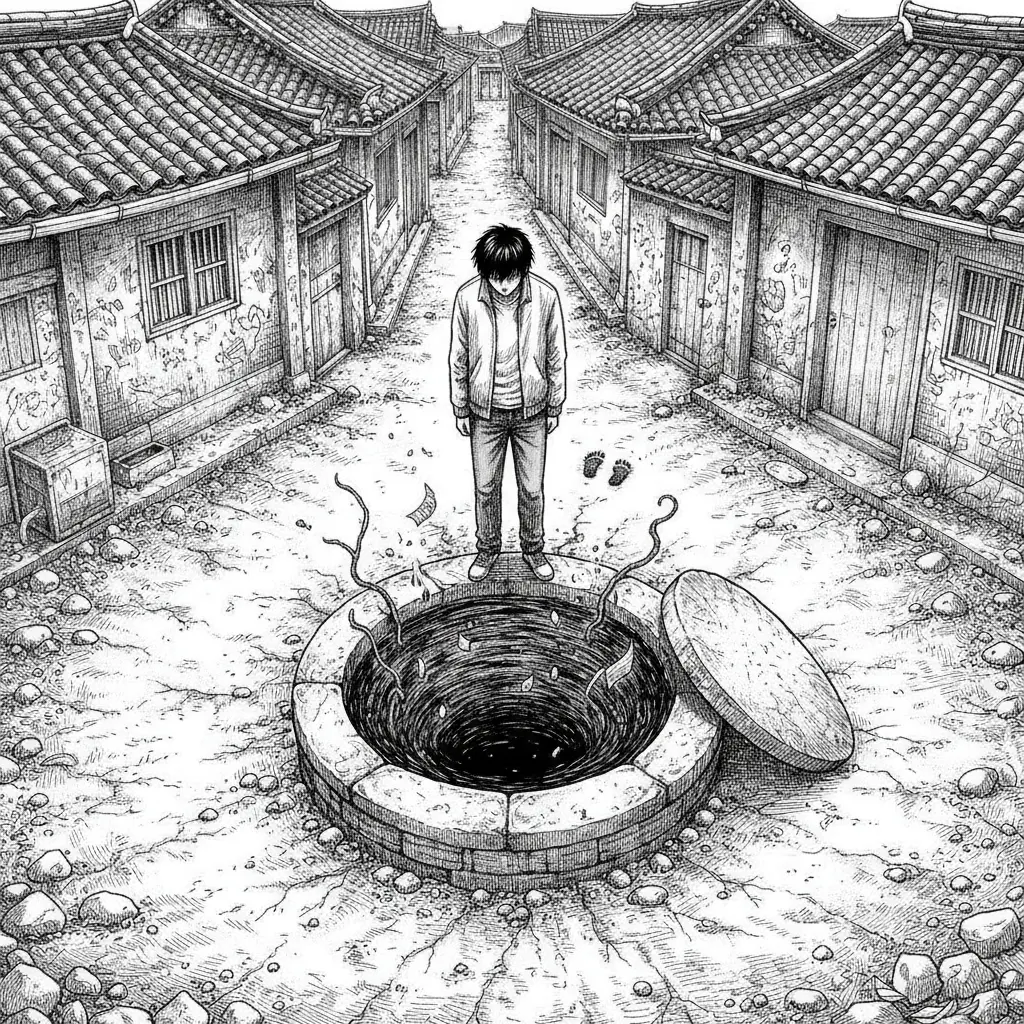
The alley bent again, and beyond the bend opened a small vacant lot. In the center of the lot stood an old well. It had no cover. Jeong-u stopped at its edge. The footsteps stopped. There was no one else in the lot. He looked down into the well and could not see the bottom. There was no water — or rather, it was too dark to know whether there was water or not. Wind rose from inside the well. Not downward, but upward. And the wind carried a smell. Earth and old wood, and beneath those, the smell of aged paper. It was a familiar smell, though Jeong-u could not immediately place where he had encountered it before.
As he searched for a way out of the vacant lot, Jeong-u understood for the first time that he was lost. Three alleys led away from the lot, and he could not tell which direction he had come from. His phone's map showed no signal. He chose the alley that looked brightest and walked, checking the time as he went. Half past two. Several hours remained before dark. He told himself this quietly and kept moving.
But as he walked, he began to notice things fixed to the walls. He had passed them without seeing at first, but once one caught his eye, he could not stop seeing them. Small pieces of paper, placed low on the walls at intervals, each bearing characters written in ink. Most were too old and faded to read. But several were still legible. I entered fifteen years ago. I grew tired of searching for the way out. This alley has no direction that leads out. Jeong-u's feet went cold. He read the next one. To whoever reads this path: do not enter the house beside the well. He raised his head and looked around. He was standing before the half-collapsed Japanese-style house. The same house. He had taken a different direction entirely, and yet here he was again, in front of the same building.
Jeong-u took out his phone and stared at the screen. No signal. The time read three o'clock in the afternoon. Thirty minutes had passed, but the sun had already dropped considerably. February days in Gwangju end early. Shadow began to press into the alley from all sides. Jeong-u started walking again. This time he ran. The alley bent, and bent again, and a dead-end wall appeared, and then a narrow passage opened. He was breathing hard. He was sweating. And then he stopped. Carved into the brickwork of the wall — not on paper, but directly into the brick, scratched with a fingernail or something sharp — were words. Running makes no difference. You stay in the same place.
Jeong-u sank to the ground where he stood. His legs had given out. He steadied his breathing and opened his camera. He went through the day's photographs from the beginning. The paper at the alley entrance, the ruined house, the well, the papers on the walls, the vacant lot. He reached the photograph of the vacant lot and stopped breathing. Standing in one corner of the lot was a person. There had been no one there when Jeong-u stood in that space — he was certain of it. The figure stood with its back against the wall, its face turned toward the camera. It was too far away and too dark to make out features clearly. But the posture — back pressed flat against the wall, arms hanging at the sides — looked like waiting. Jeong-u enlarged the image. The face came slightly clearer. Where the eyes should have been, there were no eyes. Only skin. Smooth, unbroken skin.
At that moment, footsteps sounded behind him.
Close this time. Close enough to be directly at his back. Jeong-u spun around. The alley was empty. But the air of that empty alley was different. It was warm — warm in the way air is warm when someone has just been standing in it. A warmth that had no place in a February alley. Jeong-u rose slowly to his feet. His knees were shaking. He looked ahead. The alley continued. He looked behind. The alley continued. On both sides, the same brick walls, indistinguishable from each other. He no longer knew which direction was forward, or which way he had come running from.
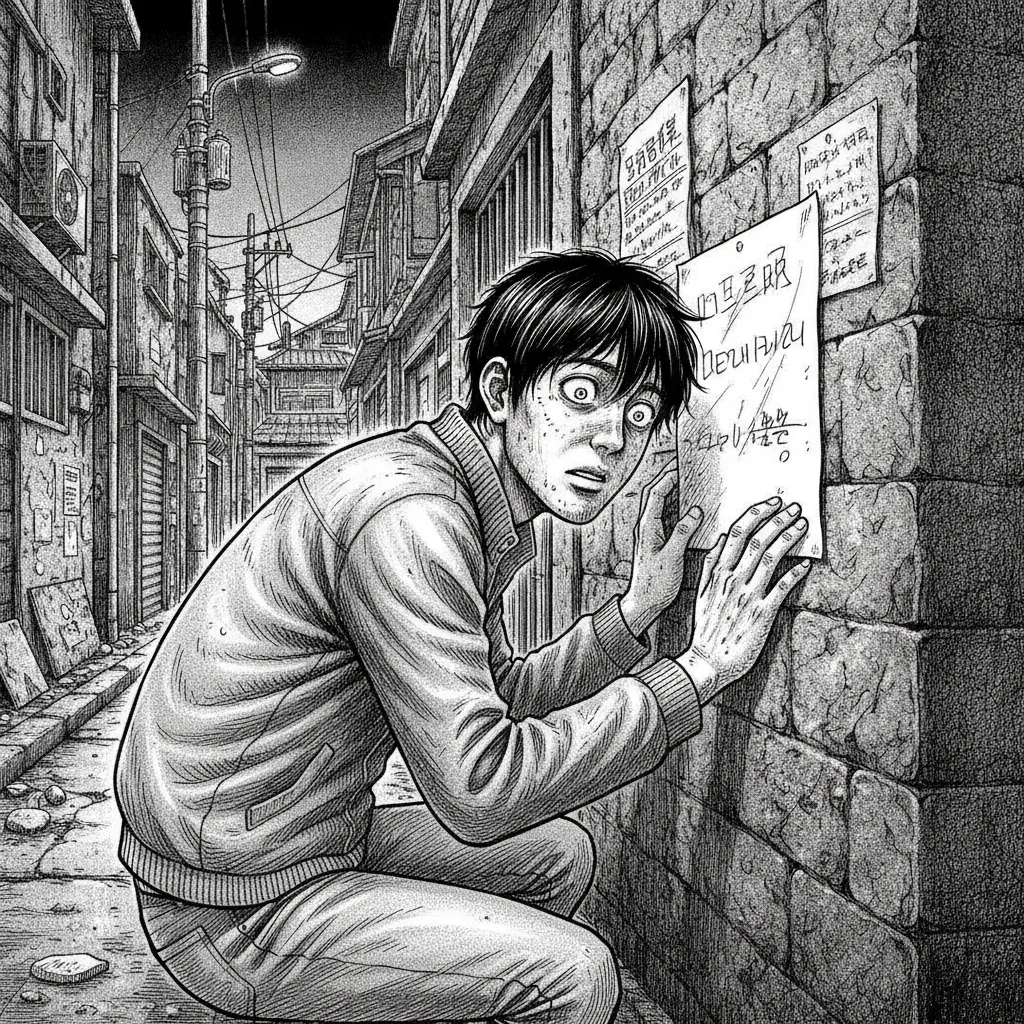
Jeong-u covered his face with both hands. He breathed in deeply. He opened his eyes. There was another piece of paper on the wall. This one was different from the others — it was new. White and clean, the writing done not in ink but in ballpoint pen. Jeong-u brought his face close to it. The handwriting was familiar. Deeply familiar. It was his own. The paper read: It may feel as though you have already left. You have not. And below that, a date. Today's date. And a time. Two forty in the afternoon.
Jeong-u tore the paper from the wall. His hands were shaking. There was writing on the back as well. When you first entered this alley, do you remember who was beside you?
Jeong-u searched his memory. He had been alone. He was certain he had entered alone. But the more he thought about it, the more his certainty wavered. Just before he had stepped through the entrance, standing at the old utility pole — a sensation crept in that someone had been beside him. Whether it had truly been there or whether this place was manufacturing the feeling, he could no longer tell. He tried to push the sensation away. The harder he pushed, the clearer it became. At the entrance, just off his left shoulder, something had been standing. Small. The height of a young child. And it had let Jeong-u enter first, then followed him in.
Jeong-u took out his phone. No signal. But there was a text message. The sender was listed as Yangnim-dong Guesthouse. It was from the proprietress. The key return time has passed. Guest, where are you now? The message had been received at six fifteen in the evening. Jeong-u checked the clock on his screen. Six twenty. Without his noticing, it had grown dark outside. The darkness inside the alley came down from all directions at once. There were no streetlamps. Jeong-u switched on his flashlight app.
In the light, the alley came back into view. And it was then, for the first time, that Jeong-u noticed a door. A door he had not seen in all the dozens of times he had passed through these lanes. An old wooden door, its paint peeling, the color of faded teal. In front of the door sat a small pair of shoes. A child's shoes. One pair. Old shoes, the toes caked with dirt. Jeong-u looked at those shoes and took two steps back.
The door opened. From the inside, slowly.
There was no one there. Beyond the door was a small room. Earthen floor, collapsed rafters, dust. And in the center of the room, a single old desk. On the desk lay an open notepad. Jeong-u's notepad. The notes he had taken during the day's work, filled with his own handwriting. Jeong-u checked his bag. The notepad was gone. He had no idea when it had left his possession. He walked to the desk and picked it up. The open page held the notes he had written that day. But on the last line was a sentence he had no memory of writing. In his own hand.
No one has left this alley yet. There are those who have felt that they left. There are none who actually have.
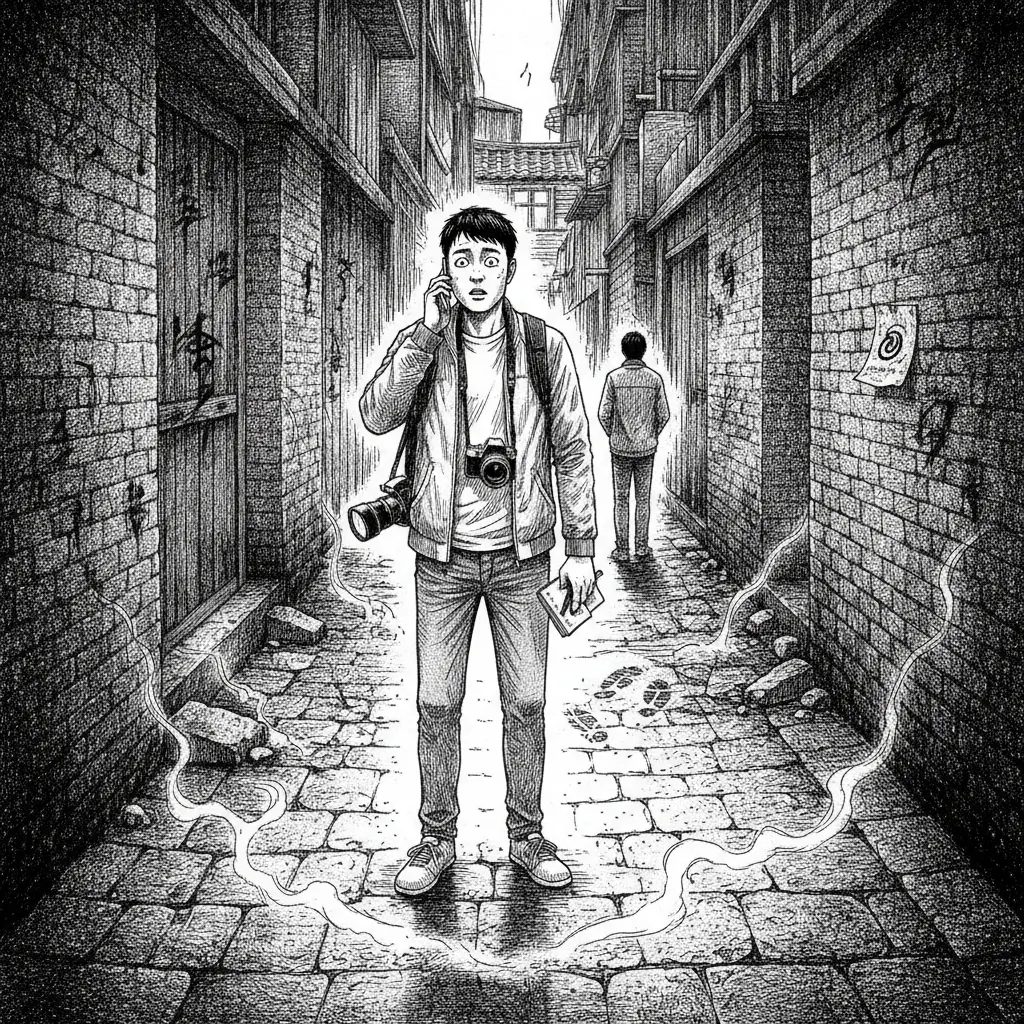
At that moment, Jeong-u's phone rang. It was the proprietress. He answered. "Hello." Her voice came through. "Oh my — guest, are you in the room? Your key is here at the counter." Jeong-u couldn't speak. "Pardon?" "You checked out earlier. You left your key. You took all your things." Jeong-u looked down at his bag. The bag was there. The camera was there. The hand holding the notepad was there. "I'm in the alley right now," he said. A brief silence. The proprietress's voice dropped slightly. "Guest. What time is it there?" "Six twenty." Another silence. "Guest," she said. "It's eleven o'clock at night here."
The call ended.
Jeong-u looked at his phone screen. The clock read six twenty-one in the evening. There was no signal. There was no trace of a call having come in. No missed call. No call log. Jeong-u stood in the room, inside the beam of his flashlight. The darkness beyond the light was thick and absolute. He walked toward the door. It was still open. The alley was visible. He stepped over the threshold and back into the lane. He began to walk. The alley bent, and walls continued, and it bent again. And then, without warning, the alley ended. A familiar street appeared. Streetlamps. People passing. The outer road of Yangnim-dong.
Jeong-u stood on the road and turned to look back. There was the alley entrance. The old wooden utility pole, and a single piece of paper. He walked close and read it. It was the same paper he had read at the beginning. To those who enter: this path, once entered, causes you to forget the direction of the way out. Take care. Jeong-u turned away. People passed. The streetlamps were lit. He took out his phone. Signal. The time was six twenty-three in the evening. No missed calls. Jeong-u walked back to the guesthouse.
The proprietress was at the counter. She looked up when she saw him. "Welcome back." An ordinary greeting. Jeong-u took his key and went up to his room. He set down his bag and switched on his camera. He went through the day's photographs again. The paper at the alley entrance, the window of the ruined house, the well, the papers on the walls, the vacant lot. He opened the photograph of the vacant lot again. The eyeless figure was still standing in the corner. Jeong-u enlarged the image. This time he could see more clearly. Beside that figure was a smaller shape. The height of a young child. A shape that had not been there the first time he checked the photograph. Jeong-u enlarged the image further. The two figures stood side by side. And both of them were facing the direction of the camera. The direction where Jeong-u had been standing. Jeong-u closed the photograph.
He took out his notepad. He opened the last page. His field notes were there. On the last line was the sentence he had no memory of writing. No one has left this alley yet. Jeong-u brought his hand to the space below it. The next line was blank. He picked up his pen, then set it down. On the blank line, very faintly, there were already impressions in the paper. The marks of words not yet written — as though they had been pressed into the page before the writing itself had come. Jeong-u picked up the pen and dragged it lightly across the impressions. Letters emerged.
It was his own name.