

The Box That Cannot Be Opened
AI AI-generated fiction — text, and any narration or images. Unrelated to any real events, people, organizations, or places.
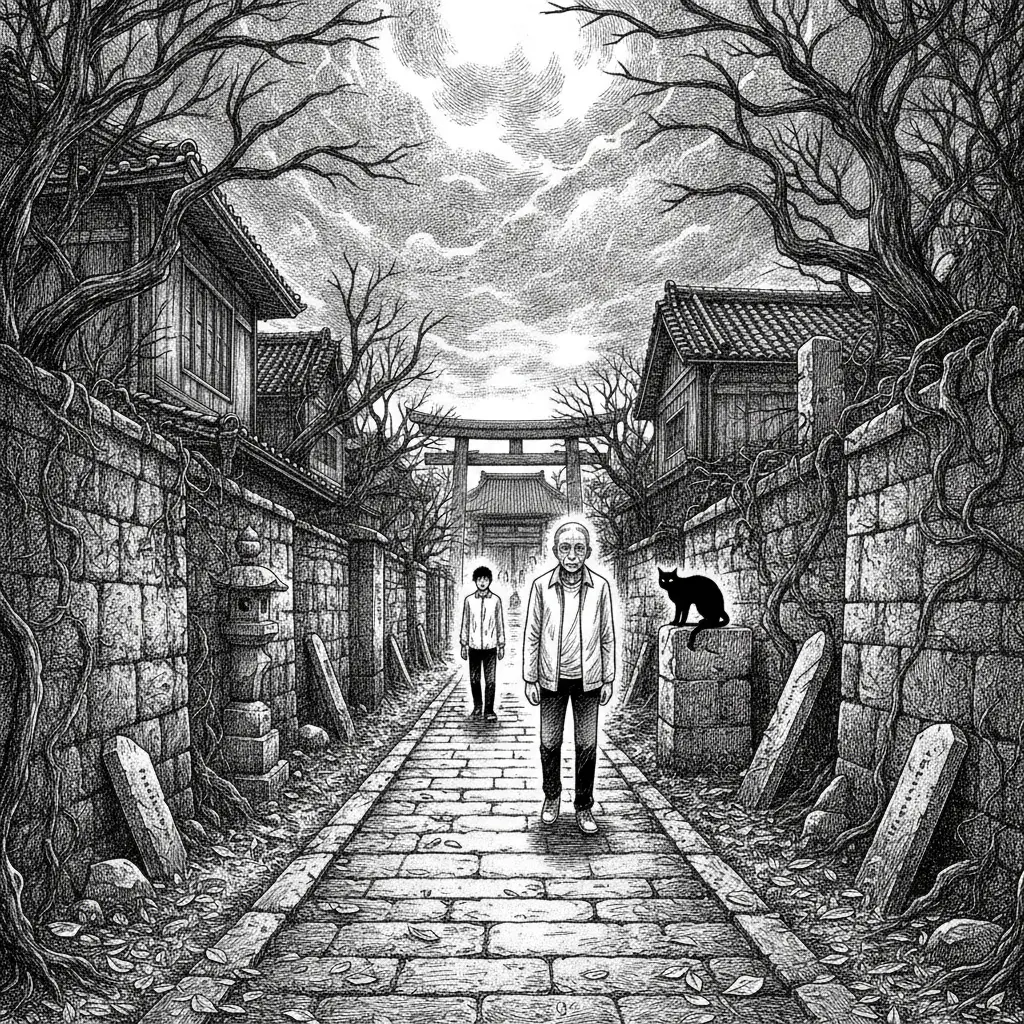
Every morning at seven, Tajidokoro Shingo (田所慎吾) walked the narrow cobblestones of Yanaka.
That part of the city — spreading between the Tokyo University of the Arts and Nippori Station, with Yanaka Cemetery lying between them — moved at a pace that felt nothing like central Tokyo. Old wooden houses with gabled roofs leaned against one another; persimmons and potted plants lined the eaves; at night the streetlamps were few, and there were still stretches of unpaved gravel road. Shingo had moved to the neighborhood six months ago. When he left his publishing house to go freelance, he had taken the opportunity to rent an old machiya whose low price suited his new circumstances. The place was nothing more than a six-mat room, a four-and-a-half-mat room, and a kitchen, yet every morning when he breathed in the Yanaka air, he felt certain he had made the right choice.
It was the beginning of October, when the fragrance of sweet osmanthus filled the lanes.
The route Shingo took each morning skirted the southern wall of the cemetery, passed the chimney of an old public bathhouse on his right, and turned left at a narrow three-way junction. Beyond that point, the walls on either side closed in until the alley was barely a meter wide — the kind of place no one stumbled into unless they already knew it was there. It had taken Shingo two weeks to memorize the way. Midway along the alley stood a single old sundry shop. A wooden sign bearing the name Fujinami-dō (藤浪堂) hung from the eaves, and behind the glass door, antique objects and old books were piled in cheerful disorder. Whether the shop was open or closed was never quite clear; it looked the same at every hour.
That particular morning, Shingo stopped at the entrance to the alley.
A cat sat motionless on top of the wall, watching him. Yanaka had no shortage of cats, and that in itself was unremarkable. But the quality of the cat's gaze was wrong. Cats, as a rule, ignore people entirely, or at most turn a glance of idle curiosity. This black cat, however, held Shingo's eyes without blinking, without moving its tail, still as carved stone. Shingo stood and stared back for a good thirty seconds, and the cat did not flinch. Eventually it was Shingo who gave in; he laughed faintly and walked on. He felt the gaze on his back. When he turned, the cat was still in the same posture, only its head rotated to follow him.
The next morning, the cat was in the same place.
This time Shingo spoke first. He said "hey," but the cat did not react. When he stepped closer, it dropped from the wall and vanished into the depths of the alley. Following it with his eyes, he noticed that the sliding door of Fujinami-dō was open a crack. Whether the wind had moved it, or the cat had pushed it, he could not say. It was the first morning Shingo had ever stopped in front of the shop.
A faint smell drifted out from inside. Not incense — something wetter than that, a mingling of old paper and aged timber and something sweet and organic underneath. In the dim interior, shelves rose to the ceiling, crowded with ceramic shards, rusted metal figurines, books stripped of their covers, and wooden implements whose purpose was impossible to guess. There was a figure at the back. A white-haired old man sat on a round stool, reading something.
"Welcome," the old man said, without looking up.
Shingo had no intention of buying anything, yet he found himself sliding the door open and stepping inside. The floorboards gave a low creak. With each step forward, the boundary between inside and outside seemed to dissolve. The air in the shop felt two or three degrees cooler than the air outside.
"Are you looking for something?" the old man said.
"No, I was just passing."
At that, the old man raised his face for the first time. He might have been in his seventies or his eighties; his face was deeply lined, but his eyes were strangely clear. The color of his irises was a shade of grey Shingo had never encountered before.
"Then take this."
The old man drew something from the folds of his clothing and set it on the counter. A small wooden box. Perhaps ten centimeters on each side, three centimeters deep. Its surface was carved with a fine pattern — something that resembled human faces, or perhaps waves, shifting between the two depending on the angle from which you looked.
"It is a box that cannot be opened," the old man said. "There is no charge."
Shingo laughed and tried to decline, but when he came to himself the box was already in his hand. No matter how he tried to reconstruct the moment afterward, the memory of it remained strangely blurred.
He went home and set the box on his desk.
There was clearly a lid, yet there was no gap anywhere. The line of the seam was visible, but pressing a fingernail into it accomplished nothing. When he applied more force, the wood felt faintly warm, almost as though it were alive. He spent the better part of an hour pressing from every direction, and the box did not open. He held it to his ear and shook it; nothing shifted inside. It was not the hollow silence of an empty container, but the heavy silence of something filled completely.
That night, Shingo dreamed.
He was walking through the lanes of Yanaka. It should have been daytime, yet the alley was dim, and the walls on either side were taller than he remembered. He walked and walked and found no exit; when he turned back, the way he had come was gone. From beyond the wall came a sound — too low to be called a voice, too irregular to be called music, a resonance that seemed impossible for a human throat to produce. It repeated itself on the other side of the wall. When Shingo pressed his ear against the stone, the sound stopped. In its place came a sensation, as though someone on the other side were breathing directly into his ear.
He woke to find the wooden box on the floor, fallen from the desk.
The impact must have shifted it; it was facing a different direction than before. Shingo picked it up and returned it to the desk. As he did, he had the impression that the pattern on its surface had changed. What had looked like waves the day before now looked unmistakably like faces — not one face, but many, crowded together, pressing outward from within the wood as though trying to push through. He put on his glasses and looked more carefully, and it was, after all, only a carved pattern. Just the grain of the wood, he told himself.
Three days passed.
During that time Shingo walked the alley several times, but the sliding door of Fujinami-dō was firmly shut. The sign was still there, but the interior was dark and the old man was nowhere to be seen. On the morning of the fourth day, intending to return the box, he headed for the alley and passed an elderly woman near the three-way junction. He greeted her, and she stopped. "Where are you headed?" she asked.
"To Fujinami-dō," he answered, and the color drained from her face.
"Fujinami-dō is gone," she said.
"The sign was still up yesterday."
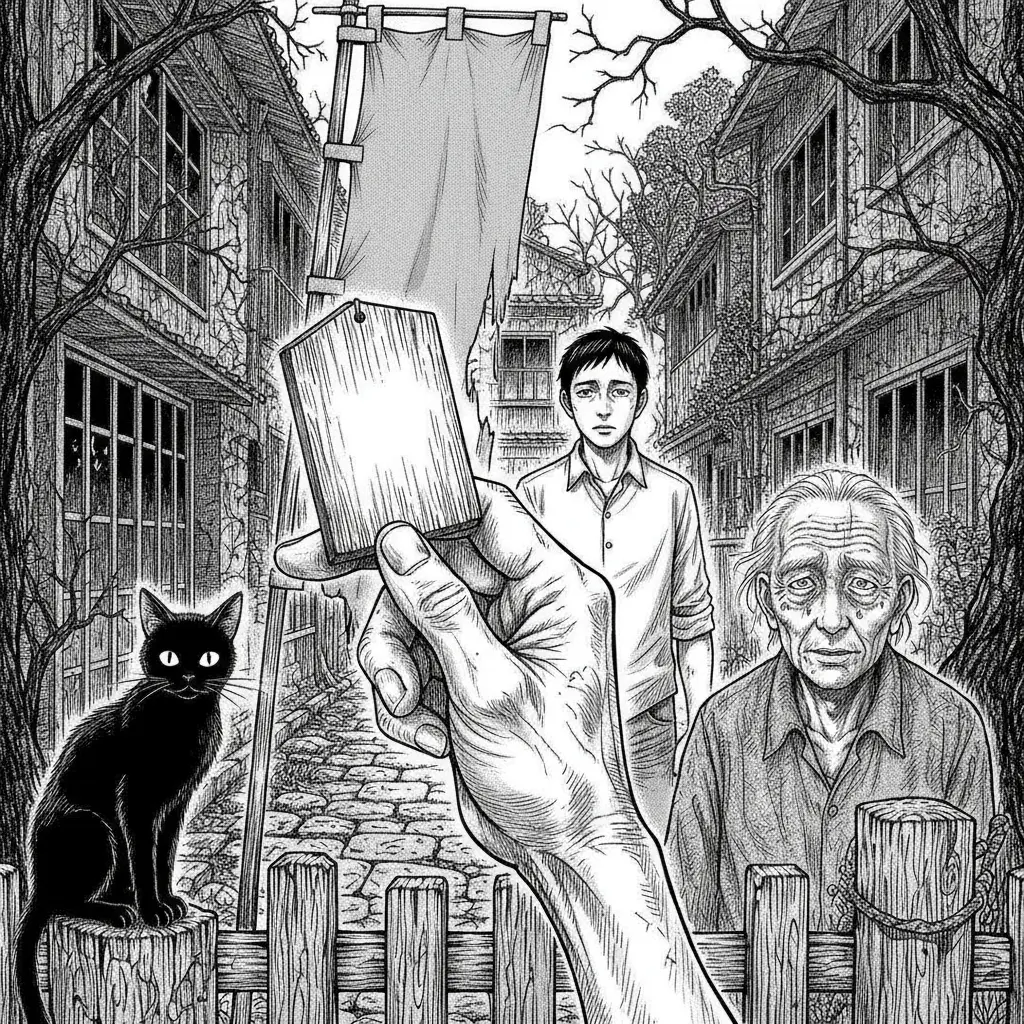
"Sign or no sign, the shop is gone. It closed twenty years ago." She lowered her voice. "The owner passed away, you see. That was the end of it. No one to take it over."
Shingo could not find words.
"You went into that alley?" The old woman studied his face. "You'd do well to stay away from there. Early mornings especially."
"Why?"
She did not answer. She looked at his hands, then looked away. Shingo realized he was holding the wooden box. For just a moment, something passed across the old woman's face — fear, or pity, or some mixture of the two that had no name.
"Be careful," she said, and walked away quickly.
Shingo went to the alley anyway.
The osmanthus scent was gone. When he entered, the air changed. It was October, a morning in autumn, yet the air against his skin carried the damp weight of rotting leaves. The old walls on either side blocked the morning light, and the bottom of the alley lay in shadow. When he reached Fujinami-dō, the sliding door was indeed shut. But the wooden sign was there. He pressed his face close to the glass and peered into the darkness. And in that darkness there was something — the outline of a white-haired old man, seated on a round stool.
Shingo knocked on the door.
The sound rang through the alley and faded. The figure inside did not move.
He was about to knock again when the black cat appeared from the depths of the alley. The same cat. It came to his feet and stopped. Then it looked at the box. Its gaze settled on the box and stayed there, and its ears flattened back against its head. The cat made a single low sound — not a sound of warning, not a sound of threat, but something closer to the sound a human being makes in the depths of despair.
The cat turned and ran.
Shingo looked down at the box.
Then the box moved.
In his hand, the box moved of its own accord. Not the lid — the whole box, as though something inside were pressing outward, swelled faintly. The swelling did not come once and stop; it repeated, rhythmically, like something breathing.
Shingo dropped the box onto the ground without thinking.
It landed with a sound but did not bounce. It came to rest quietly.
Shingo looked at the box on the ground.
A thin light was leaking from the seam.
Light was perhaps too strong a word — it was a faint brightness in the dark, nothing more. Not white, not yellow, but the reddish orange of human skin seen against a light held behind it. It seeped from the seam of the box, thin but unmistakable. Shingo crouched and brought his face close. Heat was coming through the seam. A warmth close to body temperature.
And then he heard the voices.
From inside the box, he heard voices.
Too small to be properly called voices, yet unmistakably resembling sounds made by human mouths — multiple sounds, layered over one another, transmitting themselves through the wood. Shingo brought his ear close. What reached him was not words, not sentences, only the sound of human mouths speaking ceaselessly, stratum upon stratum. Whenever one voice seemed about to become distinct, another buried it. Tens of voices, hundreds of voices, folded together inside that small wooden box.
Shingo pulled back. He stood and looked along the alley.
Then he saw it.
The walls on either side had changed.
The surface of the walls — old mortar and brick — was covered in a pattern. At first he took it for cracking. But it was not cracks. It was carved. The same pattern as the surface of the wooden box. Faces, pressed together in dense multitudes, covered every surface of both walls. A pattern that Shingo had passed dozens of times without seeing — or that had appeared there only now — filled the walls from end to end, left and right.
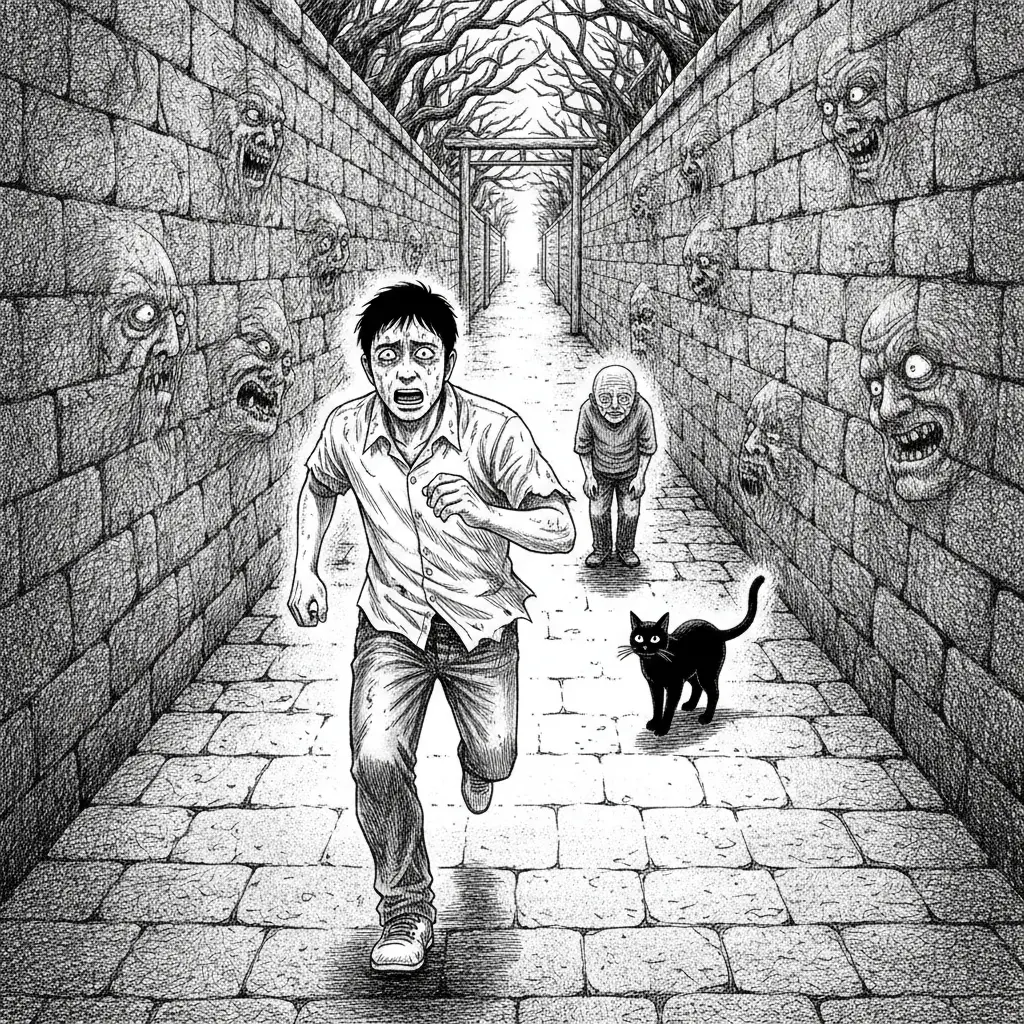
Shingo ran.
He ran toward the entrance of the alley. But no matter how far he ran, the entrance did not appear. The alley was straight, yet the exit seemed to recede. The carved faces in the walls seemed to move as he ran. He knew they were not moving, yet at the edge of his vision something was undeniably in motion.
Then, abruptly, the alley opened.
He was standing at the three-way junction. He turned: the alley was there behind him, an ordinary narrow lane. The walls bore no pattern. The sign of Fujinami-dō was nowhere to be seen. Shingo stood catching his breath and looked at his hands.
The box was in his hand.
The box he had dropped was back in his hand.
That evening, Shingo examined the box.
The seam had closed again; there was no light, no heat, no sound. It was simply an old wooden box sitting on a desk. He went to the library and searched old maps of Yanaka, then looked up the name Fujinami-dō online. He found nothing. His years at the publishing house had given him habits of research, and he considered seeking out long-time residents of the neighborhood, but he could not think what he would ask them.
The following morning, Shingo went back to the alley.
He had meant to go in the middle of the day, but when he woke it was already seven. His feet moved on their own. When he entered the alley, everything was ordinary. The walls were bare, the air was the air of an ordinary morning. When he reached Fujinami-dō, the sliding door was open.
The old man was there.
"I've come to return it," Shingo said.
The old man looked at the box in Shingo's hand. An expression came into his eyes that Shingo had not seen there before. Pity, Shingo thought. But he could not tell for whom.
"Did you open it?" the old man asked.
"I couldn't open it," Shingo answered.
"I see." The old man spoke quietly. "Then keep it a little longer."
"Why?"
"There are people who would suffer if you did not."
The old man's tone was gentle, but the meaning of his words escaped Shingo entirely. People who would suffer — what did that mean? Shingo held the box out, but the old man did not extend his hand. He simply sat on his round stool, watching Shingo in silence.
"What is inside the box?" Shingo asked.
"Voices," the old man said.
"Voices?"
"Things that gathered here over a long time. The last words of those who died in this alley. Words left unfinished. Words that had nowhere left to go. They are inside that box. The box exists to keep them contained."
"Then it must never be opened."
The old man did not answer.
"Who are you?" Shingo asked.
For the first time, the old man's eyes smiled. Only his eyes; the rest of his face did not move.
"I am Fujinami," the old man said. "I have been here a very long time."
Shingo remembered what the old woman had told him. The owner passed away twenty years ago, and the shop closed.
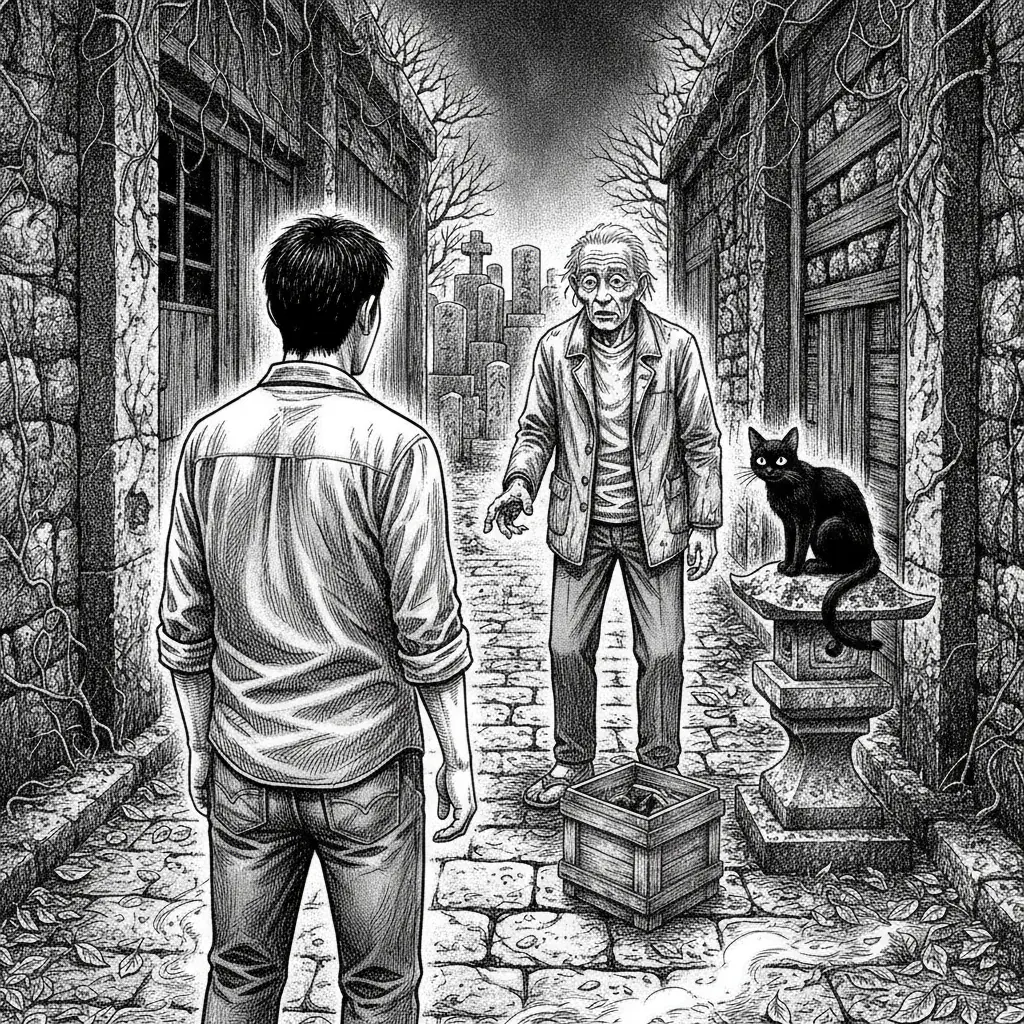
His feet would not move.
The old man, still watching Shingo's face, said: "When the box grows heavy, bring it back. I will take it then."
Shingo managed to leave the shop.
He passed through the alley, through the three-way junction, and only when he reached the road along the cemetery wall did he feel he could breathe again. He stopped and looked at the box in his hand. It was heavier than the day before. Only slightly, but heavier.
A week went by.
Each morning Shingo walked the same route. He passed Fujinami-dō each day, but the sliding door was always shut and the old man was never visible. Over the course of the week, the box grew heavier still — by the end, roughly twice the weight it had been at the start. Something inside it was clearly accumulating. On some nights, voices came from within the box. On the evenings when Shingo could not sleep and lay listening, multiple voices spoke over one another without pause. Occasionally one voice rose slightly above the rest, close enough to be understood. In those moments, Shingo always covered his ears in fear. He could not have said why he was afraid. Only that he felt, with certainty, that if he understood what that voice was saying, there would be no returning to what he had been before.
By the end of October, the box weighed roughly three times what it had at the beginning.
Shingo went back to the alley. This time the sliding door was open. But the old man was not inside. Only the round stool remained, with nothing on it. Shingo entered and looked toward the back of the shop. No one. Yet at the far end, beyond the shelves, there was a small wooden stand, and on the stand a hollow — a hollow shaped precisely to receive the box.
Shingo set the box into it.
The moment the box settled into the hollow, the voices stopped. Voices he had not realized he was hearing — through sleep, through waking, faintly, at a distance, for the past week — ceased completely, all at once, for the first time.
Shingo left the shop.
Walking out through the alley, he drew a long breath. The osmanthus season was over; the smell now was of dead leaves. Fallen ginkgo leaves lay piled on the cobblestones. He listened to his own footsteps. Only his own footsteps, echoing in the lane.
At the three-way junction, the black cat was waiting.
It sat on the wall and watched him. This time the rigid stillness was gone from its eyes. The cat narrowed them once, then dropped down behind the wall and disappeared.
Shingo spent the rest of that day working as he normally would.
In the evening he finished a manuscript, made coffee, and looked out the window. Dusk came early in Yanaka; by five o'clock the lanes were dark. He had always loved the color of the light at the hour when the streetlamps began to come on one by one — that particular shade of orange. He stood looking out, then glanced back at his desk.
The place where the box had sat was empty.
Of course it was. He had left it there that morning.
Yet on the desk, in the place where the box had been, there was a faint trace. The kind of mark left on wood when something has rested on it for a long time — a faint shadow of an outline, pressed into the grain. Shingo ran his finger along it.
Within the mark, there was a pattern.
The same pattern that had been carved on the bottom of the box was faintly inscribed in the wood of the desk. The pattern that looked like faces, or like waves, depending on how you looked at it.
Shingo lifted his finger.
Outside the window, wind lifted the dead leaves in the alley. From somewhere in the distance, someone said something — or something that resembled a voice, that resembled a sound made by a human mouth, surfaced for a moment in the night air of Yanaka, and was gone.
Shingo stood up and turned on the light.
In the brightness of the room, he looked at the mark on the desk.
The mark was still there.