

The Eye-Holes of Hahoe
AI AI-generated fiction — text, and any narration or images. Unrelated to any real events, people, organizations, or places.
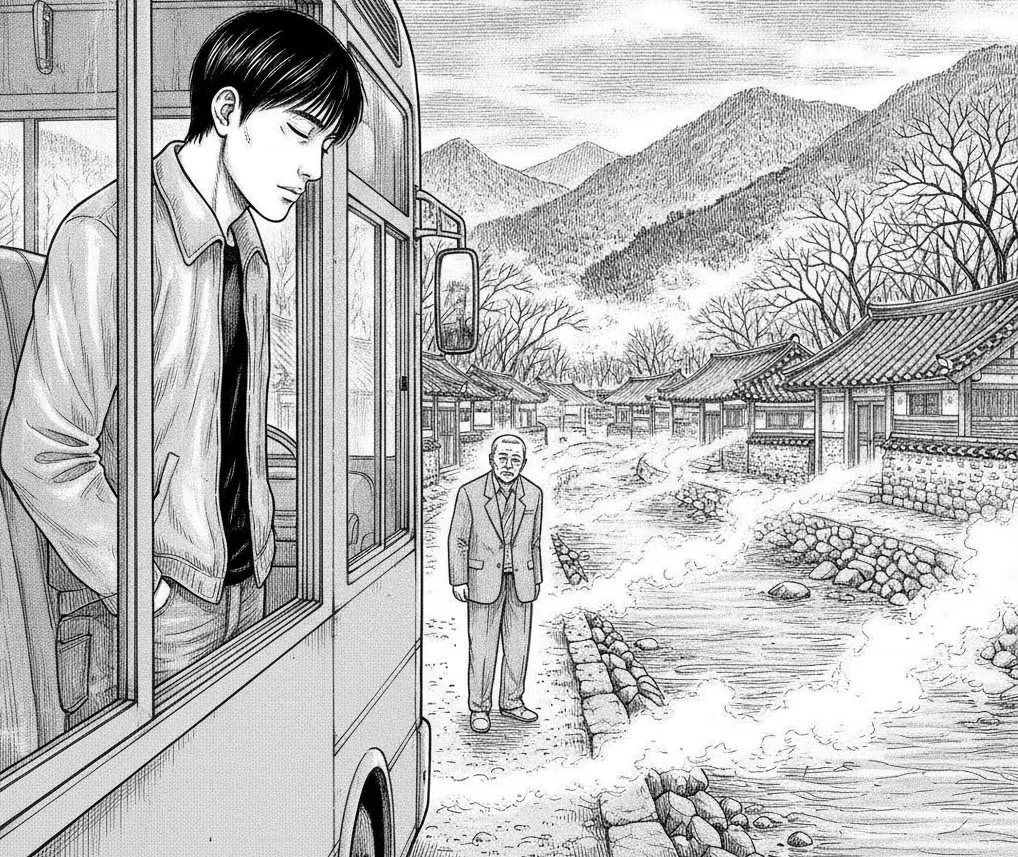
Minjun first set foot in Hahoe Village in late autumn. On the express bus down from Seoul, he sat watching the mountains drift past the window, his gaze unfocused. The further south they traveled toward the upper reaches of the Nakdong River, the lower the sky seemed to press. The clouds were not especially thick, yet the light had a quality to it — diluted, somehow, as though thinned from within. After transferring to a local bus at the Andong terminal, he rode another thirty minutes along the riverside road with his forehead resting against the glass, eyes closed. Minjun was a graduate student in architecture, and he had come for fieldwork — his thesis examined the spatial arrangement of the traditional houses of Hahoe Village. His advisor had told him to stay at least ten days and come back with measured drawings. He hadn't taken this as any great burden. If anything, he was glad to escape the research lab and the cramped study-room he rented back in Seoul.
At the village entrance, the Nakdong River curved around the settlement like an arm drawn about a waist. The water was somewhere between grey and green, and the cliffs of Buyongdae on the far bank blazed orange in the western light. Minjun shouldered his pack and stood before the tall gate at the village threshold. There was a signboard and a ticket booth, but almost no visitors — the tourist season had passed. The attendant was a middle-aged woman who handed him his ticket and added one thing before he moved on.
"Since you're here for research purposes, you can use the sarangchae — the outer quarters — at the head family's house inside the village. You said you'd arranged it in advance, yes? Just one thing: after six in the evening, please don't walk through the village alone. It's easy to lose your way once it gets dark."
Her tone was so matter-of-fact that Minjun paid it little mind. He took it for the kind of routine safety notice any tourist site might offer. The dirt path into the village was thick with fallen leaves that crackled underfoot with each step. Tiled roofs crouched low against the earth, and persimmon branches reached over the mud walls. Most of the fruit had already dropped; only a few remained, punctuating the sky like small orange embers.
The sarangchae where Minjun was to stay sat a little deeper inside the village, set back from the center. He was greeted by an elderly man surnamed Ryu, a descendant of the founding clan. The man appeared to be in his mid-seventies — slightly stooped, but with clear, steady eyes. He showed Minjun the room and explained how to feed the underfloor furnace. Minjun thanked him and unpacked. The room held an old writing desk and a low cabinet; through the hanji-papered door, the light from the courtyard seeped in softly. He set out his laptop and opened his field notebook. The first night passed without incident.
From the next morning, Minjun moved through the village with purpose. He measured the houses one by one in sequence, transferring their proportions and relationships onto his drafting sheets. Hahoe was a clan village of the Pungsan Ryu family, its houses arranged in a gentle circle following the river's bend — like a lotus, some said. The alleyways were narrow and winding. Head east and the river came into view; head west and the mountain foothills rose to meet you. Walking those lanes, Minjun kept having the impression that the village held something beyond mere topographical arrangement — some intentional structure embedded in its bones. The houses seemed to lean toward one another by slight degrees, and the alleyways seemed to converge on some invisible center point. That, he thought, might become the central argument of his thesis.
On the third day, Minjun saw a mask for the first time. Deep inside the village, slightly off the path tourists usually followed, a single Hahoe mask hung on the wall of what looked like a storage building. It was the nobleman's mask — the yangban. Eyebrows arched upward, the corners of the mouth pulled down. A face that could not be read as smiling or scowling. Minjun raised his camera and took a photograph. At the moment the shutter clicked, the shadow across the mask seemed to shift. He knew it was only the light changing as a cloud passed over the sun, yet he lowered the camera and stood looking at the mask for a long moment. It was nothing. It was wood. An old piece of lacquered wood, the finish cracked with age. But as he turned to leave, he felt it — the distinct sensation of being watched from behind. He looked back. The alley was empty.
The fourth night. Minjun had been working on his drawings in the sarangchae and fell asleep around midnight. He dreamed. In the dream he was walking through the alleyways of Hahoe Village. The light was neither day nor night — a strange luminosity in which objects were visible though no source of light existed. At the end of every lane, masks hung waiting. The maiden's mask, the monk's mask, the village idiot's mask, the young woman's mask. As he passed each one, the eye-holes were not dark. Something was inside them. Something that moved. Minjun tried to draw closer, but his feet were fixed to the ground. Then all the masks turned toward him at once. There was no sound. Only stillness, and the masks looking at him. He tried to cry out, but nothing came from his throat. And then he woke.
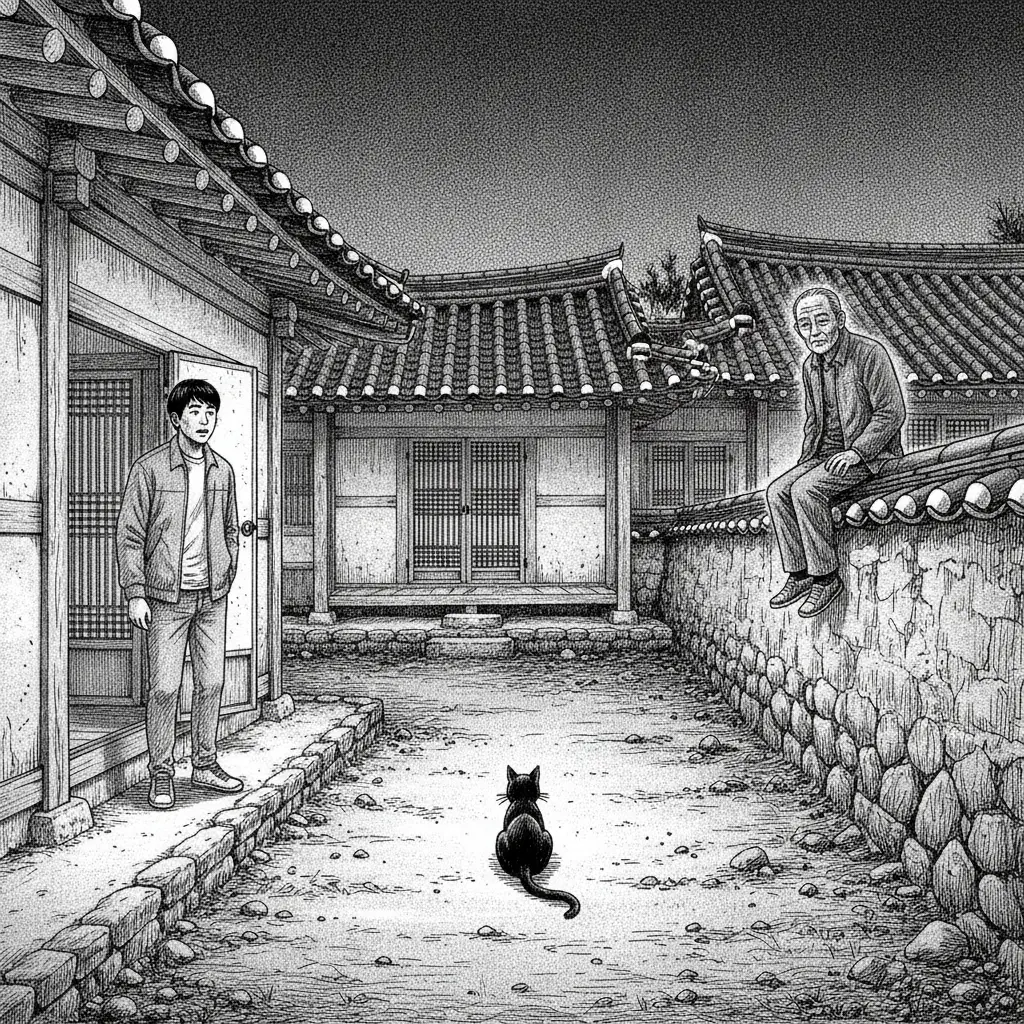
It was three in the morning. The room was quiet. Beyond the hanji door, the darkness of the courtyard lay thick and close. Minjun became aware of sweat on his forehead and stared up at the ceiling. A dream. Only a dream. He opened the door to get some water. The moment his foot touched the courtyard, something felt wrong. There was something in the middle of the yard. A shape, crouched low. Too low, too still to be a person. Minjun held his breath. As his eyes adjusted to the dark, the shape slowly resolved itself. A cat. One of the village cats had wandered into the courtyard. Minjun exhaled and laughed quietly to himself. The cat was not looking at him. It was staring fixedly at one corner of the yard. Minjun followed its gaze. There was nothing on top of the wall. Nothing at all.
On the afternoon of the fifth day, the old man Ryu came to the sarangchae. He watched Minjun drawing for a while before he spoke.
"Have you measured the empty house at the western end of the village?"
Minjun looked up. He knew there was an abandoned house at the western edge, he said, but he hadn't been there yet. The old man was quiet for a moment, then said:
"You don't need to go there. You don't need to put it in your drawings."
The words lodged in Minjun's mind in a way he couldn't quite explain. He said that his thesis required him to measure every house in the village, but the old man offered no further explanation and left. That evening, Minjun spread out his map of the village and marked the location of the abandoned house at the western end.
The sixth morning arrived in fog. River mist rising from the Nakdong had settled over the entire village, and the tiled rooftops floated in it like islands. Minjun waited for the fog to lift, then gave up waiting and walked west. He needed to see that house. He couldn't easily explain why. He told himself it was for the thesis — but the truth was that the old man's brief words had been lodged in his mind ever since, refusing to leave.
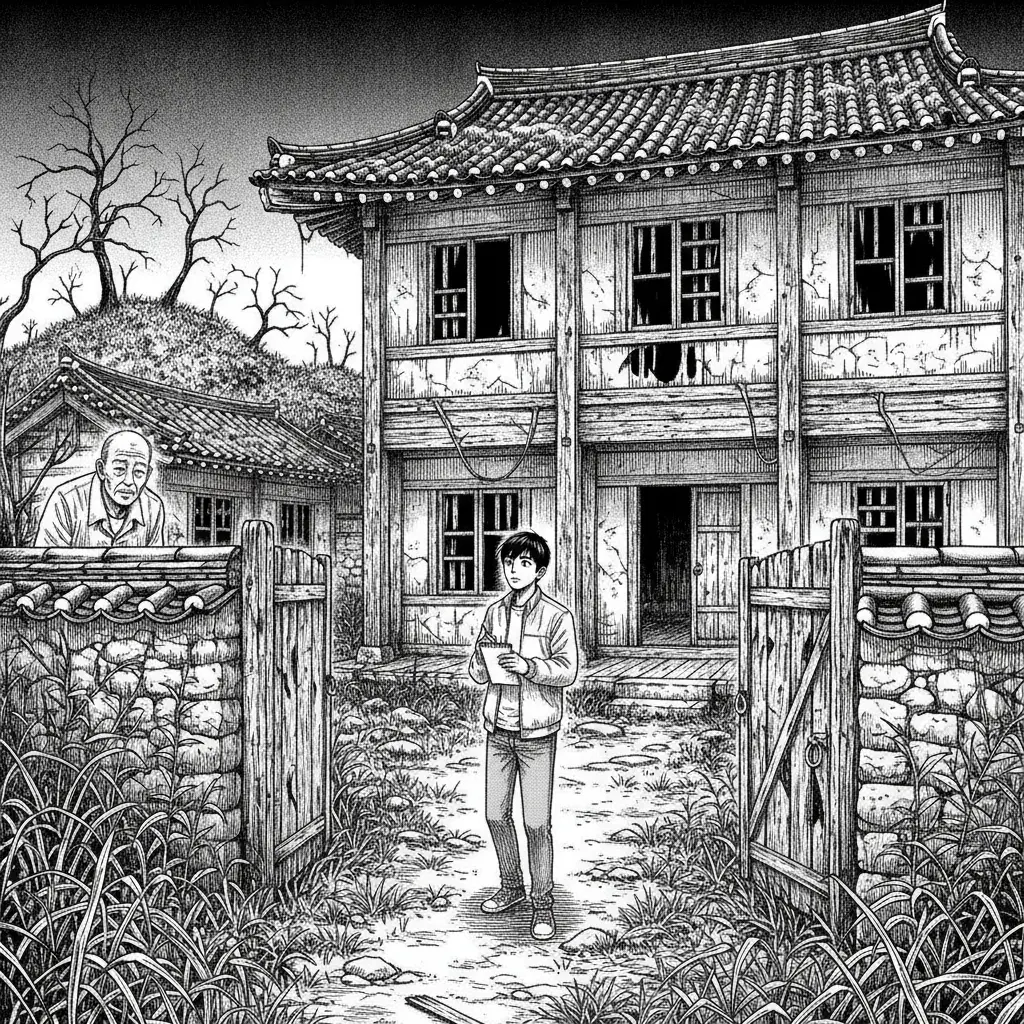
The abandoned house was deeper inside the village than he had expected. It stood apart from the other houses, leaning against the foot of a small wooded hill. The mud wall had crumbled in places, and the front gate was unlocked. Minjun pushed it open — it groaned on its hinges — and stepped inside. Weeds had grown to knee height across the yard. The main hall had a hip-and-gable roof, and all the hanji had been stripped from the window frames, leaving only bare holes. Minjun moved slowly around the structure, noting measurements on his pad. There was nothing unusual. An old, empty house. That was all.
But when he rounded the left side of the main hall, he stopped. On the lower portion of the outer wall, at a height of perhaps a hand's breadth from the ground, something was attached. At first he took it for a scrap of wood or some worn decorative fitting. But as he drew closer, he saw that it was a mask. A very small mask. The same form as a Hahoe mask, but far smaller, and coated not in lacquer but in something black. It was bound to the wall not with nails but with what appeared to be some kind of fiber. Minjun took out his phone and photographed it. Then he reached out to touch it and stopped. Through the eye-holes of the mask, he could see into the wall — into the interior of the house. And through those eye-holes, from somewhere inside, something moved. Only once. It was not a shadow. It had form. At the height where a person would have to be lying flat against the floor, something was crawling — slowly, steadily — toward him.
Minjun stepped back. His heart lurched into his throat. He kept his footsteps quiet and walked toward the gate. No — he ran. Only after he had passed through the gate and out into the alley did he finally let out his breath. The fog was still thick in the lane. He stood for a moment, steadying himself, then turned to look back. The gate he had come through was still open. And there, inside — across the yard, beneath the dark eaves of the main hall — something was standing. It had the shape of a person. It did not move. It simply stood. Where a face should have been, there was nothing.
Minjun went to find the old man Ryu. He was in the inner quarters, drinking tea. When Minjun described what he had seen in the abandoned house, the old man set down his cup slowly and said nothing for a long time. Minjun waited. When the old man finally spoke, his voice was low and heavy.
"That house belonged to a mask-maker, long ago. The Hahoe masks are sacred things — not just anyone could make them. The man who lived there was carving a mask when he stopped. He fell into a sickness. He died before the mask was finished. An unfinished mask has no face. And things without faces, it is said, go searching for one."
A chill moved through Minjun as he heard this. At the same time, he tried to reason it away — the old man was recounting a village legend, nothing more. That evening, he opened the photographs he had taken at the abandoned house. The small mask on the outer wall. But beside the mask, slightly above it, something else had been captured in the frame. The bare window opening where the hanji had been stripped away. And inside that opening — something Minjun was certain had not been there when he took the photograph. A shape resembling a face. Darkness pooled in the positions of eyes, nose, and mouth. It was oriented outward, toward the camera, from within the window frame. Minjun enlarged the image. The more he enlarged it, the more distinct the shape became — and the less it could be explained.
The seventh night. Minjun packed his bag and resolved to leave first thing in the morning. He could wrap up the fieldwork for now and return later, or fill the gaps with existing documentation. He shoved his things into his pack and shut his laptop. The room went dark. Through the hanji door, faint moonlight entered from the courtyard. Minjun lay down. Sleep would not come. He stared at the ceiling. The room was silent. And then, within that silence, a sound. Very small. Coming from the direction of the courtyard. Too irregular to be footsteps, too rhythmic to be wind. Something was crossing the yard slowly. Minjun held his breath. The sound drew closer, toward the sarangchae. And then it stopped — directly outside his door.
Minjun closed his eyes. He knew he shouldn't, and he closed them anyway. There was no sound. One minute passed. Five minutes passed. The sound did not return. Slowly, he opened his eyes. The hanji door was as it had been. Moonlight lay across it in a pale rectangle. And on that rectangle of light, there was a shadow. The shadow of something outside the door, pressing its face against the paper — the unmistakable silhouette of a nose and brow flattened against the hanji, the particular contour that only comes from a face held close against a surface. Minjun pressed his hand over his mouth. The shadow did not move. It simply remained there. Face against the door. As though looking in.
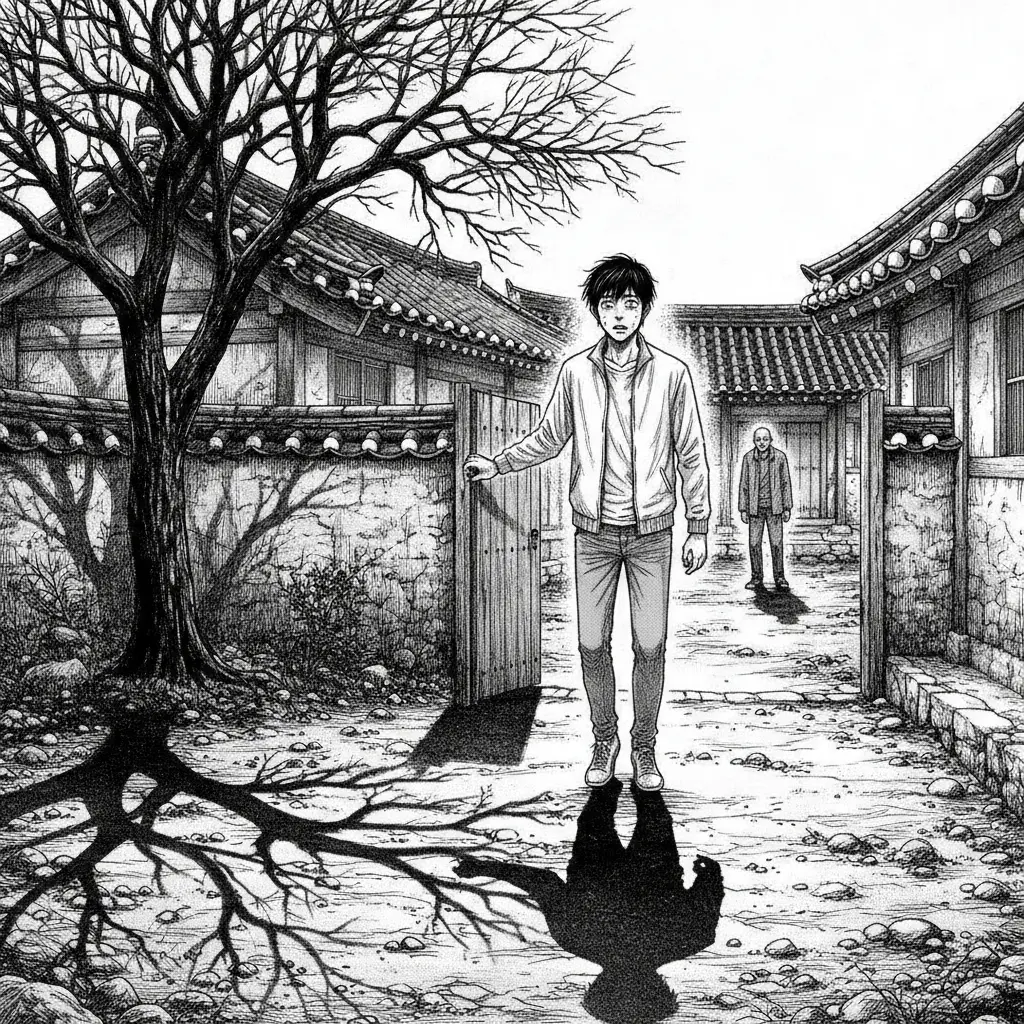
Minjun could not afterward recall with any precision how he endured the rest of that night. He did not know when the shadow disappeared. When daylight finally came, he was still curled beneath his blanket, pulled up over his head. Only when he felt the morning light entering the room did he slowly sit up. He opened the door. The courtyard was ordinary. The shadow of the persimmon tree stretched long across the bare earth. There was nothing.
But on the threshold, resting on the stepping stone, there was something. A small object. Minjun bent down to look. A piece of wood. A very small piece of wood. Two holes had been bored into it, like the eye-holes of a mask. Where the nose and mouth should have been, the surface was still unworked. Unfinished. It was something that had been trying to become a face. Minjun did not pick it up. He knew instinctively that he must not. He shouldered his pack and left the sarangchae. He should have gone to say goodbye to the old man Ryu, but his feet would not carry him toward the inner quarters. He simply walked — quickly — toward the village entrance.
At the edge of the village, Minjun turned and looked back once. In the morning sunlight, the village was quiet and beautiful. Tiled roofs, mud walls, persimmon trees. The sound of the Nakdong River wrapping itself around the village reached him faintly. Nothing was wrong. And yet — somewhere in the alleyways deeper inside, somewhere the morning mist had not yet released its hold — something seemed to be standing. Its form was indistinct. He could not tell whether it was mist or a figure. Minjun did not look any longer. He turned and walked along the riverside road.
He reached the Andong terminal and bought a ticket back to Seoul. He sat in the waiting area and took out his phone. He sent a text to his advisor saying something had come up. Then he opened his photo app. He meant to delete the pictures from the abandoned house. He scrolled through them one by one, and his finger stopped. There were photographs taken in the sarangchae courtyard. Minjun had no memory of taking any photographs in the courtyard. But there they were. Four of them. Taken at night. A dark courtyard, the door of the sarangchae. In the third photograph, the door was closed, and light leaked from within — his room, where he had left the lamp on while he slept. In the fourth photograph, a shadow fell across that inner light. The shadow of a figure standing inside the room, facing the door. It was not Minjun's shadow. At that hour, Minjun had been curled beneath his blanket.
The bus arrived. Minjun put his phone into his pack. As he boarded, he was aware that he had not deleted the photographs. He knew he should, and yet his hand would not do it. As the bus pulled out and moved through the streets of Andong, he did not look out the window. He kept his eyes closed. Along the riverside road, the motion of the bus was steady and regular. Somewhere in that rhythm, Minjun drifted briefly into sleep.
And in that state between dreaming and waking, he felt something. The sense that someone had sat down in the seat beside him. When he had boarded, the seat had been empty — he was certain of it. He did not open his eyes. He knew he must not open them. A sound came from the seat beside him. Very small. A scraping sound. The sound of something being worked — of wood being shaped. Slowly, gradually. Like the sound of a face being completed, feature by feature.
Back in Seoul, Minjun never managed to delete the photographs. He returned to his rented room, put his phone in a drawer, and locked it. For a long time he did not take it out. But at night, sounds came from inside the drawer. The sound of wood being worked. Very small, very steady. As though something not yet finished were moving, slowly and patiently, toward its completion.