

The Floating Man of the Stone Warehouse
AI AI-generated fiction — text, and any narration or images. Unrelated to any real events, people, organizations, or places.
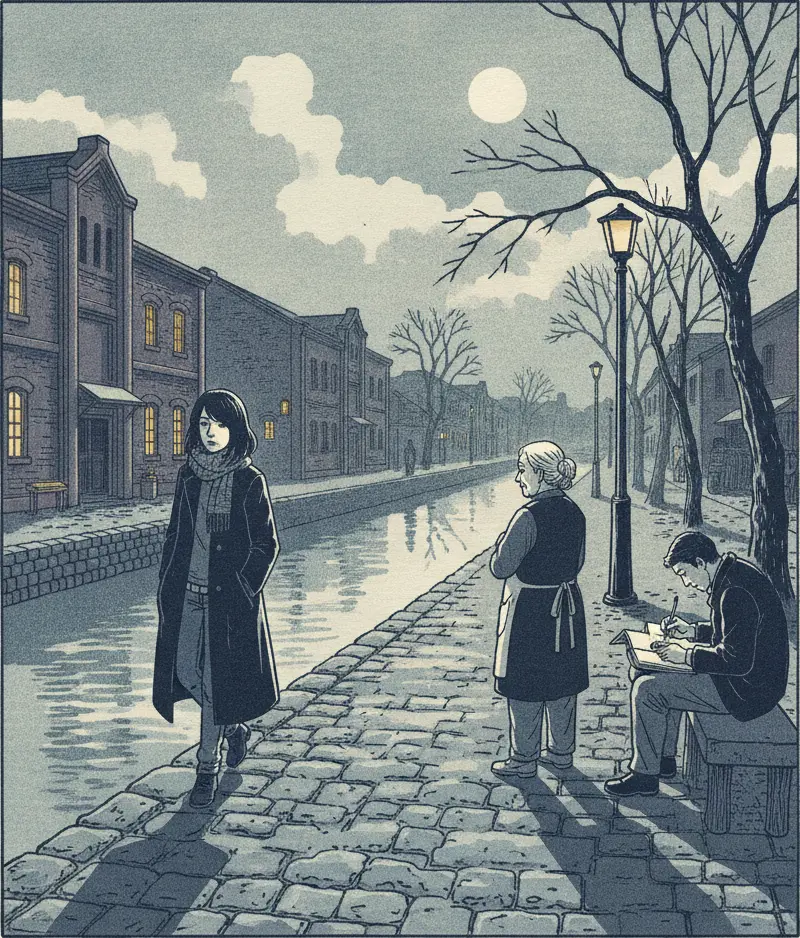
At the end of October, when I first set foot on the cobblestones along the Otaru Canal, I had not yet realized I was standing at the edge of something.
Three months had passed since I left my job in Tokyo. I had walked away of my own accord from the publishing house where I had worked as an editor for twelve years. Whenever anyone asked why, I said I was tired — but the truth was stranger than that. Every morning when I stood before the mirror, I had the feeling that the face looking back at me was, little by little, becoming someone else's. I kept it to myself, certain I would be laughed at, but the feeling grew stronger with each passing day, until one morning I shattered the mirror. That was what finally made me quit.
Choosing Otaru was almost an accident. I remembered a friend mentioning it once — something about stone warehouses and canals, nothing like the noise of Tokyo. I had heard that snow would begin to fall by November, and I thought I would go before it did. The inn I booked was an old building along the canal, a converted Meiji-era stone warehouse, according to the reservation site. Only five rooms, run by the owner alone.
I arrived just after three in the afternoon, but the sky already held the colors of dusk. So this is what it means for the northern sky to sit so low, I thought. The canal water was the color of lead, and the light from the gas-style lanterns along the far bank cast long streaks across the surface. A few tourists drifted here and there, but their movements seemed slow, as though they were walking through an exhibit rather than a street.
The entrance to the inn, Ishikuraya, faced a narrow lane set back from the canal. Three stone steps led up to a heavy wooden door, and when I pushed it open, the smell of the place came over me — dust and timber and something faintly sweet, all mingled together. The owner emerged from behind the front counter: a woman who appeared to be in her sixties, named Kishima. Her white hair was gathered at the back, and she wore a dark blue apron. Her smile was gentle, but something in the depths of her eyes was not smiling. It was not the appraising look one sometimes sees at inn counters. It was a quieter look — as though she were confirming something.
"You've come alone," Kishima said. Less a question than a thought spoken aloud.
My room was a corner room on the second floor, with a window that looked out over a portion of the canal — the cobblestone walkway, the black water beyond, the warehouse wall on the far bank. A simple, clean Japanese-style room, with a single white chrysanthemum in the alcove. I stood at the window for a while, then unpacked my things. Kishima had told me dinner would be served in the dining room downstairs at seven.
That evening's meal was a salmon hot pot and several small side dishes — modest but carefully made. One other guest was in the dining room: a man who appeared to be in his fifties, sitting at a window table, writing steadily in a notebook. He did not look up when I took my seat. When Kishima brought the pot to my table, I asked about him, as casually as I could.
"That's Mr. Saeki," she said quietly. "He's been staying with us since three days ago. He comes every year around this time. He seems to be researching something."
"Researching what?"
"I'm not sure." Kishima paused briefly. "I asked him once, but he didn't quite answer."
On my way back to my room after dinner, I noticed a narrow staircase at the far end of the corridor. I hadn't thought there was a third floor. The treads looked old, and a thin light seeped down from above. I stopped and looked toward it, but having no particular reason to go further, I went into my room.
The next morning I walked along the canal. Even at nine o'clock the air was sharp enough to sting, and my breath came out white. There were no tourists; only locals passing on bicycles. The warehouse walls caught the morning light differently than they had the evening before. The yellowish stone surfaces were stained through with moss and dark patches, their patterns resembling some kind of map.
Near the end of the canal, there was an information board for visitors. It described the history of the Otaru Canal — how it had flourished from the Meiji through the Taisho era as a vital artery for Hokkaido's goods, how after the war there had been talk of filling it in, how a citizens' movement had preserved it. Near the bottom, in small print, was this: "Along the canal, many stone warehouses were built, some of which still stand today. Among them are sites where laborers died in accidents during construction, and these are still spoken of in the local community."
I read that sentence twice. The phrase "still spoken of" caught on something inside me.
When I returned to the inn, the man named Saeki was in the lobby. He spoke to me the moment he saw me, with an ease that seemed strange for a first meeting.
"Forgive me for last night. When I'm writing, I lose track of everything around me."
"What are you writing?"
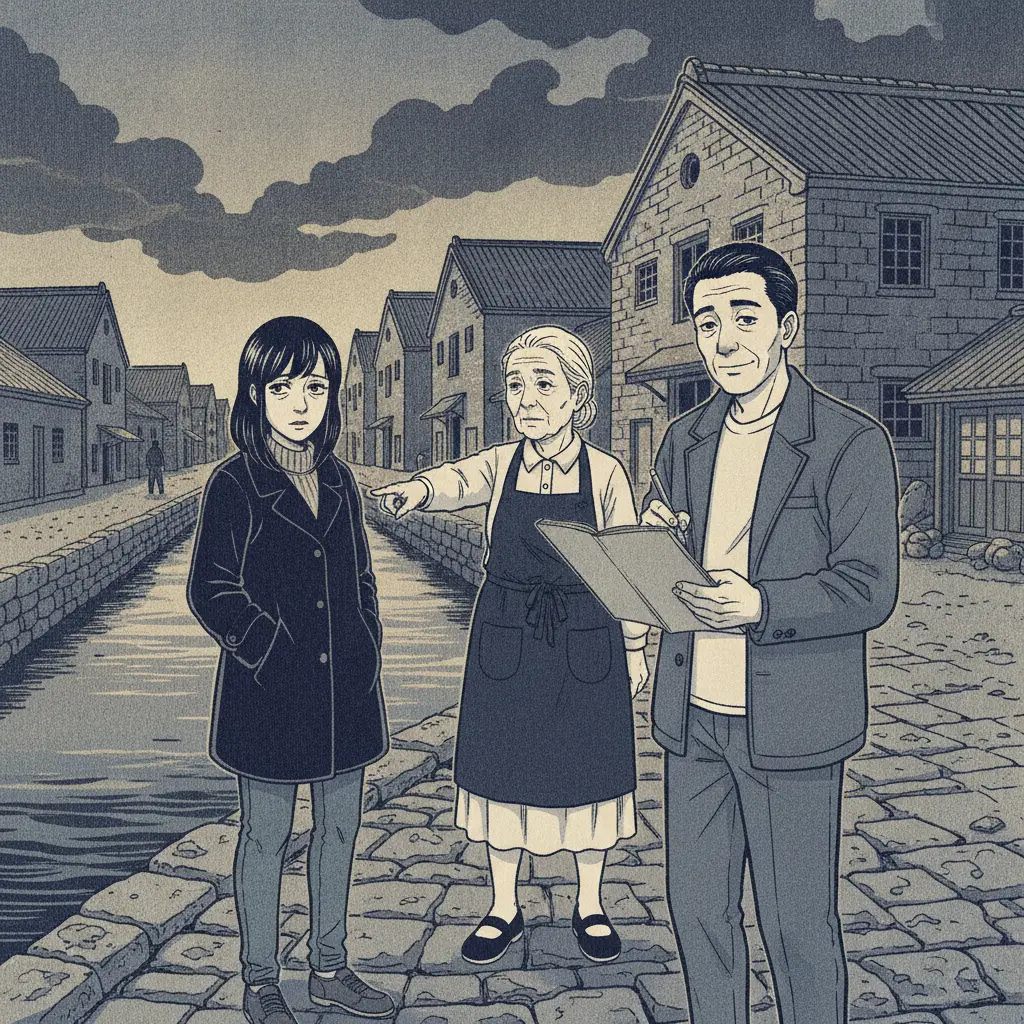
"Local history. More of a hobby, really." He smiled slightly. "I'm researching this area along the canal. The construction history of the stone warehouses, the working conditions of the time."
"I just read something on the canal information board about accidents involving laborers."
Saeki looked at me steadily. "Did you," he said. Nothing more. He lowered his eyes back to his notebook. He showed no sign of continuing, so I went upstairs to my room.
A light rain began that afternoon. I had no desire to go out, and sat in my room trying to read, but I couldn't concentrate. I glanced out the window and noticed someone standing on the far bank of the canal — pressed against the wall of one of the warehouses, facing this way. Standing in the rain without an umbrella, perfectly still. The color of the coat was dark, nearly dissolving into the stone of the wall behind.
I watched for a while, but the figure did not move. When I looked again perhaps ten minutes later, it was gone. The rain was still falling.
At dinner I asked Kishima about it. "There was someone standing on the far bank this afternoon. Is there something over there?"
Kishima paused in her serving. "Whereabouts were they standing?"
"Right in front of the oldest warehouse."
"Ah." She said it briefly and resumed her movements. "A tourist, perhaps."
It was not really an answer. I didn't ask again.
That night I couldn't sleep. I had gone to bed just after eleven, but I woke repeatedly. The third time I woke, the clock read two in the morning. The room was quiet, but I had the sense that a sound was coming from somewhere — a rhythmic sound, like something being dragged. The corridor, perhaps. I lay still and listened. The sound was real. It seemed to be coming from the direction of the narrow staircase at the end of the hall.
I got up and opened my door a crack. The corridor was dark, lit only by the dim red glow of the emergency light. The sound continued. Not dragging, I realized, listening more carefully — it was closer to footsteps. Heavy, uneven footsteps. The interval between each step was slightly longer than a person's would be.
I did not go into the corridor. I closed the door, locked it, and got back under the covers. The footsteps continued for a while, then stopped.
The next morning, breakfast was served as though nothing had happened. Saeki was there again. I told him what I had heard in the night. He set down his coffee cup, thought for a moment, and said:
"Do you know what this building was originally?"
"I was told it was a converted stone warehouse."
"That's right. Built in Meiji thirty-seven. During construction, a man died — crushed when a wall collapsed while he was transporting stone. The site of the accident is said to correspond to what is now the third floor."
I thought of the narrow staircase at the end of the corridor. "Is the third floor still in use?"
"I asked Kishima once. She said it was storage."
From that night on, I could not stop thinking about the third floor.
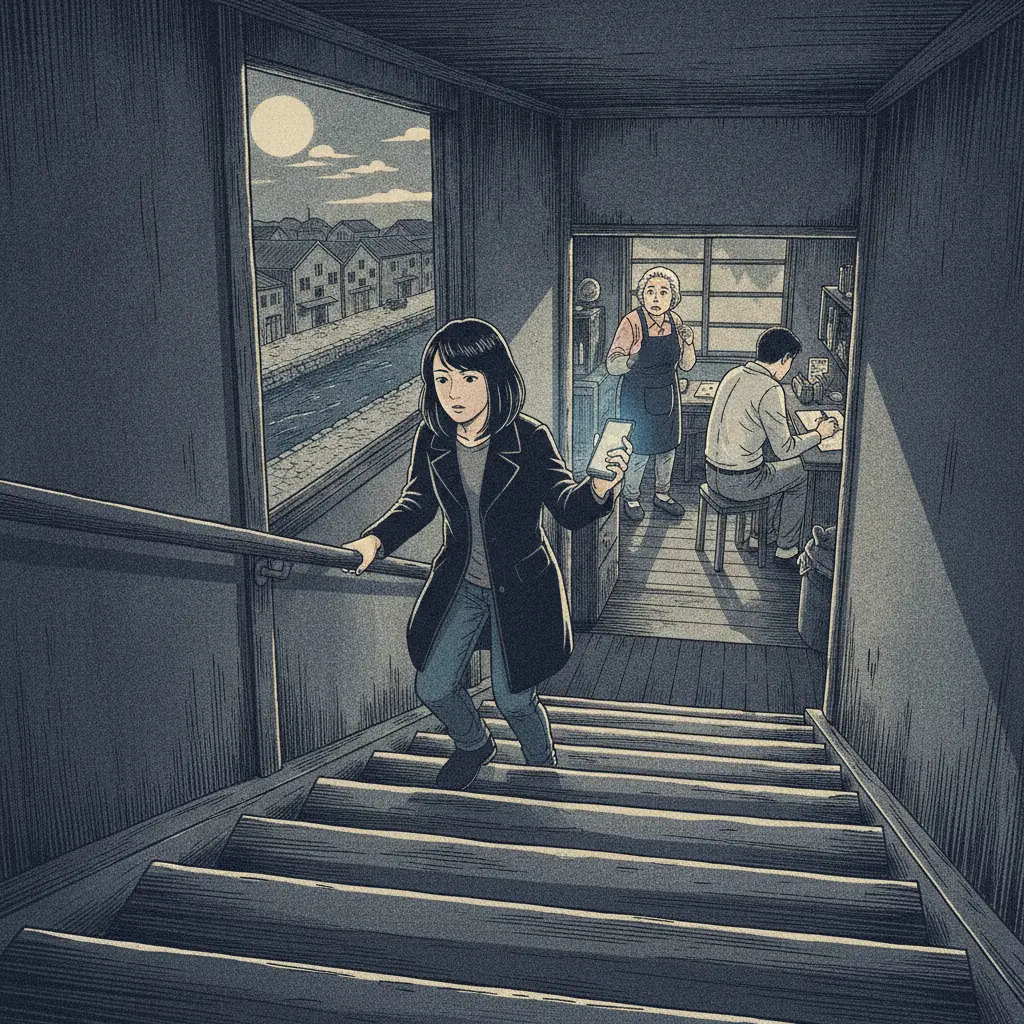
On the third night, I made up my mind and climbed the stairs. It was nine in the evening; Kishima would still be up. I brought no torch, only the light from my mobile phone. The staircase was steep, and the treads groaned underfoot. Twelve steps up, I emerged into a low-ceilinged space.
The impression was less of a storage room than of a place that had simply been abandoned. Several old wooden crates were stacked to one side, and something that might have been furniture sat against the wall under a plastic sheet. The air was different here. Not cold exactly — denser, as though it had more substance. When I breathed in, I had the strange sensation of something filling my lungs.
When I swept the light across the room, I saw something affixed to the far wall. I moved closer. It was an old photograph. The paper had yellowed and the edges had curled away from the surface. Black and white — a group of men standing before a stone wall. From their clothing, it appeared to be from the Meiji or Taisho period. All the men were facing the camera.
One of them made me stop.
The man at the far right was standing in a way that was subtly different from the others. His body was turned slightly to the side, though his face was directed toward the lens. And his feet —
I brought the light down to his feet. They were not touching the ground. Where every other man stood plainly on the cobblestones, this one appeared to be floating — just a few centimeters — above the surface.
A distortion in the old photographic paper, I told myself. I tried to believe it.
And then, behind me, a sound.
From the direction of the staircase, heavy footsteps were ascending. One step. Then another. The intervals, as before, were too long.
I turned and moved toward the staircase opening. I hurried down with the light aimed at my feet. When I reached the corridor, the footsteps had stopped. I went into my room, locked the door, checked the window, got into bed, and lay with my eyes open until dawn.
The next morning, Saeki did not come to breakfast. When I asked Kishima, she said, "He checked out late last night. It seemed to come to him suddenly." I thought that a strange thing, but said nothing.
That afternoon I debated whether to extend my stay. My reservation was for five nights, and I still had one remaining. Part of me felt there was nothing to go back to in Tokyo. And I couldn't stop thinking about the photograph on the third floor — in daylight, perhaps, it would be clearer.
When I went up in the afternoon, the photograph was in exactly the same place. The group of men. The man at the far right. Even in the light of day, his feet appeared to hover above the ground. I tried to remove the photograph from the wall, but it would not move — fixed there by something I couldn't see.
Instead, I tried to look behind it, and when I shifted the edge of the frame, I noticed a small piece of paper wedged between it and the wall. I drew it out. It was written in pencil, in old-fashioned orthography that took me a moment to parse.
"He who dwells here cannot depart. The bones of the one who laid these walls remain here still. He who has seen your face has remembered your face."
I slipped the paper carefully back. My hands were trembling.
That evening at dinner I watched Kishima. In the middle of ordinary conversation, I asked as casually as I could: "There's an old photograph on the third floor. Who put it there?"
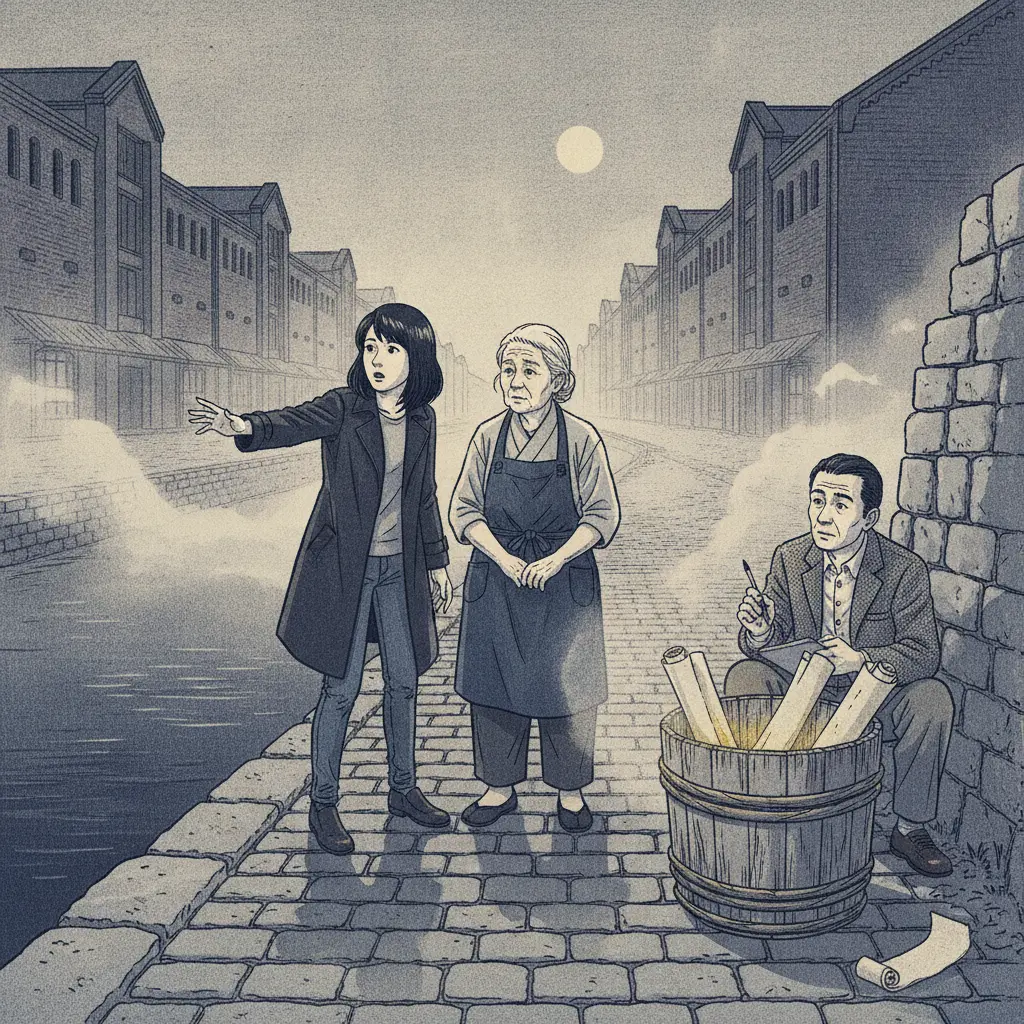
Kishima's hands paused for just a moment. "Someone left it behind. It's been there as long as I can remember."
"Who?"
"I couldn't say." She smiled. "Perhaps a previous owner of the building."
"There's a man in the photograph whose feet aren't touching the ground."
Kishima looked at me. The same look as before — quiet, as though confirming something. "Is that so," she said, and nothing more.
I went back to my room and began to pack. I would check out early in the morning. The more I thought about my reasons for leaving, the more they accumulated — the floating feet in the photograph, the footsteps in the night, Saeki's sudden departure, Kishima's eyes.
As I packed, I found myself drawn to the window. I looked across to the far bank of the canal, and there was the figure again. This time in a different spot from before — positioned directly opposite my window. It was too dark to make out clearly, but I could tell it was facing my way.
I drew the curtains.
I woke at five in the morning. The window was still dark. I took my bag downstairs and left an envelope at the front desk — the remaining balance of my bill, with a short note that said "urgent matter." Kishima had not yet risen. I went down the stone steps, through the lane, and out onto the cobblestones along the canal.
The Otaru Canal before dawn was silent. The gas-style lanterns were still lit, casting their light on the black water. No tourists, no locals — no one. Only the sound of my own footsteps, echoing off the stone walls of the warehouses.
As I was passing in front of the warehouse on the far bank, I stopped. In the place where the figure had been standing the night before, I saw something. The thin frost on the cobblestones had melted in the shape of two feet — both feet, clearly defined. But the prints ended there. There was no trail leading to them, and none leading away.
I stood looking at them. Then, without meaning to, I compared them to my own feet.
They were nearly the same size.
As I walked to the station, I turned the words from the paper over and over in my mind. He who has seen your face has remembered your face.
I sat on a bench on the platform waiting for the first train to Sapporo. From the platform at Otaru Station, you could see the sea. The leaden water grew slowly paler in the light of the approaching dawn.
Back in Tokyo, I stood before a mirror again. I looked at my own face in the bathroom mirror — the face I hadn't seen in three days. Something in it seemed slightly different from before. Not the shape of it. Something behind the eyes. A quiet look, as though confirming something.
I felt I had seen that expression somewhere before.
It took me a moment to place it.
When I realized it was Kishima's eyes — the reflection in the mirror had already begun to smile.