

Thank You for Finding Me
AI AI-generated fiction — text, and any narration or images. Unrelated to any real events, people, organizations, or places.
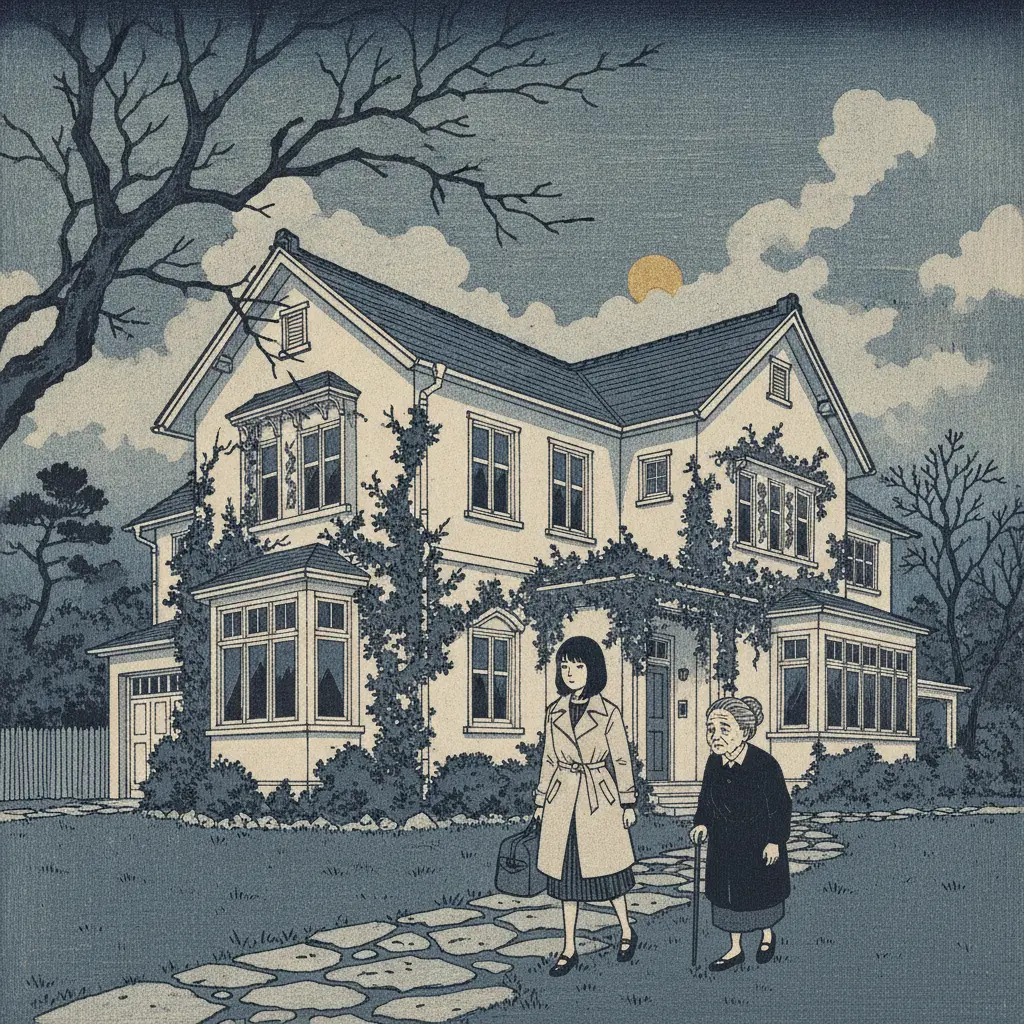
At the end of October, I moved to Yamate, in Yokohama.
The transfer from Tokyo had come suddenly, a matter of work, but the moment I saw the listing photographs the realtor showed me, I felt something pull at me — as though I were being drawn toward the place by a force I couldn't name. The house stood at the top of a narrow slope in Yamate-cho: a two-story Western-style building with white plaster walls threaded through with ivy, and a brass knocker on the front door. It was said to be over eighty years old, yet the interior had been kept with care, and the glass pendants of the chandelier hanging from the high ceiling caught the grey light of an overcast sky and glimmered quietly. The realtor explained the rent — nearly thirty percent below market — with a small laugh: "It's old, you see." I didn't press further. I had grown tired of my cramped Tokyo apartment, and more than anything, I couldn't shake the feeling that the house in those photographs was calling to me.
The Yamate district spreads across a hill overlooking Yokohama Harbor. The area had flourished as a foreign settlement from the Meiji era through the early Showa period, and even now it retains its red-brick walls and cobblestone lanes; in autumn, the ginkgo trees shed their yellow leaves across the slopes. Nearby, preserved Western-style buildings — Bluff No. 18 and Berrick Hall among them — stand as remnants of that era, drawing tourists on weekends. Weekday mornings were quiet, and sometimes the foghorns from the harbor below drifted all the way up to the windows of the house. I welcomed that stillness. Most of my editorial work could be done from home, and as long as I met my deadlines I could go an entire day without seeing another person. At the time, that seemed to me not a hardship but an ideal.
The day after I moved in, while unpacking boxes, I explored every corner of the house. The ground floor held a study, a dining room, and a kitchen; upstairs were a bedroom and one other room — a small room with a locked door. The realtor had mentioned it in passing: a storage room, he said, and the key was nowhere to be found. I hadn't given it much thought. But that night, lying in bed and staring up at the ceiling, I heard a faint sound coming from the direction of that room. The creaking of wood. An old building, I told myself — perfectly natural. Yet when I lay still and listened, the sound repeated at uneven intervals, with a rhythm that suggested not the settling of timber but something moving through the room. Someone pacing. I couldn't move for a while. Eventually I reasoned myself back to calm: it was the wind, or the wood expanding with the change in temperature. I closed my eyes and made myself believe it. By the time sleep came, the sound had stopped.
I met the old woman who lived nearby on the third day after moving in. She was sweeping the cobblestones on the slope when I greeted her, and she raised a face deeply carved with wrinkles and studied me for a long moment. Her name was Sugawara, and she had lived in the neighborhood for over forty years. "So you've gone into that house," she said. The phrasing struck me as slightly odd — gone into, rather than moved into — but I smiled and said yes, just recently. Sugawara-san was quiet for a moment, and then she said only: "Keep your lights on at night." I tried to ask why, but she had already turned back to her sweeping, and there was nothing left for me to do but thank her and walk away.
From that night on, I left a light burning while I slept. I couldn't have explained why — only that her words stayed with me. I kept the small lamp in the study on through the night, and its amber glow cast a long thin shadow across the hallway floor. The sounds from the locked room continued after that, though not every night — sometimes there were three days between, sometimes a full week. The irregularity, oddly, was what steadied me. A pattern would have been frightening; random sounds could still be attributed to an aging structure. I tried to keep believing that.
In November, as the ginkgo trees in Yamate began to shed, I went into the garden for the first time. Behind the house was a small yard, and on its stone paving stood a rusted iron table and two chairs. When I saw them in the morning light, I had the sudden, inexplicable impression that someone had recently been sitting there, taking breakfast. One chair's seat was covered in fallen leaves. The other was bare. Wind, if it blew at all, should have scattered leaves across both equally — yet one looked as though it had been carefully cleared. I went closer to examine it, but found nothing unusual. Only the flagstones beneath the chair's legs, worn slightly smooth, as though the chair had been pulled out and pushed back many times over many years.
That Thursday night, I was at my desk working on a manuscript when I looked up. Outside the study window, on the garden side, a figure was standing. It was there for only an instant; when I looked again, there was nothing. My heart hammered. I rose from my chair and went to the window. Outside was dark, the garden barely visible — the table and chairs floating dimly in the thin light from the street. No figure. I breathed slowly and told myself I had imagined it. But I couldn't sleep that night. In the morning, when I went out to the garden, one of the two chairs had shifted. Where it had faced the hedge at the far end of the yard, it now faced the windows of the house.
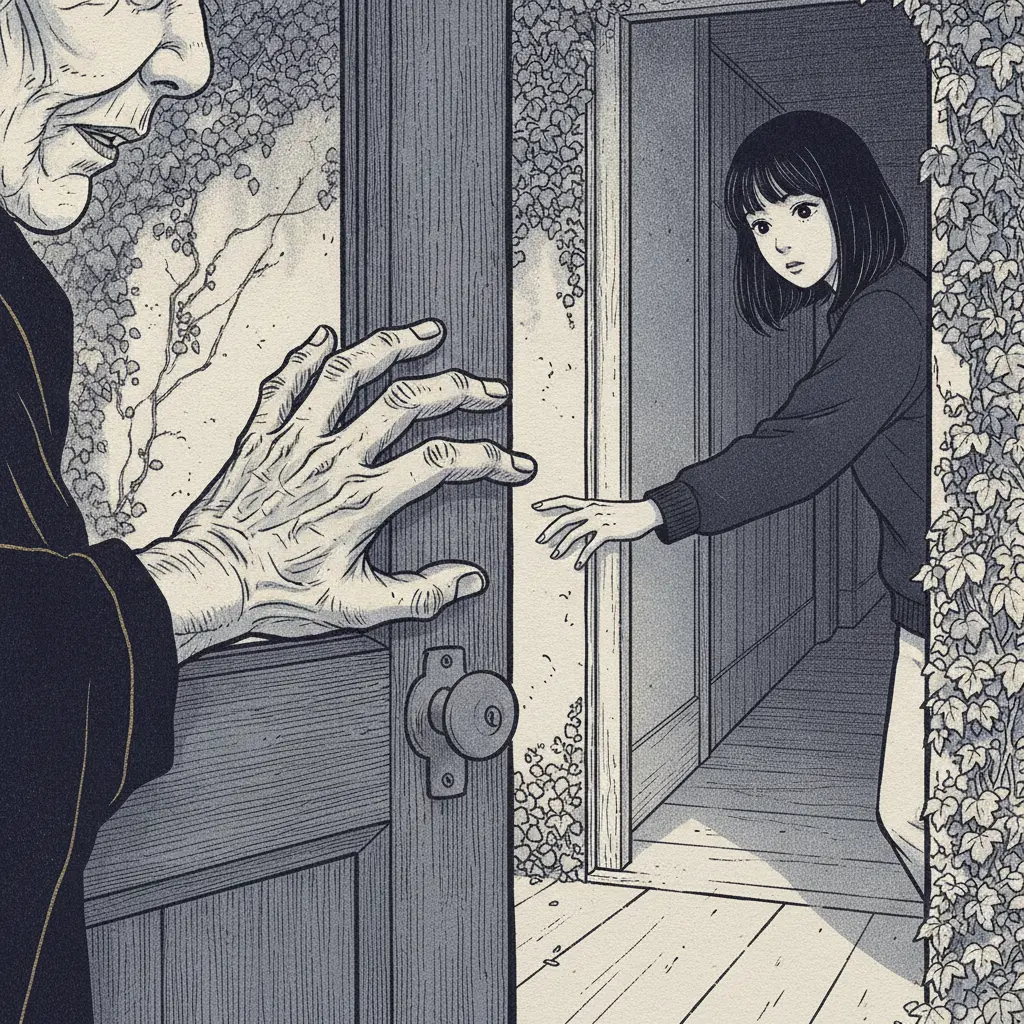
I went back to see Sugawara-san the following day. She opened her door only halfway at first. When I told her about the garden chair, her expression changed. "So you've started to see," she said. "See what?" I asked. She was silent for a long time. Then she opened the door the rest of the way and let me in.
Her house was modest by Yamate standards, but the ceilings were high, and the walls were hung with old photographs. She brought tea, and while I waited I looked at the pictures. One stopped me. A black-and-white photograph, taken in front of the very house I was renting. Several figures stood before it. At the center was a woman in a long dress, her face slightly blurred but with high cheekbones and a composed, fine-featured look. Beside her, a man. And between them — only a child's hand. No body. Just a small hand, floating in the space between the two adults, as though the child had been erased from the image but the hand had remained. I began to say something, but Sugawara-san spoke first.
"There has always been something in that house," she said. "Something?" I asked. "A little girl," she continued. "She died there before the war. I don't know her name. But she has always been there — before you moved in, after the last tenant left, always." I asked about the previous tenant. She paused before answering. "They left in less than a year. They never told me why, but the last time I saw them, the color had gone out of their face entirely." I looked again at the child's hand in the photograph. Small, pale. The fingers were slightly curved — as though reaching to take hold of someone else's hand.
That night I bathed early, turned on more lights than usual, and lay down in bed. I expected to lie awake for hours. Instead I fell asleep quickly. I dreamed I was standing on the garden's stone paving in a low, fog-filled night. Someone was sitting in the iron chair. I couldn't see a face — only a small body, rocking gently back and forth, slowly, slowly, as though on a swing. I tried to move closer but my feet would not obey. Then the figure turned toward me. Where a face should have been, there was only fog. And yet I knew, with a certainty I could not explain, that it was smiling. I tried to cry out in the dream, but nothing came from my throat. When I woke, the room was still dark, and the clock read three in the morning.
The next morning, I stood before the locked door on the second floor and put my hand on the knob. I expected it not to turn. It turned. The door swung open.
The room was dim, lit only by the thin light that crept in around the edges of the curtained window on the far wall. In the center of the room stood a small wooden chair — a child's chair. On its seat sat a doll. It was old, made of cloth, its face stitched with embroidery: black thread for the eyes, red thread for the mouth. I stared at it. The mouth seemed slightly crooked. No — I corrected myself — that was simply the shape of the stitching, the way the pattern had been sewn. I tried to hold onto that thought. But then I noticed a small slip of paper resting on the doll's lap. I picked it up. It was old stationery, the ink faded. The writing was Japanese, but the characters were archaic and difficult to read. I stood there, leaning close, until at last I made them out. "Thank you for finding me," it said.
I walked out into the hallway still holding the paper. My back had gone cold. The paper was clearly old — the ink long since faded. If that was so, it had been here all along. But the realtor had said the key was nowhere to be found. Had someone unlocked the room and placed it there? Or had the paper always been there, and had the door never truly been locked at all? I thought back to the night I moved in. Had I tried the knob then? I hadn't. I had simply taken the realtor at his word and never tested it myself.
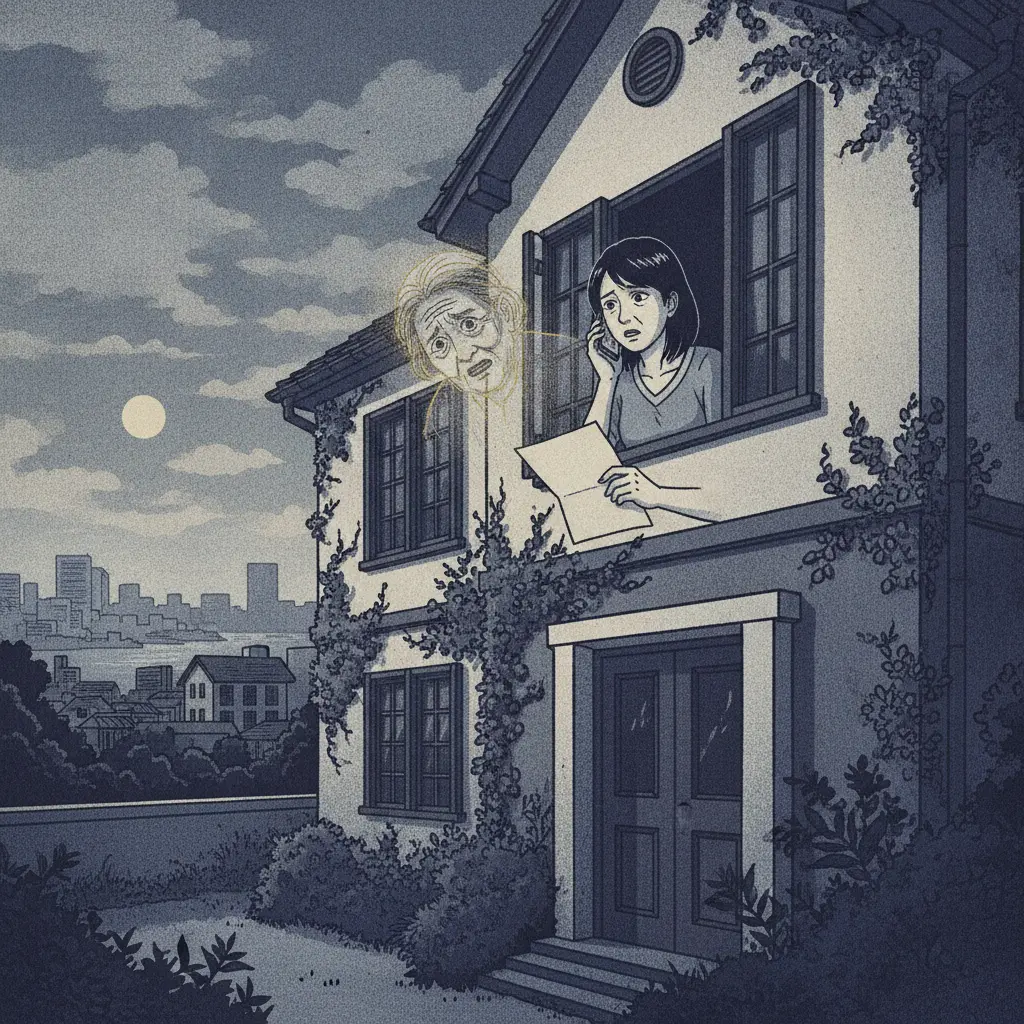
I called Sugawara-san and she answered immediately. When I told her about the doll, there was a long silence. "You shouldn't have touched it," she said. "I already have," I replied. Another silence. "And the paper?" she asked. "I'm holding it." "Put it back," she said. "Back where?" "Where you found it. Gently, just as it was. Then leave the room." I noticed that her voice was faintly trembling — this woman who had lived in this neighborhood for over forty years. I hung up without another word and went back upstairs.
When I re-entered the room, the doll on the child's chair was facing a different direction than before. It was facing the way I had come in. With trembling hands I set the paper down on the floor in front of the chair. The doll's gaze seemed to fall upon it. I left the room and pulled the door shut. This time the knob would not move at all — as though it had been locked from the very beginning.
That night I gathered what I needed into one bag and checked into a business hotel near Yokohama Station. When I returned to Yamate the following morning, the house stood as it always had, quiet on its hill. Morning light fell on the white plaster walls; the brass knocker gleamed dully. I went inside. I couldn't have said why I came back — only that I felt I had to confirm something. I moved through the ground floor and found nothing out of place. Then, on the dining room table, I found a coffee cup. I had made coffee the day before. But I had left the cup in the sink. The cup was on the table now, and the liquid inside it was still warm. I stood there without touching it.
Climbing the stairs, I counted my footsteps. Twelve steps. The landing. Seven more. The hallway. I stopped in front of the locked room. Light was seeping under the door. From a dark room with its curtains drawn shut — light. I put my hand on the knob. The cold of it was not the cold of metal; it was something deeper, something without temperature pressing back against my palm. I turned it slowly. The door opened.
The room was as I had left it. The child's chair. The doll. The paper on the floor. But the curtain at the window had been drawn slightly open, and morning light was coming through. In that light, dust moved through the air — slowly, the way it drifts after someone has passed through a room. I stood in the doorway and did not go in. I looked at the doll. Its black-stitched eyes looked back at me. The red thread of its mouth — I was certain now — had been resewn since yesterday. It curved upward. It was smiling.
"Are you here?" I said aloud. My voice surprised me with its steadiness. There was no answer. But the dust in the room stirred once, as though in response to my words, and then was still. That was all. I closed the door. I stood in the hallway and could not move. Then something touched my foot. Something unmistakably touched me. I looked down. Nothing was there. But the sensation did not leave — the feeling of a small hand closing gently around my ankle.
I went slowly down the stairs and out the front door. On the slope, I turned back. In the second-floor window, a small shadow stood behind the curtain, watching me. I kept walking down the hill. I did not run. It was not that I couldn't — it was that I understood there was no need. Whatever was in that window had no intention of following me. It was only watching me go. That, more than anything else, was what frightened me.
When I called the realtor to cancel the lease, he didn't sound surprised. "Of course," he said simply. The paperwork was handled without difficulty; the matter of a penalty fee never came up. I returned one last time to collect my belongings, and I said goodbye to Sugawara-san at her door. She looked at me and said only: "Good." "What's good?" I asked. She thought for a moment. "That you could leave," she said. "You mean me?" I asked. She didn't answer.
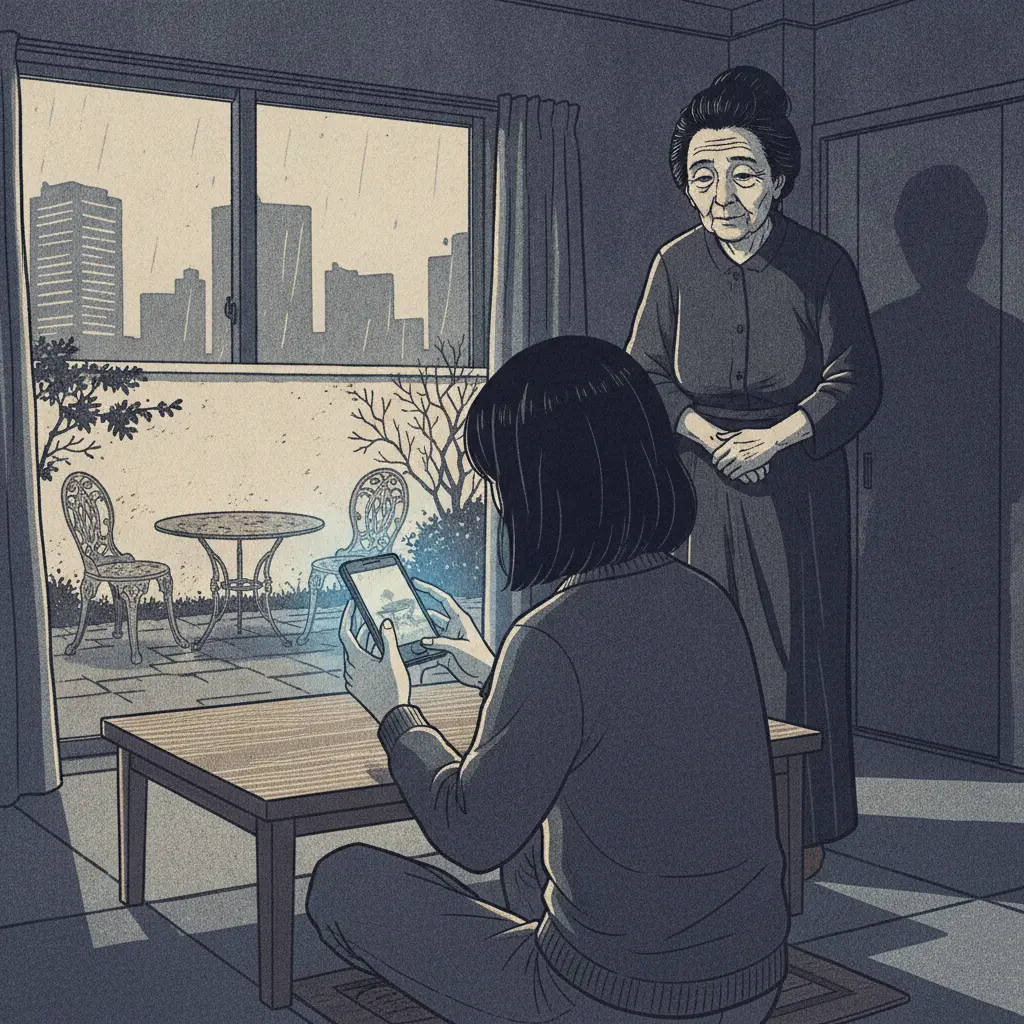
After I returned to Tokyo, I realized I had brought back one photograph — taken during the move, a picture of the garden. The iron chairs and table, the white wall of the house behind them. I didn't look at it until three days after I was back. I opened it on my phone and enlarged it.
In the photograph, someone was sitting in one of the two iron chairs. A small, pale shape. No face was visible. But the figure's hand rested on the table, and its fingers were extended toward the camera — stretched out as though reaching across the table toward someone seated on the other side.
I tried to delete the photograph and found I could not. Each time I pressed delete, the screen returned to the image unchanged. I tried three times and gave up. The photograph is still on my phone. Sometimes, without warning, the screen wakes and opens to it on its own. Each time it does, I have the sense that the direction of those outstretched fingers has shifted slightly. When I first noticed the hand, the fingers were pointing across the table. Now they are pointing, without any doubt, directly at me.
In the Yamate district, autumn will be deepening today. The ginkgo leaves will have fallen, the cobblestones will be damp, and the foghorns will carry from the harbor all the way up the hill. The white plaster house will still be standing on its slope. The brass knocker will be waiting, gleaming dully, for someone to come. Behind the curtain of the second-floor window, there may be a small shadow.
Or perhaps not. Perhaps it is no longer there.
Because since last week, at the end of the hallway in my apartment, there is a door with a lock. A door that was not there when I moved in two years ago. I contacted the building management company, and they told me there is no such door. But the door is there. At night, light seeps from beneath it. And sometimes, from the other side, I hear small footsteps — slow and measured, going back and forth, as though someone is pacing the room while they wait for me.
I have not yet touched the knob.