

The Weight of the Inner Sanctum
AI AI-generated fiction — text, and any narration or images. Unrelated to any real events, people, organizations, or places.
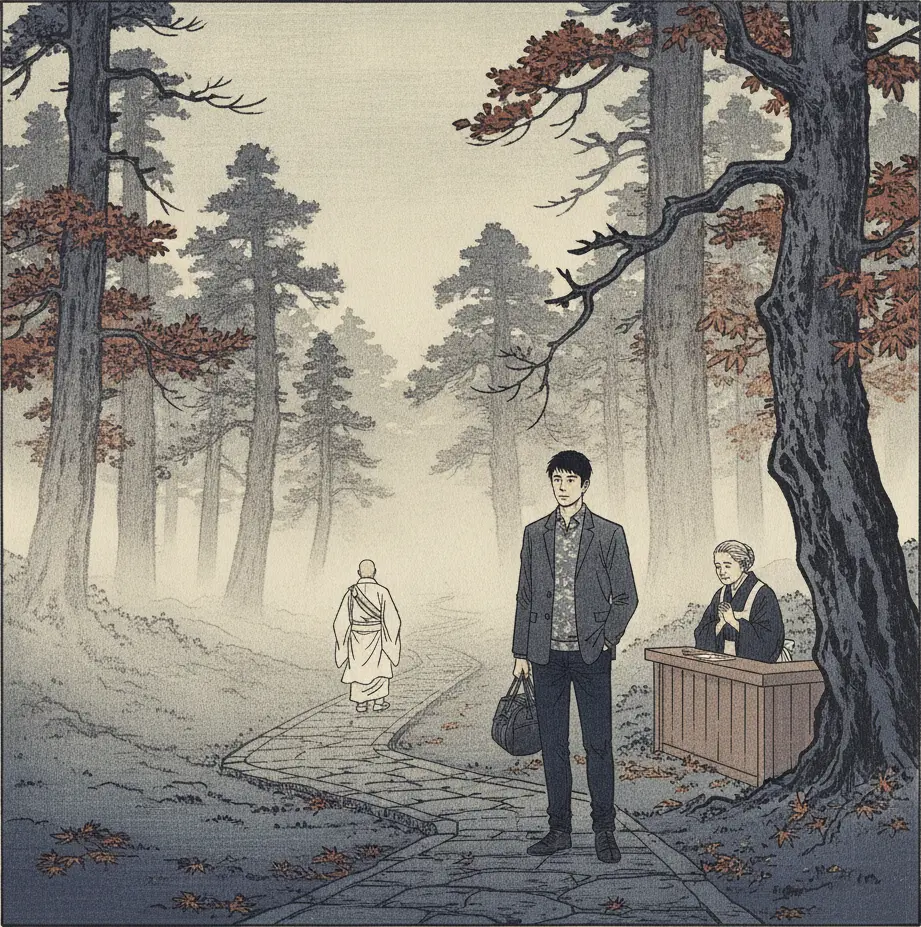
In late October, riding the Nankai Kōya Line from Hashimoto Station to Gokurakubashi, Tanaka Seiji (田中誠二) watched the mountains outside the window slowly change color. It was less autumn foliage than the mingled red and brown of coals burning themselves out, and the sky hung low and white in every direction. Seiji was thirty-eight years old. Two weeks had passed since he had pressed his seal onto the divorce papers. He had come to Mount Kōya on a friend's suggestion, not out of any particular faith. He simply needed different air. Alone in his Tokyo apartment, he had felt the walls drawing imperceptibly closer, and the sleepless nights had been piling up.
He descended from the cable car, transferred to a bus, and got off at the Okunoin stop, where ancient cedars lined both sides of the path. Some were said to be several centuries old, and they looked as though they were drawing the mist up through their roots. The stone-paved approach was damp, and each footstep produced a flat, muffled sound. Seiji adjusted the straps of his rucksack, checked his map, and set off toward the temple lodging. Tonight's accommodation was a small shukubō called Hōsen-in. The photographs on the booking website had shown a composed wooden building and a garden spread with green moss. The reviews described it as quiet and calming, though one post mentioned footsteps in the corridor at night — something Seiji had taken for the kind of atmospheric exaggeration people indulge in.
He arrived at the lodging just after three in the afternoon. Sliding open the front door, he was immediately wrapped in the smell of incense. A woman who appeared to be in her sixties sat at the reception desk. She bowed silently when she saw him. He gave his name; she wrote something in a ledger and handed him not a key but a small wooden tag. "Your room is at the far end of the corridor, the last one," she said. Her voice was low, and she moved her lips as little as possible. When Seiji asked whether there were other guests that evening, she paused for a moment before answering: "You are the only one."
The room he was shown to was an eight-mat tatami room with a hanging scroll in the alcove. The scroll appeared at first glance to show Sanskrit characters rendered in ink, but looking more closely, Seiji thought he could see lines resembling human figures layered one over another. He set down his rucksack and looked out the window. A single stone lantern stood in the garden, its base thick with moss. A sparrow was perched on the lantern's cap. When Seiji stepped toward the window, the bird did not fly away — it simply turned its head toward him. Not the movement of a bird shifting its weight, but a rotation of the head alone, as though on a pivot. Seiji told himself it was nothing and moved away from the window.
He attended the evening sutra service. When he was led into the main hall, the elderly priest — presumably the head priest — had already begun chanting. Candlelight wavered, and the sound rose and echoed through the high space. Seiji sat on a cushion at the back and closed his eyes. The chanting washed over him in waves, and thoughts surfaced and dissolved: the divorce, the emptied Tokyo apartment, the last thing his wife had said to him. "You always look as though you're watching something, but you never see anything." The words repeated themselves in his mind until he could no longer tell whether he was crying or drifting toward sleep. When the chanting ended and he opened his eyes, the priest was gone. Only the candles burned. He was alone. He had no idea when it had ended, no idea when the priest had left.
The vegetarian dinner was laid out for him alone in a large dining room — simmered tofu and root vegetables, sesame tofu, pickles. While he ate, his attention kept returning to an old dressing mirror propped in the corner of the room. It clearly did not belong there as a piece of furniture; it looked as though someone had placed it temporarily. The mirror's surface was slightly clouded, and Seiji's reflection floated dimly within it. At one point he noticed that the figure in the mirror seemed to continue lifting its chopsticks even after Seiji had set his own down. He narrowed his eyes and looked again. The reflection was still. He decided he was tired, finished his meal, and returned to his room.
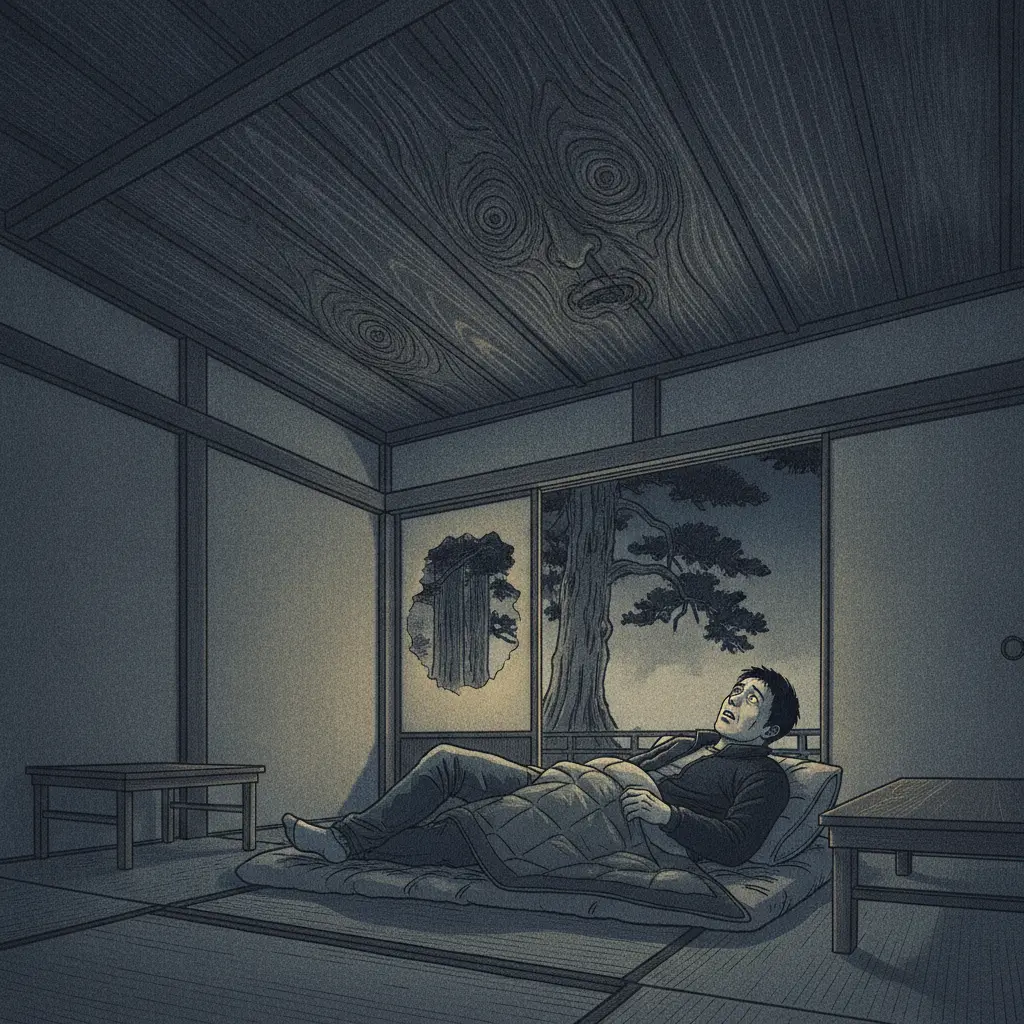
He got into bed before nine. Night comes early on Mount Kōya, and the corridor of the lodging was already dark. He switched off the light and lay staring at the ceiling. The cedar planks were marked with knots, and as his eyes adjusted, the knots began to resolve into faces. He knew it was a common trick of perception, but once seen, the faces could not be unseen. Two eyes, a protrusion like a nose, a mouth slightly open. He turned onto his side. Outside, the silence was absolute — not even the sound of wind. Within that silence, there was a low sound, as though coming from a great distance. It resembled chanting but was pitched differently. He could not determine whether someone somewhere in the lodging was reciting sutras, or whether it was simply his own ears ringing.
He woke in the middle of the night. The clock read 1:17 a.m. What had woken him was a sound from the corridor — not the sound of footsteps on hard floorboards, but something wet being dragged. Seiji held his breath beneath the covers. The sound stopped in front of his room. Something was standing on the other side of the sliding door. He could not move. Whether a minute passed or five, he lost all sense of time. Then the sound receded. He got up, went to the door, and opened it a crack. The corridor was empty. But along the floor, from the spot in front of his room to the wall at the end of the corridor, ran a trail of wet marks, like damp footprints.
The next morning he told the woman at the reception desk about the sound in the night. She listened with almost no change of expression and said, "Sounds do occur at night on this mountain. Most likely the old building settling." Then, after a brief pause, she added: "Though this time of year, in particular—" When Seiji asked what she meant, she smiled and said only, "It is a season when many come to pay their respects," and let the matter rest. Unsatisfied, Seiji decided to walk to the Okunoin inner sanctuary.
The approach to the Okunoin lay deep in morning fog. The great cedars were wrapped in it, and the gravestones lining both sides of the path were wet and gleaming black. A handful of other visitors moved through the mist, but they vanished quickly. Walking, Seiji's eye was caught by one particular gravestone — that of what appeared to be an Edo-period samurai, with characters carved into its side. He moved closer to read them, and realized that what he had taken for carving was not incised into the stone at all, but something adhering to its surface. As he drew nearer, he saw that it was a clump of moss in the shape of a hand. Five fingers spread wide, gripping the stone. He stood before the grave and could not move. Out of the fog, a figure approached slowly from the depths of the path — an elderly man in white robes, carrying prayer beads. He came to stand beside Seiji, glanced at the gravestone, and murmured, "That's not right." When Seiji asked what he meant, the old man walked on without answering.
Back at the lodging, he lay down in his room for a while. When he woke in the early afternoon, the air in the room had changed. The smell of incense was stronger, and he assumed someone had entered and burned incense while he slept — but the incense holder was empty. He looked again at the hanging scroll in the alcove. Something about it seemed different from the morning. The arrangement of the lines felt subtly shifted from what he remembered. He approached and examined it closely. The lines still appeared to show layered human forms, as they had the day before, but today one line seemed to extend slightly beyond the lower edge of the scroll itself — a single thin stroke of ink running vertically down the white margin of the paper. Seiji reached out to touch it, then stopped himself just before his fingers made contact.
In the late afternoon he walked in the lodging's garden. Moss-covered stones were arranged throughout, and at the far end stood a small shrine. Before it sat offerings: a small dish of salt and a cup of water. The water was clear, but something was reflected in its surface — not the color of the sky, but something dark. Seiji leaned over to look. He expected to see his own face. The face that looked back was not his. The outline was similar, but the expression was wrong. The face was smiling. Seiji was not smiling, yet the face in the water was. He straightened and went back inside. Passing the reception desk, he noticed the ledger lying open. On today's page, below his own name — Tanaka Seiji — there was another entry. But it was not a name. It was not characters at all. A symbol in the shape of a human figure occupied the line below his.
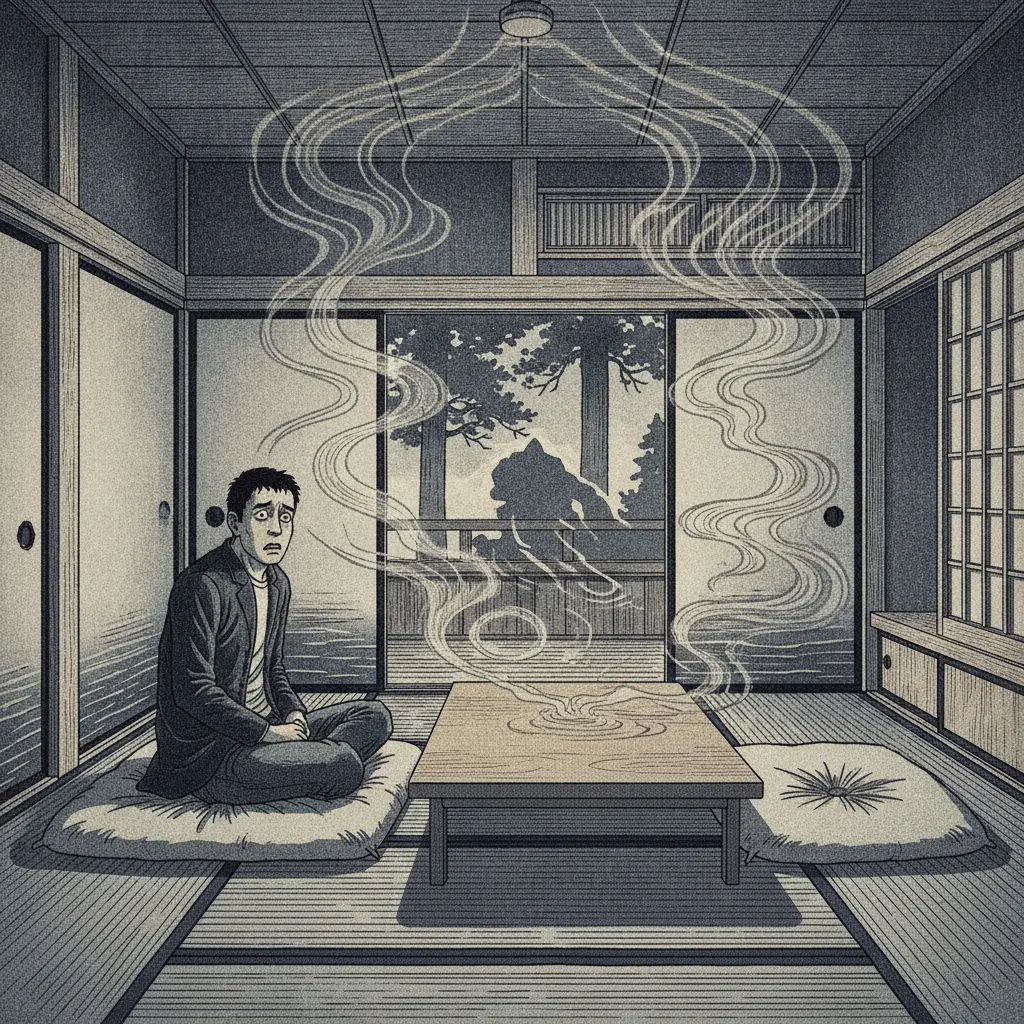
That night, Seiji could not sleep. He sat upright on the futon and watched the four corners of the room. There was nothing. But the sense of nothing could not be trusted. The air in the room was heavier than it had been in the afternoon, and with each breath the smell of incense reached deeper into his lungs. Late in the night, the sound came again — the same sound as the night before, something wet being dragged. But tonight it did not stop in front of the room. The sound came through the door. The sliding door had not opened. The sound passed through it and stopped inside the room. Seiji sat rigid on the futon and stared ahead. There was nothing in the room. And yet in the place where nothing was, there was weight. A distortion in the air, a sense of something at the edge of vision that disappeared when he looked directly at it — that kind of weight. He could not make a sound.
The weight moved toward the edge of the futon. Seiji felt it. There was no contact. But the futon sank slightly — the edge dipping as though someone had sat down on it. He could not breathe. His wife's words repeated in his mind. "You always look as though you're watching something, but you never see anything." The voice was no longer his wife's. Someone else was speaking those words — a low, dry voice. Seiji closed his eyes. Behind his eyelids there was no light. More than no light: the darkness behind them was deeper than it should have been, as though the space there extended further than it had any right to. Within that darkness, a shape was forming. It had the outline of a person, but the proportions were wrong. The neck was too long. The arms were too thin for the body. The shape was facing him.
Morning came. Seiji had apparently fallen asleep without knowing it, and woke lying on his side. His body would not move. He recognized it as sleep paralysis, and after a few minutes he was able to sit up. He looked around the room. The hanging scroll was gone. The alcove was bare; only the nail from which it had hung remained. He went out into the corridor and walked to the reception desk. The corridor showed no trace of last night's wet marks. The same woman sat at the desk. He told her the scroll had disappeared. "That scroll?" she said, and after a moment's thought: "The head priest must have had it taken down last night." When Seiji asked why, she said, "For your wellbeing." He repeated the words back to her: "For my wellbeing?" She said yes, and then narrowed her eyes just slightly. "It seemed that something had attached itself to you."
It took several seconds for the words to reach him. "Attached itself — what do you mean?" The woman answered quietly. "Please don't be troubled. On this mountain, it is not uncommon. The head priest recited sutras in front of your room last night. By this morning, it should be all right." Seiji could say nothing. The priest had recited sutras in front of his room. Was that the sound he had heard in the corridor? But the sound had moved through the corridor and entered the room. After it entered the room, the edge of the futon had sunk. He told her he would be checking out. She bowed her head quietly. "Go safely," she said — only that. The phrase struck him as strange.
He took the bus to Kōya-san Station, descended by cable car, and stood on the Nankai Line platform. Waiting for the train, he looked down at his hands. On the back of his right hand there was a thin line. Not a cut — a line. A single fine mark running vertically along the skin, as though drawn there by something. He could not tell whether it had been there the night before and he had simply not noticed, or whether it had appeared this morning. He traced it with the fingers of his left hand. It seemed to lie on the surface of the skin, and yet it also seemed to rise from somewhere beneath. The train arrived. He boarded and took a window seat. As the mountains fell away behind him, the fog lifted and the colored leaves came into view. Seiji looked at his own reflection in the window.
The face in the window was smiling.
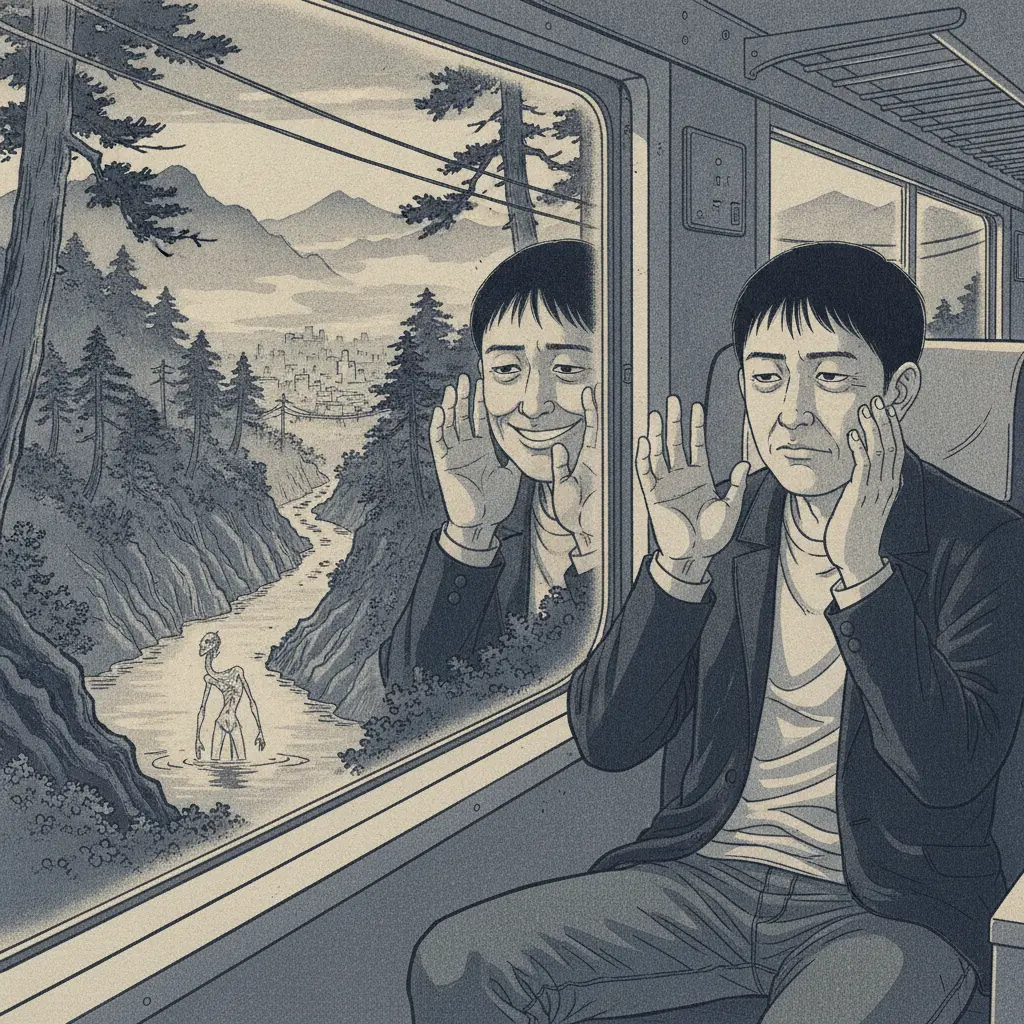
Seiji was not smiling. His lips were pressed together. But the face in the glass had its corners slightly raised. He raised a hand to his own face. The muscles were not moving. Still the face in the window went on smiling. He lowered his hand and tried to look away from the window. He could not. The face in the glass was holding his gaze. The train descended from the mountains and the city drew near — more power lines, more buildings, the distant suggestion of human voices. Seiji tried to fix his attention on the passing landscape. Trees, a cliff face, a river, a bridge. As the train crossed the bridge, the surface of the river caught the light. In that flash of light, for just a moment, he saw a shape. It had the outline of a person, but the proportions were wrong. The neck was too long. The arms were too thin.
He reached Hashimoto Station. On the transfer platform, he took out his phone. When he turned on the screen, the camera opened by accident in selfie mode. His face appeared on the screen. He moved to close it and stopped. Behind his face in the screen, there was another face. Over his shoulder, someone else's face was showing. He spun around. The platform was empty. He looked at the screen again. Now only his own face looked back. It was smiling.
Back in Tokyo that night, Seiji checked his face in the bathroom mirror. He was not smiling. He reconsidered the line on the back of his right hand, wondering if he had imagined it — but when he shifted the angle of the light, the line was still there. Thin, vertical, perfectly straight. He placed a finger over it. It was cold. His own hand, and yet that line alone had no warmth. He lifted his finger and looked at himself in the mirror. His face wore a serious expression. So did the face in the mirror. Relieved, he turned on the tap. Water ran, and the mirror fogged slightly. His reflection blurred at the edges. Within that blur, something moved.
He turned off the tap. The fog on the mirror slowly cleared. His face sharpened back into focus. The expression had not changed — still serious, still composed. But now Seiji noticed something. The eyes in the mirror were looking at a point fractionally to the outside of where his own eyes were looking. His gaze was directed straight at the mirror. But the eyes in the glass were directed at something slightly behind him and to his right. Something behind him. Something they could see. Seiji turned around slowly.
There was nothing in the bathroom. White tiles, a showerhead, and Seiji. He looked at the mirror again. This time the eyes in the glass looked straight back at him. Everything was ordinary. He turned off the bathroom light and returned to his room. He spread out the futon and lay down. He looked up at the ceiling. The ceiling of his Tokyo apartment had no knots — only white wallpaper. He closed his eyes.
Just before sleep took him, Seiji noticed. The edge of the futon was sinking.