

The Showing Shop
AI AI-generated fiction — text, and any narration or images. Unrelated to any real events, people, organizations, or places.
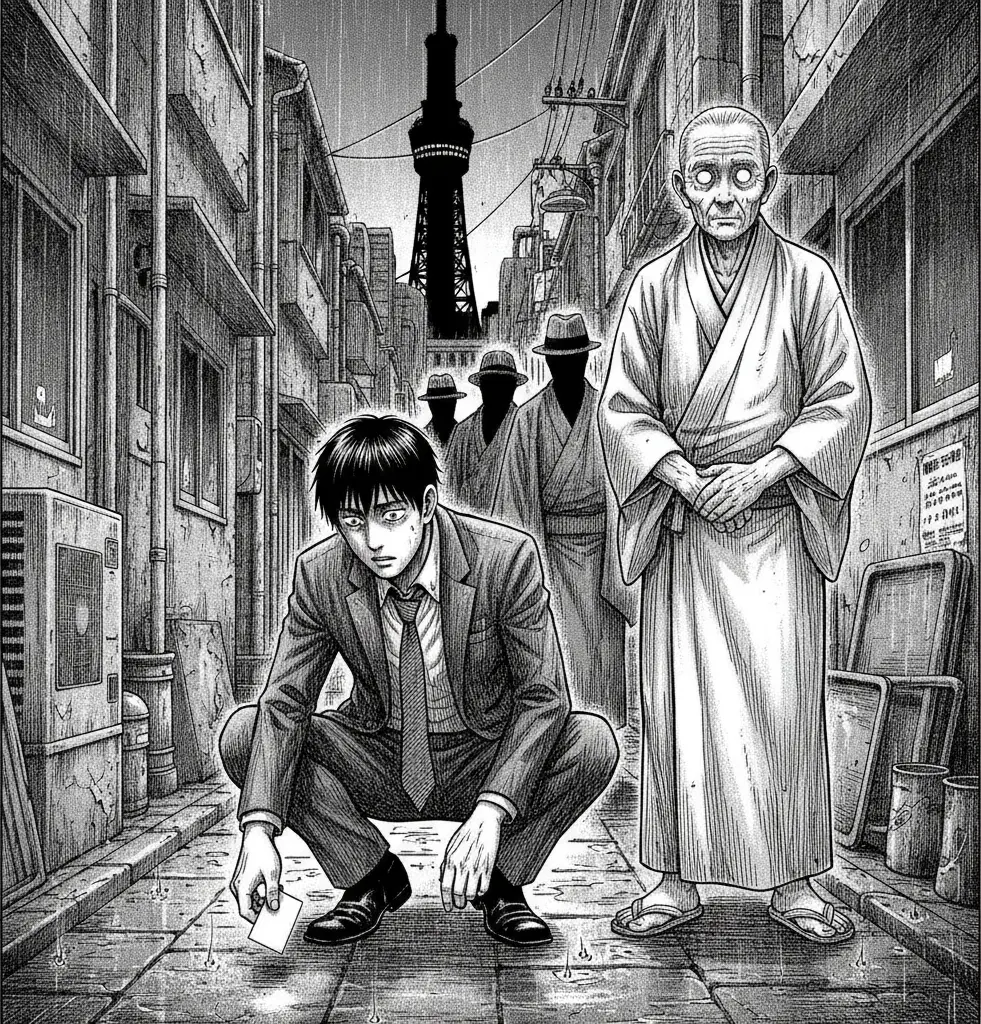
At the end of October, a thirty-four-year-old man newly transferred to Osaka found a single business card lying in an alley in Shinsekai.
His name was Murase Isao (村瀬 功). Three weeks had passed since his company, a Tokyo publishing house, had moved him to the Osaka branch. His work was advertising sales, and his evenings ended the same way each night — returning alone to an apartment along Sakaisuji with no one waiting for him. On a Saturday afternoon, wandering beneath the base of Tsutenkaku to clear his head, he found the card on the ground. Thick, yellowed stock, with characters that looked brushed in ink: "The Showing Shop — We Show Anything — Tsutenkaku East, Second Alley." In place of a proper address, a small hand-drawn arrow had been sketched along one edge.
Shinsekai was crowded that day, as always. Smoke from kushikatsu drifted through the air, the cries of touts overlapped one another, and tourists' cameras flashed. Tsutenkaku stood in its usual place against the pale autumn sky. Murase slipped the card into his wallet and began walking in the direction the arrow indicated — not so much out of curiosity as out of having nothing better to do.
East Second Alley appeared on no map. But then, most alleys in Shinsekai had that quality about them. When the kushikatsu shops ran out, the crowds thinned, and beside the sign for a shogi club there was a narrow passage. He stepped out past the end of the arcade, turned in one more time, and even in the middle of the day the light grew dim. The eaves hung low, electrical wires tangled overhead, and old brick showed through the ground underfoot. Less than ten meters in, there was a single wooden single-story building. A sheet of paper was fixed to the sliding door, and on it, in the same brushed characters, were the words: "The Showing Shop."
He slid the door open and a bell rang. Inside was a bare-floored room of perhaps six tatami mats, its walls covered with photographs pinned up with thumbtacks. All were black and white — faces, building exteriors, landscapes. They looked unremarkable, like old commemorative snapshots. In the center of the room stood a single old wooden chair. The curtain at the back stirred, and an old man came through.
He was small, dressed in a white work kimono. He looked to be past eighty, yet his eyes alone seemed strangely young — the irises large and dark, clear as water. He looked at Murase and said, in a low voice, "Welcome." It was not the tone of a greeting or a question. It was the tone of someone receiving a guest who had made a reservation.
"I found this," Murase said, holding out the card. The old man glanced at it and said only, "Is that so," then stepped to stand before the chair. "Please, sit. I'll show you something." Murase could think of no reason to refuse. He sat, and the old man stood facing him, hands folded together at his waist. "What would you like to see?" the old man asked. "What do you mean — what I'd like to see?" Murase said. The old man repeated, "What you want to see."
Murase thought for a moment, then said, lightly, "How about this city, the way it used to look." The old man nodded, and slowly passed both hands through the air in front of Murase. In that instant, the light in the room changed. The white fluorescence shifted to a dim, yellowish glow. The photographs on the wall seemed to be moving. No — they were growing larger. One photograph began to fill Murase's entire field of vision.
The Tsutenkaku in the photograph was thinner than the one he knew, its old steel frame exposed, and the streets at its base were packed with wooden buildings. Prewar, or just after — Shinsekai as it had been. People were walking. In the black and white, people moved, and there were sounds. A child laughed somewhere in the distance; someone shouted nearby. Murase sat in the chair and watched. It felt like a dream, yet his mind was strangely clear. He could feel the wood of the chair beneath him. He could hear the floor creak. This is real, he thought.
After about five minutes the light returned. The old man folded his hands at his waist again and said, "How was that?" Murase said, "Incredible." No other words came. The old man smiled faintly and said, "Please come again." He charged nothing. Murase thanked him and stepped outside, and the alley was filled once more with ordinary afternoon light. The bell rang behind him.
That night, Murase tried to explain the experience rationally. A projector, or some kind of trick, he told himself. But from the moment he had opened the sliding door to the moment he stepped back out, he had seen nothing in the room that resembled equipment. There were no holes in the ceiling. The photographs on the wall were no larger than the palm of a hand — no device capable of projecting them at that scale had been visible anywhere. The more he thought about it, the less it yielded to explanation, and lying in bed before sleep he recalled once more that yellow light, and the strange, impossible youth in the old man's eyes.
The following Saturday, Murase returned to the alley. This time he went deliberately. The bell rang when he opened the door, and the old man was already standing before the curtain, as though he had known Murase was coming. "What would you like to see today?" the old man said at once. "My grandfather's face," Murase answered. He regretted it as soon as he said it — it seemed disrespectful somehow. But the old man's expression did not change. "Understood," he said, and passed his hands through the air again.

The light changed. This time there was color. It was not the old man's room — somewhere else appeared. The engawa of an old house in the mountains of Nagano. Unmistakably his grandfather's house, the one Murase had visited a handful of times as a boy and never returned to after his grandfather died. His grandfather was sitting on the engawa. An aged back, white hair, a straw hat. Something rose in Murase's chest. The scene lasted about three minutes, then was gone.
On his way out, Murase asked the old man, "May I come again?" "Of course," the old man said — and it was then, for the first time, that Murase noticed something. The backs of the old man's hands were scattered with black spots. Too uniform in shape to be age spots. Round marks, perhaps ten of them if you counted. He thought he might be imagining it, and tried to look again, but the old man had already withdrawn behind the curtain.
After that, Murase began visiting the Showing Shop every Saturday. On his third visit he asked for "scenery from abroad." On his fourth, "my grandfather again." On his fifth, "my childhood bedroom." Each time, the old man passed his hands through the air without a word, the light in the room changed, and Murase sat in the chair and looked upon the past or upon distant places. He was never once asked to pay.
On the day of his sixth visit, Murase felt something was wrong the moment he stepped into the alley. Felt is not quite right — his body knew before he did. His legs grew slightly heavy. The smell of the alley had changed. Within the usual mixture of oil and dust there was something sweet and cloying — like rotting fruit. But the alley itself was unchanged. Tangled wires, low eaves, old brick underfoot. The same alley as always.
The bell rang when he opened the door, but today the old man was not there. Only the chair stood in the bare room. Murase called out, "Excuse me." After a moment the curtain stirred and the old man appeared. He was not wearing his white work kimono today but a black formal kimono. His color was poor. No — it was not his color, exactly. The shape of his face seemed different. The way his cheekbones sat — it was not the same as last week. You're imagining things, Murase told himself. A person's face cannot change shape in a week.
"What would you like to see today?" the old man said. His voice was the same as always. "I haven't decided anything in particular," Murase answered. The old man was quiet for a moment, then said, "Then I will show you what you ought to see." Murase felt a faint unease. "What do you mean, what I ought to see?" he asked — but the old man had already raised both hands and begun to move them through the air.
The light changed. This time it did not simply darken — something seemed to seep in from the edges of Murase's vision. At first it was a difference in color. The far edge of the bare floor grew slightly darker. Then, within that darkness, shapes appeared. Human shapes. Standing. Not just one. Three, four — more. All of them were facing Murase where he sat in the chair.
They had no faces. More precisely, they had faces, but those faces had no features. Eyes, nose, and mouth were each in their proper place, yet nothing could be read from them — no emotion, no age, no gender. Their skin was pale, their hair black, their clothes old. All of them were moving slowly forward, as though each meant to sit in the same chair where Murase sat. There was no sound. Not even the sound of breathing.
Murase tried to rise from the chair. His legs would not move. His body seemed fixed to the seat as though fused to it. The figures drew closer. The one at the front reached out a hand. On the back of that hand, black circular spots were scattered. The same spots as on the old man's hands. Murase tried to scream, but his throat made no sound.
The light returned. The figures were gone. The old man stood with his hands folded at his waist. Murase's shirt was soaked through with sweat against his back. "How was that?" the old man said, in his usual tone. His face still seemed different from the week before. The cheeks had fallen further. The eyes sat slightly lower. Yet the eyes themselves had not changed — black, large, clear as water.
"What did you show me?" Murase forced out. The old man paused, then said, "What you have been seeing." "What do you mean?" Murase said. The old man did not answer. He only said, "Please come again," and disappeared behind the curtain.
That night Murase could not sleep. He laid out all six visits in his mind, one after another. First, old Tsutenkaku. Second, his grandfather's engawa. Third, foreign scenery. Fourth, his grandfather again. Fifth, his childhood bedroom. Sixth, the faceless figures. Arranged in order, it looked like a trajectory of something changing. The first two were things Murase had asked for himself. So were the third, fourth, and fifth. Only the sixth had been different — the old man had said "what you ought to see" and shown it without being asked.

There was something else Murase noticed. Across the six visits, the old man's face had been changing, little by little. At first it had been the face of a man in his eighties. But with each visit the cheeks had fallen further, the contours had shifted, and by the sixth visit he looked like someone else entirely. It was not the progression of age. The shape itself was changing. As though he were becoming something other than what he had been.
Two weeks later, Murase could not make himself enter the alley. He came as far as the entrance, in front of the shogi club, and looked toward the far end. The shadows of the eaves, the tangled wires, the old brick underfoot — the same alley as always. But his feet would not move. The sensation of being fixed to the chair during his last visit had returned now to his feet at the alley's entrance. A sweet, cloying smell of rot drifted from the far end. Murase stood there for ten minutes, then turned and walked away.
Three weeks after that, Murase steeled himself and went in. He chose the middle of the day, when people were about. The noise of the arcade vanished the moment he stepped into the alley. Old brick, tangled wires, low eaves — all the same. But when he stood before the sliding door, he stopped. The paper on the door had changed. Below the words "The Showing Shop," a line had been added in handwriting: "For the seventh-time visitor — please come in."
No one but the old man could know how many times Murase had visited. He put his hand on the door. It was cold — as cold as if October had returned. The bell rang, and the bare room came into view. The chair was there. The photographs on the wall were there. But the old man was nowhere to be seen. The curtain was gone as well. The back wall was simply a wall. On it, a single photograph was pinned with a thumbtack.
Murase approached the photograph. It was black and white. A vertical image showing the bare room. The chair. And in the chair, a man — a man in a suit who appeared to be in his thirties. His face was turned forward. His eyes were wide open. His mouth was slightly parted. His expression was that of someone watching something. No — more precisely, it was the expression of someone being watched.
It was Murase himself.
Along the edge of the photograph, small words had been written in pencil: "The seventh time — there is nothing to show."
Murase looked away from the photograph. He looked at each corner of the room. At the ceiling. At the walls. There was no one. He opened the sliding door and stepped out into the alley. The bell rang.
Outside, the sweet cloying smell was gone. Wires tangled overhead, eaves hung low, the brick was old — the same alley as always. He walked toward the arcade, and the smoke from the kushikatsu reached him, and the voices of the touts returned. Tourists took photographs, children ran, and Tsutenkaku stood in the autumn sky.
That night Murase lay awake thinking about the photograph. When had it been taken? Who had taken it? A photograph of him, taken without his knowledge, had been fixed to the wall before he ever walked in. That was impossible. And yet the man in the photograph was unmistakably him. The suit, the shoes — the same ones he had worn that day.
There was something stranger still. The Murase in the photograph was watching something. Sitting in the chair, facing forward, eyes wide open, watching something. But when the photograph was taken, Murase had not been sitting in the chair. When he entered the room, the old man was gone. He had not gone near the chair. He had looked at the photograph on the wall, recognized himself, and walked back out into the alley. He had not sat in the chair even once.

The next morning, before leaving for work, Murase went to the alley. The sliding door was locked. The added line of text was gone. Only the words "The Showing Shop" remained.
That weekend, Murase stood at the entrance to the alley and looked toward the far end. He could see the Showing Shop's sliding door. It was closed. He did not go in. He only looked.
At the far end of the alley, the sliding door seemed to shift slightly. It had not moved. There was no wind. Murase narrowed his eyes.
On the other side of the sliding door, someone was standing.
The door was closed. And yet, through the wooden panels of that closed door, a human shape was visible. Only an outline. No distinguishing features. Height, build, age, gender — none of it could be read. But it was facing Murase.
Murase did not move.
The shape did not move either.
The noise of Shinsekai continued just behind him at the alley's entrance — touts calling out, kushikatsu smoke, tourists laughing, Tsutenkaku. Yet Murase heard none of it. He could hear it, and yet he could not hear it.
The shape on the other side of the sliding door grew slightly larger.
Was it drawing closer? Had the door opened? Murase could not tell. Only, where the eyes should have been on that shape, there was something that caught the light. Dark, large, clear as water — those eyes.
Murase stepped out of the alley. He returned to the crowd in the arcade and kept walking. He did not look back.
That night, changing in front of the mirror in his apartment, Murase looked down at the backs of his own hands.