

The Pinwheels of Osorezan
AI AI-generated fiction — text, and any narration or images. Unrelated to any real events, people, organizations, or places.
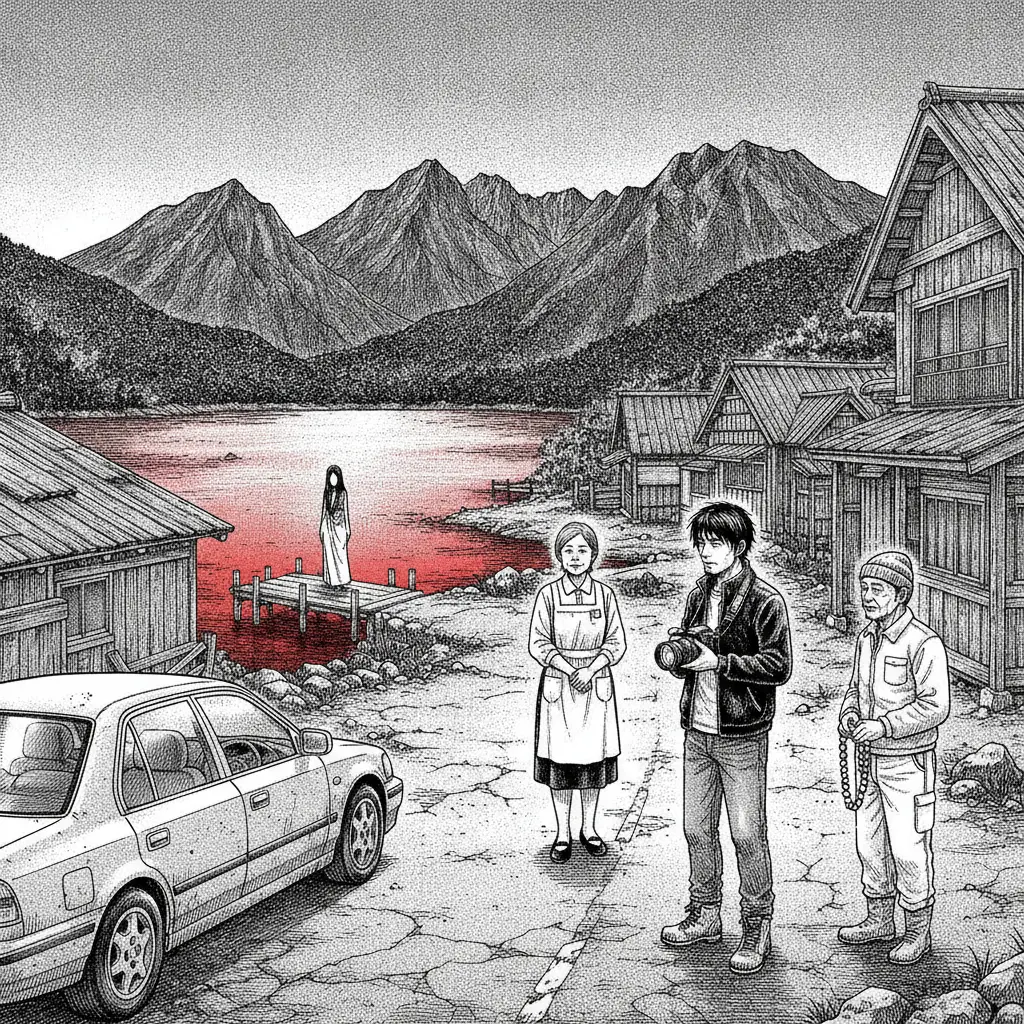
Tanaka Keisuke arrived at the village nestled at the foot of Osorezan at dusk, near the end of August. The surface of Lake Usori was stained red as blood, and beyond it the ridgeline of the mountains looked like the spine of a sleeping giant. Keisuke had driven seven hours from Tokyo, and after his navigation system announced that it had reached the end of its guidance, he had pressed on for another thirty minutes down a narrow road where the asphalt was peeling away before he finally arrived. He had come to gather material for a photography book. Four years had passed since he had gone independent as a folk photographer, and he felt it was time to produce something he could call a defining work. His subject was the culture of the itako — the spirit mediums of Osorezan and the surrounding region — and the practice of kuchiyose, the ritual summoning of the dead.
The village had no name on any map. His editor, Sasaki, had simply told him to ask the local elders when he got there. In person, the village was even smaller than he had imagined. Fewer than ten old houses stood with their backs to the lake. Moss had crept across the rooftops, and the wooden walls had weathered to grey over the years. Yet there were signs of life. Thin threads of smoke rose from evening fires, and somewhere a dog gave a low, sustained growl.
He was to lodge at the only guesthouse in the village, a place called Mutsua. When he slid open the front door, a woman who appeared to be in her sixties was standing in the entryway. She let out a quiet breath when she saw his face. "You must be Tanaka-san. Long way, wasn't it," she said, and led him to his room — a traditional eight-mat space with a tokonoma alcove, in which hung an old scroll painting. It depicted a mountain rendered in ink, with something that appeared to dangle from the summit, though the room was too dim to make it out clearly. The landlady told him when dinner would be served, and as she left she said only, "Please don't go near the lake at night." He tried to ask why, but she had already turned the corner of the corridor.
Dinner was simple but carefully prepared. Mountain vegetables from the surrounding area, dried fish said to come from Lake Usori, white rice, and miso soup. Keisuke ate alone, moving his chopsticks while turning over his plans for the following day. First the grounds of Osorezan temple, then interviews with elders in the nearby settlements, and if possible, permission to photograph an actual kuchiyose ceremony. Sasaki had said that with the summer festival already over, there would be fewer people around, but that would make for quieter, easier shooting. After dinner he stepped out onto the veranda and looked at the lake in the dark. The water gleamed in the moonlight, perfectly still, without a single ripple. It struck him as unnatural — a body of water that vast, frozen as though it had turned to glass. He raised his camera and pressed the shutter three times, then felt a vague unease settle over him and went back inside.
He rose early the next morning and made his way to the temple grounds. Passing through the main gate, he was met immediately by the smell of sulfur. White steam vented from cracks in the earth, and scattered across the desolate grey landscape of bare rock stood countless pinwheels. Each time the red and white blades spun, he thought he heard a faint sound leaking from somewhere — not the wind, but something higher and thinner, like a voice being wrung from deep in a throat. He strained to listen, but the sound came and went, never quite resolving into something he could hold. When he looked through his viewfinder at the pinwheels, he noticed something strange. Despite the wind that was clearly blowing, one pinwheel was not turning. It stood in the far corner of the grounds, tucked behind a large stone, perfectly motionless while every other pinwheel around it spun furiously. Keisuke walked over and took his photographs. He thought something might be wound around the axle, but when he looked closely there was nothing. It simply did not move. That was all.
An old man approached him just as he finished photographing the still pinwheel. He was short, somewhere in his seventies or eighties — it was impossible to say with any certainty. He wore ordinary work clothes, but a double strand of prayer beads was wrapped around his neck. "You're a photographer?" the man said. Keisuke nodded. "Best not to photograph that one," the man said quietly. Keisuke asked which one he meant, and the man tilted his chin toward the motionless pinwheel. "That's an offering. Someone brought it. The people who knew whose it was — none of them are here anymore." Keisuke didn't fully understand, but he asked why he shouldn't photograph it. The man was silent for a moment before he answered. "Because you'll call something." With that, he turned and walked back the way he had come. Keisuke watched him go, then checked the image he had just taken on the camera's LCD screen. The pinwheel in the picture was still motionless. But he noticed something at the edge of the frame — a pale, blurred shape, like a human silhouette. He enlarged it, reduced it, enlarged it again. The shadow was there. Yet as far as he had known, the only people on the grounds had been the old man and himself.
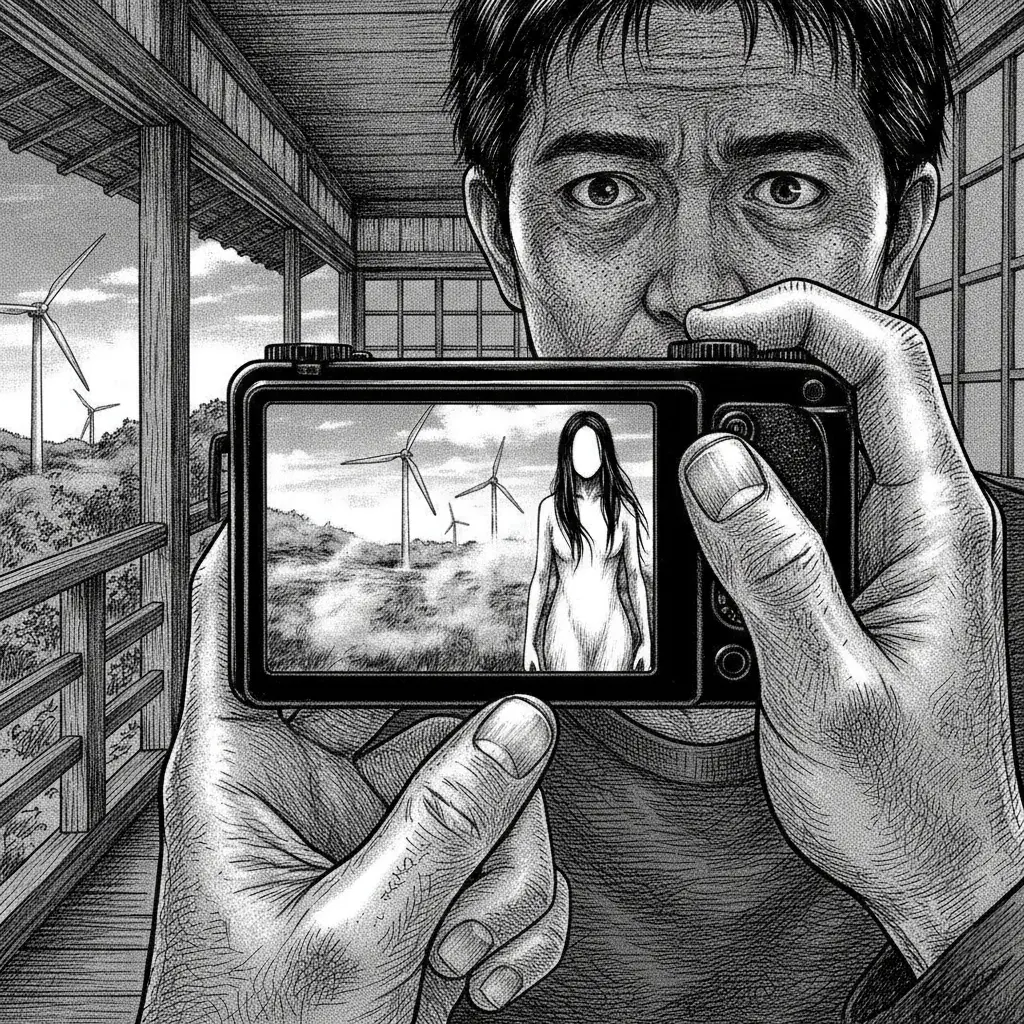
That afternoon, back at the guesthouse, Keisuke mentioned the old man to the landlady. Without changing her expression she said, "Ah, that'll be old Sato. He's always been around those parts." When Keisuke asked whether the man knew much about the area, she paused briefly before answering, "Knows more than is good for him." She said nothing further. In the evening, Keisuke sat on the veranda sorting through his camera and reviewing the day's photographs. The landscapes of Osorezan, the pinwheels, the sulfurous steam, the stone Buddhas — all of it was beautiful, more than adequate material for a photography book. But every time he returned to the photograph of the still pinwheel, a peculiar feeling came over him. The white shape at the edge of the frame seemed, the more he enlarged it, to draw closer and closer to the form of a human figure. Standing. Facing toward him. Arms visible. But no face. He moved to delete the photograph, then stopped. He told himself he should keep it as evidence — though evidence of what, he could not have said.
On the second night, Keisuke dreamed. In the dream he stood on the shore of Lake Usori. The water was darker than it had been in daylight, and the sky held not a single star. Across the lake, something was standing. It was too far away to make out clearly, but he knew it was looking at him. He understood that he should not look back, yet he could not turn away. Gradually the shape began to move toward him — not walking, but gliding, skimming across the surface of the water without its feet ever touching it. As the distance closed, its outline became visible. It had the shape of a person. The shape of a woman. Long black hair hung down, and what she wore was white. But where her face should have been there was nothing — only a smooth, flat whiteness. Keisuke tried to cry out and found he had no voice. The shape came to a stop directly before him. Then, in silence, it reached out its hand. The moment those fingers touched his shoulder, he woke.
The room was dark. Sweat ran down the back of his neck. Keisuke steadied his breathing and endured the sensation of the dream clinging to his body like a film. It was past three in the morning. His throat was dry, so he went out into the corridor to find water, and as he did he noticed how strange the silence of the guesthouse felt — not quiet so much as hollowed out, as though sound itself were being absorbed. Even his own footsteps, the creak of the floorboards, reached his ears as if from a great distance. He drank water in the kitchen and was making his way back down the corridor when he saw a figure through the frosted glass of the front door. Someone was standing on the other side. Keisuke held his breath. The shadow did not move. It simply stood there. He walked slowly to the door and pulled it open all at once.
There was no one outside. The gravel in front of the entrance bore no footprints. There was only the air of a late August night and the distant glimmer of Lake Usori. Keisuke stood there for a few seconds, and as he turned to go back inside he saw something lying on the gravel. A red pinwheel. Its axle was snapped and half its blades were torn away. It was the same shape as the ones sold at the Osorezan temple grounds, but far older, its color bleached and faded. He picked it up and carried it back to his room. The next morning he showed it to the landlady, and the color drained from her face. She asked where he had found it, and when he said at the front entrance, she was quiet for a long moment before she spoke. "You should go home tomorrow," she said.
"Why?" Keisuke asked. Instead of answering, she went to the kitchen and returned with an old photo album. It held many faded photographs — pictures of the village, of festivals, of children. And on the last page there was a single photograph. It appeared to have been taken on the grounds of Osorezan, and it showed several people. One of them caught Keisuke's eye — a woman standing at the edge of the group, wearing a white kimono, long black hair falling loose. Her face was blurred. Not out of focus in the way a camera produces, but blurred as though the face alone had been erased, or as though there had never been a face there to begin with. Keisuke thought of the shadow in his dream. "Who is this?" he asked. "I don't know," the landlady said. "There was no one there. The person who took this photograph, and everyone else who appears in it — they all said the same thing. There was no one standing there."
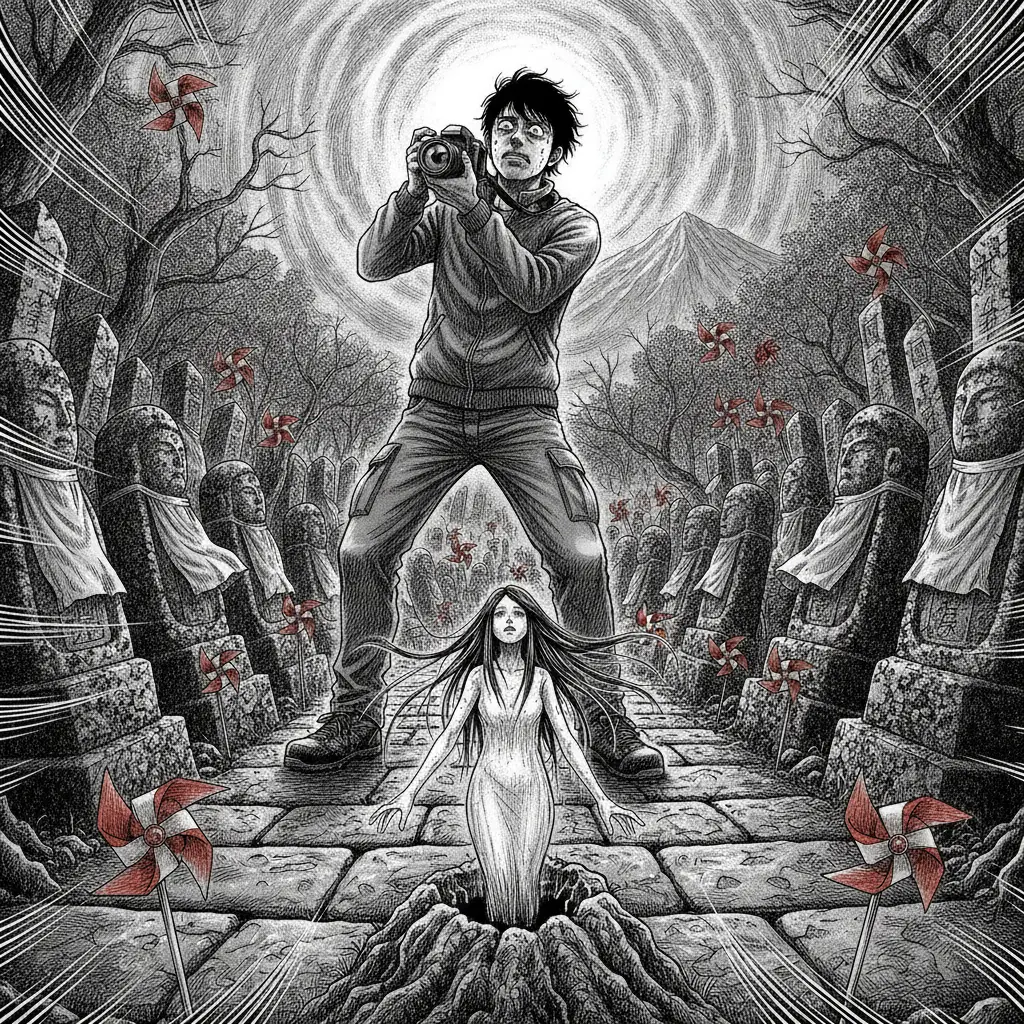
That afternoon, Keisuke went back to Osorezan one more time. The landlady's words would not leave him, but there was something he needed to confirm before he left. The white shape in the photograph he had taken — the thing that had appeared at the edge of the frame, right beside where he had been standing. He needed to see for himself what it was. The smell of sulfur met him as he passed through the gate. He walked among the stone Buddhas and made his way to the spot where the still pinwheel had stood. But the pinwheel was gone. There was nothing behind the rock — only a small hole in the ground where the stake had been driven in. Keisuke photographed the hole and looked around. Every other pinwheel was spinning. Red and white blades turning in the wind. And beneath that sound, he heard it again — the thin, high sound, as though wrung from deep in a throat. This time it was unmistakable. It was not words. It was not a name. It was simply the sound of something calling.
Keisuke raised his camera. He turned the viewfinder toward the direction of the sound. The ravaged ground with its venting sulfurous steam, the grey rock, the distant glimmer of the lake — and there, within the steam, something was standing. White. The shape of a person. His finger stilled on the shutter button. It did not move. It stood half-dissolved into the drifting steam, simply there. Keisuke held his breath and pressed the shutter. The instant he did, a gust of wind swept the steam aside, and the spot was empty. Only rock, and sand, and the smell of sulfur remained.
He returned to the guesthouse and began packing his things. He had decided to follow the landlady's advice. He could not have said why he had suddenly become willing to do so. He only knew with certainty that he could not stay here any longer — not as a reasoned conclusion, but as something his body understood. As he packed, he reviewed the day's photographs one last time on the camera's LCD screen. The landscapes of Osorezan, the empty hollow behind the rock, the steaming ground — and finally, the last image. The photograph he had taken of the thing standing in the steam, the one where the shadow had appeared almost at his own position, right beside the camera. He enlarged it.
He found it. Back in Tokyo, Keisuke opened the photograph on his large monitor. Steam. Rock. Empty ground. And at the edge of the frame — nothing. He frowned and checked the other photograph, the one from the first day, the still pinwheel with the white shape at its edge. He opened it. The shape was gone. There was only the pinwheel. But now the pinwheel was spinning. He hadn't noticed on the small LCD screen, but on the large monitor he could see it clearly — the blades were in motion, blurred with movement. Definitely turning. Keisuke shook his head. That pinwheel had been still. He had seen it with his own eyes. But in the photograph, it was turning.
He went back through all the photographs from the beginning. One hundred and seventy-three images. Every photograph he had taken at Osorezan, one by one. Not a single shadow appeared in any of them. The white figure was nowhere to be found. Instead, Keisuke noticed something else. In seven of the photographs he had taken, the same person appeared. In the distance, in the background, half-hidden behind stone Buddhas — a woman in a white kimono with long black hair, appearing in seven different locations across seven different frames. He had no memory of her. He could not recall seeing anyone like that while he was shooting. But there she was. In all seven photographs, the woman was facing toward him. In all seven photographs, her face was clearly visible.
He enlarged the first image. A face came into focus. Eyes. A nose. A mouth. An ordinary human face. But it was the expression that made his hands stop. She was smiling. Not simply smiling — smiling as though she knew something. As though she had been waiting all along for him to notice. Keisuke looked away from the monitor and scanned the room around him. A Tokyo afternoon. Sunlight coming through the windows, the sounds of the city outside. Nothing there. Nothing at all. He took a sip of his coffee and turned back to the monitor.
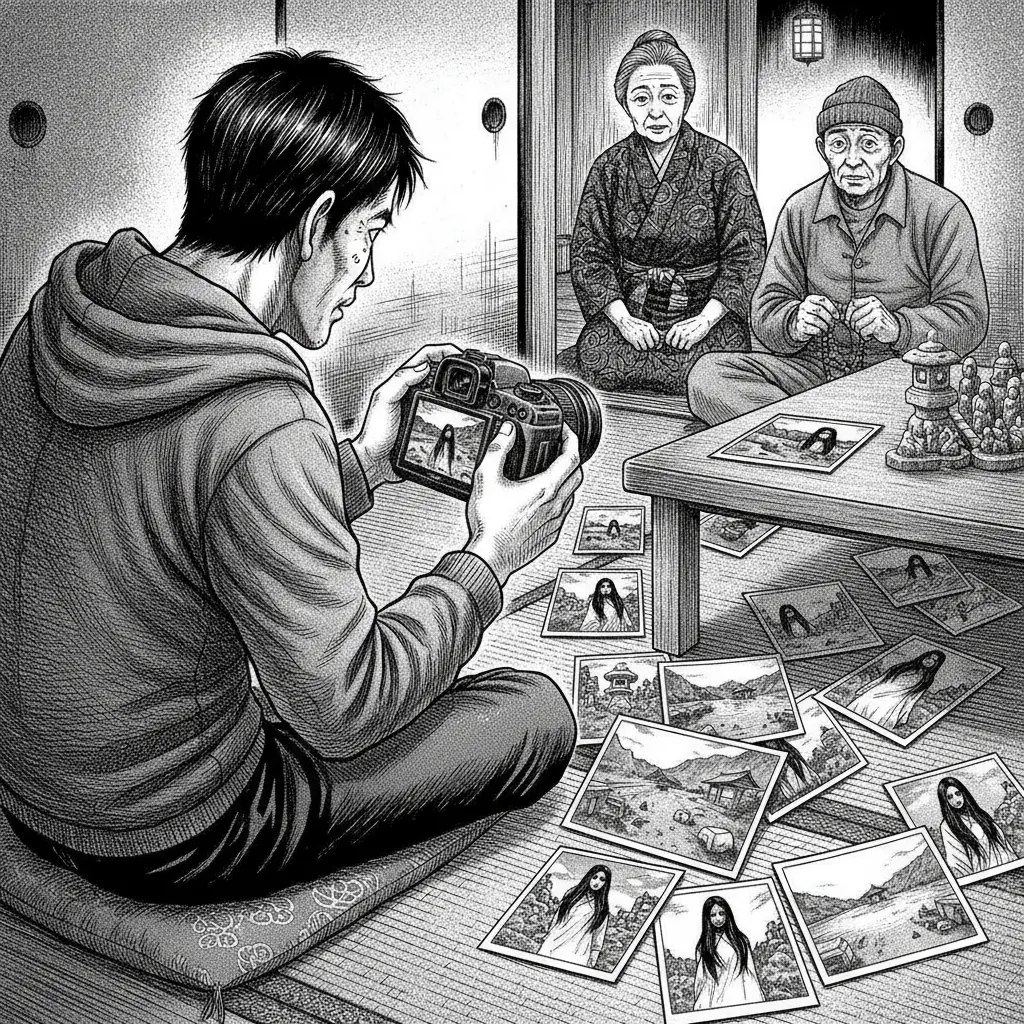
The woman was the same face in all seven photographs. But in one of them — the last one he checked, the photograph he had taken from the veranda on the night before he left Tokyo, looking out at the lake — her position was different. She was reflected in the surface of the water. But for something to be reflected in the water, it would have had to be standing on the shore. Keisuke tried to remember the moment he had taken that photograph. He had stepped out onto the veranda, pressed the shutter three times, felt that vague unease, and gone back inside. Had someone been standing beside him then? No. There had been no one. He was certain of it.
He pulled the camera bag toward him and checked inside. Camera, lenses, spare batteries, memory cards. And at the very bottom, something else. When he touched it, he felt a thin axle and the texture of paper blades. He took it out. A red pinwheel. Its axle was snapped and half its blades were torn away. The one he had picked up from the gravel outside the front door, carried back to his room, and assumed had vanished by morning. It was in his bag. He set it on the table. There was no wind in the room. The windows were closed.
And yet the pinwheel began, slowly, to turn.