

The Sound from Shaft No. 7
AI AI-generated fiction — text, and any narration or images. Unrelated to any real events, people, organizations, or places.
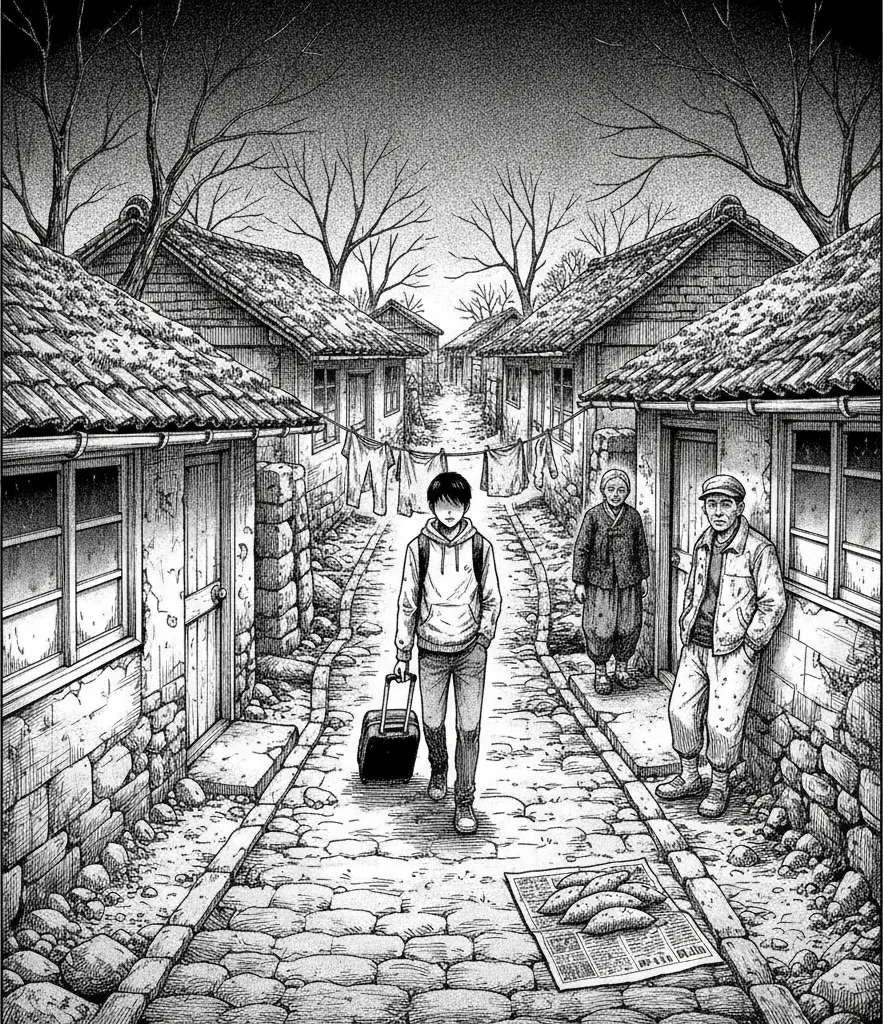
Seungjae arrived in Jeongseon for the first time on a late October afternoon, the autumn color long gone and only bare branches remaining. He stepped off the bus in Gohan-eup and dragged his luggage through the narrow lanes, where the houses lining both sides stood in a silence that seemed to have stopped breathing long ago. Thick moss clung to the slate rooftops, and every windowpane was filmed with dust so dense you couldn't see inside. Yet here and there laundry hung from clotheslines, and in front of one house a pile of sweet potatoes, freshly dug by the look of them, lay spread across a sheet of newspaper. People still lived here. For now.
Seungjae was a graduate student at Kangwon National University, researching regional depopulation. His thesis focused on the psychological changes in communities left behind after mine closures, and the area around Gohan in Jeongseon was an indispensable field site. His advisor had told him to stay two months at most, but Seungjae had packed three months' worth of living expenses. He was the kind of person who believed the longer you stayed in the field, the deeper your research became. His lodgings were at a guesthouse in a village on the Sabuk side, a little removed from the town center. He had spoken with the landlady, an elderly woman named Choi, over the phone beforehand, and so a warm room and a pot of doenjang jjigae were waiting when he arrived.
Behind the guesthouse stood the site of what had once been a mine shaft entrance. It was sealed now with concrete blocks, and in front of it stood a single rusted iron sign. The lettering was half worn away, but Seungjae shone his flashlight on it and read: Sambo Colliery, Shaft No. 7 — Closed 1995. Beside it lay two makgeolli bottles, tipped on their sides as if someone had left them there long ago. A little liquid still remained inside each one. Seungjae photographed the spot and recorded the date and location in his notebook. The habit of a researcher.
Grandmother Choi was a talkative woman. Every evening as she set out the dinner table she would reach back into the past. In the days when the mine was running, she said, more than five thousand people had lived in this village. There had been a market, a cinema; at night the neon signs of the drinking houses had scattered light all the way down to the foot of the mountain. Now fewer than a hundred people remained, she said. She smiled as she said it, and Seungjae couldn't quite tell whether the smile was sad or simply resigned. She added one more thing: "Don't go toward the back mountain at night. There's no path up there."
Seungjae didn't think much of it. If there was no path, he simply wouldn't go.
The first week passed quietly. Each day Seungjae walked the village and interviewed its elderly residents. Most were in their seventies or older; the men, he was told, had mostly left after the mine closed or had died early from pneumoconiosis. What remained were largely women, and the houses those women kept. Seungjae recorded their stories, took photographs, made notes. In the evenings he organized his materials in his room at the guesthouse. Wind came down from the mountain and rattled the window, a sound that felt strange at first but within a few days had become something like a lullaby.
The first strange thing happened on the tenth night.
It was just past midnight when Seungjae woke. At first he didn't know what had roused him. The room was quiet; outside was quiet too. Yet something was wrong. The air inside the room had changed. There was a smell — not the smell of burning coal, but something older, something damp and settled, as if it had risen from underground. He got up and opened the window. The outside air was cold and clean. The smell was only inside the room.
He sat for a moment and thought it through. It was an old house; the smell could be coming up through the ondol floor system somewhere. There was always a rational explanation. He lay back down and closed his eyes. But just before sleep took him, for the briefest instant, he heard something. It was less a sound than a vibration — a regular, rhythmic pulse that seemed to rise from beneath the earth, as though someone very far below were knocking against something. He convinced himself he had heard it in the borderland between sleep and waking.
But the same thing happened the following night.

This time it wasn't only the smell. Seungjae opened his eyes at midnight and heard the sound simultaneously. It was unmistakable now — not quite a knocking, closer to footsteps. It came from the direction behind the guesthouse, from where the shaft entrance stood. It was not regular. It would stop, then start again. Seungjae took his flashlight and opened the back door. Outside was moonless and dark; the trees swayed in the wind. Nothing moved within the reach of his flashlight beam. He walked about ten paces toward the shaft and stopped. The sound had gone. Only a faint trace of that smell still hung in the air.
The next morning Seungjae asked Grandmother Choi about it — told her there were sounds in the night. She didn't pause in ladling out the rice. "Rats, or the wind," she said. That was all. When he tried to ask more she changed the subject: the weather was fine today, she had to go to the market, it was Jeongseon market day. Seungjae tried to read something into the brief silence, but there was nothing written on the old woman's face. Only the blankness of someone who had lived a very long time.
In the course of his village research, Seungjae learned of a man the locals called Bak-ssi ajeossi — Mr. Bak. He had never actually met him. Several people had mentioned the name, but always obliquely. "Mr. Bak lives up there." "Ask Mr. Bak — he knows more about the mine than anyone." Yet no one would take him there directly. When Seungjae asked where "up there" was, they all gestured vaguely toward the back mountain — the same direction Grandmother Choi had told him not to go at night.
One afternoon, Seungjae climbed the path behind the mountain on his own. There was no path, they had said, but in his experience there was always something. And indeed there was: a narrow trail half-buried under weeds, wide enough that people must once have walked it often. Fallen leaves made the ground soft underfoot, and birch and pine grew together on either side. After about twenty minutes he came to a small clearing, and at its edge stood a house — an old cement-block structure with a corrugated iron roof, a thin thread of smoke rising from the chimney.
Seungjae knocked, and after a moment the door opened. A man who looked to be in his late sixties stood before him. His face was weathered dark, his eyes deep and still. He wore something like a worn work uniform. This was Mr. Bak (박씨). He looked at Seungjae without any sign of surprise, simply watching. Seungjae greeted him and introduced himself as a researcher; without a word, Mr. Bak stepped aside and gestured for him to come in.
The interior was dim. The windows were small and hung with curtains, so that even in the middle of the day it felt like dusk. A single candle burned on a small table, and beside it sat a cup of makgeolli. Mr. Bak told Seungjae to sit and took his own seat. The two men faced each other in silence for a moment. Mr. Bak spoke first. "You've come to talk about the mine?" When Seungjae said yes, Mr. Bak looked up at the ceiling briefly, then began.
Mr. Bak said he had worked at Sambo Colliery for twenty-three years — had seen it from nearly its opening to its closure. His manner of speaking was slow and dry. Seungjae reached for his recorder, but Mr. Bak raised a hand to stop him. "Just listen." Seungjae set down his notebook and pen. As Mr. Bak spoke, the light outside the window gradually fell. The accidents that had happened inside the mine. The colleagues who had never come back out. And the sound he said he had heard inside the shaft on the night before it closed. At that point Mr. Bak paused.
"The night before the closure, I went into the shaft alone one last time. To say goodbye." Seungjae nodded. "That's when I heard it. From deep inside the shaft. A knocking sound." Seungjae's hand went still. Mr. Bak continued. "At first I thought I'd heard wrong. But it kept going. Regular. Like something alive." The candlelight caught in Mr. Bak's eyes and made them gleam faintly. "Do you know what it was?" Seungjae didn't answer. Mr. Bak said: "Better not to know."
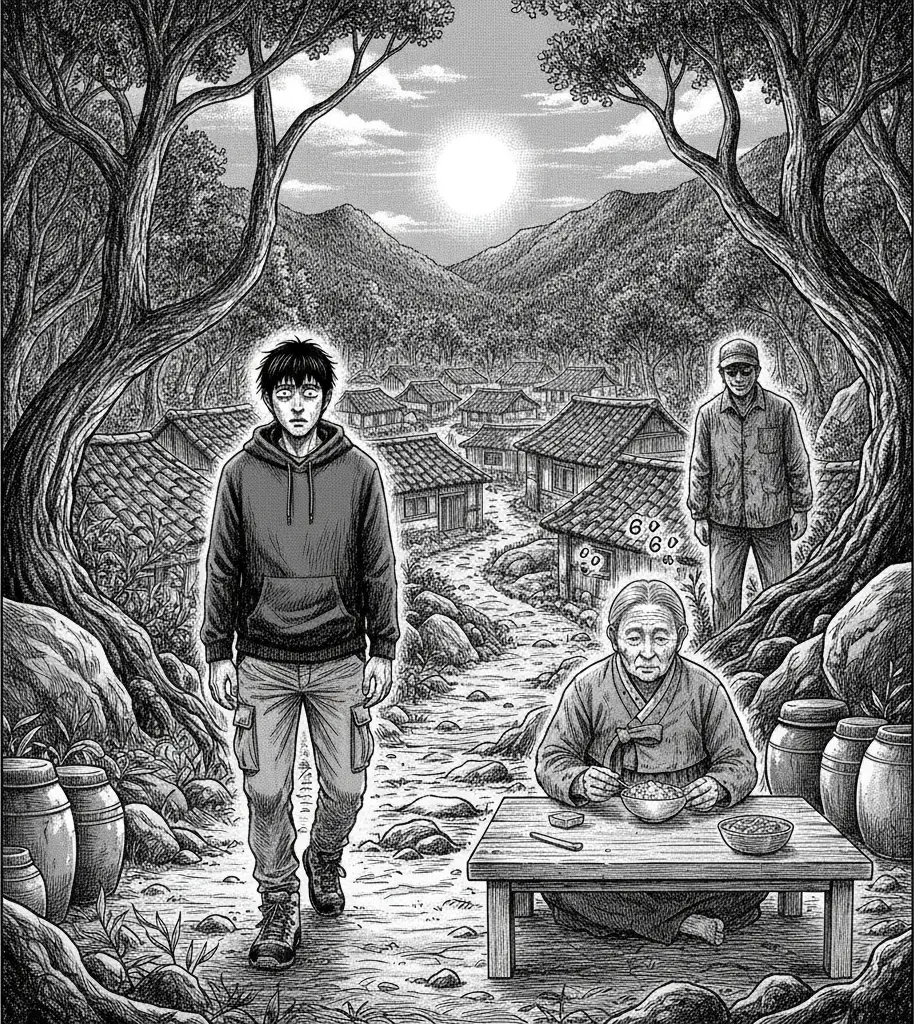
Seungjae came down the mountain quickly that evening. He wanted to be back in the village before dark. Mr. Bak's words circled in his mind. A knocking sound. The very thing he had been hearing each night. But he still didn't know what it was, and Mr. Bak had not told him. That evening Seungjae left half his dinner untouched. Grandmother Choi said nothing.
That night Seungjae woke before midnight. This time the sound came first. A knocking that seemed to resonate from inside the walls, from the other side of the wall, from beneath the floor. He threw off the blanket and got up. He took his flashlight and opened the back door. Outside was dark as before. But this time something was different. From the direction of the shaft entrance, from where the concrete blocks stood, there was light. A very faint light — as if it were seeping up from underground, leaking through the gaps between the blocks. Seungjae walked toward it.
The closer he got, the stronger the smell became. The smell of underground — coal dust and damp and something older still, all mixed together. And the sound grew clearer. It was not a knocking. It was not footsteps. It was breathing. Deep, slow breathing, like the exhalations of someone asleep, coming from the other side of the concrete blocks. Seungjae stopped and stood before them. He shone his flashlight on the surface of the concrete. There were cracks. Not old cracks — the edges were too clean, too recent. And through those cracks, light was leaking out.
Seungjae did not know how long he stood there. When he came back to himself he was inside his room at the guesthouse, sitting on the bedding with the flashlight still in his hand. Outside it was still dark. He could not be certain whether he had gone to the shaft or only dreamed it. But the lens of the flashlight was smeared with coal dust. And the soles of his shoes were caked with black earth.
The next day Seungjae asked the village elders whether the shaft entrance had been opened, whether anyone had been near it recently. Everyone shook their heads. It was dangerous; no one went there, they said. One old man said: "That place is just sealed. When they closed it, they left everything inside and blocked it up." Seungjae started to ask what he meant by everything inside, then stopped. The old man's expression had shifted — not the look of someone who refused to say more, but the look of someone who hadn't expected the question at all. The face of a man who had let something slip without meaning to.
That afternoon Seungjae went back up to find Mr. Bak. As he climbed he tried to arrange in his mind what he had seen and heard the night before — the light, the breathing. When he reached the clearing, the house was there, but no smoke rose from the chimney. He knocked. No answer. He knocked again. The door was unlocked and drifted slightly open. He looked inside. The candle was gone from the table. The cup was gone. But on the table lay a single sheet of paper. Seungjae stepped inside and picked it up.
It was handwritten — pressed into the paper with an old ballpoint pen. Just two lines.
If you hear the sound, do not answer it. The moment you answer, it will remember your voice.
Seungjae stood holding the paper. After a moment he set it back on the table, left the house, and came down the mountain. When he reached the village he did not go into the guesthouse but stood in front of an old pavilion at the village entrance. The sky hung low and overcast; there was no wind. The village was quiet. Too quiet. What frightened him, suddenly, was not the quiet itself — it was that the quiet no longer seemed strange to him. That he had already grown accustomed to something in this place.

That night Seungjae tried not to sleep. But when midnight came his eyes closed. And the sound came. Closer than ever before — rising as if from deep within the ondol floor beneath him, a slow and heavy breathing. Seungjae lay inside the blanket with only his eyes open. He did not answer. The words on the paper repeated themselves in his mind. The moment you answer, it will remember your voice. The sound continued for a long time, then slowly faded. Seungjae did not close his eyes until four in the morning.
He packed his things the next day. Grandmother Choi was setting out breakfast and looked over at him. She didn't try to stop him. She simply ladled out more rice. As he ate, Seungjae said to her: "Mr. Bak left me a note." The old woman's hands paused for just a moment, then resumed their work. "Mr. Bak passed away ten years ago," she said. Seungjae did not put down his spoon. He felt that he must not put it down. He chewed. He swallowed. Outside the window the sky was clear.
As he walked to the town center to catch the bus, Seungjae tried not to look back. But just before he passed the edge of the village, he turned once. The back of the guesthouse, the direction of the shaft entrance. There was nothing to see. Only the mountain, the trees, the sky.
But the trees were moving, and there was no wind.
Seungjae turned his face forward and walked. The bus came and he got on. He pressed his forehead against the window. He closed his eyes. He heard nothing.
Back in Seoul, Seungjae wrote his thesis. He organized his field notes, edited his interviews, added footnotes. He did not write about Mr. Bak. He did not write about the sounds he had heard at night. Those things could not be research data.
On the night he finished the thesis, just before sleep, he heard something. A slow, deep breathing that seemed to rise from beneath the apartment floor. He opened his eyes. The room was silent. He listened again. There was nothing.
He was about to close his eyes again when he stopped.
Because he could not say with certainty that he had truly never answered — not even once.