

The Half-Open Door
AI AI-generated fiction — text, and any narration or images. Unrelated to any real events, people, organizations, or places.

It was early spring when Minjun first found the alley — one of those days when winter had not quite let go of the air. While tourists crowded the lanes of Gahoe-dong, busy framing roof tiles and stone walls in their cameras, he walked alone, map folded away in his pocket, drifting at his own pace along the back alleys toward Gye-dong. As an aspiring photographer, he had always wanted to capture what others walked past. Shadowed corners, worn stone steps, the grain of time pressed into old wooden doors — these things felt truer to him than anything else.
Following the narrow lane that stretched from Samcheong-dong toward Gye-dong, there was a place where the stone wall curved to the right. Such a bend usually led to a dead-end staircase or the blank face of someone's garden wall. But that day was different. Between the stones, a small wooden door stood half open. The grain of the wood was deep and dark, like old oak, and the iron handle had rusted to nearly the same color as the surrounding stone. Minjun raised his camera and looked through the viewfinder. Beyond the door lay a narrow courtyard, and beyond that, a single-story hanok beneath a low-slung tiled roof.
He thought it strange. Most of the hanok in this part of the city had long since been converted into guesthouses, cafés, or cultural heritage facilities. But this one was different. Along the courtyard wall, a row of earthenware jars stood on a wooden rack, their lids sitting at crooked angles, and at the edge of the wooden veranda a pair of old straw sandals had been placed neatly side by side. The sandals were flattened from long use, but almost no dust had settled on them. As though someone had worn them just yesterday — or earlier that very day.
Minjun pressed the shutter. The light was good. The afternoon sun caught the edge of the roof tiles and fell at a slant into the courtyard, and the way it settled over the jars and the sandals was quietly beautiful. He stepped half a foot inside the gate, searching for a better angle. Then he heard a sound from within the house. Footsteps on the wooden floor. They were too light to be certain — at first he thought it might be a door panel shifting in the wind. But the sound had a rhythm to it. One step, then another. Moving from the far end of the veranda toward the inner room.
Minjun quickly stepped back outside and lowered his head, feeling the embarrassment of someone caught trespassing, and beneath that, something else — a faint, inexplicable quickening in his chest. He half expected the room door to slide open at any moment, but nothing opened. The footsteps ceased. He pulled his camera to his chest and stepped back into the alley. When he turned to look, the wooden door was still half open, just as before. A breath of wind passed through and nudged it slightly wider, then seemed to draw it back again. Watching it, Minjun had the odd thought that the door was breathing. Then he found the thought ridiculous, and smiled to himself.
When he got home and pulled the images up on his screen, he noticed nothing unusual at first. The courtyard photographs were good. The angle of the light, the arrangement of the jars, the flattened shape of the sandals — all of it was exactly what he had wanted. But as he zoomed in, his finger stopped. At the far end of the veranda, just behind the sandals — there was a shadow. It had formed beneath the eaves, but its shape was wrong. A silhouette that suggested a standing figure. Feet together, torso inclined slightly forward. He tilted the screen and looked from different angles. It could have been an optical illusion — the eaves and the pillar conspiring with the light. A trick of refraction, a game of shade. He closed the file and went to bed.
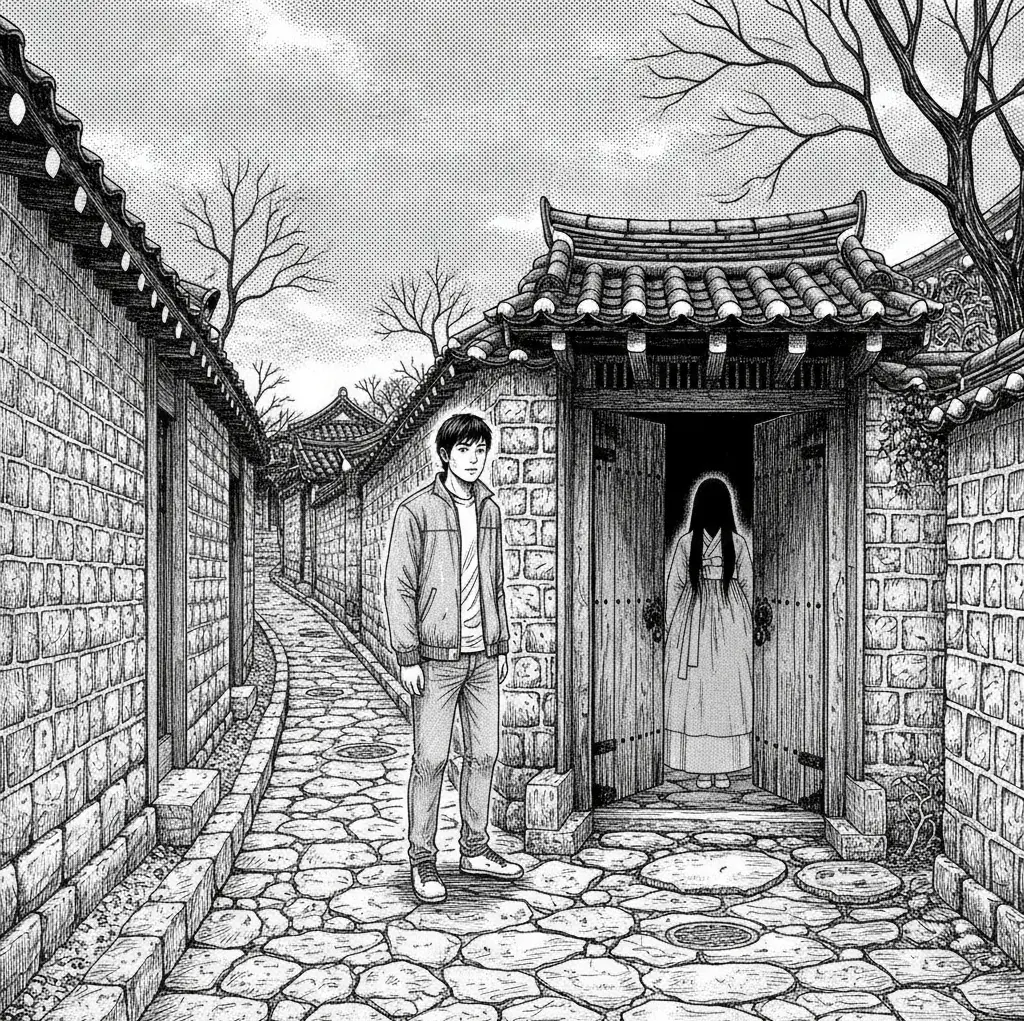
Two days later, he went back. He couldn't have explained why, not clearly. There were other alleys, and Bukchon still held countless corners he had never photographed. But his feet carried him, without argument, back toward that curved stretch of stone wall. It was morning this time. Low clouds made the light uneven, and the alley was empty of people. The wooden door was half open again. That fact alone was already strange. A house with someone living in it would have its door closed. An abandoned house would not be left consistently, precisely half open.
This time he walked into the courtyard. His footfall on the packed earth made a small sound. The ground was firm and well-trodden. He stood before the jar rack and examined the lids, running a finger across one — little dust had gathered. As though someone had touched them recently. He raised his camera to photograph the veranda, and then he saw it: something resting on the wooden floor. A comb. An old fine-toothed comb, made of dark wood. It had not been there on his first visit. He couldn't be entirely certain — perhaps he had simply missed it. But the way it lay on the veranda floor troubled him. It had not fallen there. It had been set down with intention, with care.
That evening, Minjun began trying to find out about the house. He asked some of the older residents in the neighborhood, and eventually made his way to an elderly man who ran a long-established stationery shop near the Gye-dong community center, and raised the subject carefully. The old man at first pretended not to know what he was talking about. But when Minjun described the location precisely, the man's hand paused. The hand that was setting down a brush paused — very slowly, with excessive care. A silence followed. Then the old man spoke, his voice low. That house isn't there. There's just a wall. Minjun said no, he was certain — there was a hanok, he had seen it clearly. The old man looked at him once, then picked up his brush again. What followed came out almost like a murmur, addressed to no one. Don't keep going there. That place has always been like that. He said nothing more.
That night, Minjun dreamed. In the dream he was standing in the courtyard of the house. It was night, and there was no moonlight. Yet everything was perfectly visible. The jar rack, the sandals, the veranda — and on the veranda, a figure seated with her back to him. A woman. She wore a white jeogori and a dark skirt, her long hair hanging loose down her back, and in her hands she held the fine-toothed comb, drawing it slowly through her hair. Each stroke made a sound. A dry, whispering rasp. The sound was so vivid that even within the dream, Minjun forgot he was dreaming. He raised his camera and pressed the shutter. At that moment, the woman turned her head. Minjun woke. He had not seen her face. Or more precisely — where a face should have been, there was nothing.
The next morning he opened the previous day's photographs again. The courtyard, the jar rack, the veranda. And the comb. He enlarged the image of the comb. Caught between its teeth were strands of hair. Long, black hair. He hadn't noticed it when he took the photograph — or perhaps he had noticed and let it pass. He pinched the screen to zoom in further. The ends of the hair trailed out beyond the comb and lay against the wooden floor. And those ends — they did not stop at the edge of the floorboard. They seemed to continue past the frame of the photograph, as though leading somewhere beyond it.

He took his camera and went back to Bukchon. It was late afternoon, the sun beginning its descent behind Inwang Mountain to the west. The moment he turned off the main road in Gahoe-dong and entered the Gye-dong alley, he felt the air change. It was spring, but this particular alley was cold. The moss on the stone walls was unusually thick, and the paving stones were damp in a way that suggested sunlight never reached them, even at midday. He rounded the bend in the wall. The wooden door — this time — was completely shut. It was the first time. He stood before it and hesitated. He placed his hand on the handle. The iron was cold. A coldness that seemed to travel from his palm up through his wrist, up toward his elbow. He pushed the door open.
The courtyard was as it had always been. The jar rack, the sandals, the veranda. But the comb was gone. The veranda floor was bare. Minjun stepped inside and looked slowly around. Then the room door opened. Without a sound. The panel slid inward and darkness was revealed. The room was dark — dark in a way that refused the daylight, as though the interior had its own rules about what it would accept. Minjun stopped. From within the darkness came a sound. That dry, whispering rasp. He knew it. He had heard it in the dream. The sound of a comb moving through hair. He raised his camera. Placed his finger on the shutter. And looked through the viewfinder into the dark.
There was a shape in the darkness. At first it seemed only that the dark was denser in one place than another. Then an outline emerged. A seated form. Seated with its back to him. Something white and long fell from the shoulders downward. Minjun's finger trembled. He pressed the shutter. The flash fired. In that instant of light, he saw it. The form was turning its head. Already halfway around. And when the flash died and the darkness returned, the form was no longer in the room.
Minjun stepped back, crossed the courtyard, and moved toward the wooden door. His feet felt as though they did not want to leave the ground. But as he reached the door, he stepped on something. He looked down. The comb. The comb that should have been on the veranda was lying in the dirt of the courtyard. He knew it had not been there moments before. He kept his eyes away from it as best he could, pushed through the door, and stepped into the alley. Behind him, the door swung slowly shut. And before the sound of it had fully faded, from somewhere on the other side, it came again. That dry, whispering rasp.
He did not look back once as he made his way out of the alley. Only when he reached the main road in Gahoe-dong did he finally exhale. In the evening light, tourists were posing for photographs in front of tiled walls. Music drifted from a café, laughter, the sound of a passing car engine. Everything was so ordinary that it made him feel as though he were the one who was wrong. Minjun stood there for a long time, watching the normal world move past him on all sides.
Back home, he set his camera on the floor and stared at it for a long while. He did not want to look at the photographs. In the moment the flash had fired, through the viewfinder, he had seen it — the head, already halfway turned. He was certain that image had been captured. And if it had, he would see the face. In the dream there had been no face. But in the photograph — he stopped the thought. That night he removed the memory card from the camera and put it in a drawer.

Three days passed. He did not go to Bukchon. He took photographs in other neighborhoods — Euljiro, Changshin-dong, Itaewon. He kept himself deliberately busy. But every night in his dreams he returned to the house. The content shifted slightly from one night to the next. One night he was counting the jars on the rack; there had been seven, and then without transition there were eight. Another night he was sitting on the veranda and looked down to find he was wearing the straw sandals — too small for his feet, tightening around them until they ached. And one night he saw himself. Seated on the veranda, back turned, hair hanging long, a comb held in his hand.
On the evening of the fifth day, he opened the drawer. He took out the memory card and slotted it into the camera. He opened the last photograph taken that day — the one from the moment the flash fired. The image appeared on the screen. A dark room. A seated form. As expected. He enlarged it. The form was turning its head. Halfway around. A profile visible over the shoulder. He enlarged it further. His fingers were shaking. The image blurred at the edges, but the outline held. And within that outline, he saw — his own face.
No. It was not his face. It could not be. He looked away from the screen and breathed. He looked again. The image was indistinct. A form in darkness, a head turned halfway, the outline of a profile. Thinking it resembled him had been an error of perception. A single flash in a lightless space. In blur and noise, the mind finds resemblance where it wants to. He closed the file.
But in the instant before the file closed, as his eyes passed over the screen one last time, he saw something else. Beside the figure's feet, on the wooden floor. The comb. And next to the comb — a small object. Too small to identify at first. He reopened the file. He enlarged it. The small object beside the comb on the veranda floor. It was a camera. The same shape as his camera, rendered very small.
Minjun stared at the screen for a long time. Then he set the camera down, slowly. Outside the window, a spring wind was blowing. It came from the direction of Bukchon. Something seemed to move within it — faint, hovering at the very edge of hearing. That dry, whispering rasp.