

The Eyes of Gamcheon
AI AI-generated fiction — text, and any narration or images. Unrelated to any real events, people, organizations, or places.
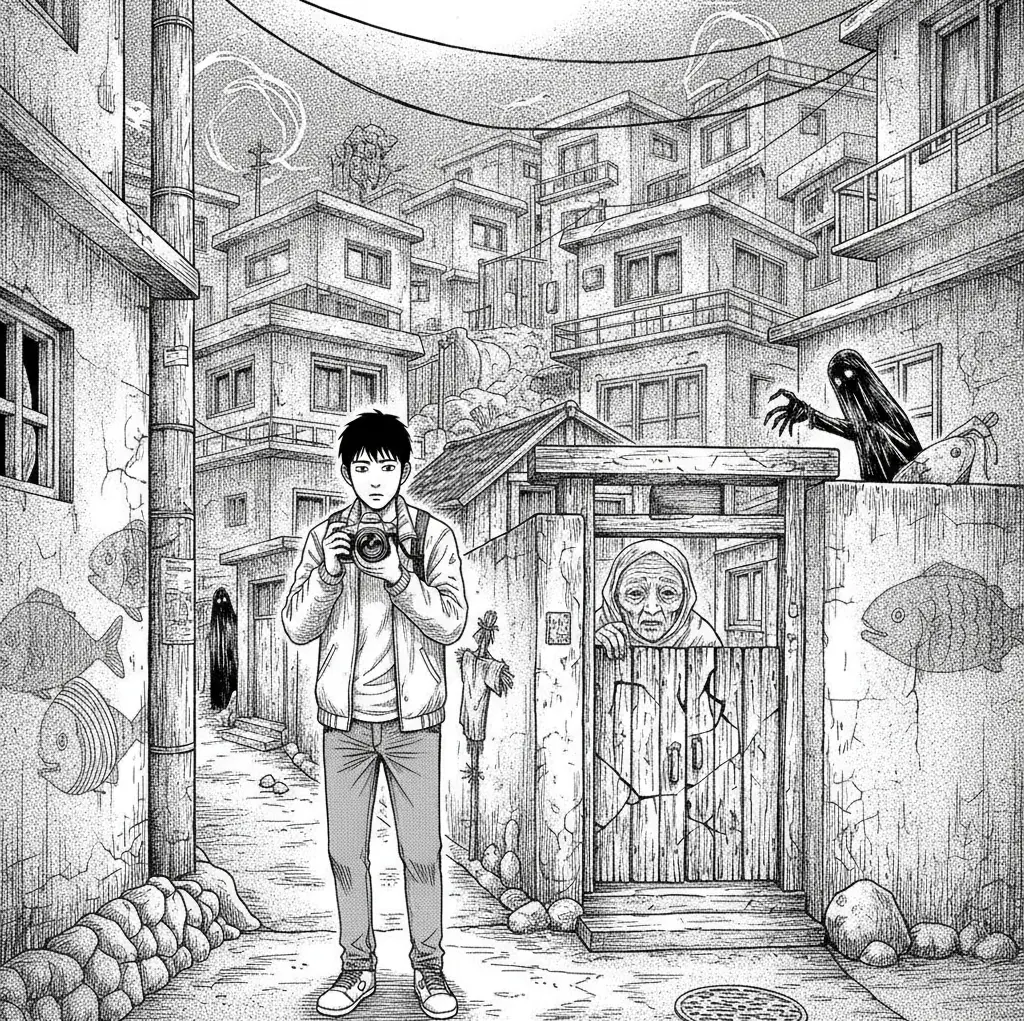
Minjun remembered clearly the day he first set foot in Gamcheon Culture Village. It was mid-November, just as Busan's winter had begun to nip at the edges of things. The sea wind blowing in from Gamcheon Harbor was cold and faintly salt-bitten, and the pastel-colored houses packed tight along the hillside stood unmoved against it. On the train down from Seoul, Minjun had spent the whole journey studying photographs of the village. In the magazine spreads, it looked so pretty it seemed almost unreal. But in person it was smaller than the pictures, older, and far quieter.
The place he'd booked was a small guesthouse tucked deep inside one of the village's inner alleys. The owner, a woman who looked well past seventy, glanced at his bags and asked, "Here to take photographs?" When Minjun nodded, she handed him the room key without another word. The room was narrow and low-ceilinged. Through a small window he could look down over the terraced alley below, and beyond it the harbor glimmered faintly. He set down his pack and opened the window. A salt wind stirred the curtain. For the first time in a while, he felt something in him settle.
The first day went smoothly. Minjun rose early and wandered the tight lanes. The alleys of Gamcheon were not simply paths. Some ended without warning against a blank wall; others dropped without notice into steep flights of steps before leveling out again. He liked the labyrinthine quality of it — the feeling that even when you were lost, you weren't really lost, only being led somewhere. The walls were covered in murals: fish, children, glowing stars, smiling faces. He pressed the shutter hundreds of times. When he returned to the guesthouse that afternoon and spread the day's work across his laptop screen, every shot was good. The light was good, the framing was good, and above all the village itself was good.
On the evening of the second day, Minjun noticed something. There was a staircase that appeared on none of the village's tourist maps. It began at the far end of the wall behind the guesthouse — a narrow stone stair with no railing and no streetlamp. He had stumbled across it while wandering during the day, and from the foot of it he could make out several more houses higher up. A district that didn't exist on any map. When he asked the old woman about it, she lowered her eyes for a moment before saying, "Nobody lives up there. Hasn't been anyone for a long time. Nothing worth seeing." He didn't press her. But that night, gazing up toward that staircase through his narrow window, he saw a faint light flickering somewhere above it. At first he told himself it was a reflection from a neighboring house. But the light didn't behave like a reflection — it wasn't steady. It moved, slightly, the way something moves when it's being carried in someone's hand.
On the afternoon of the third day, Minjun climbed the staircase. Camera in hand, alone. It was longer than he'd expected. With each step upward, the sounds of the village fell away — the laughter of tourists drifting up from the lanes below, the radio playing somewhere, the cry of a cat. All of it receded as he climbed. In its place the wind grew louder. It came up from Gamcheon Harbor and threaded itself between the steps, and to Minjun's ears it had a low, almost growling quality. At the top of the staircase he found a small open courtyard, ringed by three houses. All the doors were locked. The windows were boarded over with planks. There were no murals on the walls here. Unlike the vivid colors of the alleys below, the walls of this place had been steeped so long in damp and salt air that they had taken on a color somewhere between gray and black. Minjun raised his camera. Pressed the shutter. And in that moment he saw something through the gap between the planks on the window of the middle house. Just for an instant. Eyes. Something that looked like a person's eyes, watching him through the gap in the boards. His heart skipped a beat. But when he looked again there was nothing. Only the darkness between the planks.

Coming back down the stairs, Minjun talked himself out of it. A trick of the light. The old timber had warped and the shape of it had looked like eyes, that was all. He ate dinner, opened his laptop, and went through the day's photographs. The shots from the courtyard were poor — awkward framing, bad light. But when he opened the last image, the one taken at the precise moment he'd pressed the shutter, he sat for a long time staring at the screen. There in the gap between the boards on the window, in the darkness, was something that could only be called an eye. Round, bright, and aimed directly at him. Minjun zoomed in as far as the image would allow. The pixels dissolved into mush as he enlarged it, but the shape did not disappear.
On the morning of the fourth day, Minjun was wandering the village when he came across an old man — a man who looked close to seventy, sitting on a low wall at the edge of the village, gazing out at the distant sea. When Minjun spoke to him, the old man turned his head slowly. They talked for a while about nothing in particular. Then Minjun carefully brought up the unmapped staircase and the houses above it. The old man's expression changed — not hardening, but loosening, as though he were accepting something. He spoke slowly. Those houses, he said, were where the first refugees had settled during the Korean War. The oldest houses in the village. People had gone on living in them for many years afterward, but about twenty years ago the last resident left, and no one had gone back since. When Minjun asked why, the old man looked out at the sea for a moment before answering. "Everyone who lived up there went strange. The last old woman, the families before her. They all went strange and left. Or they went strange and just stayed." Minjun started to ask what he meant by that last part, then stopped. The old man had turned his face back toward the sea. It had the feel of a conversation that was over.
From that afternoon onward, Minjun began to notice things. Or more precisely, he began to see things. Moving through the village, he would occasionally catch the eye of a stranger in the crowd — someone who seemed to be neither tourist nor resident. They stood at the corners of alleys, or looked down from the tops of staircases, or stood in front of murals with no expression on their faces. When Minjun raised his camera toward them, they were already gone. He turned a corner and they had vanished; he looked up a flight of steps and there was no one there. At first he put it down to exhaustion — he hadn't been sleeping well, and his meals had been irregular. But on his way back to the guesthouse that evening, reviewing the photographs he'd taken, he had to abandon that explanation. One shot taken in front of a mural: in the corner of the frame, the outline of a person. At the moment Minjun had pressed the shutter, there had been no one there. He was certain of it. And yet in the photograph, someone was.
On the night of the fifth day, Minjun could not sleep. He kept looking out the window toward the staircase above. The light was there again. It had been there the night before, and the night before that. He couldn't be sure whether he had seen it every night from the beginning, or whether it had only started recently. That uncertainty was somehow worse than anything else. Around two in the morning he got up, took his camera, and began to climb. It was dark this time. He carried a flashlight, and the surface of the stone steps looked different from how it had in daylight. A thick growth of moss covered them, and here and there were marks that resembled footprints — not the tread of a shoe sole, but the impression of toes and heel pressed directly into the stone. Bare footprints, leading upward, upward.

When he reached the courtyard, the light was gone. The three houses stood as dark and quiet as they had in the afternoon. But something was different. The door of the middle house, which had been shut when he came before, was now open — just barely. A gap the width of two fingers. Through it, the interior was invisible. Pure darkness. Minjun aimed his flashlight at the gap. The beam entered, but showed him nothing — no wall, no floor, only light dissolving into dark, as though the door opened not into a room but into an absence. He reached out and pushed the door a little further. At that moment, something inside caught the beam of his flashlight and threw it back. Eyes. Not one pair. Many. Eyes gleaming in the darkness, all of them fixed on him. At different heights — some standing, some crouching, some lying flat against the floor. They did not move. They made no sound. They only watched.
Minjun stepped back. One step, two. His foot caught the edge of the top stair. He grabbed for balance and lost the flashlight. It clattered down the steps, its beam swinging wildly through the dark. He felt his way down the staircase by touch. His knee struck the edge of a step; his palm scraped across the mossy stone. He did not stop until he could see the glow of the streetlamp in the alley below. He ran into the guesthouse, locked the door of his room, and turned on every light. His palm was bleeding. His knee throbbed. He sat on the bed and steadied his breathing. After a long while, he picked up his camera. His hands were shaking, but he pressed the playback button. There were no photographs from the courtyard — he hadn't taken any, hadn't thought to photograph the open door. But there was one last saved image. One he had no memory of taking. The angle was from the top of the staircase, looking down — the kind of shot you'd take from the courtyard, looking toward the village below. The photograph showed the alleys, the houses, the streetlamps. And on the staircase, the back of a man descending. A man with a camera in one hand and a flashlight in the other, going down alone. It was Minjun.
The next morning, Minjun packed his things. The old woman was in the kitchen, stirring something on the stove. When he told her he was leaving early, she didn't look up. "All right," she said. "Safe travels." He hesitated, then asked: "Are there people up in those houses? Last night I saw eyes. More than one pair." The old woman stirred the pot for a long moment. Then, very quietly, she said: "The people who lived there all left long ago. But something stayed." He started to ask what she meant. She spoke before he could. "Watching things. They were always there. They were there while people lived in those houses, and they were there after the people left. It's the people who change. If they're watched long enough." Minjun said nothing. The old woman looked back into the pot. The conversation was over.
Leaving the village, Minjun turned once to look back. The pastel-colored houses covering the hillside, the terraced alleys, the windows catching the morning light. It was beautiful. The beauty felt strange to him now. The village hadn't changed. He had. He walked toward the bus stop with his hand tight around the camera in his pocket. Inside it was a photograph he had no memory of taking. He had not deleted it. He had tried to, but his finger wouldn't move to the delete button. He couldn't bring himself to look at it again. But he couldn't bring himself to erase it either.
Waiting for the Seoul train at Busan Station, Minjun stopped at a bathroom mirror. He washed his face. As he dried it, he looked at his reflection. His reflection looked back. Their eyes met. And in that moment, Minjun had the sense that the reflection's blink was not quite in time with his own. Just slightly. Perhaps a tenth of a second behind. He looked again. This time they were perfectly synchronized. Exactly the same. He let out a long breath and left the bathroom. He could hear the train pulling in. He walked toward the platform, and as he walked he told himself he would not think about it again.

Back in Seoul, Minjun left his camera untouched for a while. A week passed. A deadline approached. He had no choice but to open his laptop and connect the camera. He went through the photographs one by one — the alleys from the first day, the murals, the views from the staircase. They were good. He selected and re-selected until he had twelve. The last file he did not open. It sat in the folder, visible only as a filename. He moved his cursor over it, moved it away, moved it back. In the end he closed the folder without opening it and sent the twelve photographs to the magazine. The editor replied that the shots were excellent, that they captured the atmosphere of the village beautifully, and that they would run in the next issue. He also had one question: in the second photograph, the one looking up the alley staircase, there was a person standing at the top — would a model release be required? Minjun opened the photograph again. The staircase, the sky, the overhead wires — that was all he had meant to capture. But there at the very top of the stairs, in the darkest part of the frame, a figure was standing. No face visible. Just a shape, standing there. Minjun had no way of knowing when it had come to be there — whether it had been there when he pressed the shutter, or whether it had appeared afterward.
He wrote back to the editor: he didn't know who it was, probably someone who had walked into the shot. After sending the reply he sat still for a moment. Through the window, Seoul spread out before him — tall buildings, traffic, people. He looked down at his hands. The scrapes from the Gamcheon steps had healed completely. Not even a scar. He touched his knee. The same. No trace of anything. He picked up his phone and searched for Gamcheon Culture Village. Photographs filled the screen — the pastel houses, the alleys, the staircases, the murals. He scrolled through them. Then he stopped. In a tourist photograph someone had posted, a wide shot of the whole village, up near the top of the hillside — in the area that corresponded to the unmapped district — there was something small. Too small to tell whether it was a window or something else. Minjun enlarged the image. The more he enlarged it, the more it dissolved. But even through the smeared pixels, the impression that something up there was directed downward would not go away. Toward the people who came to the village, toward the people climbing the alleys — always up there, always looking down.
Minjun turned his phone face-down on the desk. Then he looked at his laptop screen, at the filename of the last file he still hadn't opened. Just a date and a number. A photograph he hadn't taken. Taken from the top of the staircase, looking down at him, using his camera. He moved the mouse. The cursor settled over the file icon. His finger rested on the mouse button and stopped. The room went suddenly quiet. The sounds from outside — traffic, the neighbor's movements, all of it — seemed to recede at once. Minjun closed his eyes. Opened them. The cursor was where he'd left it. He didn't click. He couldn't. Tomorrow, he told himself. Tomorrow, in the full light of day, when he'd steadied himself. But it was three days later that he came back to the file. Or rather, three days later that he tried to. When he opened his laptop that third day, the file was gone. Vanished from the folder. In its place was a new file. Its creation timestamp read three o'clock that morning. While Minjun had been asleep.
He did not open it. He closed the laptop. Drank a glass of water. Looked out the window. Seoul at night was bright — bright in the way of a city where nothing is wrong. Minjun stood and looked at that brightness for a long time. Then he realized he couldn't remember when he had come to be standing at the window. He remembered drinking the water. He remembered closing the laptop. But he had no memory of walking to the window. He was simply here. For how long. Standing with his forehead against the glass, watching the cars move along the road below, for how long he had been standing here like this.