

The Gaze from the Outer Room
AI AI-generated fiction — text, and any narration or images. Unrelated to any real events, people, organizations, or places.
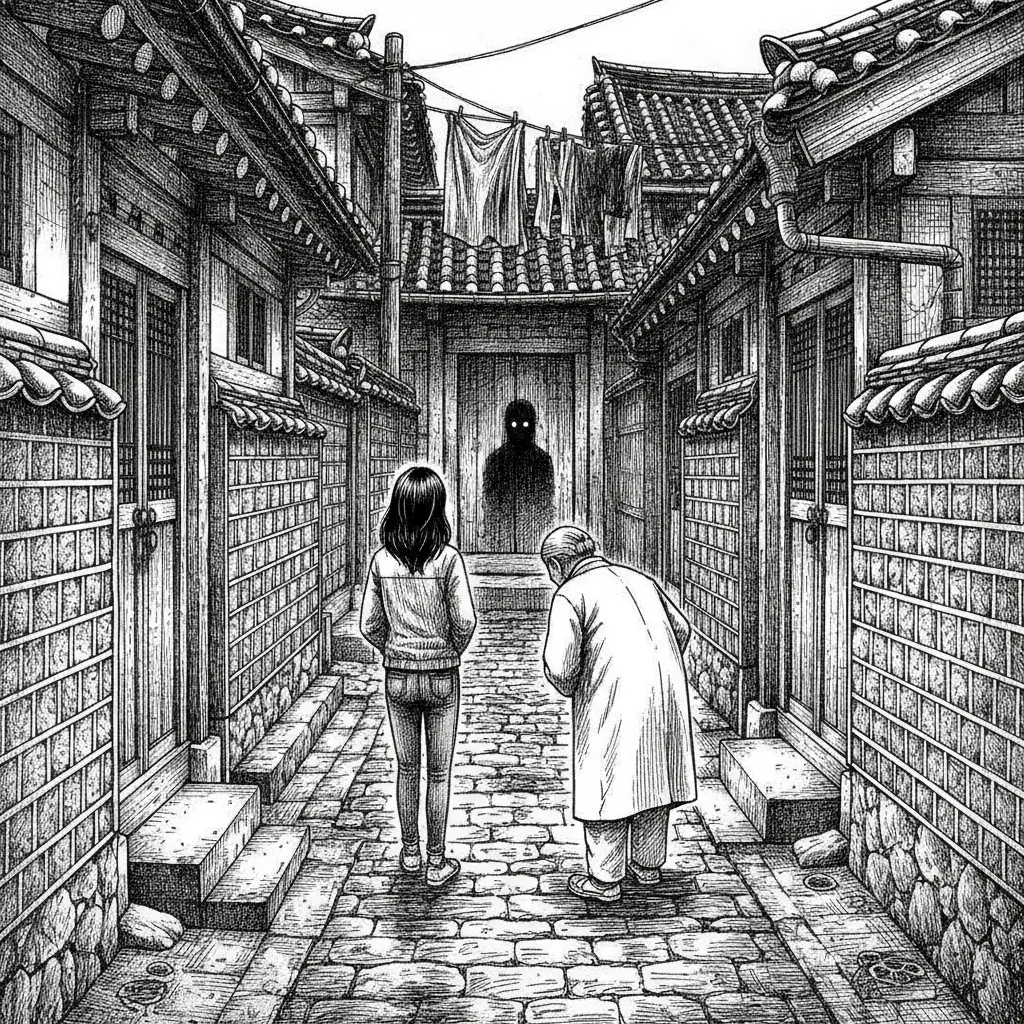
A Neighbor in the Bukchon Alley
Minseo (민서) moved to Bukchon Hanok Village in late autumn, when the last of the ginkgo leaves had fallen and only the smell of dry earth lingered in the alleyways. One block in from Gyedong-gil, down a narrow lane that bent away from the main road, stood a single weathered hanok at the very end. The landlord had handled the lease entirely by phone, and the key had been waiting inside the mailbox. She had found the place on a real estate app. The monthly rent was less than half the going rate for the neighborhood. Minseo did not ask why.
The hanok was larger inside than it looked. The inner quarters and the outer quarters faced each other across a small courtyard, and Minseo decided to use the inner rooms. The outer building had small, dim windows, and even in daylight its interior held a dense pooling of shadow. On her first day she opened the outer door, then closed it almost immediately. There was no particular reason. It was simply that the space inside — empty as it was — felt somehow full.
On the third day after moving in, the old woman from next door came to call. The old lanes of Bukchon had low stone walls in places where you could see straight into a neighbor's courtyard, but the house beside Minseo's was screened by a tall fence, and she hadn't even known anyone lived there. The woman was small and slight, dressed in a white durumagi. In this weather, Minseo thought. The woman held out a container of kkakdugi and said:
"Take good care of yourself. This house has been empty a long time."
When Minseo asked how long, the woman was quiet for a moment. Then she said only, "Quite a while." The phrase lingered in Minseo's mind in a way she couldn't account for. As the woman turned to leave, Minseo looked past the wall at the neighboring rooftop. Thick moss had settled over the roof tiles. Nothing was strange. It was simply an old house in an old neighborhood.
Minseo was a photographer. Coming to Bukchon was, in part, about her work. The light in the early-morning alleys, the dawn mist seeping into stone walls, the stillness that settled after the tourists had gone. These were the things she wanted to capture. In her first week she rose every morning at four, took her camera, and went out into the lanes. The slope up through Gahoe-dong, the descent toward Samcheong-dong, the long walk following the wall of Changdeokgung. The neighborhood wore a different face before dawn. The same streets that filled with voices and the smell of coffee by day seemed, in those early hours, indistinguishable from the alleys of the Joseon era. Minseo loved that threshold.
The first strange thing happened about ten days after she moved in. Returning from a morning shoot, she was sorting through the images on her memory card when she stopped at one. It was a photograph taken at the entrance to a Gahoe-dong alley — a narrow passage framed between two stone walls, the sky above Changdeokgung still dark. She remembered being alone in that alley. Four-thirty in the morning. No one around.
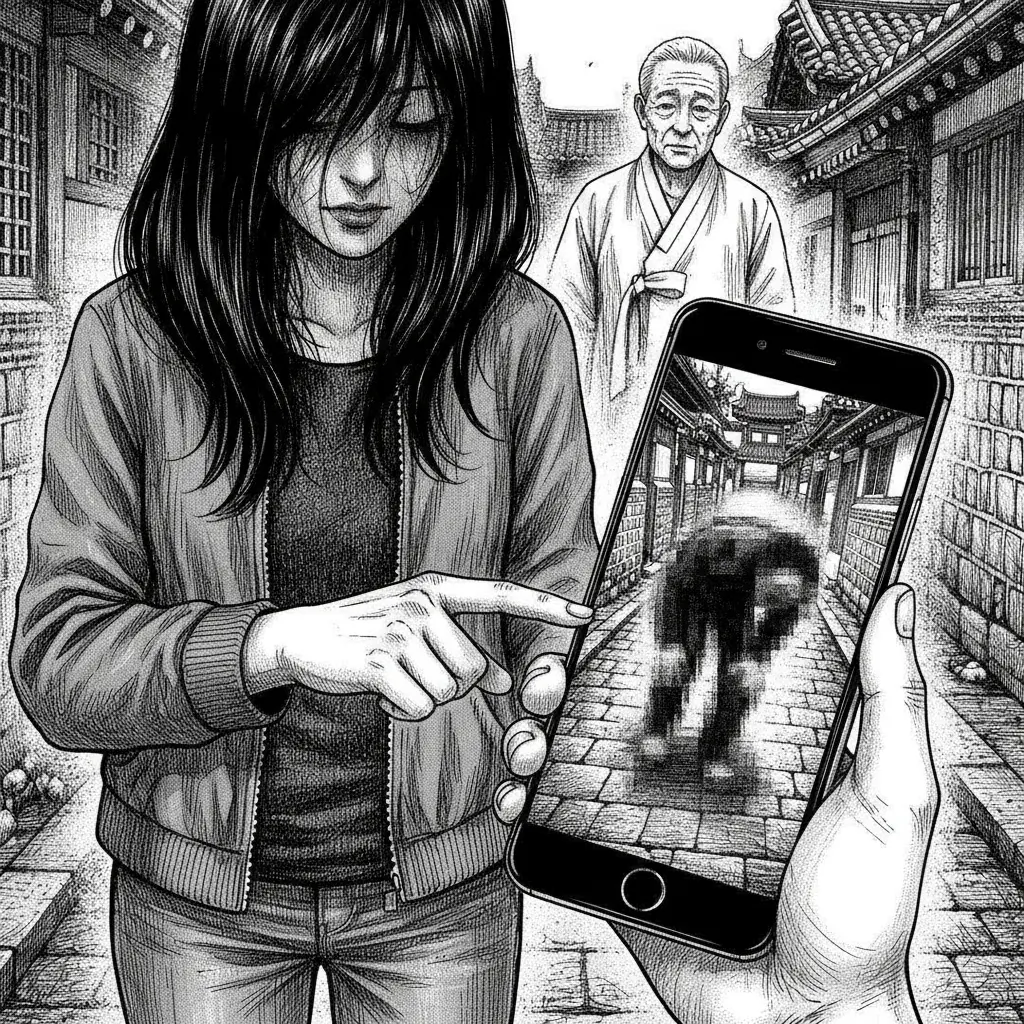
And yet at the far end of the alley, at a distance where the focus had not quite reached, there was the shape of a person. Not quite standing, not quite crouching — tilted slightly forward. The face was turned toward the camera. Minseo enlarged the image on her screen. The pixels dissolved into blur, but the shape was unmistakably human. Or rather, it was the form of a human. She studied it for a moment, then deleted it. She always deleted blurred or out-of-focus shots right away, she told herself. This was no different.
But the same thing happened the next morning, and the morning after that. Always one photograph. Always at the edge of the frame or at the farthest point of the shot. Always a shape she had not seen when she pressed the shutter. She suspected a camera malfunction — something on the lens, perhaps, or a problem with the shutter speed. But what unsettled her was that the shape appeared each time in a different location, a different alley, at a different angle, and yet it was always facing the same direction. Toward the camera. Toward Minseo.
She stopped going out before dawn for several days and stayed in the house. She swept the courtyard, replaced the hanji paper on the inner room's latticed doors, and scrubbed the old wooden floor. Putting the house in order helped her collect herself. But the outer quarters she left untouched. Whenever she thought she ought to open the door and clean inside, her feet would not carry her there. It was difficult to explain. It was simply that standing before the outer door, she felt a difference in the air on the other side. Cold and damp, saturated with something old. Less a smell than a texture — something that made contact with the inside of her nose and throat.
One night, Minseo heard a sound from beyond the courtyard-facing window. Footsteps. The sound of bare feet pressing against wood, as though someone were walking along a wooden floor. It was not the floor of the inner quarters. The sound came clearly from the outer building. Minseo lay rigid beneath her blanket. The sound repeated — three times, four times, at regular intervals. Then it stopped. An hour passed before she turned on the light and looked out into the courtyard. There was nothing. The outer door was closed. A few fallen leaves lay motionless on the ground, undisturbed by any wind.
The next morning Minseo went to find the old woman next door. There was a small gate in the wall between the two properties, and it opened onto the neighbor's yard. The woman came out from the kitchen. When Minseo brought up the outer quarters, something shifted almost imperceptibly in the woman's expression. She pressed her lips together, looked at Minseo for a moment, then settled herself on a low step near the earthenware jars in the yard and spoke.
"There's someone who used to live in that house."
Minseo asked whether there had been a previous tenant. The woman shook her head.
"Not a tenant. Someone who lived there."
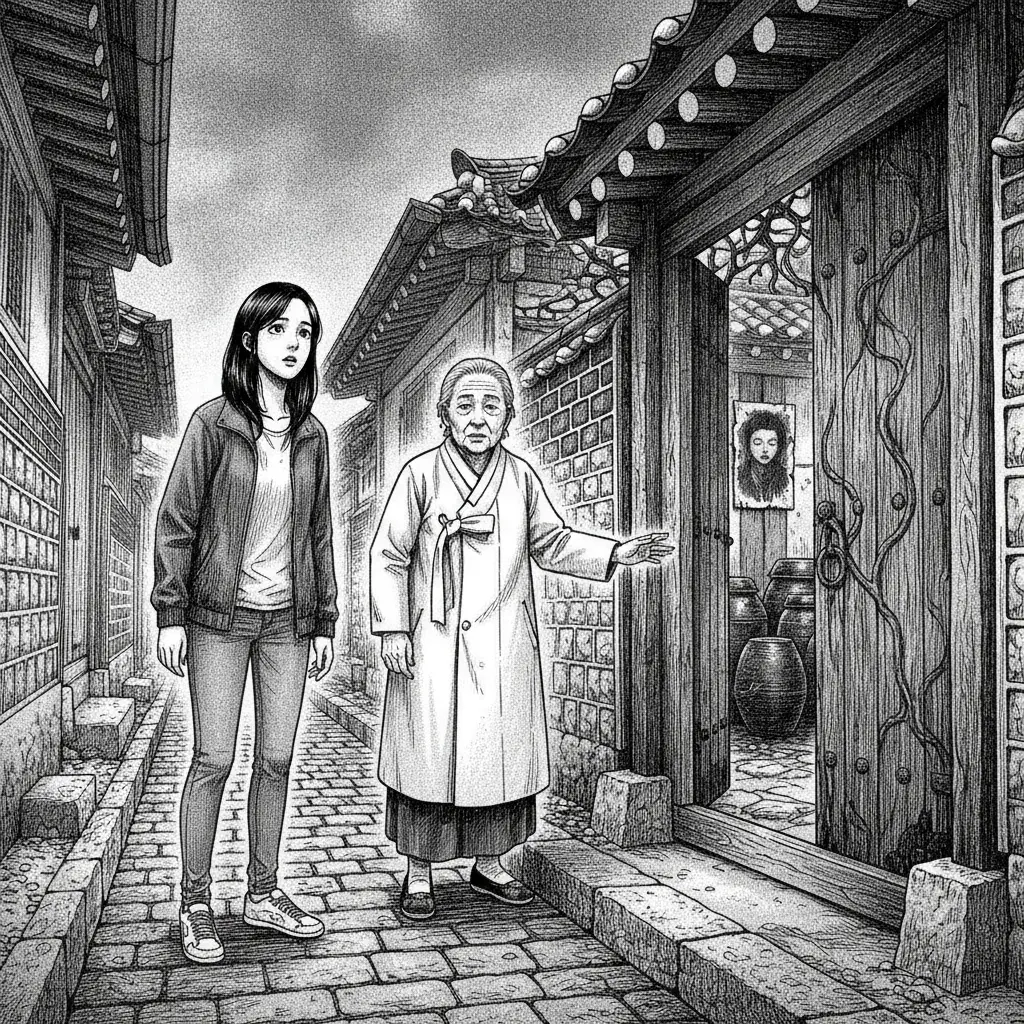
Minseo tried to understand what the distinction meant. If the person who lived there was not a tenant. The woman offered no further explanation. Instead she said: "Don't open the door to the outer quarters. It's better to leave it alone." When Minseo asked why, the woman gazed for a moment at something beyond the earthenware jars and said: "There's something it likes."
That night Minseo took out her camera again. Not for a morning shoot — she fixed the camera toward the courtyard, set the timer, and configured it to shoot through the night. Interval photography, one frame every five minutes. She secured the camera on the windowsill and got into bed. Sleep would not come. She lay staring at the ceiling, checking and rechecking in her mind that the outer door was closed. No sounds came. This time there was nothing at all. That, somehow, was worse. She could endure waiting, but the particular sensation that arose when silence moved in an unexpected direction — the feeling that something had already shifted elsewhere — was harder to bear.
The next morning Minseo reviewed a hundred and sixty photographs. Most showed the courtyard in darkness, empty. The outer door was visible in the frame, small in the distance beyond the window. Her hand stopped at a photograph taken at two-fifteen in the morning. The outer door was open. In the photograph immediately before, it had been closed. In the one immediately after, it was closed again. In that single frame alone, the door stood open. Beyond it was absolute darkness. And within that darkness, faintly, was the silhouette of something standing inside, facing out.
Minseo enlarged the image. This time she did not delete it. The shape was human. Small in stature, leaning slightly forward. The same posture as the shapes she had seen in the alley photographs. The same angle of inclination. The same orientation. It was inside the outer quarters. While the door stood open, it had been standing there, looking toward the inner rooms, toward the camera, toward the room where Minseo had been sleeping. She could not look away from the photograph. What frightened her was not the shape itself. What frightened her was the fact of its presence — and the fact that it had been there for a long time already. In the alleys. In the courtyard. During all those early-morning hours when she had believed herself to be alone.
That day Minseo packed her things. Quickly, taking only what she needed most. Her camera, her laptop, a few changes of clothes. When she stepped into the courtyard, the outer door was closed. It was daytime, the sky was clear, and the courtyard held nothing. She was walking toward the front gate when she stopped. She had not meant to look back. But she felt something behind her. Not a sound. Not a smell. It was a gaze. Cold and old and directed at her without any feeling at all — simply aimed. Minseo turned around.
The outer door was closed. The windows were closed. The courtyard was empty. But at the lower edge of the outer building's small window, through a tear in the hanji paper, something was visible. Minseo could not remember whether the tear had always been there. What showed through it was darkness. But the darkness was not simply darkness. Within it was something darker still. It did not move. It was simply there. Looking out through the torn hanji. Looking at Minseo.
Minseo opened the front gate and stepped into the alley. The daytime face of Bukchon spread before her, ordinary and unhurried. A few tourists were making their way up the Gahoe-dong slope. A bicycle leaned against the front of a café. From somewhere came the smell of coffee. Minseo walked. She did not look back. When she reached Gyedong-gil and came out onto the main road, she drew her first full breath. The air that had been pressed flat inside her chest finally moved.
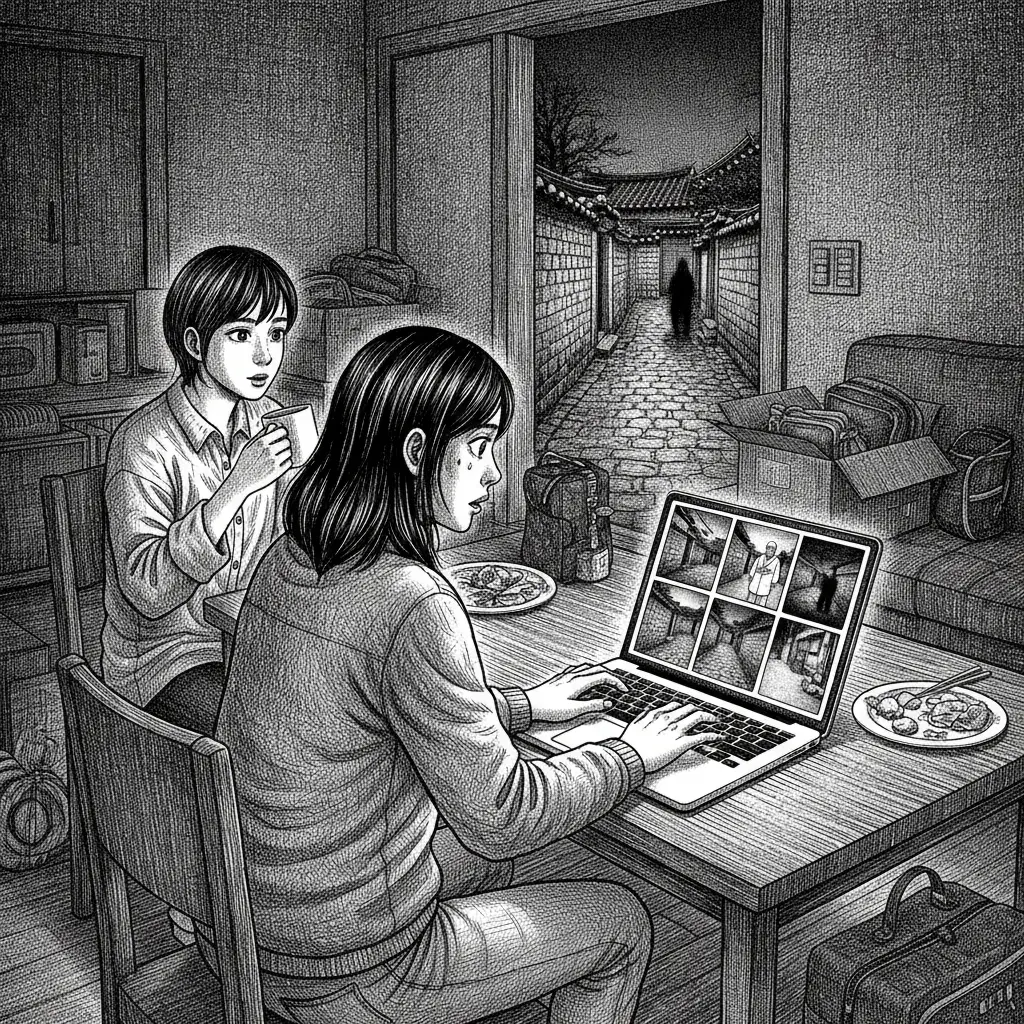
That afternoon Minseo brought her things to a friend's apartment. Over dinner, her friend asked how Bukchon had been. Quiet, Minseo said. The early mornings were nice. The work had gone well. When her friend asked why she had left so suddenly, Minseo said the atmosphere hadn't suited her. Her friend didn't press further. After dinner Minseo opened her laptop and began sorting through her photographs. Everything from Bukchon. Dawn alleys, stone walls, frost on roof tiles. They were good photographs. She went through them one by one. The interval shots from the courtyard were there too.
Minseo looked for the photograph taken at two-fifteen in the morning — the one with the open door. She wanted to look at it once more before deleting it. She opened the folder, sorted by time, and scrolled down. Two-fifteen a.m. The photograph was there. She clicked on it.
The door was closed.
The courtyard was empty.
Minseo went still. She checked the photographs before and after. All of them showed the door closed. The open door she had clearly seen that morning, the silhouette in the darkness — that photograph was gone. She had no memory of deleting it. She went through the entire folder again. The alley shots, the photographs in which the shape had appeared. All of them gone. What remained were only empty alleys and an empty courtyard.
Minseo stared at the screen. The room was quiet. Her friend had already gone to bed. Beyond the window, the lights of Seoul at night. Minseo noticed that her hands were trembling slightly.
The problem was not that the photographs had disappeared. The problem was this: if the photographs had never existed, then what had she seen that morning? And rising from somewhere deeper, another question. If the shape had existed only in photographs — then during all those early-morning hours when Minseo had walked alone through those alleys, shooting frame after frame without seeing anything, who had actually been standing at the far end of each lane?
Minseo did not close the laptop. The light from the screen fell quietly across her face. She sat there for a long time. Outside, there was no sound at all. And that had nothing to do with the fact that this room was quite far from Bukchon.