

The Shadowless Face
AI AI-generated fiction — text, and any narration or images. Unrelated to any real events, people, organizations, or places.
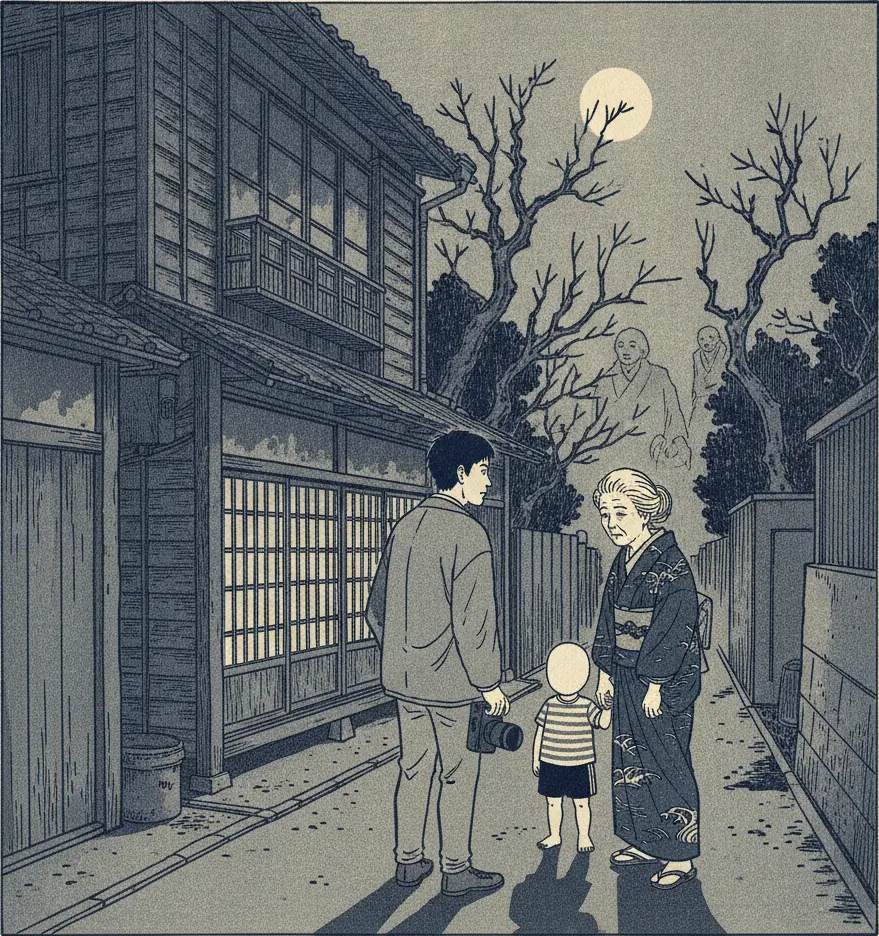
I moved to Yanaka at the end of March.
About ten minutes on foot from Tabata Station, a narrow alley runs along the northern edge of Yanaka Cemetery, and at its far end stands an old two-story wooden rental house. The rent was less than half the going rate, and the man at the real estate office said only that it was "eighty years old, but solidly built," and offered nothing more. I was thirty-two — a photographer named Mizuno Ryo — and I had been worn down by a string of failed work and the wreckage of a divorce. I wanted nothing but cheapness and quiet. Yanaka seemed to offer both.
On moving day, the driver of the light truck finished carrying in my things, then stopped at the entrance to the alley, glanced back at the house, and murmured, "Tough place." I started to ask what he meant, but he was already starting the engine. I took it for the brusqueness typical of Tokyo tradesmen and forgot about it almost immediately.
Yanaka in spring was beautiful. The cemetery's cherry trees were in full bloom, and petals drifted all the way into the alley. Cats wandered through the Yanaka Ginza shopping street, and the eaves of antique shops were lined with old Showa-era signs. In the mornings I woke to the horn of the tofu seller; in the evenings, temple bells carried through the air. I walked the alleys with my camera, gauging the quality of light and shadow, and felt certain I had made the right choice in coming here. The neighbors seemed wary at first, but as I kept greeting them, their faces gradually softened.
There was, however, one thing that nagged at me.
Directly across from my rented house stood another old wooden building of the same kind. There was no nameplate, the rain shutters were always closed, and the mailbox was stuffed to overflowing. The garden shrubs had grown wild, and the place had the look of an abandoned house. Yet at night, now and then, a faint sliver of light would seep through the gaps in the second-floor shutters. Perhaps it was the reflection of a streetlamp. Perhaps moonlight bouncing off something. At first I paid it little mind.
By April I had begun to settle into life in Yanaka. Work requests were slowly returning, and a magazine commissioned me to photograph the back-alley scenery of the neighborhood. I spent a week walking the lanes of Yanaka, Nezu, and Sendagi, shooting old walls and stone pavements, moss-covered steps, the depth of alleys seen from a cat's-eye view. I photographed inside Yanaka Cemetery as well. Weeping cherry trees bloomed among rows of old gravestones, and light and shadow crossed each other in intricate patterns — as a photographer, I could not have asked for better subjects.
On the last evening of that assignment, returning from the cemetery, I saw a figure standing in front of the house across the alley.
An old woman. Eighty, perhaps, or older. She wore a kimono, her white hair gathered back. She stood before the mailbox, taking out the letters one by one, studying each in silence. I called out a greeting, and she turned slowly to face me. For a moment I lost my words. There was no expression on her face. No smile, no surprise, no displeasure — only eyes that looked at me as though looking at something.
"I'm Mizuno," I said. "I've just moved in across the way."
She regarded me for a moment, said only, "Is that so," and returned her gaze to the letters. I waited a little, but she said nothing more, so I bowed and went inside. That night, light seeped again through the gaps in the second-floor shutters of the house across the alley. A little stronger than usual, a little more distinct.
The following day I asked the owner of a nearby antique shop — a solidly built man in his sixties named Tamura — about the house across the way. Tamura set down his work, paused for a moment, and said, "Ah, that place. That's the Sunada residence. The husband passed away quite some time ago, and the wife has been living there alone, apparently, but..." He stopped himself. "Best not to get too involved," he said, and returned to his work.
Don't get too involved. The phrase lodged itself in my mind for days afterward.
Around the end of the May holidays, I saw the old woman — the Sunada woman — standing in front of her house again. This time it was not evening but just past seven in the morning. She was facing the alley, not in the direction of my house but toward the far end of the lane — toward the cemetery. Her posture was unnatural. Her back was unnervingly straight, as though she had swallowed a rod, and she did not move even slightly. I watched her from behind the curtain, and when I next noticed the time, more than forty minutes had passed. She was still standing in exactly the same place, in exactly the same posture.
I brought my camera to the window and raised it to my eye.
Through the viewfinder, the old woman was facing the far end of the alley. From where I stood, I should have been able to see only her profile. Yet somehow, looking through the viewfinder, her face appeared to be turned forward. Turned toward me. I lowered the camera and looked again with my bare eyes. A profile, unmistakably. I raised the viewfinder. She was facing forward.
I did not press the shutter. I cannot say why. I simply could not.
That afternoon I steered the conversation gently toward the subject with another neighbor — a woman in her seventies named Kinoshita-san, who lived near the entrance to the alley. She had lived in Yanaka for more than fifty years and knew everything about the area. When I mentioned the Sunada woman, Kinoshita-san's voice dropped at once. "You know," she said, "the husband passed away more than ten years ago now... but ever since then, she's been like that. Every morning at that hour, standing there, looking toward the cemetery. For years now. Rain or shine, even in the dead of winter."
"Every morning?" I said.

"Every morning. But that's not what bothers me," she continued. "Things got strange after the child started coming."
The word child caught on something inside me.
"A child?"
"Yes. For about the past year, at night, there's been a child standing in front of that house. Seven or eight years old, by the look of it. But no one knows whose child it is. The Sunadas never had children, and no grandchildren either, as far as anyone knows. Not a neighborhood child either..." She stopped, and her expression changed abruptly. "Let's not talk about this anymore. I'm sorry to have brought it up."
From that night on, I began watching the house across the alley with deliberate attention.
In mid-May, just past eleven at night, I was sorting through work files when I glanced out the window. There was a figure in the alley in front of the house across the way. A small figure.
A child, I knew at once. A slight-bodied child of seven or eight was standing at the gate of the house across the alley. A short-sleeved shirt and shorts — far too thin for a May night. The child stood motionless, simply standing there before the house. I opened the window slightly and called out, "Hey." The child did not move. "What are you doing out at this hour?" I said, a little louder. The child turned slowly around.
In the light of the streetlamp, I saw the face.
No face, I thought. That was not quite right — there were eyes, a nose, a mouth. But the face had no shadow. Light fell on it, yet the hollows and contours that should have cast shadows cast none at all. A flat face. Like a face drawn on paper — perfectly, entirely flat.
I closed the window. I locked it. And I could not move a single step.
I don't know how much time passed. At last I forced my trembling legs to carry me back to the window. The alley was empty. The child was gone. Light seeped through the gaps in the rain shutters of the house across the way. Stronger than usual.
The next morning I went to see Tamura. I wanted to know more about the Sunada woman's husband. Tamura was reluctant at first, but when I pressed him, he opened his mouth slowly. "The Sunada husband died in the cemetery," he said. "By his own hand. Early in the morning." He paused. "By the time his wife found him, it was already... After that, she became the way she is. Standing in the same spot at the same hour every morning, staring in the direction he walked. Thirteen years now."
"And the child?" I asked. "What do you know about the child?"
Tamura looked up. "Who told you about the child?"
"Kinoshita-san mentioned it briefly."
Tamura was quiet for a moment. "There was a child at the Sunada house, long ago. A son. But he died young. In the cemetery — he wandered in at night and... That was more than forty years ago."
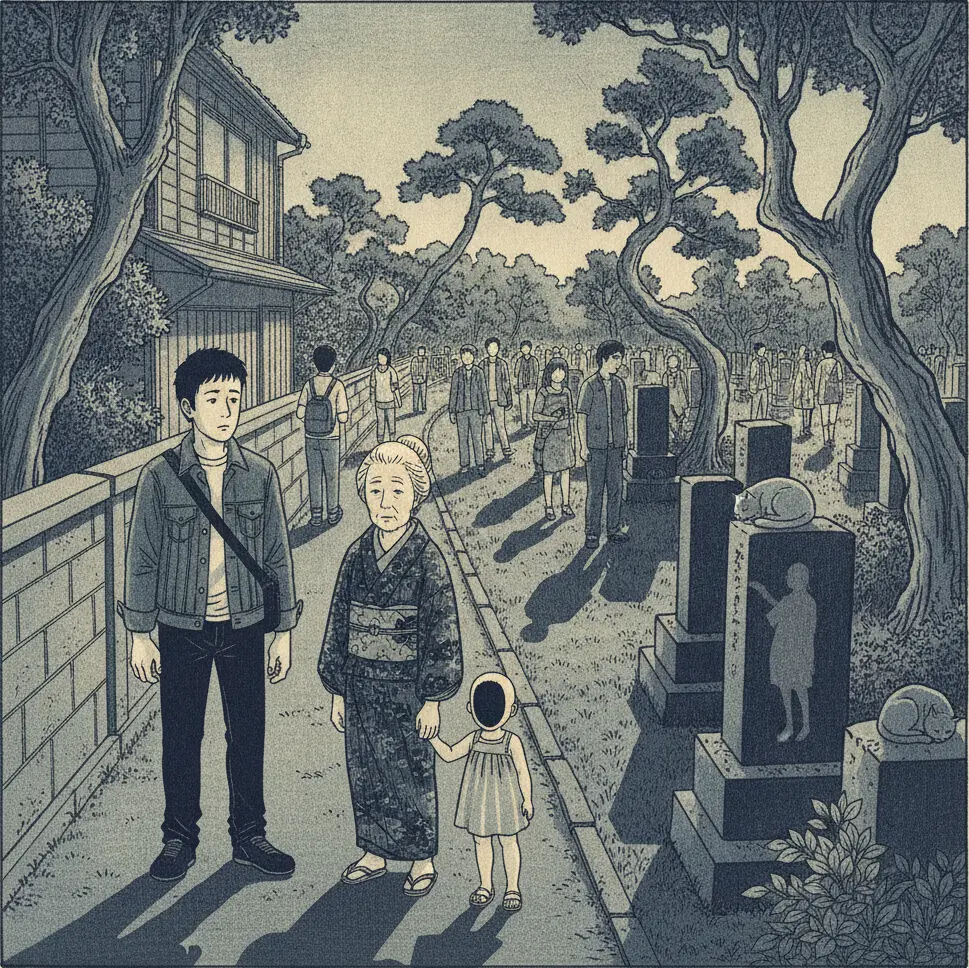
On my way home I passed in front of the cemetery. In the daytime it drew tourists, and cats dozed on top of gravestones. But the scene no longer looked the same to me as it once had. The shadows between the headstones seemed too deep. It was as though the darkness of night had seeped into the daylight.
That night I could not sleep.
Past two in the morning, I looked out the window again. A child was standing in the alley. Tonight it was not in front of the house across the way but directly before my own gate. The same clothes, the same posture. And the same shadowless face.
The child was facing me. Had been facing me from the start.
And beside the child stood the old woman. The Sunada woman, in her kimono, her hand resting on the child's shoulder. In the light of the streetlamp, her face too had no shadow. Neither of them moved at all.
I stepped back from the window, went into the bedroom, and pulled the covers over my head.
The next morning I thought about leaving Tokyo. Staying at a friend's place, checking into a hotel — anything to get away from here for a time. But as I packed my things, I became aware of something. The fear from the night before had been real. Yet what I felt now, packing my bag, was not fear alone. Something else was mixed into it.
Grief, perhaps, was the word.
I thought of the old woman who had stood in the same spot every morning for thirteen years, staring in the direction her husband had disappeared. I thought of the son who had died in the cemetery more than forty years ago. And I thought of that shadowless face — the child's face. What did it mean, to have no shadow? Did it not mean having no substance solid enough to receive the light of the real world?
I picked up my camera.
It was not a rational decision. Looking back, it may not have been a sane one. But I was a photographer, and for me, to see was to understand. I walked out of the house with my camera and stood before the gate of the house across the alley. I raised the viewfinder toward the house.
In the viewfinder, I saw the old woman.
She was standing at the front entrance. Through my naked eye there was nothing to see, but through the viewfinder she was clearly visible, standing at the door. And beside her was the child. The child was holding her hand. Both of them were looking toward this side of the alley — toward where I stood.
For the first time, there was an expression on the old woman's face.
She was smiling.
It was the kind of smile that comes through tears, or the kind that comes when something long sought is finally found. I pressed the shutter. Once only.
When I lowered the camera, there was nothing at the entrance.
That evening I went to Tamura's shop and showed him the photograph — a single image on the screen of my phone. Tamura looked at it for a long time without speaking.
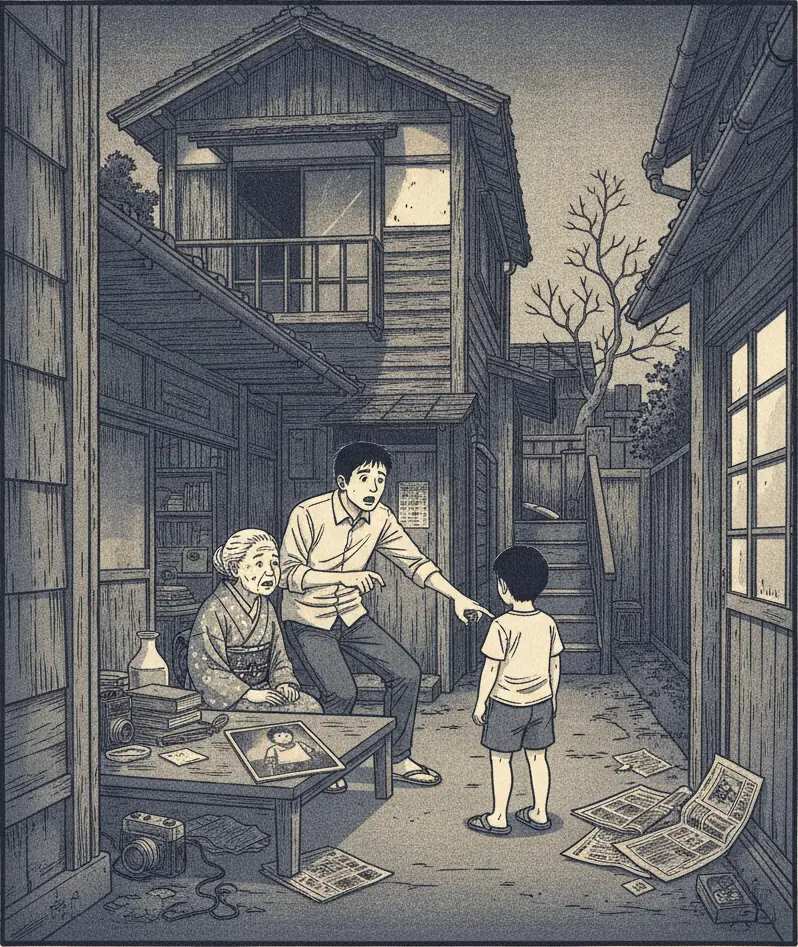
"This..." he finally said. "This child looks like the Sunada boy. There was a photograph she showed me once, years ago... about the same age, and the clothes..."
"Where is the Sunada woman now?" I asked.
Tamura went quiet again. "The thing is, an ambulance came this morning. She collapsed, apparently. They're saying it's old age. She was taken to hospital... she's conscious, from what I hear."
That night I looked at the house across the alley. The shutters were closed, and no light seeped through. For the first time, no light at all. The alley was quiet, and a single cat walked along the top of a wall.
The following morning, at the hour that had nearly become a habit — just past seven — I looked out the window. The old woman was not standing in the alley in front of her house. Of course she wasn't; she was in hospital. But the emptiness felt like a hole in the shape of a person who had always stood there, gaping open in the lane.
Three days later, Tamura told me that the Sunada woman had died in hospital.
The funeral was a quiet affair in the neighborhood. There was almost no family; only a handful of local residents gathered. Kinoshita-san murmured, "She must have had such a long, hard time of it." I said nothing.
For a week after the old woman's death, I looked at the empty house across the alley every morning. Not once did light seep through. Not once did a figure stand in the lane.
After that, I went on living in Yanaka. Work came back, and talk of a photo book of back-alley scenes moved forward. Spring passed, summer came, and the trees of the cemetery deepened to a rich green.
The single photograph I took that day is still in the camera. I have not transferred it to my computer. I have not printed it. It remains inside the camera, sitting on my desk.
Sometimes I look at it on the camera's small LCD screen.
The old woman and the child are standing at the front entrance. Both of them are smiling. But each time I look at the photograph, I notice something that unsettles me — something I did not see the first time. In the photograph, in the entrance behind where the old woman and child are standing, deep in the dim entryway, there is another figure.
A tall figure. A man's silhouette.
Facing this way, standing in a posture that suggests waiting.
I always look away from the screen at that point. I set the camera back on the desk. And I look out the window at the alley. The rain shutters of the empty house across the way are closed again today.
No light seeps through.
For now.