

The Lane Behind the Wicket Gate
AI AI-generated fiction — text, and any narration or images. Unrelated to any real events, people, organizations, or places.
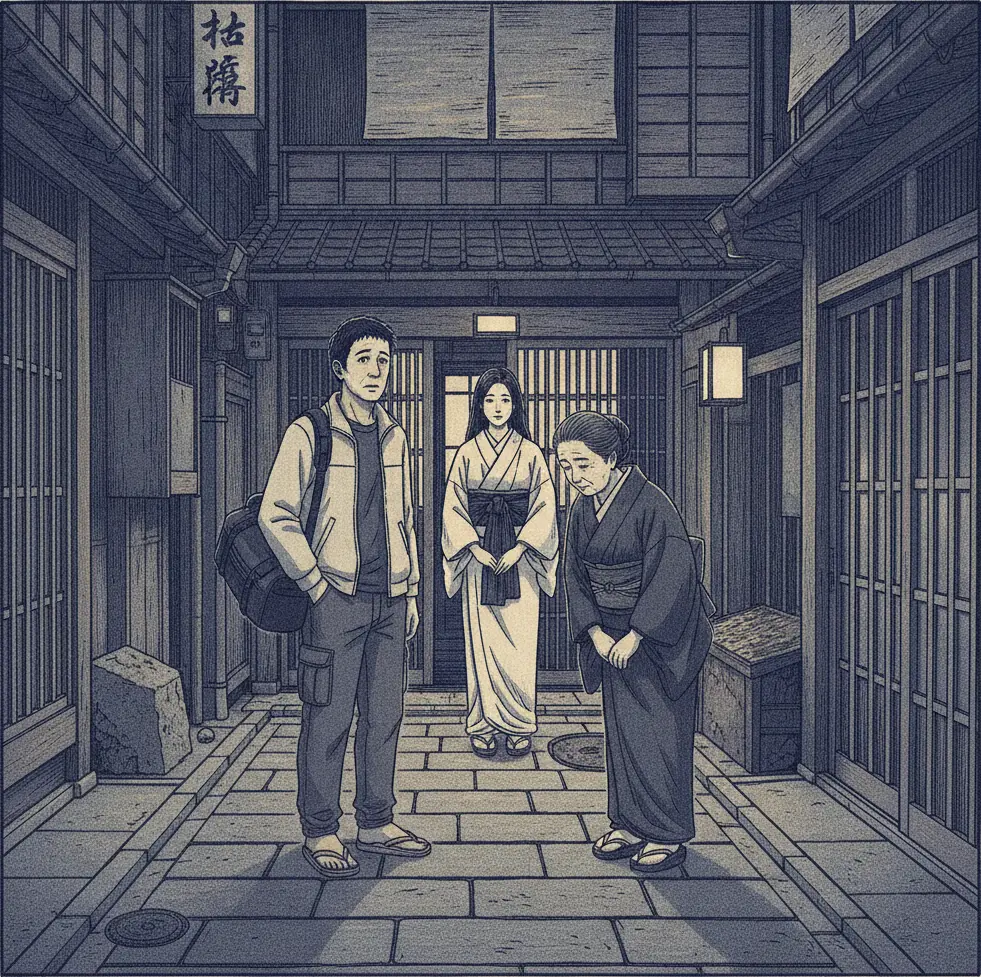
Kyoto in the last days of summer, just past the peak of the heat, recovers a peculiar stillness as the tourist crowds begin to thin. At the end of August, photographer Murase Koji accepted an assignment and stepped into the back lanes of Gion. The job was straightforward enough: shoot the old townscape, deliver several dozen photographs for a Kyoto travel booklet to be published the following year. One week to do it. His lodgings were a small inn a five-minute walk from Hanamikoji, the building itself a converted machiya of more than a century's standing. The proprietress was a slight woman somewhere in her sixties, and when Murase appeared at the entrance she bowed to him — slowly, deeply — as though she had been expecting him for a very long time.
His room was at the far end of the second floor. Opening the window, he looked out over the tiled roof of the neighboring house and, beyond it, a narrow strip of summer evening sky. He thought he could hear the Kamo River somewhere in the distance, though the river was far too far away for that. The source of the sound remained unclear. He unpacked his bags and wrote the next day's shooting route into his notebook. Stone-paved lanes, white plaster walls, rows of latticed doors — the kind of picturesque scenes that filled every magazine spread. But what he was really after were the places that never made it into tourist photography: the slightly shadowed passages, the spots where light barely reached and no one's gaze lingered. In the gaps, in the margins — that was where Kyoto's true face hid. Murase had believed this for as long as he had been working.
He rose early the next morning and left the inn. Even at six o'clock, Kyoto in summer was heavy, the humidity pressing against his skin. He walked south along Hanamikoji, turned east, and almost immediately left the tourist routes behind. The lane bent at right angles, then bent again, and before long he had lost all sense of which direction he was facing. The stone paving was thick with moss. The houses on either side faced each other in silence. Behind the latticed windows there was only darkness; it was impossible to tell whether anyone lived in them at all. Murase raised his camera and moved deeper in, pressing the shutter as he went.
The day's haul was not bad. One frame in particular satisfied him — a moment when the morning's raking light crossed the corner where the lane turned at an L, caught at exactly the right instant. Back at the inn, working through the images on his laptop, he was interrupted by the proprietress bringing his evening meal. Thin-seasoned simmered vegetables, white rice — the flavors of Kyoto. As he ate, he mentioned the lane he had walked that day and asked what the area was called. The proprietress paused before answering. "That would be the Lane Behind the Wicket Gate," she said. A name the locals had always used, she added — it appeared on no map. Then she seemed about to say something more, and closed her mouth. Murase did not press her.
On the third evening, something shifted.
He had gone back to the lane that day as well, wanting the late light. After five o'clock, the angle of the western sun cutting into the passage was at its sharpest, the shadows long, the unevenness of the stone thrown into relief. He set up his tripod, took his light readings, and moved slowly through his compositions. He lost himself in the work, and by the time he noticed, the lane had darkened rapidly around him. He folded the tripod and stood up — and at that moment sensed a presence deeper in the passage. He turned. A woman was standing perhaps ten meters away, her back to him. A summer kimono, white with a fine pattern; the obi a dark, near-black navy. A woman in a kimono in Gion at dusk was hardly unusual. Murase raised his camera again and tried to capture her silhouette. But she was already gone. He thought she might have turned a corner, but the lane ran straight, and the nearest bend was still some distance ahead.
He told himself it was nothing. He was tired. Back at the inn, he checked every frame he had shot. The exposure he had taken when the woman was standing there showed no figure at all — only the stone paving, the old wall, the fading sky. He remembered pressing the shutter. He was certain of it. And yet there was no trace of her. He enlarged the image, thinking perhaps the focus had gone soft, but the grout lines between the stones were perfectly sharp. It was not a focus problem. Simply, there had been nothing there. Murase stared at the frame for a long time, then closed the laptop.
On the fourth night, he could not sleep.
The inn was quiet. Perhaps it was livelier in the busy season, but for now Murase seemed to be the only guest. The floorboards in the corridor creaked now and then on their own — the ordinary complaint of old timber. But sometime after two in the morning, the quality of the sound changed. It was no longer the boards settling. Something was moving along the corridor. Not footsteps — more a continuous, low friction, as though something were being dragged. Murase lay in his futon, breath held, listening. The sound stopped outside his room. Something was on the other side of the sliding door. He was certain of it. After a long silence, the sound withdrew, and only the ordinary creaking of the house remained. When he mentioned it to the proprietress in the morning, she smiled and said, "It's an old building." The smile seemed to him somehow to slide past the surface of things.

On the fifth day, Murase walked the lane in the afternoon. Perhaps because the night still clung to him, the lane looked subtly different. The same stones, the same walls, the same latticed windows — and yet something was slightly off. The spacing of the lattice seemed different from the day before. The stains on the plaster seemed to have moved. He told himself it was a trick of memory and kept walking, and then he noticed it: at the end of the lane, where there had been nothing yesterday, stood a wooden gate. Old planks, hinges rusted, no sign of having been opened in years. And yet through the gap in the boards something seeped — not wind, not sound, only the certainty that there was another side, dissolving into the suffocating summer damp.
Murase lowered his camera and approached. Putting his eye to the gap, he could see a small courtyard beyond: a stone-paved garden with a single moss-covered water basin, a stone lantern standing unlit beside it. At the far end of the garden was an old building with a narrow veranda, and in the shadow of that veranda someone was sitting. Facing him. Perfectly still. The distance was too great to make out a face, but he thought it was a woman in a white kimono — possibly the same kimono as the woman he had seen in the lane three days before. The moment that thought formed, the woman turned toward him. Or rather — it might be more accurate to say he realized she had been facing him all along. Murase stepped back from the gate and walked quickly out of the lane.
He called his client as soon as he returned to the inn. The shoot was going well, he said; he had nearly everything he needed. He would leave tomorrow, a day early. The client sounded mildly surprised but agreed. Packing his things, Murase noticed how exhausted he was. There were shadows under his eyes. The face in the mirror looked like his own, but slightly thinner — slightly less present. He told himself it was fatigue. Of course it was. But when he turned on the tap to wash his hands, the figure in the mirror moved — just for an instant — a fraction of a second before he did. It was over almost before it happened. He turned off the tap and looked again. This time the reflection moved in perfect unison with him.
That night — his last night — Murase dreamed.
In the dream he was walking the lanes of Gion again, in a light that belonged to neither day nor night, the borderland between dusk and dark. The stone paving transmitted itself through the soles of his feet; the damp air filled his lungs. He knew it was a dream, but the self inside the dream did not. He came at last to the wicket gate. It was open. The courtyard lay beyond. A woman stood before the water basin — white kimono, black obi. Her back was to him. When Murase passed through the gate, she turned. She had a face. The face was his own. But the expression was absent. Her eyes were open and reflected nothing. He tried to cry out and found he had no voice. The woman opened her mouth and spoke. He heard nothing, but he could read her lips. "The exchange has already been made," she said.
He woke in the darkness before dawn, drenched in sweat, the futon pressing down on him like something solid. He got up and opened the window. The air of late summer moved in. The outlines of the old houses rose beyond the lane. Nothing had changed. Just a Kyoto morning. He said this to himself as he made his final check of his luggage, shouldered his camera bag, wheeled his suitcase into the corridor, and went downstairs. The proprietress was already up, sweeping the stone entrance floor with a broom.
"You're leaving early," she said.
"Thank you for everything," Murase answered.
The proprietress stopped sweeping and looked at him steadily. Under ordinary circumstances the look would have meant nothing, but that morning something was different. Her eyes seemed focused not on the surface of his face but on some point slightly behind it. Murase thanked her again and stepped outside. The moment his foot met the stone paving, the proprietress said something behind him, in a low voice. He turned to ask her to repeat it. She had already resumed sweeping and was not looking at him. He pretended not to have heard, and walked on.

On his way to Hanamikoji to find a taxi, Murase passed through the Lane Behind the Wicket Gate one more time. He could not have said why his feet took him that way. Perhaps he wanted a last look. Perhaps he needed to confirm something. The lane was still in shadow at that hour, the stones dark and wet. He knew this path well by now, and yet his footing felt subtly wrong — as though he were walking with someone else's stride. He stopped and looked down. His shoes cast their shadow on the stone. An ordinary shadow. But the outline of it was, by the smallest margin, narrower than his body.
He reached the end of the lane where the gate stood, same as yesterday. He had no desire to look through the gap. But as he moved to pass, a voice came from the other side — not a clear voice, low and muffled, yet unmistakably human. And unmistakably like his own. Murase did not break his stride. Something told him he must not stop. He quickened his pace, cleared the lane, and came out onto Hanamikoji. The moment he re-entered the world of people and movement, something in his chest loosened slightly. He hailed a taxi and headed for Kyoto Station.
On the Shinkansen, Murase reviewed his images. More than three hundred frames over five days — more than enough of the picturesque lanes the client wanted. He was running a slideshow, checking each frame in turn, when he stopped at a photograph from the third evening. The frame he had taken when the woman was standing there — the one with no figure in it. Still nothing. But he noticed something now that he had not noticed before. One of the shadows on the stone paving was wrong. Given the angle of the light, the building's shadow should have fallen further to the right. One shadow alone pointed in a different direction — falling precisely where a shadow would fall if a person were standing there. A shadow with no one to cast it.
Murase looked at the frame for a while, then moved on to the next.
He arrived back in Tokyo in the early afternoon. He returned to his apartment, unpacked, showered. Standing before the bathroom mirror, the unease he had felt in the inn's mirror came back to him. This time nothing happened. The reflection moved in perfect unison with him. He washed his face, dried it with a towel, went to the living room, and sat on the sofa. He looked up at the ceiling for a while without doing anything at all.
His client called the next day and praised the photographs. Several frames in particular, he said — the handling of light and shadow was exceptional. Which ones, Murase asked. Every frame the client named was from the third day onward. The lane behind the wicket gate. The passages at dusk. Looking at them again, he could see it: something in those photographs was different from his earlier work. The shadows were bolder. The unlit places were entered more deeply. "Did something change for you?" the client asked. "It may have," Murase said.
Several weeks passed.
Work went well; new commissions came in. Nothing in daily life was out of order. But Murase had noticed, since a certain night, that his sleep had changed. He no longer dreamed. He had always been a vivid dreamer, but now each night was a complete darkness he moved through without images, waking clean on the other side. The waking itself was not unpleasant — if anything, he felt clearer in the mornings than before. And yet, in the moment of rising and looking out the window, something small stirred in his chest — something that tried, for just an instant, to verify whether this clarity was his own. Then it was gone.
One evening he drank with an old friend from the photography world. The conversation turned to Kyoto, and Murase mentioned the good frames he had gotten in the Gion lanes. His friend said, with the easy certainty of the slightly drunk, "There's always been something off about those back alleys." Something like what, Murase asked. His friend laughed and said: "They say empty husks settle in the lanes behind Gion. After the real thing has gone, the shape stays behind." Murase laughed and drank. It was a ridiculous story.
It was, without question, a ridiculous story.

Back home, he washed his hands. He looked in the mirror. His own face looked back at him — eyes, nose, mouth. Tired, but familiar. He felt the water running over the backs of his hands. He felt the texture of the towel. He went to the living room and sat on the sofa. The cushion pressed against him. Beyond the window, the Tokyo night spread out in lights. Everything was in order. Everything was present.
Murase closed his eyes.
In the darkness, there was the memory of stone paving underfoot. The memory of summer humidity. The memory of a woman in a white kimono. The memory of words spoken in a dream. "The exchange has already been made."
He had stopped asking himself to whom those words had been addressed.
He opened his eyes. The mirror was on the far side of the room. At this distance he could not see his own face. There was no need to. Murase settled deeper into the sofa and began to organize tomorrow's shoot in his mind. There was work to do. There were things that needed doing. That was enough. That alone was enough.
Except for one thing.
The morning he left the inn, the proprietress had said something behind him as he stepped outside. He had pretended not to hear. But he had heard. Her voice was low, and perfectly clear. She had not said "take care on your way home." She had not said "please come again." What the proprietress had said was this:
"I'm sorry we couldn't give you back."