By day, Seoul's Garosu-gil hums with life — sleek cafés, boutiques, the easy confidence of a street that knows it is admired. But when night falls over the city's most fashionable avenue, something else stirs. A rumour, a story, a thing that moves through the dark between the trees.
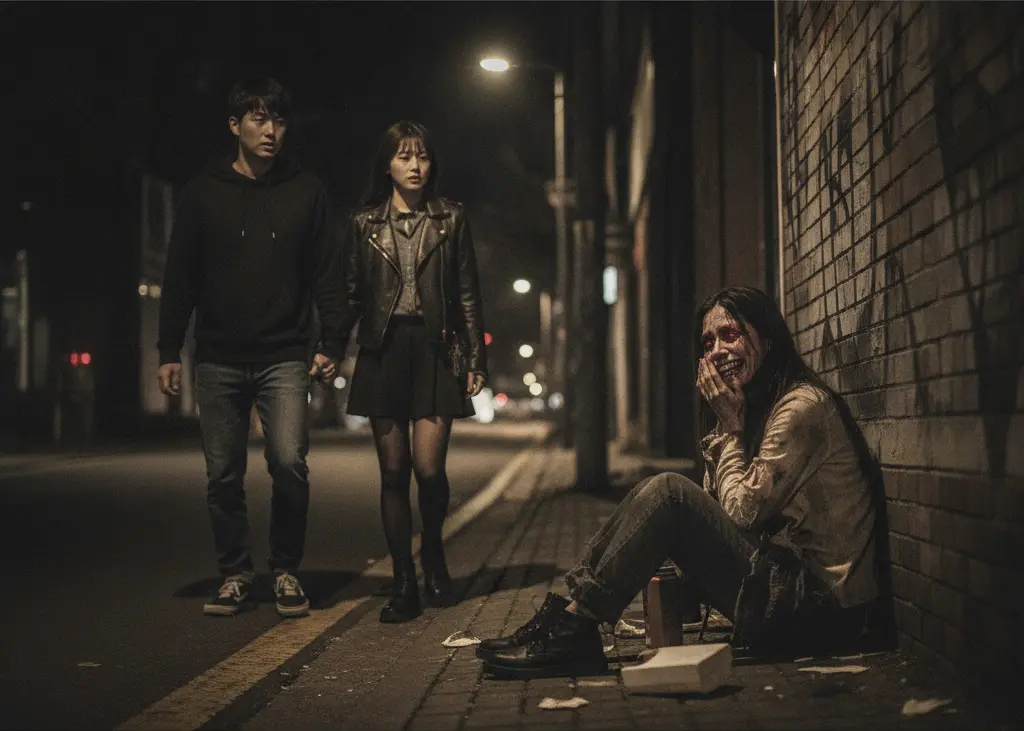
Some years ago, a couple used to walk that road. They had left a café late one evening and were making their way along Garosu-gil in search of a taxi when they heard it — a sound drifting toward them through the stillness. Sobbing. Soft, but unmistakable. Curiosity pulled at them, and they followed it.
When they found the source, they found a woman. She was sitting at the edge of the pavement in worn, shabby clothes, her head bowed, her shoulders trembling with each broken breath. They approached and asked if she was all right. She did not answer. Instead, she slowly raised her head and looked at them. Her eyes were a deep, raw red, swollen as though she had been weeping for a very long time. Her mouth was wrong — split, somehow, in a way that made no sense.
The couple stepped back. They turned to leave, quickly, but the woman laughed — a sound that did not belong in a human throat — and called after them. *You'll end up just like me.* Those words. They ran, and still the laughter followed, growing louder with every step, filling the space behind them until they could hear nothing else.
The next night, they dreamed. In the dream they were wandering Garosu-gil again, and the sobbing led them back to her, as it always would. Then hands made of shadow reached out from somewhere that had no name, and pulled them into the dark. They did not wake from that dream. They did not wake at all.
Since then, it is said that those who walk Garosu-gil late at night and hear a woman weeping know one thing above all else: do not stop. Everyone who has seen her has vanished, and her parting words have lodged themselves in the minds of all who have heard the story, sharp and immovable as a splinter. *You'll end up just like me.*