…Would you care to hear it?
I cannot say with any certainty. Only that, after so many years in service to this mountain, such stories have a way of drifting to one's ears — carried, as it were, on the wind.
It concerns Mount Moiwa.
People come from great distances, I'm told, to see Sapporo spread out below at night — the glow of the ropeway, the cheerful bustle of the observation deck. And yet the old locals, when they speak of that mountain after dark, have a habit of lowering their voices, just slightly. …That is simply how it is, or so I have been told.
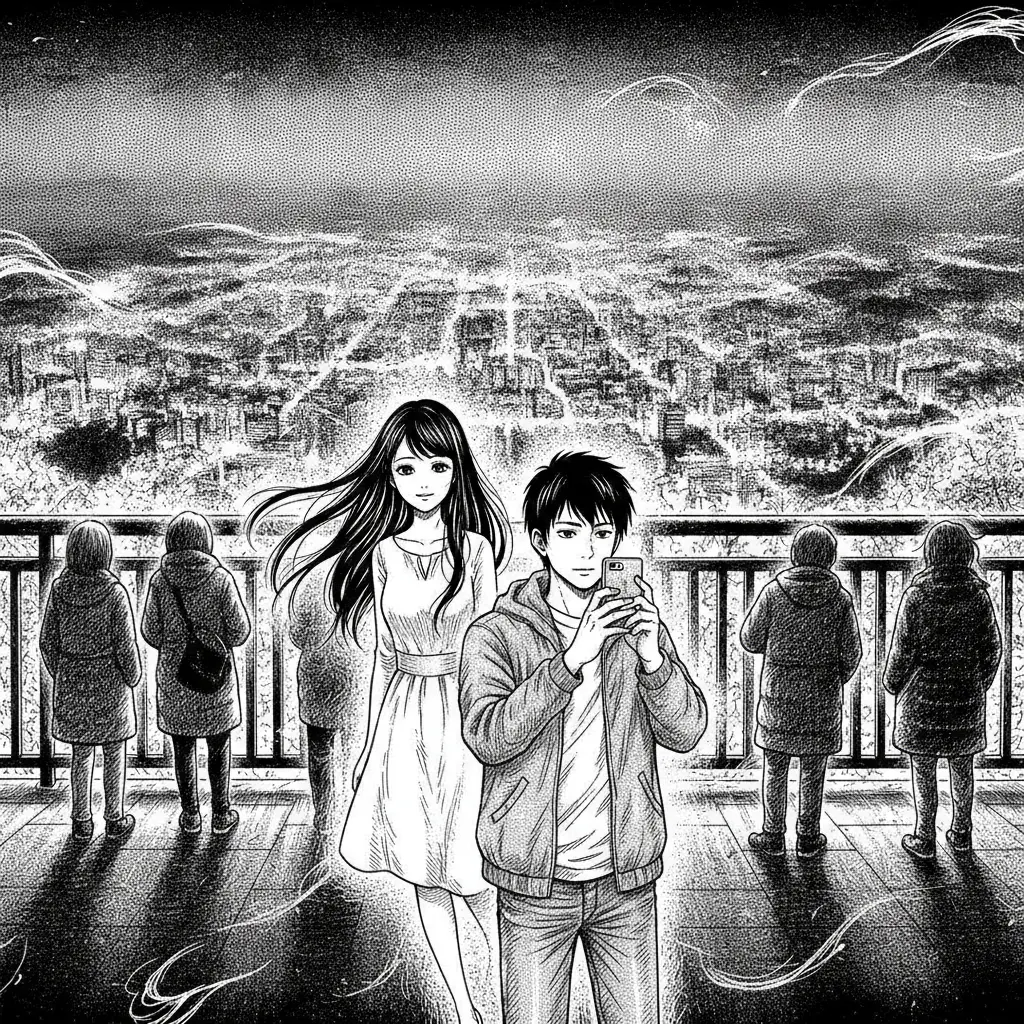
It happened, as I heard it, toward the end of one autumn. A young man had gone up to the observation deck with his sweetheart. It was past nine in the evening, the tourists had thinned to almost nothing, and a cold edge had crept into the wind. The two of them stood with the city lights at their backs and took a few photographs. A memento, nothing more.
He noticed nothing at the time, he said.
It was later, back at the inn, when he was quietly looking back through the photographs, that his hand went still.
In one of the pictures, the two of them stood side by side. And there, beyond them — through the glass walls of the observation deck, out in the darkness outside — something white was faintly visible.
His first thought was snow, he said. But there had been no snow on the mountain that day. It was pale and diffuse, elongated — widening softly from what might have been shoulders down to a hem. The longer he looked, the more unmistakably it resolved into the shape of a person.
Arms. Hair.
And a face — turned toward the camera.
He could not look away from the screen for some time. It wasn't quite fear, not at first — he wanted to believe it was a trick of the eye. But when he showed it to his sweetheart, she turned the screen face-down immediately and said only one word: *Delete*. Her voice was trembling, he said.
The white woman was smiling.
Gently. Warmly. As though she were simply glad to have found her way into the photograph — glad to be there, with them.
…That was what disturbed him most, he said, when he spoke of it afterward. Anger he might have understood. A scream, a contorted face — something like that, perhaps, he could have made sense of. But a smile. Standing quietly beside them, close as a companion, smiling as though she were happy.
There is an old story, passed down for generations, that a woman died on that mountain long ago. The particulars… I could not say with any clarity. Only that mountains have a way of holding within them those who remained behind, still deep in their grief.
He deleted the photograph, in the end.
Though perhaps deleting it did not bring anything to a close.
After that, the man was rarely spoken of again, or so I was told. What became of him and his sweetheart, no one seemed to know.
Still, people come to Mount Moiwa at night. Couples stand together, gazing out over the city lights, and take their photographs.
And beside them, as though she had always been standing there, the white woman draws close — watching the same night view, together with them.
…Smiling, so very happily.