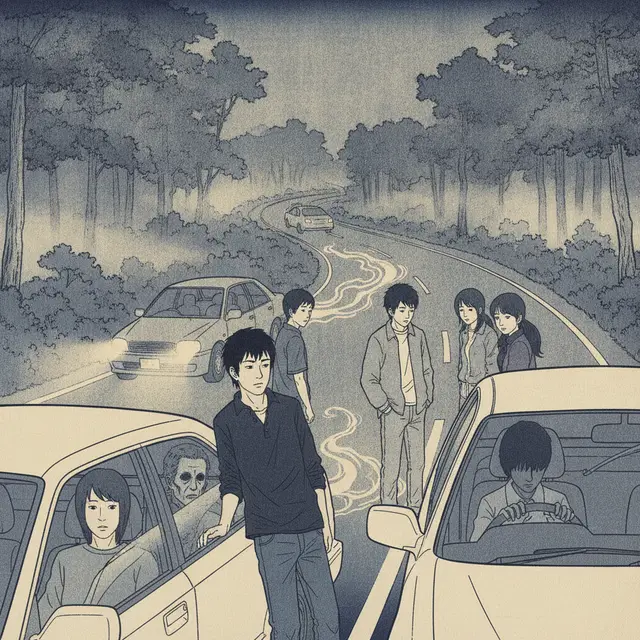
This is a story I heard from someone up in Aichi.
Apparently there's a place in Toyota City called the Old Isejin Tunnel. An abandoned tunnel, long out of use, sitting alone in the mountains with its mouth hanging open. Everyone who grew up around there knows about it. They know about it — which is exactly why they don't go near it after dark.
It happened one autumn, from what I was told. A man in his twenties drove out there alone around one in the morning — a dare, essentially. His friends had goaded him into it, though by all accounts he was the stubborn sort, the kind who'd insist on going by himself just to prove a point.
When he pulled up to the entrance, the first thing that got to him was the smell. Mountain air at night is supposed to be cold and clean, but not there. A damp, clinging odor — wet earth and something like rotting wood — pressed itself into the back of his nose and stayed. Even so, he put the car in gear and eased slowly into the tunnel.
Inside, his headlights were all he had. The concrete walls had gone nearly black, streaked top to bottom with long trails where water had seeped through. The ceiling sat low overhead, and even inside the car he felt it — a strange, suffocating pressure closing in around him.
Somewhere past the halfway point, he noticed something.
The passenger-side window looked fogged.
He glanced over, thinking it was the air conditioning. It wasn't. There were handprints on the inside of the glass. Small handprints. Not an adult's hands — a child's, a very young child's, pressed flat and full against the window. Not just one. Two, three, layered over each other.
He floored the accelerator and drove straight for the exit. The moment he cleared the tunnel, warning lights flickered on across the dashboard. When he hit the brakes, the pedal felt wrong — distant, unresponsive — and the car wouldn't stop cleanly. He managed to wrestle it onto the shoulder and finally brought it to a halt.
He looked at the passenger seat, hands still shaking. The prints were still there.
He wiped at them with a tissue. They didn't come off. He tried again and again — breathed on the glass, rubbed it warm, tried once more. Nothing. The shapes stayed, perfectly clear, as if pressed into the surface itself.
Back home, he checked again. They were still there that night. In the morning, he told himself they'd be gone — but they weren't. Three days later, they were still there.
That much I've heard from more than one person.
But there's another part to the story. One that hasn't spread as far.
Apparently it's known locally that a worker died in an accident during the tunnel's construction. Separately from that, there's also a story that when Typhoon Vera struck, a landslide came down off the nearby mountain and swallowed a mother and her young child. I can't verify any of it, so I won't pretend to know how much is true.
But there was something he said afterward, later on.
Among the handprints on the glass, he said, one of them was different. Nearly the size of an adult's hand.
What that means, I honestly couldn't tell you.