…Would you mind listening for a moment?
I have been hearing things lately — fragments, here and there — about the Otomaru Overpass in Kanazawa. I cannot say I have verified any of it myself, but enough people have told me similar things that I felt it would be wrong to stay silent.
You may know the bridge's supports. They are said to be modelled after the kotoji stone lantern in Kenroku-en, and by daylight, apparently, they have a certain quiet elegance to them — two lantern-like legs planted wide, bearing the weight of the bridge with unhurried solidity. The locals say it is quite unlike anything else in the city.
At night, however, the shape begins to look like something else entirely.
This is a story I heard not long ago, passed to me through an acquaintance of an acquaintance — a man in his thirties, whose name I will leave unspoken. He had occasion, several times, to cross the Otomaru Overpass late at night on his way home from work.
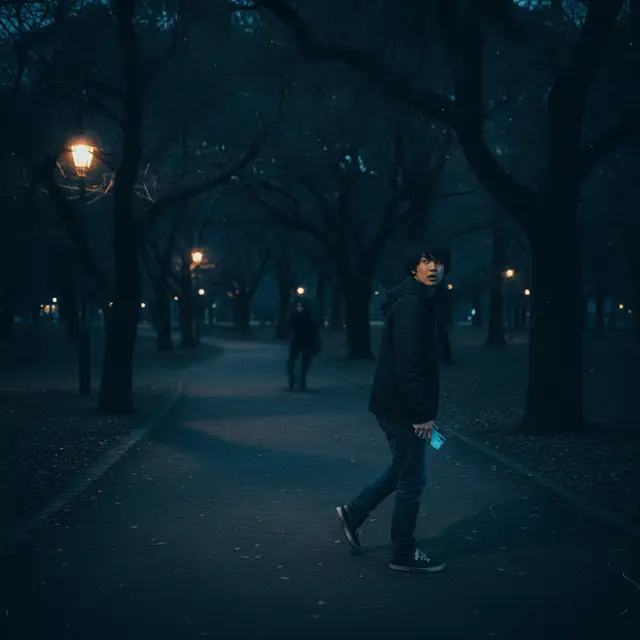
It was an autumn evening, he said. A little past eleven. The streets around him had emptied, and he was alone on the overpass. Below, the Hokuriku Shinkansen viaduct crossed the JR tracks, and whenever a train passed, the whole bridge would tremble faintly — a vibration that crept up through the soles of his feet and settled somewhere deeper.
That night, too, the sound of a train rose in the distance, and the bridge shivered beneath him.
The moment the trembling stopped —
— he heard a voice.
A whisper, right beside his ear.
Not one voice, but several, layered over one another, speaking something he could not make out. He could not tell whether it was Japanese or something else entirely. But it was unmistakably human in quality — low, damp, as close as a mouth pressed to the side of his face.
He spun around. There was no one.
Only himself on the bridge, and beyond the railing, the night sky, the tracks, the distant scatter of city lights.
He told himself it was nothing, and walked on.
But when he reached roughly the middle of the bridge, he saw something — outside the railing, near the base of one of the supports.
He thought at first it was a shadow. There, at the joint where the lantern-shaped pillar met the underside of the bridge, jutting out beyond the edge — something was standing there.
It was looking down, he said.
Head bowed, perfectly still. The outline was indistinct; he could not tell whether it was a man or a woman. Only that it was standing — there is no other word for the way it simply stood.
He leaned out over the railing to get a better look.
And at that moment, the figure slowly raised its face.
He could not see the face. Whether the darkness concealed it or whether there was simply nothing there, he could not say — only that the part where a face should have been was flat and dark and empty. And yet he knew, with complete certainty, that it had turned toward him.
He ran the rest of the way across the bridge without stopping, and I am told he has taken a different route ever since.
Why such things are drawn to that particular place, I cannot say. There is an old belief that where rail lines cross, the flow of something becomes unsettled — and I find myself wondering, too, whether the shape of those supports might invite something, in ways we do not understand.
But there is one detail that stays with me.
Just before he ran, he said, he noticed a smell on the bridge — the smell of wet earth. On a clear night, with no rain for days. He described it, after a pause, as the smell of grave soil.
…What was it that stood beneath those supports?
Even now, I imagine, every time a train passes, the bridge is trembling.