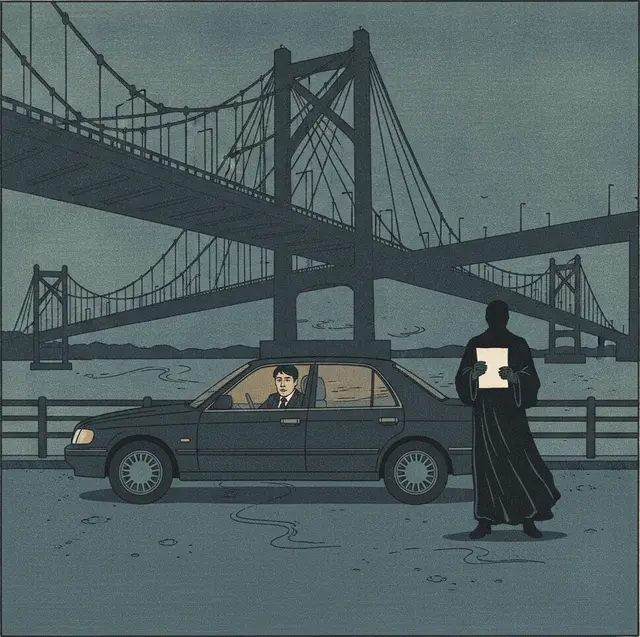
Now, the story I've brought you today.
I heard it from someone I know over in Gwangju, so I can't say for certain it's true. It's just... something that drifts around in those parts.
Halfway up Mudeungsan, at the very start of the road leading into Ullim-dong, there's said to be a zelkova tree. Five hundred years old, they say — the trunk so thick that two or three grown adults joining hands can't reach all the way around it. The village people have called it the dangsan tree since time out of memory. The tree where the spirit that watches over the village makes its home.
Every year on the first full moon of the lunar calendar, they would appoint a hwaju — the person who presides over the rite — and hold the dangsan ceremony. Rice cakes, fruit, all laid out in offering. Prayers for the village's peace, prayers for a good harvest. Hundreds of years, they kept it up without fail.
But at some point, it stopped.
The reason is a little strange.
Every person who took on the role of hwaju, something bad would find them afterward. Nothing you could put your finger on exactly — people used the phrase that a shadow had fallen over the household. A business going under, someone in the family falling ill. It wasn't that anyone blamed the hwaju directly, but that's just how people are. When it happens twice, three times, the rumors start to spread.
Then, about ten or so years ago, there's the story of the last person to take on the role.
An elder who had lived in Ullim-dong a long time. With no one else willing to come forward, he volunteered himself. On the morning of the ceremony, before dawn, he set out the offerings alone and stood before the tree.
They say that particular dawn was unnaturally still. No wind. No sound of insects. The elder spoke of it to his family afterward — that the moment he bowed his head to make his first prostration, a sound came from somewhere up in the tree.
Something heavy, moving slowly. Walking along the branches.
Too slow to be a footstep, too regular to be the wind. He'd also heard it said that there were several sounds at once, as though whatever it was had five or six legs. But when he raised his head and looked up, there was nothing there.
So he told himself it must be some animal, and finished the rite.
But when he got home and went to wash his hands, he found something sticky on the back of them. It seemed like tree sap, but the smell was wrong — a sweet smell, he said, like something rotting.
He washed and washed, but the smell wouldn't leave him for the rest of that day.
What became of that elder afterward — well, that I couldn't say. Everyone who tells it tells it differently, so I honestly don't know. But on one point they all agree: after that, not a single person ever came forward to be hwaju again.
The tree is still there, they say. It's been there five hundred years, after all.
But no one goes to it anymore. A tree that receives no prostrations, no offerings laid before it. When something has been fed for hundreds of years, and then one day it simply stops —
do you think it just sits there quietly?