…This is something I heard. Whether it is true, I really cannot say.
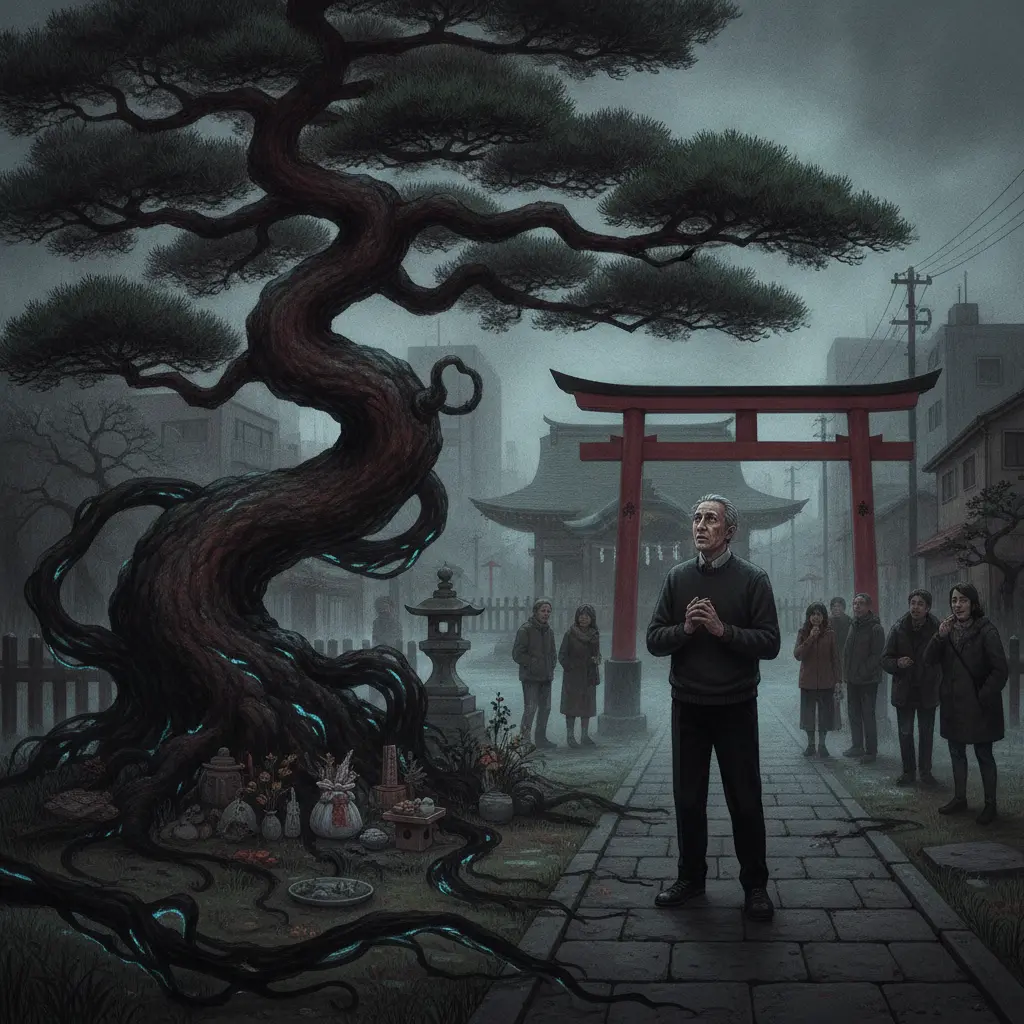
There was, they say, a pine tree in Udagawacho.
Somewhere along the approach to Kitatani Inari Shrine, or so I was told. It had already been standing there by the early years of the Showa era, apparently. The spread of its branches was magnificent — a great tree that drew the eye from a considerable distance. And yet, if you stood beneath it, for reasons no one could explain, even at the height of midsummer, a cold sensation would come creeping up from the ground around your feet. Less like something touching the skin, and more like something stroking the inside of it, if that makes any sense.
The locals called it the Man-Eating Pine.
No one could say with any certainty how it came by that name, but for as long as anyone could remember, there had been a steady trickle of stories — someone who had wandered close to its roots and found, without knowing how, that the day had gone dark around them; someone who had lost all sense of the way home. People did not speak of these things loudly, though. That much I have been told.
The rezoning came sometime in the middle of the Showa era.
When it was decided the tree would be felled, several craftsmen were hired to do the work. On the first day, the man who set the saw to the trunk collapsed that same night with a sudden, violent pain in his stomach. The man who took his place the following day fell from the scaffolding and broke his arm. There was no wind, someone who had been there said afterward. There was no wind, and yet the branches had creaked.
A single sound. Low.
Only once.
The moment the man on the scaffolding heard it, his hands slipped.
Of all the accounts, the one that stays with me most is that of the man who eventually took charge of the work himself. He had dreamed, the night before he was to begin. He said he was standing somewhere dark when, from above, countless thin branches came descending and wound themselves, softly and without resistance, around his neck and arms. In the dream, the branches were warm. Warm like a living body, he said — a faint, damp warmth, not what you would expect from wood at all.
When he woke, there were fine scratches, several of them, across his neck.
He did not take part in the work. That is what I heard.
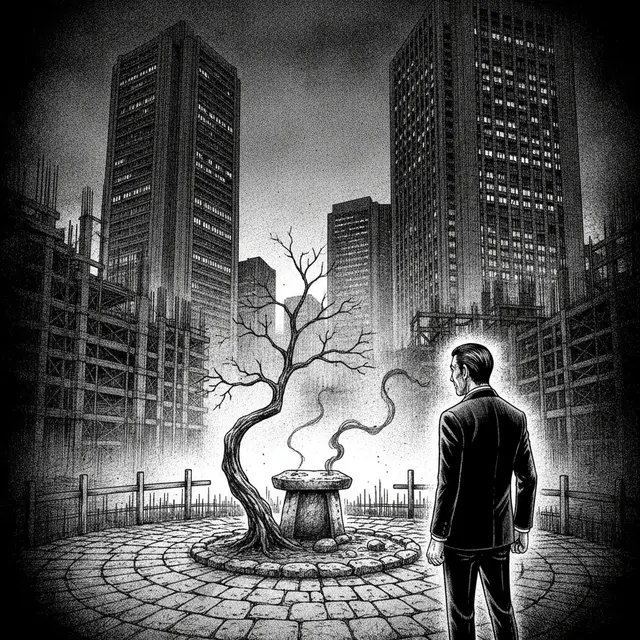
In the end, the pine was cut down. But after the felling, when they dug up the roots, something is said to have come out of the earth — what it was, no one seems to know clearly — and the men who finished the work that day did not speak a single word among themselves until the following morning. Not one of them said what they had seen.
The pine was moved to another location, but it withered before long.
After that, shrines to Benzaiten and the dragon deity were established within the grounds of Kitatani Inari. Some say it was to appease a curse; others say it was to offer an apology.
Even now, there are those who say that if you pass through that area at night, the back of your neck goes cold — even when there is no wind.
But what I keep returning to is the matter of those scratches.
The man who dreamed of being entwined by the pine apparently had the same dream many times in his later years. Toward the end, though, it was no longer his neck or his arms the branches were moving around. They were reaching somewhere deeper, he said. Searching.
Where exactly they were searching — the person who told me this would not say any more than that.
…There is no way to verify any of it. But that is what I was told.