

The Eyeless Inn
AI AI-generated fiction — text, and any narration or images. Unrelated to any real events, people, organizations, or places.
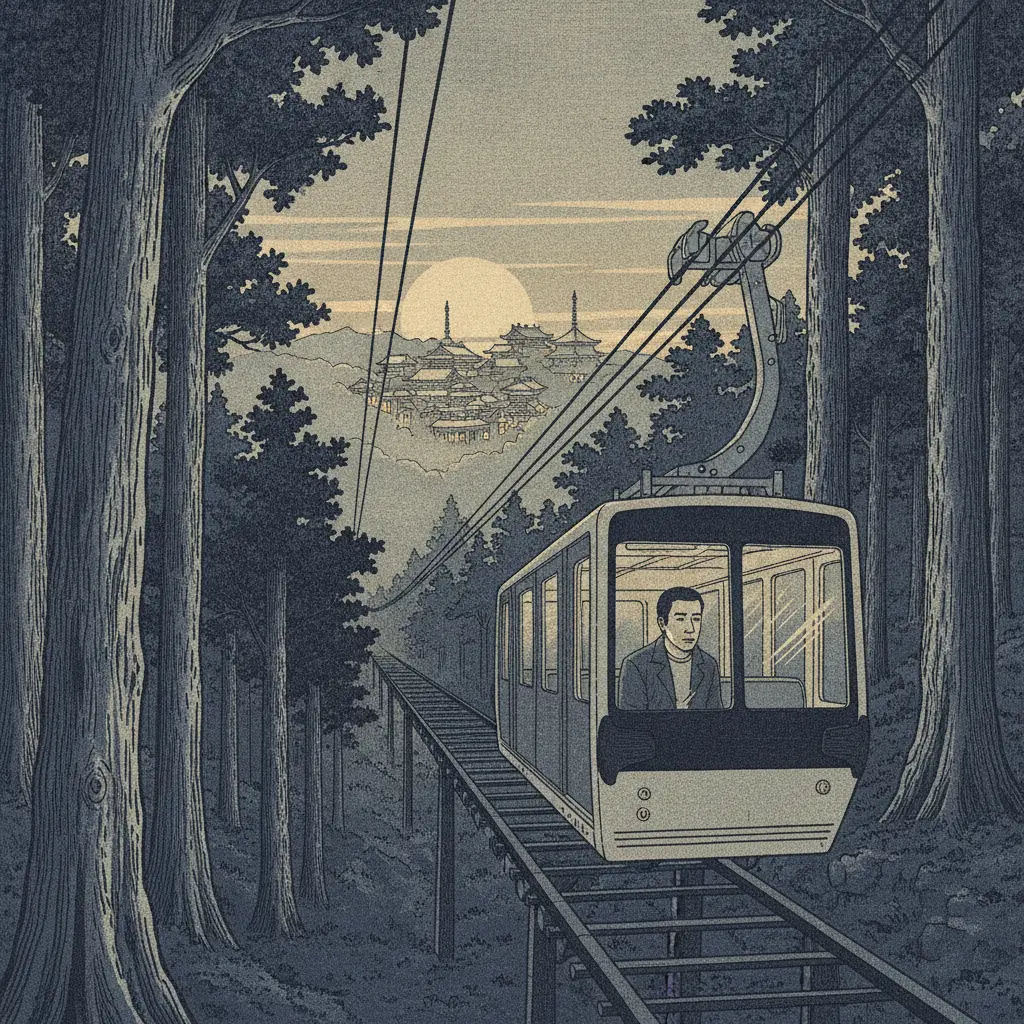
At the end of October, Kakimoto Shin'ichi rode the cable car alone from the southern terminus of the Nankai Line. It was a weekday afternoon, and he was the only passenger. The car crawled up the steep grade, and each time the cedar forest outside the window cut across the fading light, the interior plunged briefly into darkness. It was his first time on Mount Koya, and though he called the trip a rest, it was more honestly a flight. He had left the publishing house where he'd spent three years, been abandoned by his fiancée, and was left alone in a single room in Tokyo — until one night, staring idly at a rail map, he noticed the words "Mount Koya" printed small at the edge, and simply decided to go. There was no reason. The absence of a reason was the only reason there was.
When he stepped out of the station, the air changed. The damp warmth of the lowlands was gone, replaced by a deep, mingled scent of cedar resin and cold earth. Along both sides of the road leading to Okunoin, cedars hundreds of years old stood in rows, their trunks too wide for any human arms to encircle. Shin'ichi took the bus and got off at Senjuin-bashi. The temple lodging was called Enjaku-in. When he had telephoned to reserve a room, the man's voice on the other end had been so low that Shin'ichi had to ask him to repeat himself several times — he remembered that now, only now.
Enjaku-in stood a little apart from the main lodging district, at the end of a narrow stone-paved lane one turn off the main approach. The gate was old wood, its nameplate's ink blurred by rain until the characters were barely legible. Beyond it lay a gravel forecourt with a stone water basin at its center. The water in the basin was frozen, despite it being the end of October. Shin'ichi found this strange, then told himself it was only natural at this elevation. He called out at the entrance, and a man of about sixty appeared — thin lips, deeply carved wrinkles, and eyes that alone seemed to gleam with an odd light. "You must be Kakimoto-sama," the man said, not as a question but as a statement, and before Shin'ichi had even nodded, he was already arranging the guest slippers.
The room was at the far end of the second floor. It was an eight-mat tatami room with a single hanging scroll in the alcove — a brushwork figure, a monk of some kind, hands pressed together in prayer, but the face had no eyes. Whether they had been deliberately left unpainted or had simply faded away with time, he could not tell. Outside the window was nothing but cedar forest; there were no neighboring buildings, and the evening light had already retreated to the very tops of the trees. Shin'ichi set down his bag and tried to read the paperback he had brought, but the words would not enter his mind. Why had he come here, he wondered again. Then he heard footsteps in the corridor — slow, evenly spaced — approaching, stopping just outside his door. But no one came.
Dinner was served in the dining room on the ground floor: shojin ryori, the austere vegetarian cuisine of temple life. Sesame tofu, simmered wheat gluten, pickled vegetables, and plain hot water. There were no other guests. When Shin'ichi asked whether he was the only one staying, the woman who had brought the food paused for just a moment. She appeared to be in her thirties, but her skin was pale as ash and her face showed almost no expression. "You are the only guest tonight," she said, and left the room at once. Shin'ichi brought the sesame tofu to his lips. It was good. But as he ate, he began to feel a gaze from the corner of the room. He turned — no one was there. Only the carved transom above the sliding door, a lattice of flowers and leaves, which for some reason now looked like a face. The hollows of eye sockets. A crack like a mouth. He laughed it off as imagination and drained his tea.
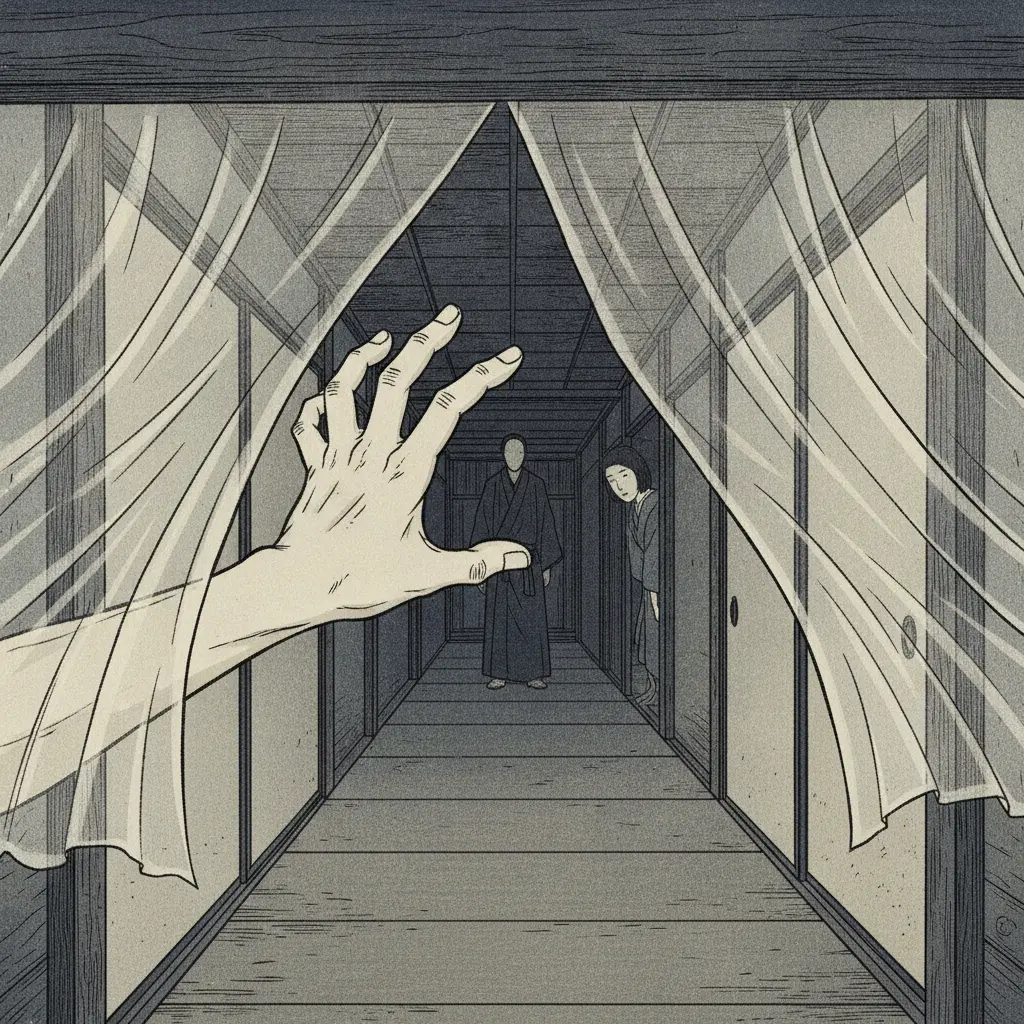
Lights out was at nine, he had been told. Shin'ichi returned to his room just after eight and lay down on the futon. There was no wind. And yet, somewhere down the corridor, something moved with a soft, rhythmic sound — paper, or cloth, something thin swaying at regular intervals. He lay still and listened. The sound did not stop. Without his noticing the moment it happened, he was asleep.
He dreamed. He was walking the approach to Okunoin. It appeared to be daytime, but the light did not fall from above — it seeped up from the ground. The stone monuments on either side each bore a different name, half-swallowed by moss, and they arranged themselves into a procession that kept pace with his steps. At the far end of the approach stood a figure. As he drew closer, he saw it was a monk, standing with its back to him. Shin'ichi said, "Excuse me," and the figure turned slowly. There was a face — but it was the same as the face in the hanging scroll. No eyes. The eyeless face looked at him. It was looking. It was seeing something, unmistakably. Shin'ichi tried to cry out, but no sound came.
He woke to a dark room and a sweat-damp futon. The time was past two in the morning. The heat of the dream still lingered in his body. He was about to step into the corridor for water when he noticed something in the corner of the room. There on the tatami in front of the alcove, beneath the hanging scroll, something had been placed that had not been there when he fell asleep. He went closer. It was a small stone — a single white stone, round and ordinary, like a river pebble, nothing remarkable about its shape. He thought about waking the innkeeper, but it felt wrong to make a disturbance in the middle of the night. He picked the stone up. It was cold — cold in a way that would not yield to body heat. He set it on the window ledge and lay back down, but sleep did not return.
In the morning he went to pay his respects at Okunoin. From Ichi-no-hashi bridge to the Gobyo mausoleum of Kobo Daishi is roughly two kilometers, with more than two hundred thousand stone monuments said to line the way on either side. In the early morning mist, the sight was otherworldly. The rows of monuments dissolved into the fog, and there was no telling where they ended. As Shin'ichi walked, he could not shake the feeling of being watched. Watched was not quite the right word — counted was closer. Each stone monument silently tallying the living who passed by. What number was he? And the next time he came this way, which side of the path would he be standing on?
Partway along the approach, he came upon a monument unlike the others — shorter, thickly cloaked in moss, its inscription completely illegible. Shin'ichi stopped without quite knowing why and stood looking at it. It was clearly very old. A great deal of time had passed, and it had stood here with no one to tend it. Then, from behind the stone, a voice came. Low, brief. It might have been "hey" or simply a sound of recognition. Shin'ichi spun around. In the mist, there was no figure to be seen. No footsteps. No sign of any other visitor. Only the voice, which had been there and now was not. He walked on quickly.
Back at the inn, he soaked in the bath before lunch. The bathing room at Enjaku-in was old in its construction, a wooden tub just wide enough for one person. When he entered, steam filled the space and the mirror was fogged completely white. Sunk to his shoulders in the hot water, he turned the matter of the stone over in his mind. If someone had placed it there, they had entered his locked room. He had locked the door. Or had he, sleepless and unaware, gone out and picked it up himself? He had no memory of doing so. He was still thinking when he became aware that something seemed to be reflected in the clouded mirror. He narrowed his eyes. Within the white haze, there appeared to be the outline of a person — the back of someone standing there. He stood up and wiped the mirror with his hand. There was nothing. Only steam. But in the smear his hand had left, something remained that was not a fingerprint — thin, evenly spaced lines drawn across the surface of the glass. As though something had scratched from the inside.
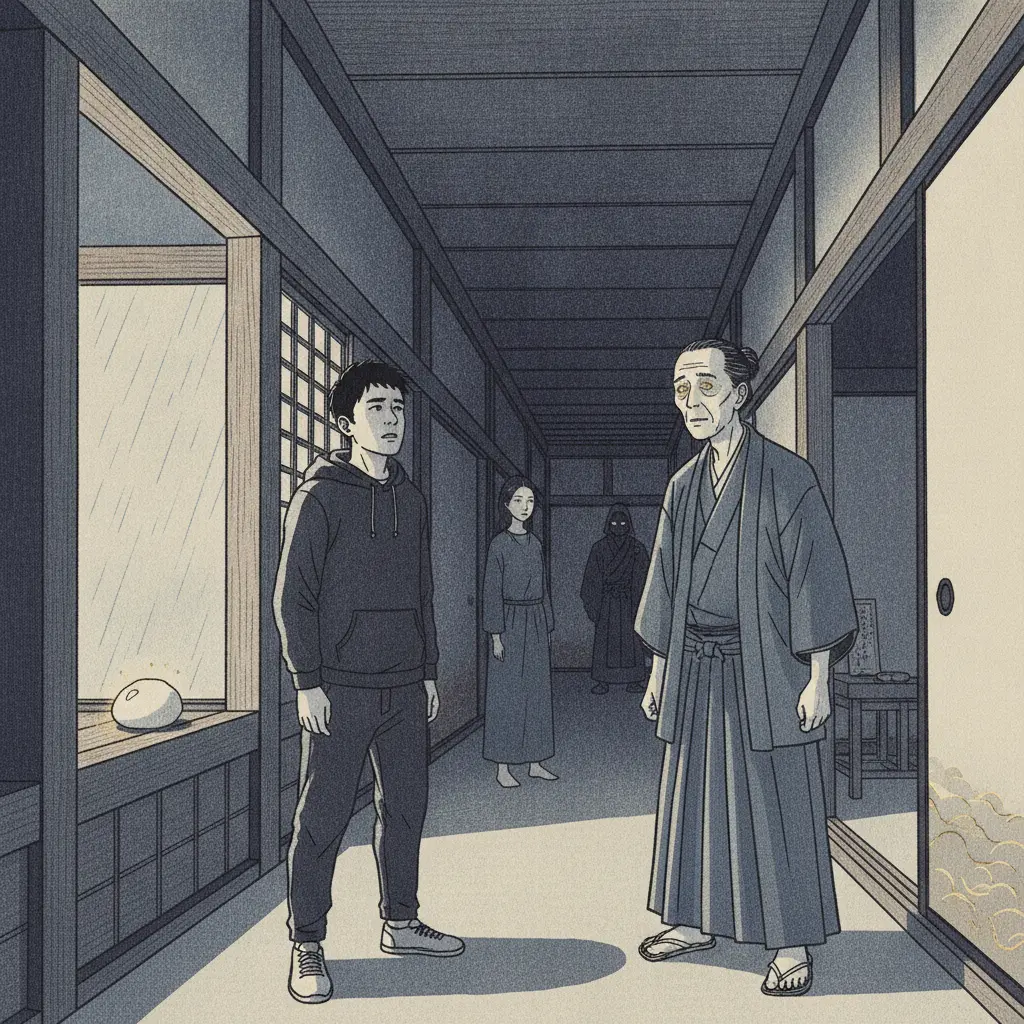
After lunch, Shin'ichi approached the elderly innkeeper. "Did someone enter my room last night?" he asked. The old man studied his face for a long moment. Those eyes — the strangely luminous eyes that had unsettled him the day before — seemed to be looking not at his face but at something else, something that occupied the same space as his face. "No one walks the corridors of this inn at night," the old man said. "There was a stone in the alcove of my room," Shin'ichi continued. The old man's expression shifted — not shifted, exactly, but stopped. The way a clock stops. "A stone, you say." "White. Round." "…Is it still in your room?" "I left it on the window ledge." The old man lowered his eyes once, then raised them again. "I understand. I will look into it." With that, he withdrew down the corridor and was gone.
That night, Shin'ichi decided to stay another day. He had only planned for one night, but there was no reason to go back. Nothing was waiting for him in Tokyo. At dinner, the woman refilled his cup and said, "So you'll be staying another night." It was phrased as a confirmation, but there was something beneath it. "Yes," Shin'ichi said. The woman gave a small nod. "Please do not go out into the corridor at night," she said. He asked why. She did not answer. She rose and left the room without a word. Her footsteps faded down the corridor and then there was silence. Shin'ichi sat holding his chopsticks, unable to move.
The second night was colder than the first. Even under the futon, his feet would not warm. Shin'ichi tried to read, the woman's words turning in his mind. He was turning pages when something caught his attention. Between two pages, a single slip of paper had been tucked — one he had no memory of placing there. He unfolded it. There were characters written in ink, something that resembled a sutra, but the cursive script was so dense and archaic that he could not read it. Except for one passage, which was perfectly legible. It was a name. Kakimoto Shin'ichi, written there in plain, clear strokes.
Shin'ichi got to his feet and stepped into the corridor, the paper still in his hand. He had forgotten the woman's warning. Or perhaps fear had simply outrun reason. The corridor was dark. Red emergency lights burned at even intervals, and the far end of the hallway was lost in shadow. He had just started toward the innkeeper's room when he saw someone standing at the end of the corridor. The old man. Standing in the dark, facing him. "Excuse me — I wanted to show you this," Shin'ichi called out, walking toward him. The old man did not move. Five meters. Three. One. Shin'ichi reached out his hand — and in that instant, the old man's face came clear in the red light of the emergency lamp.
There were no eyes.
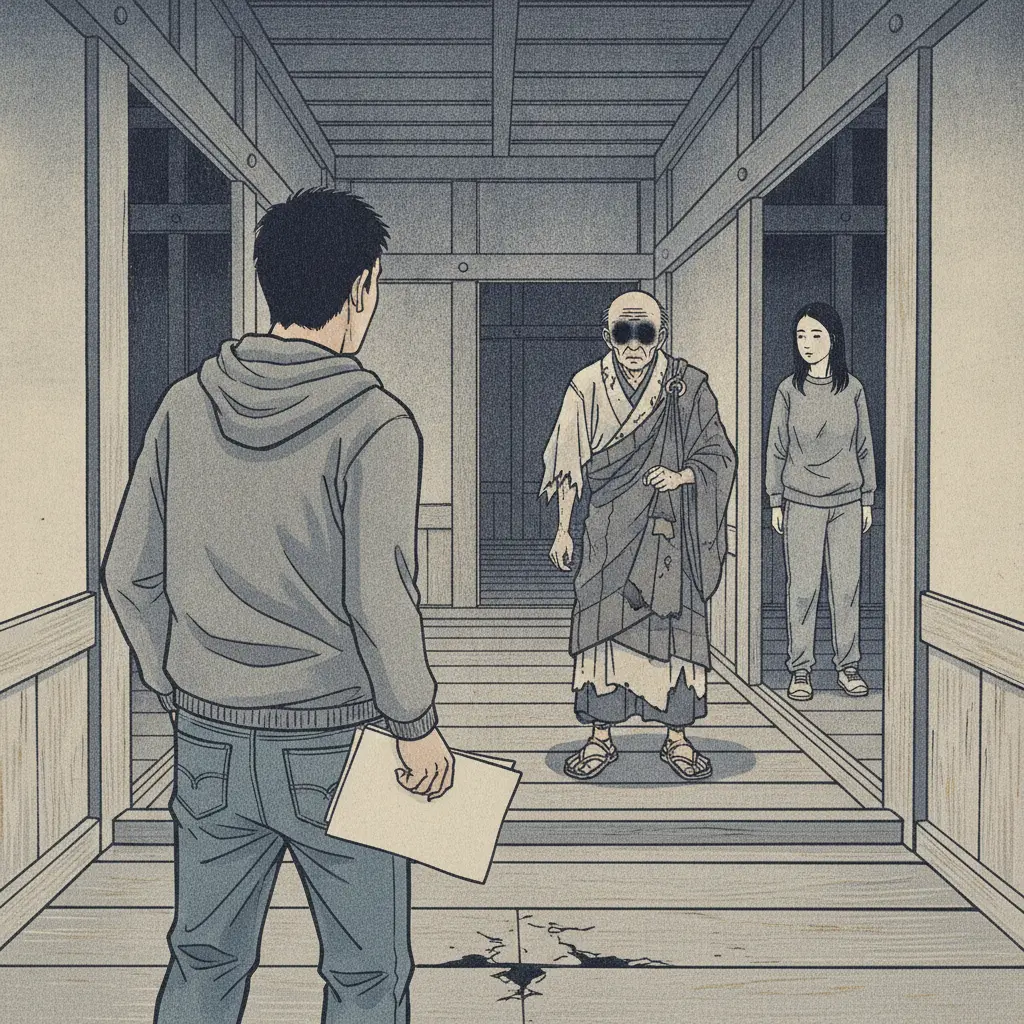
Where the eyes should have been, there was only darkness. Not the absence of eyeballs — it was as though darkness itself had been fitted into those sockets, filling them completely. The old man's mouth moved. No sound came. But Shin'ichi read the lips, or believed he did. Not "go back" and not "do not come here" — something else, something he could not name. He stepped backward. The floorboards creaked beneath him. The old man did not move. Shin'ichi ran. He threw himself into his room, locked the door, and burrowed into the futon. The paper was still in his hand.
He did not leave the futon until the night had passed. When the world outside began to pale, he heard birds. He heard wind moving through the cedar boughs. The ordinary sounds of morning. With trembling hands he gathered his things and went downstairs three hours before checkout. The innkeeper was standing in the entrance hall — a different man, it seemed, from the one in the corridor. His face was composed and mild, and he had eyes. Of course he had eyes. "Leaving so early," the old man said, and held out the bill. Shin'ichi paid in silence and put on his shoes. "Last night, in the corridor—" he began, and the old man said quietly, "Guests occasionally see strange things here at night. The altitude is high, the air is thin. And this is a place with a very long history." Shin'ichi nodded. He asked nothing more. He could not.
As he crossed the stone path and passed through the gate, Shin'ichi looked back. Enjaku-in stood quietly in the morning light. At the second-floor window — the window of his room — something caught his eye. The white stone he had left on the ledge was visible from outside. But beside it was another stone, also white. He had left only one. He looked again, carefully. Two stones, unmistakably. The wind came, and the cedar tops stirred and murmured. Shin'ichi turned toward the approach.
While waiting for the bus, he put his hand in his pocket. His fingertips touched something. Cold. Round. He drew it out. A white stone — the very stone he had left on the window ledge. He stood for a long time looking at it in his palm. It did not take his warmth. No matter how tightly he held it, it remained cold. The bus came. He boarded and looked out the window. The cedars of the approach slid past. He turned his gaze toward Okunoin, and through the morning mist he could see the long rows of stone monuments. Near the far end of the row, there was a figure. A figure simply standing there. The bus rounded a curve, and the figure was gone.
He rode the cable car down the mountain, took the train, and changed to the shinkansen in Osaka. When he finally exhaled deeply in his seat, he realized there was something he had left behind. The paper. The paper with his name on it — he had left it in the room. Or had it been a dream? But the stone was real; it was in his hand. He took out his phone and searched for Enjaku-in's telephone number. He typed in the words. The results appeared. But what was displayed was a record of closure. Dissolved in 1968, the entry read. The building no longer exists. Shin'ichi stared at the screen. The words on the screen did not move. The shinkansen continued toward Tokyo, and the landscape outside the window dissolved into the dusk. Only the stone in his palm remained cold.