

The Breath of the Burial Mound
AI AI-generated fiction — text, and any narration or images. Unrelated to any real events, people, organizations, or places.

Park Jisu (박지수) arrived in Gyeongju late in the afternoon. The moment she stepped off the train, the air was different. Seoul's air carried the smell of something always demanding more, but Gyeongju's air smelled of old stone. Jisu liked that. Three months had passed since she pressed her seal onto the divorce papers, and she had known, ever since, that she needed to go somewhere alone. Somewhere ancient — somewhere that held things older than her own grief.
Her lodgings were a small hanok guesthouse near Daereungwon. It sat tucked inside an alley just off Hwangridangil, in a spot where the ridge of the burial mounds was visible over the stone wall. The proprietress looked to be in her late sixties and was a woman of few words. As she handed Jisu the key, she said exactly one thing. "Don't open the window at night." Jisu assumed she meant mosquitoes. She did not notice, then, that the old woman's eyes had paused for a moment — as though she had been about to say something more, and had decided against it.
The room was small and clean. Through the window, the mounds of Daereungwon were visible. In the light of dusk, the burial mounds swelled a deep, heavy green. Jisu stood and looked at them for a long while. There was something strangely comforting about them. The fact that kings dead for centuries lay out there as great, rounded hills seemed to make her own small sorrow feel somehow less significant. She unpacked her bag, ate a simple dinner, and went to bed early.
The first night, nothing happened.
The following morning, Jisu walked through Daereungwon park. It was a weekday, and there were few tourists. She moved slowly along the grass paths that wound between the mounds. Up close, they were even more immense. She stopped in front of Cheonmachong (천마총). Cool air drifted from the entrance — not the chill of a few centuries, but of fourteen hundred years sealed inside the earth. Jisu did not go in. She could not have explained why. She simply did not want to. Her feet stopped of their own accord.
That afternoon, she sat on a bench between the mounds reading a book, and dozed off. It felt like only a moment, but when she opened her eyes the sun had shifted. And on the slope of the mound across from her — midway up its gentle incline — a person was standing. A man, on the grass, on the smooth rise of the mound, looking down at her. White clothing. Too far away to make out a face, but there was no question he was looking at her. Jisu felt a flicker of awkwardness and raised her hand in a small wave. The man did not move. She glanced down at her book for just a moment, then looked up again. The man was gone.
The slope of the mound was steep. It would have been impossible to descend in so short a time.
Jisu told herself it had been a trick of the light. The white had been a smear of brightness, nothing more. She returned to the guesthouse, and over dinner she asked the old woman, casually, whether people ever climbed the burial mounds. Instead of answering, the woman set down her spoon and studied Jisu's face for a moment. Then she said: "You saw something?" Jisu hesitated, then nodded. The old woman picked up her spoon again and said quietly, "Best to pretend you didn't." That was all. She offered no further explanation.
That night, Jisu kept the window closed.
It was the third night. Past midnight, Jisu woke and got up to use the bathroom. The room felt strangely cold. The window was shut. On her way back to bed, she glanced out of habit toward the window. The silhouettes of the mounds were black against the sky. At night, the burial mounds were darker than the darkness around them. And there, in that darkness, atop one of the mounds, something was there. A standing shape. The same position, the same place she had seen it in the afternoon. This time, in the moonlight, it was a little clearer. White clothing. Long hair. And the face was turned toward her.
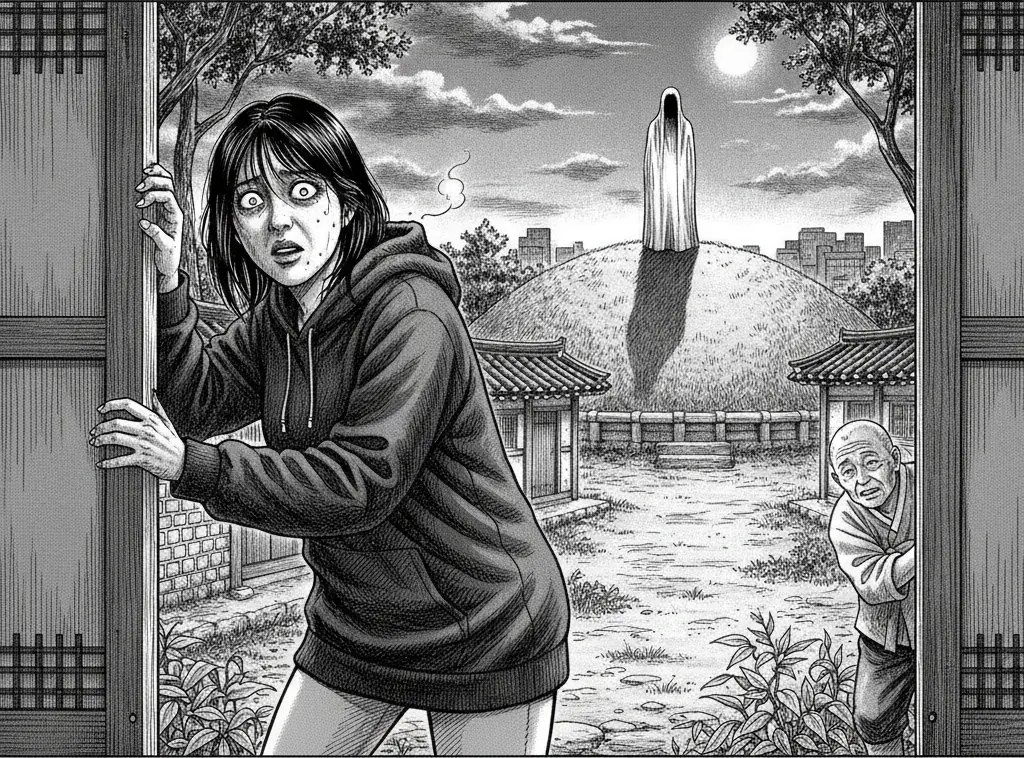
Jisu went still. She held her breath. Her heart beat slowly, but far too loudly. The shape did not move. Not even the hem of its clothing stirred in the wind. Beneath a sky washed with moonlight, that figure on the mound was the only thing in the world that was perfectly, absolutely motionless. Jisu stepped back slowly. She pulled the blanket over herself and closed her eyes. She could hear her own heartbeat. After a long while, she crept back to the window with great care. The shape was gone. The mound was just a dark hill.
She did not sleep that night.
On the fourth day, Jisu wandered through the city trying to clear her head. She went into the Gyeongju National Museum and looked at the Silla relics — gold crowns, bronze bells, earthenware. Certain words appeared again and again in the exhibition texts. Sunjang. Human sacrifice. Jisu stopped in front of the word. The tombs of Silla nobles had held people buried alongside their masters — interred with them, alive or killed, so that they might serve in the afterlife as they had in life. Beside the explanatory panel, a photograph showed excavated remains. Skeletons arranged in a ring around the central coffin, lying in postures of attendance. Jisu stared at the photograph for a long time. What had their final expressions been? Had they been afraid? Or had their faces already surrendered to something beyond fear?
Walking out of the museum, Jisu found herself seized by a strange thought. Those people are still there. The excavated bones had come here, to this place — but the ones never excavated would still be down there, beneath the mounds. Not every tomb had been opened. A significant number of the mounds within Daereungwon remained untouched, their interiors unseen. Sealed. Sealed for fourteen hundred years.
That evening, Jisu asked the old woman whether some of the mounds had never been excavated. The woman nodded. "Most of them." Jisu was quiet for a moment, then said, "So there are still people inside." The old woman glanced at her. "There are." Then she added: "People who haven't come out yet." Jisu noticed something odd in the phrasing. Not people who haven't been excavated — people who haven't come out. The old woman was already carrying the dinner tray away.
It was the fifth night. This time, Jisu heard a sound in the half-space between sleep and waking. It was not coming from outside the window. It was coming from inside the room — from very close by. Breathing. Someone breathing, very slowly. Jisu lay with her eyes closed and felt her entire body turning rigid. The breathing was regular. Like the breathing of someone asleep. But there was no one else in this room. She knew that if she opened her eyes, she would see something. And so she could not open them. The breathing continued. It did not stop. Jisu pulled the blanket up over her head. Somewhere inside that sound, at some point she could not identify, she fell asleep again — exhausted by fear, or drawn under by something else entirely.
When she woke in the morning, the room was ordinary. Nothing was there. But beside her pillow, there was soil. Not a clump of dirt — a fine trace of earth, drawn in a long, thin line. As though a finger had passed through it.
Jisu knew it was time to leave. She packed her bag. Her hands trembled slightly. As she crossed the courtyard of the guesthouse, she came face to face with the old woman. The woman looked at her and narrowed her eyes. "Leaving already?" When Jisu nodded, the old woman said, "Good. There are people who shouldn't stay too long." Jisu wanted to ask what she meant. But it felt like something she should not ask. Instead she said a brief goodbye and turned away.
At the end of the alley, Jisu looked back once. The burial mounds of Daereungwon shone green in the morning light. They were beautiful. And inside that beauty, something was wrong. The shapes of the mounds — those gentle, rounded curves — suddenly looked different to her. They looked like something swelling with the breath of a living thing. Like something slowly, steadily rising and falling.
Jisu looked away. She walked quickly.

On the way to the train station, she searched her phone for information about Daereungwon. Articles about human sacrifice. That the practice had been common in the early Silla period. That it had been prohibited under King Jijeung (지증왕). And then one more entry caught her eye — something from an excavation record. In certain mounds in the Daereungwon area, an unusual detail had been noted: the remains of sacrificed individuals had been found not at the periphery of the burial chamber, alongside the grave goods, but at the center. Not beside the master's coffin, but oriented toward the entrance of the mound — kneeling, as though they had walked there themselves.
Jisu read that sentence twice. As though they had walked there themselves.
The train came on time. Jisu sat down and looked out the window. The city of Gyeongju began to recede. Burial mounds passed outside the glass. One, two, three. Even beyond Daereungwon, the mounds were everywhere across the Gyeongju basin — beside roads, in the middle of fields, between houses. Hundreds of mounds scattered across the whole of the city. Gyeongju was a place where the living made their lives among the dead.
As the train gathered speed, the mounds passed faster. Jisu was exhausted. She closed her eyes. She slept.
And she dreamed. In the dream she was somewhere dark. There was a smell of earth. Soil on every side. She could hear someone breathing. Close. Right beside her. She did not turn her head. She knew she must not. The breathing continued. Regular. Slow. And even inside the dream, Jisu thought: whoever owns that breath has been breathing like this, in this darkness, for a very long time. Fourteen hundred years. Alone. Until one day, in the sealed dark of the burial mound, a light appeared from outside. For the first time. And toward that light, on their knees, they had crawled.
The train lurched. Jisu opened her eyes.
A burial mound passed outside the window. A low hill, green. Her face was reflected in the glass. And there, directly behind her reflected face — on the receding slope of the mound beyond the window — a white shape was standing. Standing, watching the train. The train was moving fast, and the shape vanished from sight almost immediately.
Jisu looked at her own face in the glass.
Her expression was wrong. It was not the face of someone startled. It was blank. The face of someone who had known, from the beginning, that the thing would be there. It was only when she became aware of the expression she was wearing that the fear finally arrived.

The train kept moving. Burial mounds passed one by one outside the window. Jisu tried not to look. But her gaze kept returning to the glass. Like a habit. Or like something pulling her there.
She understood it only now. The line of soil left on her pillow had passed beside her face as she slept. And that line was the trace of something that had grazed her cheek — very lightly, in passing.
The train entered a tunnel. Darkness. Only Jisu's face remained in the window. And in the dark, she heard something close to her ear. A sound, very low and very even. Breathing.
The tunnel ended. Light returned. The sound was gone.
Jisu took out her earphones. She put them in. She turned the music up loud. She did not look out the window. She looked straight ahead. The train moved. Gyeongju fell further behind. The further away, the better she would feel — that was what she told herself.
But something was wrong. Even with the earphones in, even with the music playing, in the spaces between sounds — in the brief silences between one beat and the next — she could hear it. The breathing. Or she thought she could. Or perhaps she had simply learned, somewhere along the way, how to hear it. Perhaps she was now capable of hearing it anywhere.
That was what frightened her most. Not that something from Gyeongju had followed her — but that she had brought something back from Gyeongju. That the breathing from the darkness had been inscribed somewhere inside her ears.
Jisu did not take out the earphones. She turned the music louder. She closed her eyes.
The music played. And beneath it, from somewhere very deep, something breathed — quietly, steadily, without pause.