

The Old Woman Without a Shadow
AI AI-generated fiction — text, and any narration or images. Unrelated to any real events, people, organizations, or places.
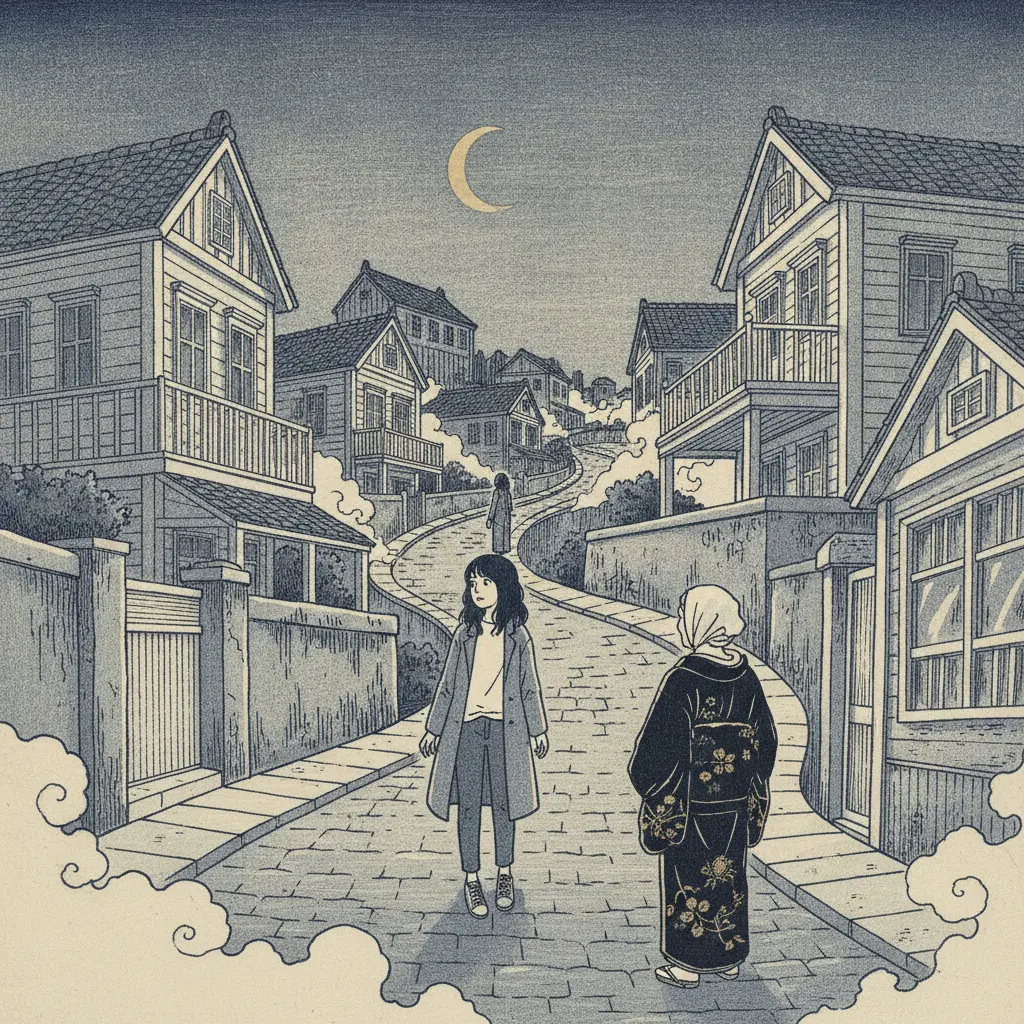
It was three weeks into my stay in Nagasaki when I first lost my way on the slopes of Higashiyamate.
The tourist guides call it "a hillside town brimming with exotic charm." They are not wrong. Stone-paved lanes fold over one another in layers, and the white plaster walls of old Western mansions catch the afternoon light and glow with a soft luminescence. A salt wind rising from the harbor stirs the leaves of the camphor trees along the slope, and through their gaps the silhouette of Mount Inasa is just visible. I had recently left my position at a Tokyo publishing house to work as a freelance writer, and had taken on a serialized feature about Japan's port cities. Nagasaki was my first destination. The former foreign settlement of Higashiyamate — a hilltop where expatriates had made their homes during the Meiji era — was meant to be the heart of that work.
My name is Takase Tomoko (高瀬朋子). I am thirty-one years old. With a tote bag holding my camera and reporter's notebook slung over one shoulder, I climbed the stone steps one by one, photographing the old buildings as I went. October in Nagasaki holds more humidity than Tokyo, and with each rise in elevation a thin sweat gathered at the back of my neck. Even so, the air here had a particular density to it. Something that might be called the weight of history — the shogunate's edicts, the homesickness of foreigners, the fires of the atomic bomb — all of it laid down in strata, seeping up through the stones of the path like breath from the earth itself. I loved that feeling. At least, I did until that night.
Partway up the slope stood a building I came to call the Old Number Seven. I never learned its proper name — there was no sign — but it appeared to be a two-story wooden Western-style house from the Meiji period, distinguished by shutters painted in alternating white and pale green. It appeared on no tourist map. It stood slightly apart from the well-maintained row of Western mansions nearby, and a rusted padlock hung from its gate. The windows were shut, but the glass was unbroken, and the garden had not entirely gone to ruin. There was no clear sign of habitation, yet it did not feel wholly abandoned either. That ambiguity unsettled me, and I raised my camera and pressed the shutter several times.
Late that afternoon, on my way back down the hill after finishing my work, I came around a bend in the path and encountered an old woman. She appeared to be somewhere in her eighties. She wore a dark kimono printed with small flowers, and a white hand towel was wrapped around her head. She had one hand pressed against the stone wall beside the path and was breathing slowly, steadying herself. I asked if she was all right. She raised her face and turned clear eyes on me from within a landscape of deep wrinkles. "Oh, I just ran out of breath," she said in the soft Nagasaki dialect. "These slopes are hard on you." We stood together for a while and looked out toward the harbor. The setting sun dyed Nagasaki Bay a deep orange, and the mountains on the far shore dissolved into silhouette. The old woman gazed at the view and said quietly, "You'd do well to stay away from that house."
I turned and followed her gaze. She was looking at the Old Number Seven — the very building I had photographed so many times. "Why?" I asked. She shook her head. "It's always been that way. Everyone on this hill knows it." She said nothing more, and began to make her slow way down the slope. I started to call after her, but in the backlit dusk her small figure vanished almost at once. There was no one in the direction she had gone, no sign she had turned into any alleyway. Only the evening wind, moving across the stones.
That night, back at my lodgings, I reviewed the day's photographs and found one that gave me pause. It was a straight-on shot of the second-floor window of the Old Number Seven — the closed shutters, with a sliver of dim interior visible through the slats. In that darkness, something was standing. The outline resembled a human figure, but I could not determine whether it was actually a person or simply a piece of furniture, a column, casting a shadow. I enlarged the image again and again and reached no conclusion. Someone breaking in, perhaps, I told myself — and saved the photograph to a folder and tried to put it from my mind.
For the next several days I made a point of avoiding the Old Number Seven. Even so, every time I passed along that stretch of slope the building caught my eye. The tourists climbing the stone path never paused before it; they walked past as though it were invisible. One afternoon in a local bookshop I was leafing through a photographic collection of Meiji-era Nagasaki when I came across an old map of the district — a plot plan of the former foreign settlement, with numbered lots and the positions of the Western mansions marked. The house on lot seven was labeled "Filgen Residence." Below the owner's name, in small type, was a brief annotation: "1897 — occupants disappeared. Unoccupied thereafter." A single line. Nothing more.
As I closed the book, I caught a glimpse through a gap in the shelves of the stone path outside. In the slanted evening light, a small figure in a kimono stood on the slope. For just a moment it looked like the old woman. Then it was gone. I stepped outside and scanned the hill in both directions. There was no one. A single streetlamp cast its orange light down onto the stones.
The night in question came three days later.
I woke just past one in the morning. Something outside the window of my lodgings had pulled me from sleep — a sound that resembled footsteps on stone pavement, but with a rhythm that was wrong. The intervals between steps were uneven, as though whatever was climbing the slope was dragging something behind it. I opened the window and looked out. The nighttime hill was quiet; the stone path stretched white under the streetlamps. There was no one there. But the sound continued. Somewhere, distinctly, it continued.
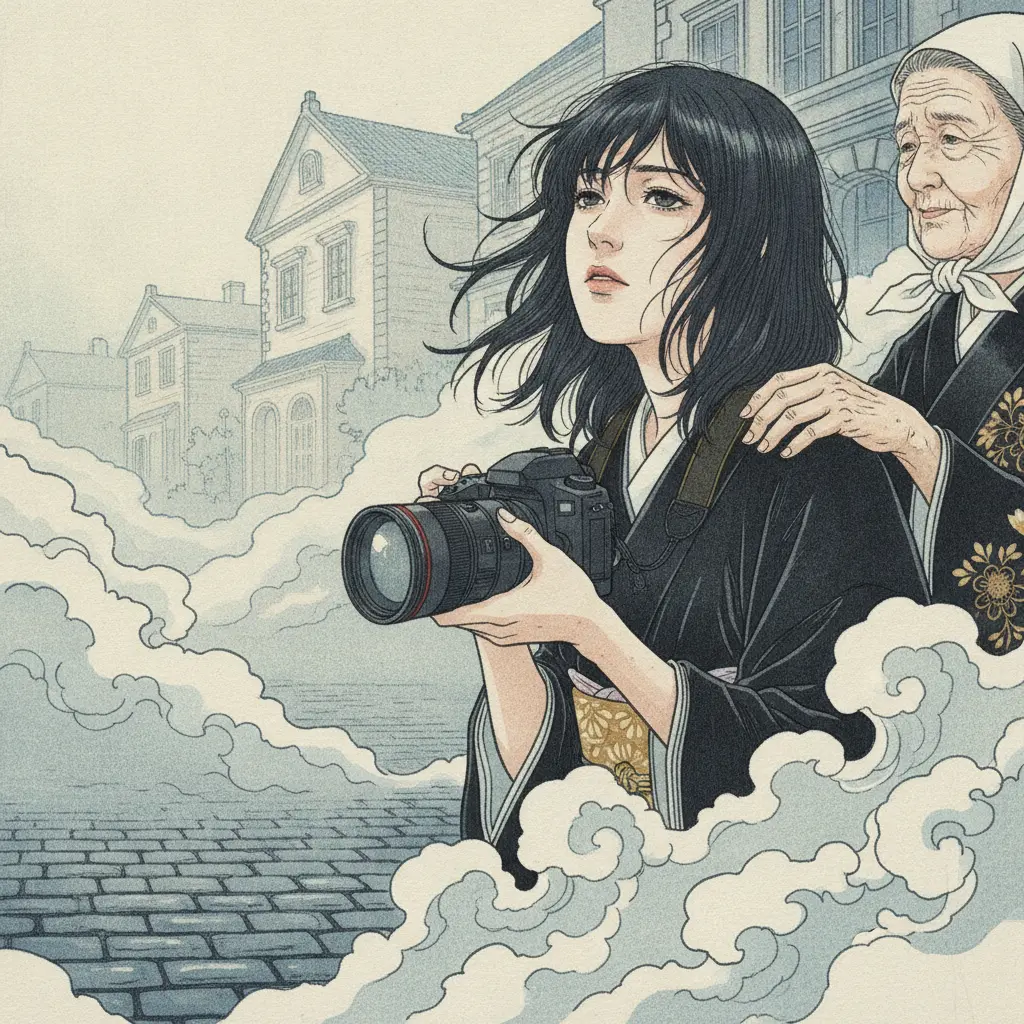
I lay awake until dawn. When the sky began to pale I took my camera and went out onto the slope. The stone path in the early morning was deserted and wrapped in fog. Nagasaki's morning fog has a character of its own — it rises from the harbor and stalls partway up the hill, covering everything to knee height in white. Walking through it, you feel as though only your feet belong to the waking world and your upper body is adrift in a dream. I came to my senses and found I was standing in front of the Old Number Seven.
The rusted padlock was lying on the ground.
The gate stood half open. I stopped and stared at the building for a long moment. My reason said: do not go in. But my feet were already moving slowly forward through the fog. The excuse of journalistic curiosity came to me only afterward. What drew me in at that moment was not curiosity. It was something closer to gravity — the way a slope inclines, the way a foot simply moves.
The garden was larger than I had expected. Ivy wound around the columns of the entrance porch, and the paint had peeled from the wooden door, but the door itself was solidly built. When I laid my hand against it I thought I felt a faint warmth from the other side. I pushed, and it opened without a sound.
Inside it was dim. With the shutters closed, almost no morning light entered. I turned on the flashlight on my phone. The entrance hall had a stone-tiled floor. An old wooden staircase. Along the walls hung a row of empty frames — the pictures had been removed, leaving only rectangular impressions in the thin layer of dust. The dust itself was strange. In the corridor leading from the entrance toward the back of the house, there was almost none. The floorboards had a faint sheen to them, as though someone walked that path with regularity.
As I moved toward the rear of the house I became aware of something. A faint smell permeated the whole building — something like soap, or perhaps flowers. Not the mold and decay one expects of an abandoned structure, but something clean, something close to the smell of a lived-in place. I stopped in front of the door at the end of the corridor. A thin line of light showed beneath it.
A light was on.
I pushed the door open.
In the center of the room stood a single chair. Someone was sitting in it. An old woman. The old woman — the one who had been steadying her breath against the stone wall on the slope. She sat in her kimono with both hands resting on her knees, her back to me. It was not an electric light but an old desk lamp placed in the corner of the room that lit her from behind. "Excuse me," I said. She did not move. I was about to call out again when my eyes dropped to the floor.
The old woman cast no shadow.
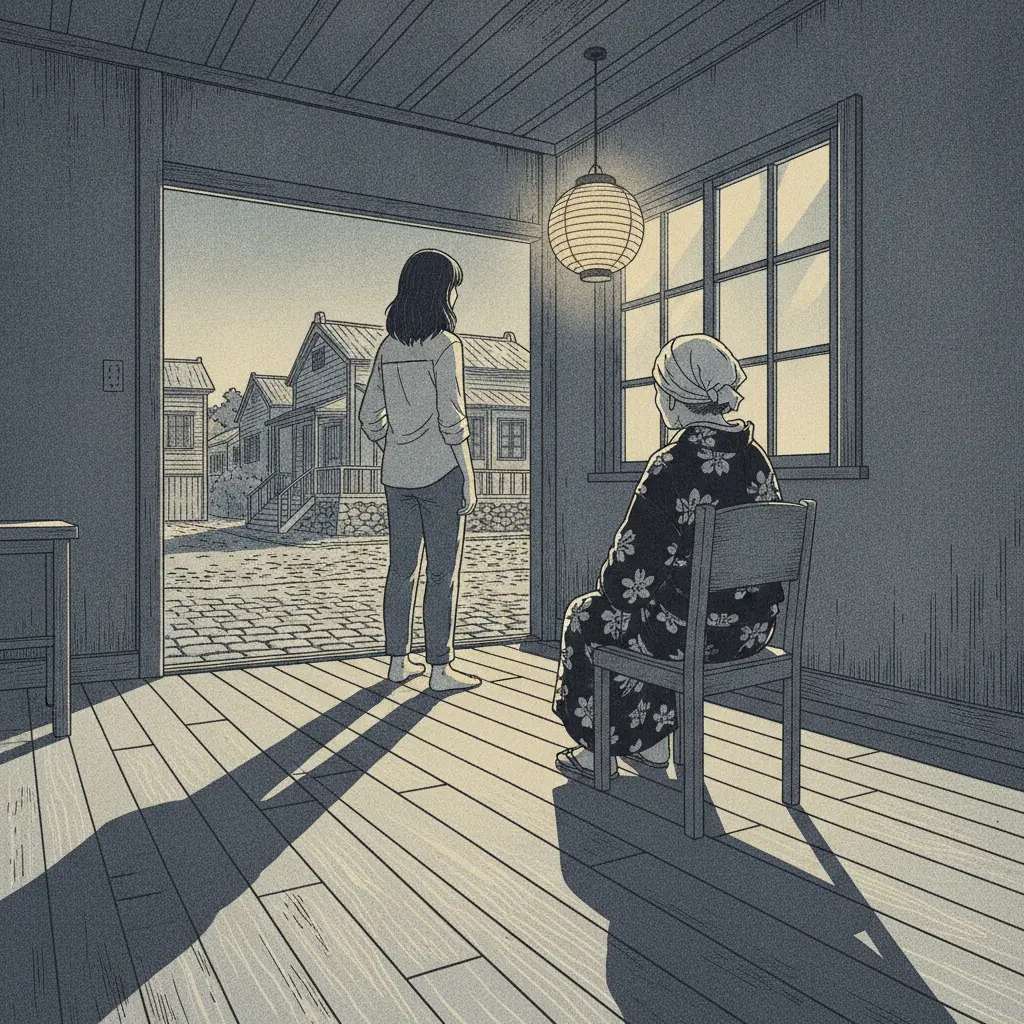
Both light sources were real — the pale morning light filtering through the shutters, and the lamp. My own shadow lay clearly on the floor. But the old woman's shadow was nowhere. The chair legs cast their shadows. The old woman's body cast nothing. The floor beneath her was clean and bright, as though the chair existed and nothing sat upon it.
I stopped breathing. My heart struck hard enough to hurt. I began to step back — and at that moment the old woman slowly turned around.
There was a face. A human face. Deep wrinkles, clear eyes, a white hand towel — everything exactly as I remembered from that day on the slope. But something was irrevocably different. The old woman opened her mouth and spoke to me. "So you've come back," she said. "You've finally come home." Her voice was gentle, suffused with a tender, reminiscing softness. But the words were plainly not meant for me. Her eyes were on me, yet they were not seeing me. The words were directed at something beyond me, at someone standing at my back.
I could not turn around.
There was a presence behind me. Not warm, not cold — simply there, occupying space. The presence of something standing. No — the presence of something that had once been a person, standing. My entire body had turned to stone. The old woman was smiling. It was the absolute peacefulness of that smile, its utter naturalness, that frightened me more than anything else. I did not scream. It was not that fear had closed my throat — it was that the stillness of that room would not permit any sound to be made.
Then my feet moved. Not by any act of will. My body ran on instinct alone. Down the corridor, through the entrance, across the foggy garden, out through the gate and onto the stone path. My legs tangled and I went down on one knee against the stones, but I was up again before I felt the pain, running down the slope. The streetlamps streaked past, the fog struck my face, and the feel of the stones beneath my feet was the only thing that was real. I burst into my lodgings, locked the door, pressed my back against it, and slid to the floor.
For a while I had no sense of time at all.
When I came back to myself the window was full of light. The morning sun of Nagasaki was edging in around the curtains. From the direction of the harbor came the sound of a ship's horn. I got slowly to my feet and reached for my camera, thinking I should check the photographs from that morning. I had no memory of taking pictures inside the Old Number Seven, but it was possible I had pressed the shutter without thinking, before I ran.
I looked through the camera's data. There were, in fact, photographs taken inside the Old Number Seven. The corridor. The door to the rear room. And one photograph taken inside the room itself.
The photograph showed a chair. A single chair in the center of the room, lit by the lamp. The chair was empty. There was no trace of the old woman anywhere in the frame.
That alone might have been bearable.
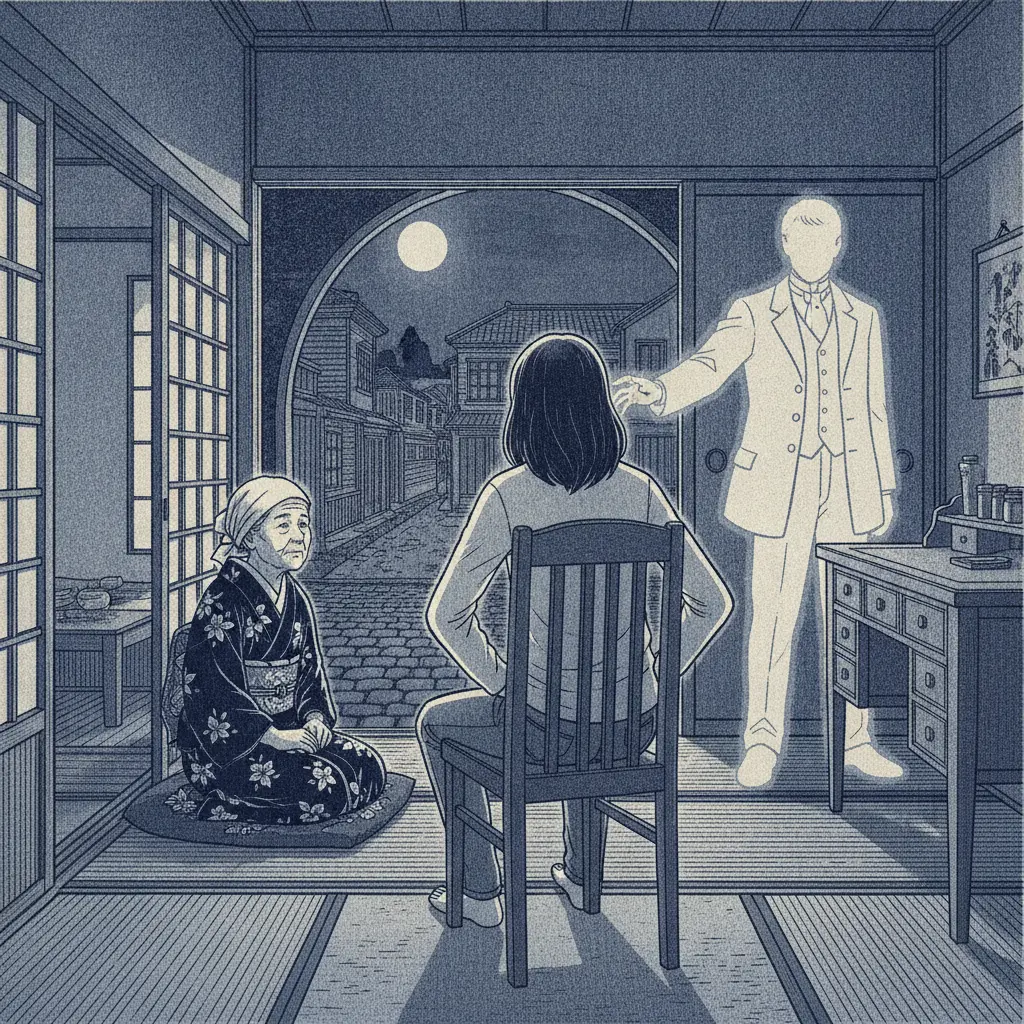
The problem was what stood behind the chair. There, against the far wall — in the direction I had been unable to turn and face — was the outline of a human figure. Not a dense shadow blocking the light, but something that seemed rather to gather it: a pale, blurred silhouette. The shape appeared to be a human figure dressed in Meiji-era Western clothing. The face was indistinguishable. But the outline had the form of something reaching out one hand — stretching it forward.
Whether that hand was reaching toward the back of the chair, or toward my back, I could not tell.
That afternoon I checked out of my lodgings. My reporter's notebook was empty. On the bullet train back to Tokyo I turned the old woman's words over and over in my mind. "So you've come back. You've finally come home." The single line from the old map — "1897 — occupants disappeared" — would not leave me. If someone had been waiting in that house all this time. And if the old woman had been there not as one of the waiting, but as a witness — there to see the moment when whatever had been waiting through all those decades was at last drawn back to the door by the sound of footsteps on the path at night.
Or perhaps the old woman, too, was one of those who had come back.
Two weeks have passed since I returned to Tokyo. I wrote the feature. I wrote about the beauty of the stone-paved slopes of Higashiyamate. I wrote about the history. I wrote about the exotic atmosphere. I did not write a single line about the Old Number Seven.
Only one thing has changed.
When I wake in the middle of the night, I sometimes hear from outside the window of my Tokyo apartment a sound like footsteps on a stone path. On the third floor of a building, in a neighborhood with no slopes anywhere near it, I hear it clearly. An uneven rhythm, striking stone. Each time I hear it I pull the covers up and close my eyes. I do not turn around. I am afraid that if I do, something will be there behind me, smiling.
There is one question I cannot put from my mind.
When I entered that room, I had opened the front door myself. But after I fled — just before I reached my lodgings, I glanced back for a moment. The gate of the Old Number Seven, receding in the distance, was firmly shut. The padlock was in place.
I cannot account for how I got out.