

Don't Look Up
AI AI-generated fiction — text, and any narration or images. Unrelated to any real events, people, organizations, or places.
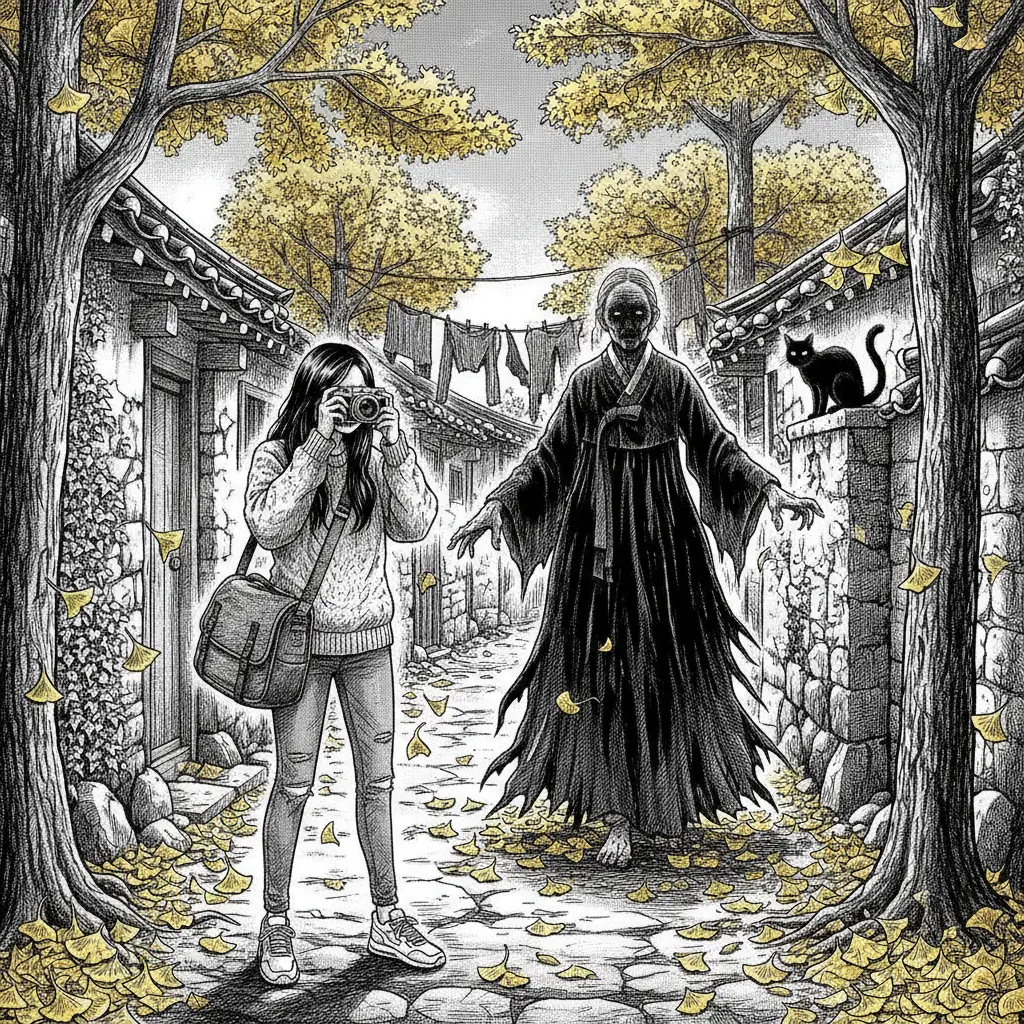
Minseo's (민서) first visit to Yangnimdong (양림동) came on a late autumn afternoon. The assignment her professor had given her was simple enough: find an alley where modern-era architecture still stood and come back with ten black-and-white photographs. When she opened the map app, Yangnimdong's historic lane had a respectable rating, and the reviews were full of phrases like "romantic alleyway" and "the feeling of time standing still." She slung her camera bag over her shoulder and stepped off the bus. Standing at the entrance to the neighborhood, she found old stone walls and tiled rooftops resting quietly in the slanted afternoon light. The ginkgo leaves had just begun to turn yellow, trembling softly each time the wind passed through. From somewhere deeper in the alley came the sound of someone taking in laundry, and far off, a cat sat atop a stone wall watching her. Minseo raised her camera and pressed her eye to the viewfinder. A place like this, she thought, and ten shots would be nothing at all.
The alleyways of Yangnimdong were more tangled than she had expected. Thick utility poles and weathered walls took turns appearing around each bend, and the sight of red missionary-era brickwork standing side by side with the eaves of traditional Korean houses was strange and beautiful at once. Minseo walked slowly, following the lane and pressing the shutter as she went. A faded curtain hanging in a second-floor window. Moss pushing up between stone steps. Roof tiles lined in a row along the top of a wall. The black-and-white world inside the viewfinder was still and composed. But after a few frames, Minseo noticed something odd. The alley had gone too quiet. The sound of laundry, the cat — both had vanished at some point without her realizing. The only footsteps were her own, and each time they echoed off the stone walls she found herself glancing back for no reason. There was nothing, of course. Just the alley.
She first saw the woman beside an old well deep in the lane. The well had been sealed with a concrete lid and left to itself, and next to it sat a single worn wooden chair. In the chair sat an old woman in a black hanbok, her back curved, both hands folded in her lap, facing the direction from which Minseo was approaching. Minseo stopped and gave a small bow. The woman did not respond. Whether her eyes were open or closed was impossible to tell from that distance. Minseo raised her camera, then lowered it. It wasn't right to photograph a person without asking. She was about to step closer and say something when a gust swept around the corner of the alley and a shower of ginkgo leaves came pouring down. For a moment the leaves filled her vision, and when they cleared the chair was empty. The old woman was gone. Minseo walked a full circle around the chair. The alley ended in a dead end. There was nowhere she could have gone.
She must have gotten up quickly and stepped inside, Minseo told herself. There was a worn wooden house nearby with its gate standing half open. The old woman probably lived there. She reassured herself and lifted the camera again. The light was dropping fast. She needed to fill the rest of her frames before it was gone. She turned the lens toward the well. Through the viewfinder it looked quiet and unremarkable, just an old sealed well. She was about to press the shutter when she hesitated. There was something on the wooden chair in the viewfinder. The chair that had been empty a moment ago. She lowered the camera and looked with her bare eyes. The chair was empty. She raised the viewfinder again. On the chair sat a pair of old rubber shoes — gomusin. White ones, worn at the toes, smeared with dirt. When she lowered the camera they were gone; when she raised it they were there. Minseo felt her heart lurch once, hard.
That night she returned to her gosiwon room and transferred the photos to her computer. Most were as expected — stone walls, roof tiles, moss-covered steps. But when she reached the photograph of the well, her hand went still. The wooden chair in the image held nothing. No rubber shoes. Yet directly beside the chair, on top of the concrete lid, something had been captured. At first she took it for a shadow. But when she enlarged it, it was not a shadow. It was a hand. A shape resembling a human hand lay pressed flat against the lid, five fingers distinct, the wrist appearing to continue down into the gap along the lid's edge. Minseo closed the photo and reopened it three times. Each time she saw the same thing. She shut the laptop.
The next day Minseo went back to Yangnimdong. She found it difficult to explain to herself why. She told herself it was for the assignment — there hadn't been much she could use from the day before. But the moment she stepped off the bus and stood at the entrance to the lane, she already knew she would walk toward the well. The alley looked the same as before. Stone walls, utility poles, tiled rooftops. The ginkgo leaves that had been yellow yesterday had fallen more thickly now, blanketing the ground and muffling her footsteps. When she reached the well, the wooden chair was as she had left it, and there was nothing on it. She placed her hand on the seat. The wood was cold. And damp. The sky was clear and the hour for dew had long passed, yet the chair was wet. She pulled her hand away and wiped the moisture on her jeans, then looked down at the concrete lid. Nothing on it. But around the lid, on the concrete floor, there were marks — scratches. Looking closely, she saw they were letters. Thin, irregular characters, as if scored with a fingernail, ran in a ring around the edge of the lid.
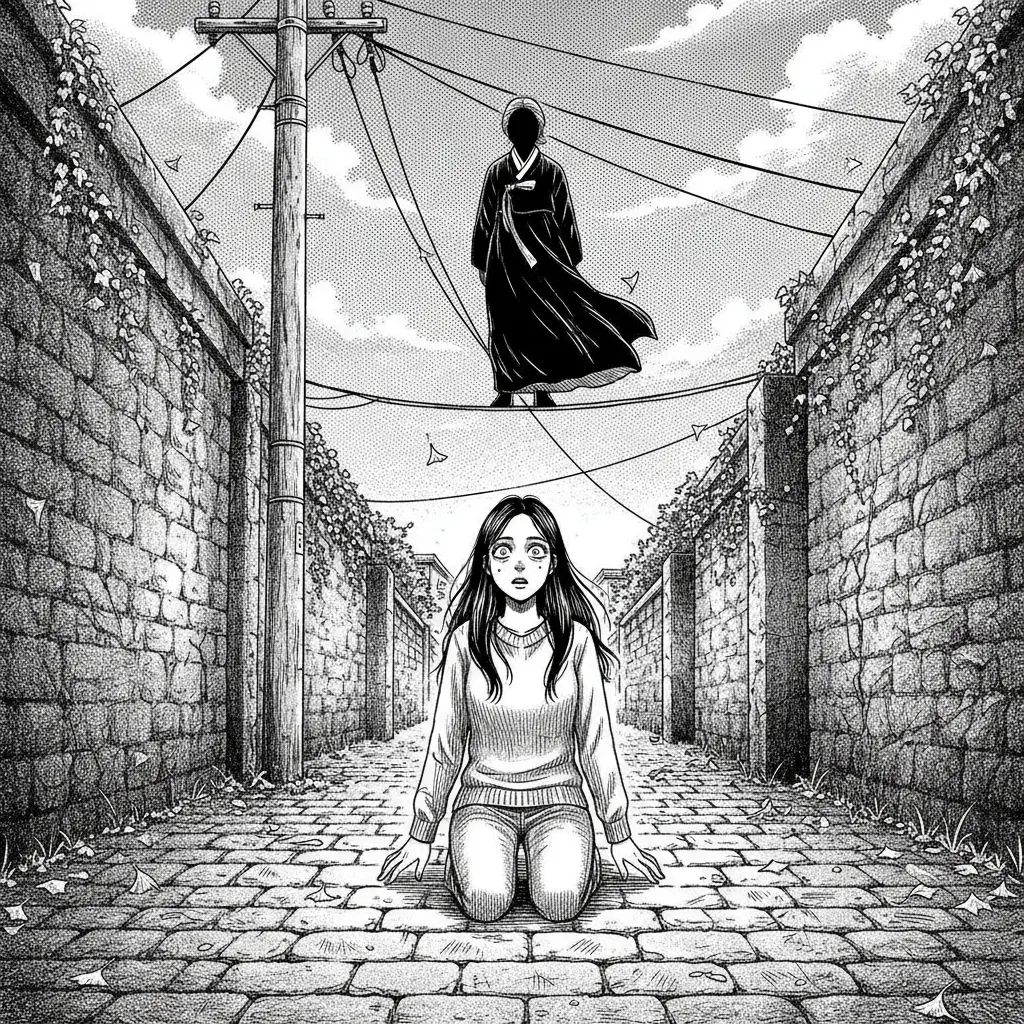
Minseo knelt and tried to read them. They were worn with age and the lines were faint, and it took a long time to make them out. When she finally did, she found the same sentence repeating. Don't look up. That was all. The same four words, going around and around, written dozens of times. Don't look up. And there in that spot, having just read those words, Minseo looked up. Perhaps it was instinct. She saw the sky. White clouds drifting slowly. And directly above the well, standing on the electrical wire that ran from the utility pole to the house, was the old woman. She stood upright on the wire, both feet planted, looking down at Minseo. The curved back was straight now. The black hanbok shifted in the wind. Her face was not visible. Where a face should have been there was only darkness — as though the light could not reach it, or as though there was no face there at all.
Minseo did not scream. She could not. The air caught in her throat and she could not breathe. Her legs had locked. She tried to close her eyes and could not. The old woman did not move. She simply stood there. Looking down. After a long time Minseo began to step backward. One step, then another. When she turned the corner and the well disappeared from sight she spun and ran. She had no memory of how she found her way out of the alley. It was only when she reached the bus stop that she could breathe again. Her hands were shaking and her camera bag had slipped from her shoulder. She sat on the bench at the stop for a long time, unable to do anything at all. People passed by. The world was going about its business as usual.
That night Minseo lay awake until she finally fell asleep in the early hours before dawn. In the dream she was back in the alleyways of Yangnimdong. It was daytime in the dream, but the light was wrong — colorless, the way everything looks in a black-and-white photograph. She was walking with her camera. When she arrived at the well, the old woman was sitting in the chair. This time she had a face. She was looking at Minseo and smiling. A perfectly ordinary smile — kind eyes in a wrinkled face. But the smile did not stop. No matter how long Minseo looked, the woman's expression did not change by even a fraction. No blinking. No small tremor of movement. It was not the face of a living person. In the dream Minseo pressed the shutter. At the click, the old woman's smile vanished. The face went dark again. Then the woman opened her mouth. There was no sound. But the shape of the words was unmistakable. Why did you take my picture.
After that dream Minseo decided to abandon the photography assignment. She told her professor she wasn't feeling well. She put her camera away at the bottom of her bag. Days passed. Life seemed to return to normal. She went to class, ate her meals, talked with friends. The events in Yangnimdong grew hazy and dreamlike, the way frightening things do when enough time has gone by.
Then, about two weeks later, in a class where students were presenting their assignments, a male student put up photographs he had taken in Yangnimdong on the screen. He had gone there for the same project, it seemed. The images advanced one by one. Stone walls, roof tiles, red brick. Watching them, Minseo felt her chest tighten — the scenes were too close to what she herself had photographed. But it was the last image that made her stop breathing. The last photograph was the well. In the young man's picture the wooden chair was visible, and on the chair sat a pair of white rubber shoes. And on the wall beside the well, faint but unmistakable, was a face with its mouth open wide.
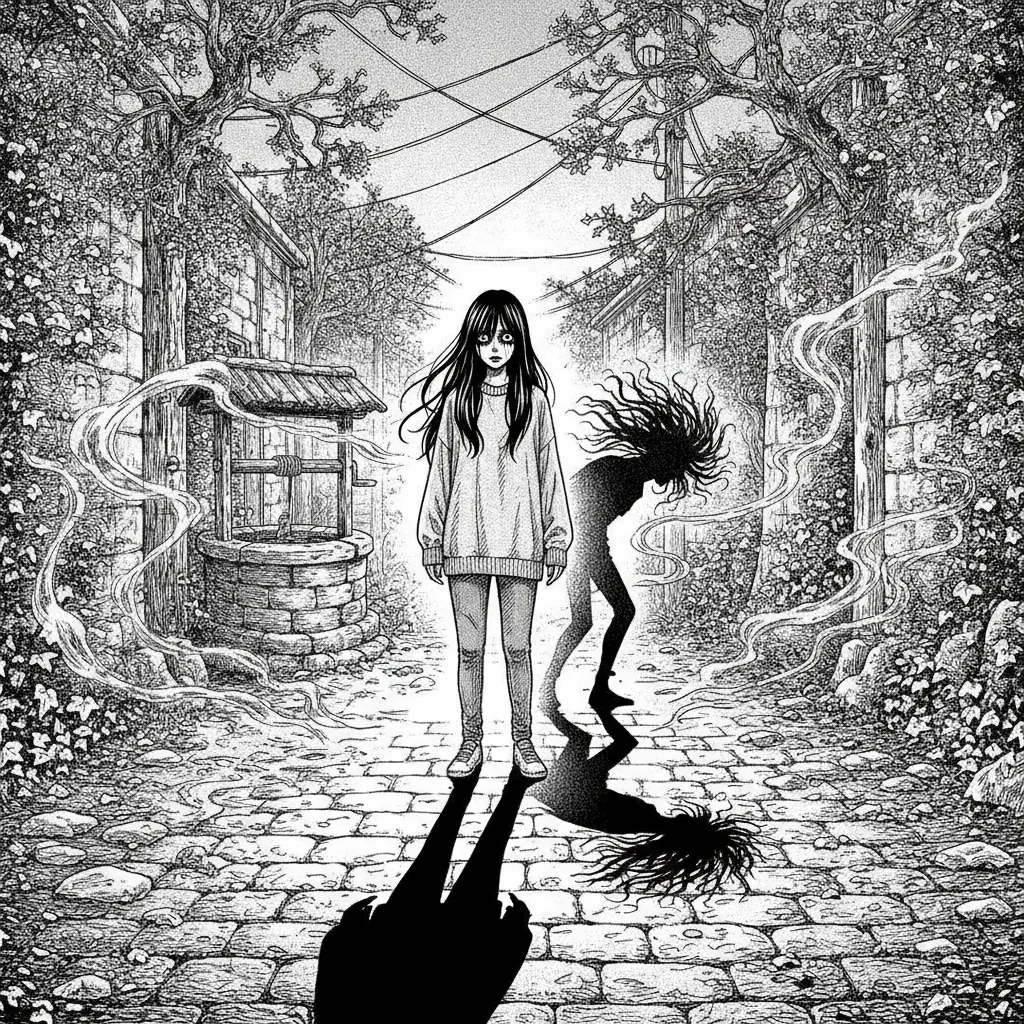
Minseo raised her hand to ask about the photograph, then stopped. The student was explaining it without any particular concern. The professor praised the composition. No one else seemed to see it. Minseo could not tell whether she was the only one who could see it, or whether everyone could see it except her. She turned her gaze from the screen to the window. Electrical wires ran past outside. There was nothing on them. Only after confirming this did she allow herself a small measure of relief.
But then, looking at her own reflection in the classroom window, Minseo went still. The glass was semi-reflective. In daylight, when the room was bright, the interior showed in the pane. In the glass, behind the reflection of Minseo, in an empty seat in the last row, sat a figure in a black hanbok. The figure was facing forward. Watching the screen. Its back was no longer curved. It sat upright, perfectly still. Minseo could not turn around. Instead she slowly looked back toward the front. The photograph of the well was still on the screen. The professor's voice continued. The friend beside her was writing something in her notes. The world was going about its business as usual.
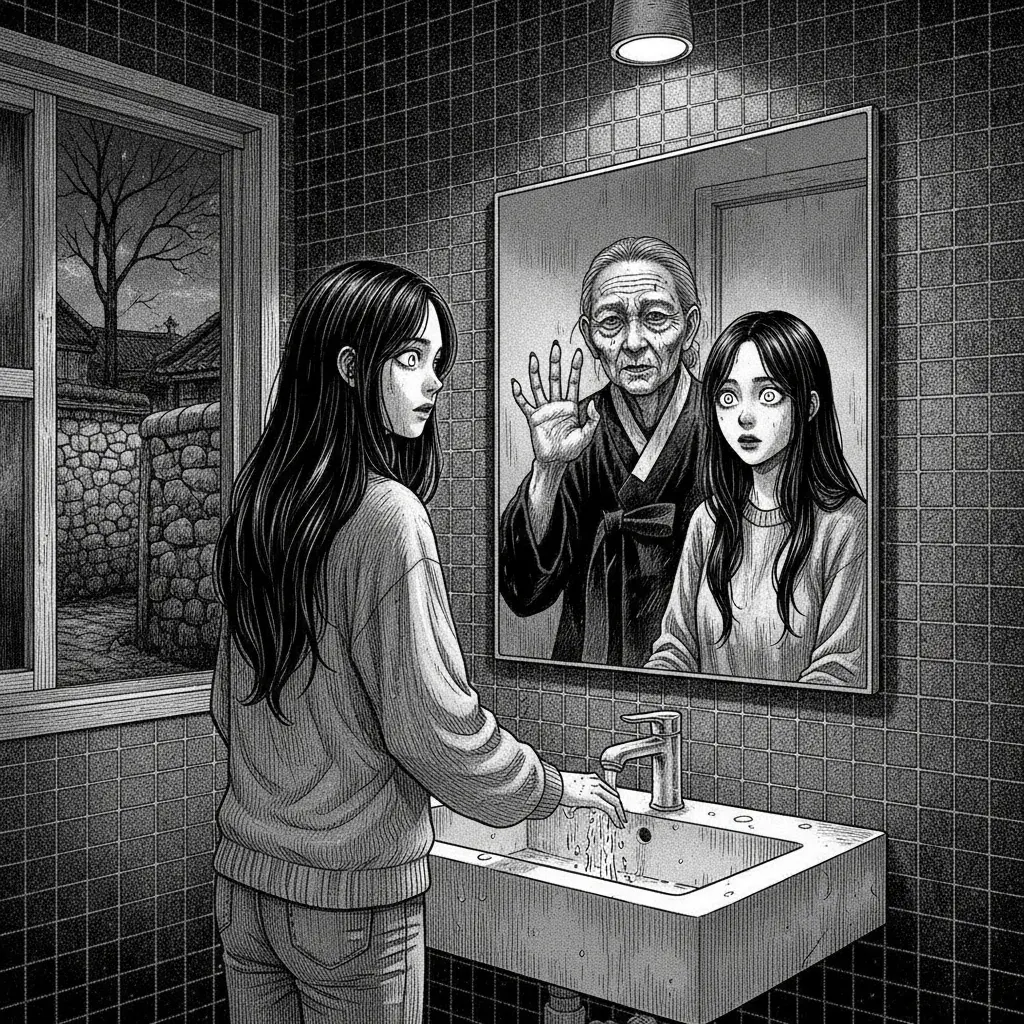
After that day Minseo tried not to look at glass. In places where there were reflective surfaces she kept her eyes low or turned away. But one night, washing her hands in the bathroom, she looked at the mirror before she could stop herself — the way you do without thinking, the way looking at a mirror while washing your hands is the most natural thing in the world. The mirror showed Minseo. Behind Minseo it showed the bathroom wall. That was all. Nothing else. She was about to look away, relieved, when the eyes of the Minseo in the mirror blinked. Her own eyes had not.
She turned off the tap and left the bathroom. Back in her room she pulled the blanket over her head. After a while she took out her phone and sent a message to her friend Jihye (지혜), asking if she could be with her tomorrow. Jihye's reply came quickly. Sure, why? Minseo wasn't sure what to write, so after a pause she sent back just: no reason. She was setting the phone down when the screen went dark, and in the last moment before it did she caught the time on the lock screen. Two forty-seven in the morning. And below the time, where the date should have been, instead of a date there was a short sentence. Minseo picked the phone back up. Woke the screen again. The date was there. Ordinary numbers. No sentence.
She decided it had been a trick of the eye. Late at night, tired — it was easy to misread things. She pulled the blanket back up. Closed her eyes. Sleep would not come. Behind her eyelids she saw the alley. The well. The wire. The figure that had stood on the wire looking down at her. The one with no face. She opened her eyes again. Stared at the ceiling. The ceiling was white and ordinary. The fluorescent light left a faint glow. She lay looking up at it and thought: what does it want. Why does it come to whoever takes the photographs. Or is it not about the photographs at all — does it come to anyone who goes to that well. Is that student seeing these things too, right now.
No answer came. It was a question that could not be answered. Minseo simply closed her eyes. This time nothing appeared. No alley, no well. Only darkness. Within the darkness she fell asleep. She did not dream. Or perhaps she did, and simply could not remember. When she opened her eyes in the morning the room was ordinary. Sunlight came in. She sat up and stretched. Looked out the window. There was nothing on the wires. She let out a slow breath.
But when she went to the shoe rack and reached for her sneakers, she stopped. There inside the rack, beside her own shoes, sat a pair of old white rubber gomusin, placed neatly together. They had not been there yesterday. She was certain of that. Minseo stood looking at them for a long time. The shoes sat quietly where they were. The toes were worn. There was dirt on them. And pressed into the inside of each shoe was the shape of a foot. The shape of someone who had worn them for a long, long time.