

The Rhythm from the Lower Shaft
AI AI-generated fiction — text, and any narration or images. Unrelated to any real events, people, organizations, or places.
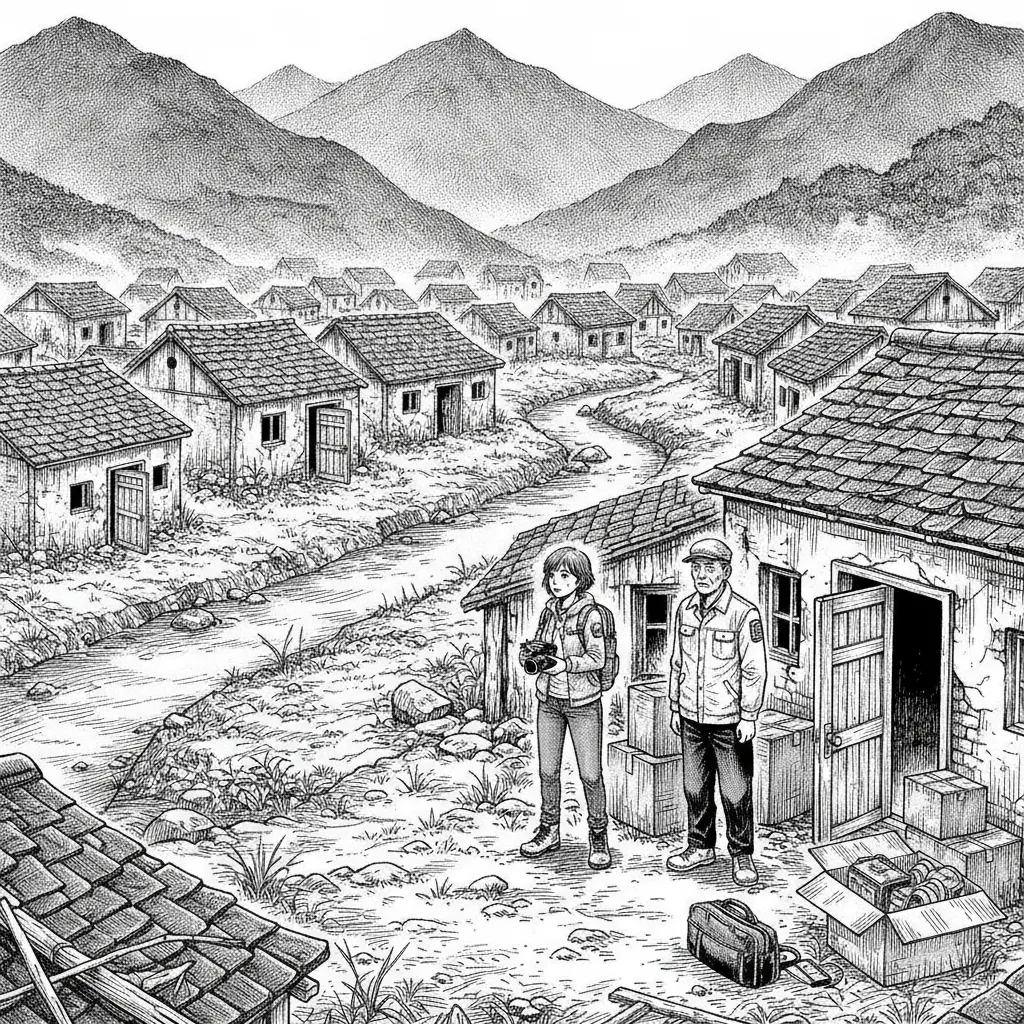
About forty minutes by car from the Jeongseon county office, where the Auraji River curves around the flank of a mountain, lies a small village on the outskirts of Sabuk. On maps it appears as "Hagaeng-ri," but the locals simply called it "the Lower Shaft." In the years when the coal mines flourished, more than six hundred households had lived there, packed in close together. Now fewer than twenty remained. Collapsed slate rooftops lined the mountain slope one after another, and the doors of empty houses hung half-open, creaking in the wind. I moved into that village on a three-month contract — a documentary filmmaker assigned to a project archiving the abandoned mining regions — with three boxes of equipment, a single laptop, and no idea whatsoever how long that village would stay with me.
At the entrance to the village stood a single cooperative store building. The sign had fallen off long ago, and only the word "Supermarket" remained on the cement wall, faint in flaking paint. The man who rented me the second floor was the village's only solitary resident, an elder named Hwang Chilbok. He said he was seventy-six, but his face looked as though ninety years had been carved into it. He took one look at my luggage and handed over the key without a word. The upper floor had two rooms. Through the window of the front room, the sealed entrance to the mine shaft was visible — a concrete wall with the words "No Entry" written in red, though the wire mesh had clearly been torn away by someone long ago. Hwang noticed me looking in that direction and said briefly: "Don't go near there. Not even in the daytime."
For the first two weeks I filmed every corner of the village. The crumbled walls of the company housing, the stream blackened by accumulated coal dust, the rusted rails of the mine carts, the remnants of the aerial tramway that had once carried supplies all the way to the coalface. Near the village entrance, the public bathhouse the miners had used still stood intact, though its ceiling had already caved in and you could see open sky through the gap. I spent about an hour filming inside before I noticed something strange. Along one wall of the changing room, at roughly the height of a standing person, handprints had been pressed into the surface. They were made in black coal dust, and there was not just one — dozens upon dozens overlapped and layered across the entire wall. They varied in size, and some were so small they looked like a child's hand. I raised my camera, but something about the way those prints seemed to multiply inside the viewfinder — more numerous on screen than they appeared to the naked eye — made me pull my eye away from the lens.
Every evening, Hwang set a meal tray at the foot of the stairs to the upper floor. He was a man of few words, and he never spoke first unless I asked him something. One evening over dinner I brought up the year the mine had closed. He set down his chopsticks and looked at the ceiling for a moment. "Thirty years now," he said. "Before it closed, there was an accident. A collapse at the coalface. Twelve men went in. Nine came out." I asked if I could turn on the camera. He shook his head. "That story doesn't need to be recorded." He resumed eating. I asked nothing more. That night I lay awake for a long time staring at the sealed shaft entrance beyond the window before finally falling asleep.
The first time I heard the sound was on the eighteenth night of my stay. It was past midnight. At first I thought it was something from inside a dream — a low, regular sound. Thud. Thud. Thud. The intervals were even, as though something deep underground were slowly knocking. I woke and lay still, listening. The sound continued. It felt like a vibration carried through the walls, and when I pressed my palm to the floorboards I could feel a faint trembling. I opened the window. Outside was quiet — only the wind coming down from the mountain and the distant sound of the Joyang River. But when I closed the window, the sound returned, as though it were rising from beneath the earth itself. I lay awake until two in the morning, and only after the sound stopped did I finally sleep.
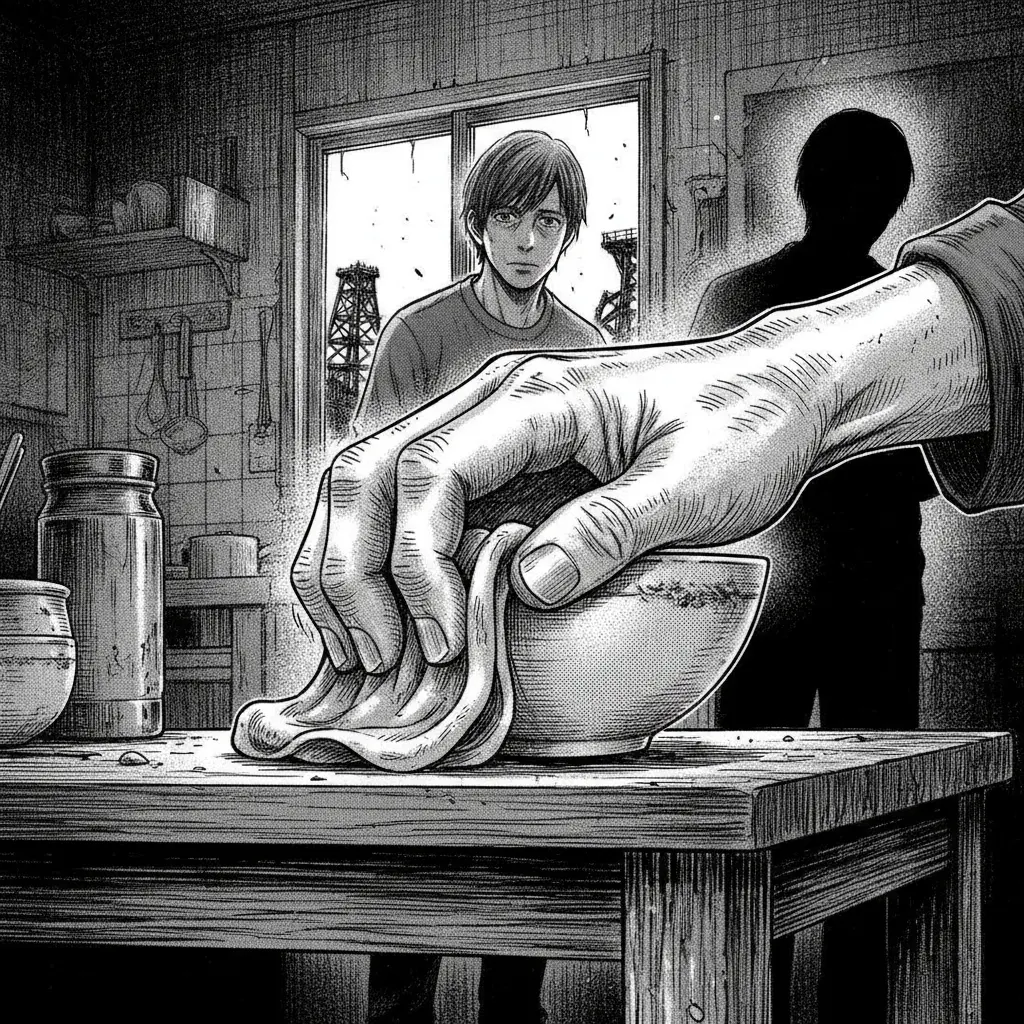
The next morning I told Hwang there had been a sound in the night. He stopped wiping the soup bowl in his hands. "Since when?" he asked. "Last night, for the first time." "What time?" "From just after midnight until around two." Hwang said nothing and went back to wiping the bowl. After a long pause he spoke. "It's a sound that comes from the mine sometimes. Old shaft ground settling and subsiding. Nothing to worry about." His voice was calm, but I noticed that the hand with which he set down the bowl was trembling slightly. I tried to tell myself it was an old man's palsy.
The sound came back roughly every three nights after that. Always after midnight, always stopping within two hours. I placed a recorder on the floor and tried to sleep. In the morning I listened to the file. The sound was there — thud, thud, thud — but something about the recording was different from what I had heard with my own ears. Between the thuds, something else had been caught. Very faint, another sound woven in. At first I took it for noise on the recording. But when I put in earphones and raised the volume, I understood what it was. Breathing. Regular, even breathing — like a sleeping person's slow respiration. I listened to the file five more times. I stopped before the sixth. The rhythm of the breathing aligned precisely with the rhythm of the thuds. As though the knocking and the breathing came from the same living thing.
That afternoon I went to find a former miner who lived at the eastern edge of the village. Ryu Giman, sixty-eight years old, living alone. He was drying chili peppers in his yard, and the moment I mentioned the sound his expression hardened. "You shouldn't be listening to that," he said. "Why not?" "There were people who heard that sound before. Before the accident." I asked what accident. He was quiet for a long time, then looked toward a crumbling section of the yard wall. "The collapse, thirty years ago. Some men said they heard sounds coming from inside the shaft and went in to investigate — three of them. They said it was a rescue signal. They said their colleagues who'd gone in first were alive and knocking." He paused, then added: "Those men never came out either."
On my way back to the lodgings I stopped in front of the sealed shaft entrance. The afternoon light fell at an angle across the concrete wall. In the dirt below the wall there were marks that might have been footprints — but they were wrong somehow. The heel impressions were missing. Only the toe ends had pressed into the earth, the prints of someone whose weight was pitched forward. They led inward only. There were no prints leading back out. I raised my camera. At the moment I was about to press the shutter, a breath of air came from inside the shaft — wind carrying coal dust and moisture together. The instant it touched my face, tears came to my eyes for no reason I could name. It was less like grief than like something reaching into my body and pressing against some old, wordless reflex. I lowered the camera and went back inside.
That night the sound began earlier — before eleven o'clock. And this time it was different. The intervals between the thuds were gradually shortening, as though something were drawing nearer. I lay under the covers with the light on. The sound grew faster. Then, around one in the morning, for the first time it acquired a direction. It came from the north wall — the direction of the shaft. I did not press my ear to the wall. I did not want to. But even without pressing close, something was transmitted through it: vibration. And within the vibration, faint but unmistakable, there was something else. A rhythm. The thuds were not random. They formed a pattern — a repeating sequence. As I lay there listening, I had the feeling that I recognized it. That I had heard it somewhere before. Then, at two in the morning, the sound stopped abruptly.
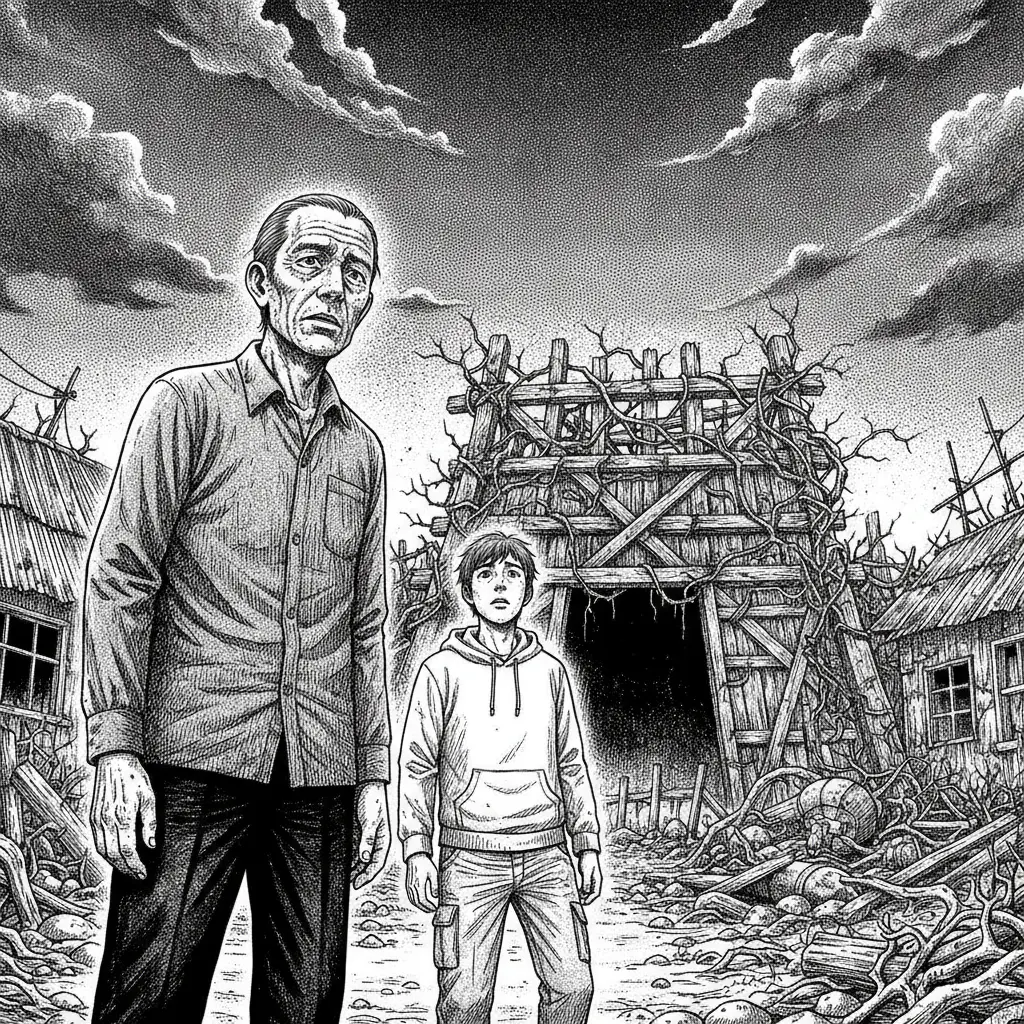
The next day I asked Hwang: "The three men who were trapped in the accident — what were their names?" He looked at me for a very long time. There was something in his eyes — not fear, but something older than fear, something close to resignation. "Why do you ask?" "There's a sound coming from inside the shaft. It has a rhythm. A rhythm that feels familiar, like something I've heard before." Hwang turned to look out the window. After a long silence he spoke. "Yi Hongseok. Bak Suman. And my younger brother." I could not find any words. Hwang continued. "My brother was good at singing miners' songs. He always hummed before going into the shaft. He had a distinctive rhythm — a rhythm no one else could follow." He paused, then went on. "Is that the rhythm? The one you heard?" I did not answer. Hwang looked at my silence and slowly nodded.
That afternoon I stood alone before the shaft entrance. It was daytime. Sunlight fell brightly on the concrete wall. Through the gap where the wire mesh had been torn away, the inside was visible. The shaft opening was a black rectangle. There was no way to gauge its depth. Air continued to flow outward from within — a wind carrying coal dust, groundwater, and the smell of old timber pit props. I raised my camera and switched on the light. The inner wall of the shaft came into frame: black rock where the coal seam was exposed, collapsed wooden supports, rust-colored water pooled on the floor. Then I pushed the camera a little further in, and I saw something on screen. Handprints on the wall. Coal-dust handprints, the same as those I had seen in the bathhouse changing room. Not just one. They continued along the shaft wall, one after another — deeper in, deeper in, as far as the light could reach.
I withdrew the camera and stepped back. At that moment a sound came from inside the shaft. It was daytime. A sound that had never come in the daytime. Thud. Thud. Thud. And this time it was not breathing. It was voices. Very small and very far away, but unmistakably voices. I could not make out the words. But there was more than one voice — several, at different pitches, layered over one another, and the layering produced something like a chord that flowed out through the shaft entrance. I could not move. My feet were fixed to the ground. The chord continued. And within it, one voice rose above the others — low and solid, repeating something over and over against the rhythm of the knocking. I took one step forward, straining to hear what it was saying.
Hwang's voice came from behind me. "You must not." He was standing there. I had no idea when he had arrived. His face was pale. "Don't listen. The more you listen, the closer it gets." I asked him: "What do you mean, closer?" He did not answer. He took hold of my arm and steered me away from the shaft. His hand was trembling. I did not resist. But even as I walked away, I felt the black rectangle of the shaft entrance at the back of my skull. And the voices — no longer audible as sound — were still reaching me as vibration through the soles of my feet. As though the earth itself were speaking.
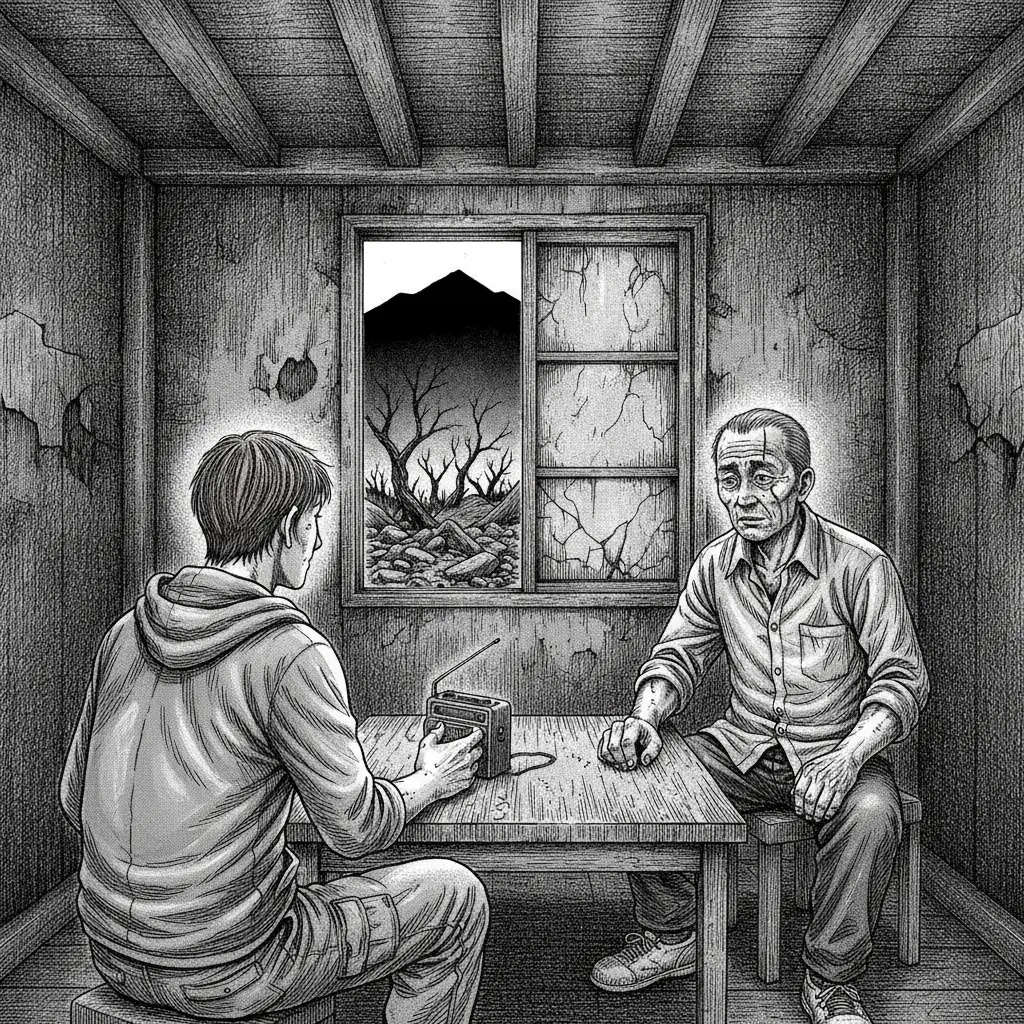
That night Hwang sat across from me for the first time and talked for a long while. He told me about the accident. When the collapse occurred thirty years ago, nine of the twelve men had been near the entrance. Three were deep inside at the coalface. The collapse happened in the middle section. The nine survived; the three were trapped. Rescue teams tried to go in, but there was a risk of secondary collapse. For three days they attempted to reach them. For three days, sounds came from the shaft. Knocking sounds. The signal that Hwang's brother was still alive. Hwang spent those three days at the shaft entrance, listening. On the fourth day, the sound stopped. The rescue teams declared the men dead. The bodies were never recovered. The shaft was sealed and the mine closed for good. Throughout everything he told me, Hwang did not look at me once. He looked out the window, where there was nothing — only the mountain and the dark.
I did not sleep that night. The sound came. This time it was different — not the steady thud, thud, thud, but faster and irregular, as though something had lost its rhythm. Then at three in the morning the sound changed entirely. It was no longer knocking. It was scraping. A rough, slow sound, like fingernails dragged across a wall. And the sound was moving along the north wall — moving inward, toward the room. I turned on the light. The room was empty. But the sound continued, from inside the wall. Then it moved toward the window, and I saw something on the glass. Something dark. Coal dust. On the outside of the window, a handprint had been pressed into the glass. It was a second-floor window. The second floor.
In the morning I told Hwang. He listened without speaking for a long time. Then he asked: "How many prints were there?" I said one. He nodded. "It starts with one," he said. I was frightened — not so much by the words themselves as by the voice in which he said them. Calm and worn, the voice of someone confirming what they had already known for a long time. "Have you seen this before?" I asked. He did not answer. Instead he asked: "Before you came here, did you research this village?" I said I had. "Then you may know. Of the people who left this village over the past thirty years, quite a few came back." I did not understand what he meant. Hwang continued. "Even after they left, the sound followed them. Some people said they heard it in the city. They came back in the end. On their own." A silence settled between us. From outside came the sound of wind moving across the slate rooftops.
That day I packed my things. I loaded the equipment into boxes and carried it to the car. Hwang stood in the yard and watched. There was no farewell, no attempt to stop me — he simply watched. As I got into the car I said to him: "Why do you stay?" He looked up at the sky for a moment. "Because I can still hear my brother." That was all. I drove away. As I turned out of the village onto the main road I checked the rearview mirror. Hwang was still standing in the yard. The sealed shaft entrance was visible behind him. I looked away.
I had passed through Jeongseon and Yeongwol and was coming into Wonju when I turned on the radio. Music came on. And within the music I heard something — a very small, very low sound. A sound with a rhythm. Thud. Thud. Thud. I turned off the radio. Silence. Only the noise of the highway. I steadied my breathing and drove on. A little while later, something caught my eye at the passenger-side window. Something on the outside of the glass. Something dark. I did not slow down — could not slow down — there in the middle of the highway. A handprint pressed into the glass on the outside. One print. Still only one.