

Beyond the Latticed Door
AI AI-generated fiction — text, and any narration or images. Unrelated to any real events, people, organizations, or places.
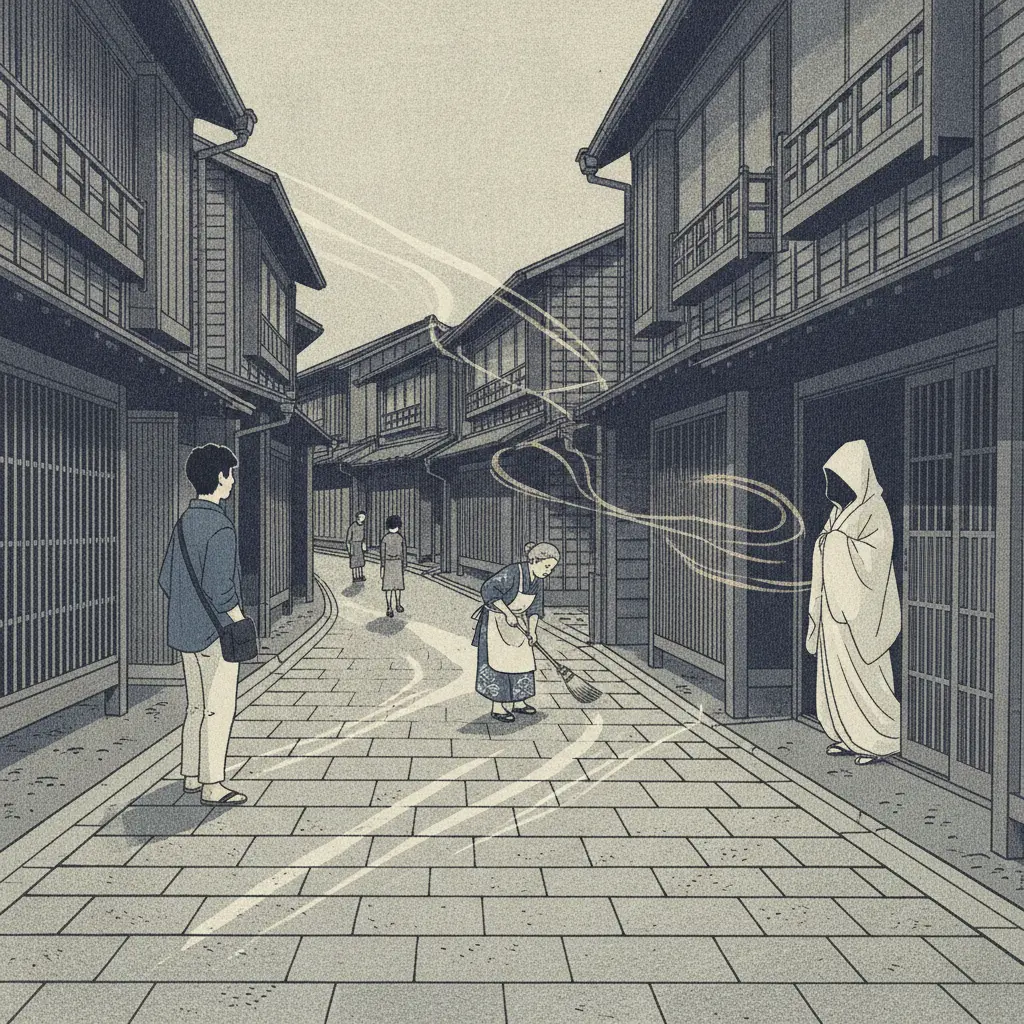
There are things that never appear in travel photographs, Fujisaki Yosuke had always believed. The angle of light on cobblestones, the darkness that drifts behind latticed doors, the smell of incense and face powder and old timber hanging in the air — no matter how fine the lens, such things were always left behind somewhere else. That was why he returned to the Higashi Chaya district every year. Not so much to shoot as to confirm. To see with his own eyes whether the place still existed as he remembered it.
Yosuke was thirty-four, a freelance photographer based in a cramped Tokyo apartment. His work centered on travel magazines and regional promotional publications, but lately the commissions had been thinning, and without quite realizing it, he had been pressing the shutter less and less. The sensation of that moment — the click, the capture — had lost some of its old sharpness. When an unexpected week opened up in early October, he booked a Shinkansen to Hokuriku without hesitation.
He arrived at Kanazawa Station at dusk. The vermilion of the Tsuzumi-mon gate was stained by the red of the western sky, and the flow of tourists dispersed in every direction in search of dinner. Yosuke slung his heavy camera bag over his shoulder and boarded a bus. By the time he stepped off at the stop nearest the Higashi Chaya district, the bustle of sightseers had nearly vanished. Only the amber light glowing behind latticed doors remained, drawing long, narrow stripes across the wet surface of the cobblestones.
His lodging was a small inn not far from the tea-house district, and he had reserved a corner room on the second floor. The proprietress appeared to be in her sixties — a composed woman who looked at him and said simply, "Just yourself?" and asked nothing more. The room was an eight-mat tatami space; when he opened the window, a narrow alley came into view. At the far end of the alley stood an old house with a latticed door, its second-floor window at exactly the same height as Yosuke's room. The window held no light. It was simply dark.
The following morning, Yosuke rose early and went out into the district. Before seven o'clock there were almost no tourists, and the only things present were the sound of water being swept across the cobblestones and the scent of dashi drifting from some kitchen nearby. He walked to the innermost lane and spent a long time photographing the shadows of latticed doors and the details of eaves. The light was soft, the shadows deep, and with each press of the shutter a sensation he had not felt in some time began to return. After shooting for about three hours, he stepped into a small coffee shop at the edge of the district and ordered a cup.
It was there that Yosuke exchanged a few words with an elderly woman. She wore a white apron and was seated at the far end of the counter, speaking familiarly with the owner in the manner of a local. When Yosuke set down his bag, she turned her gaze toward him. "You're taking photographs?" she said. Her voice was low but unhurried. When he nodded, she paused for a moment and then said, "You'd do well not to go near that latticed house." She did not say which one. Before Yosuke could ask, she rose from her seat and left.
He told himself not to think about it. Every old tourist district had stories like that. Buildings with dark histories, places one was not to approach, taboos known only to locals — such things sometimes even added color to the experience of a place. Yosuke finished his coffee and went back out into the street with his camera. But as he walked, the image of that house — the one with the unlit window he had seen from his room the night before — caught at the edge of his mind and would not let go.
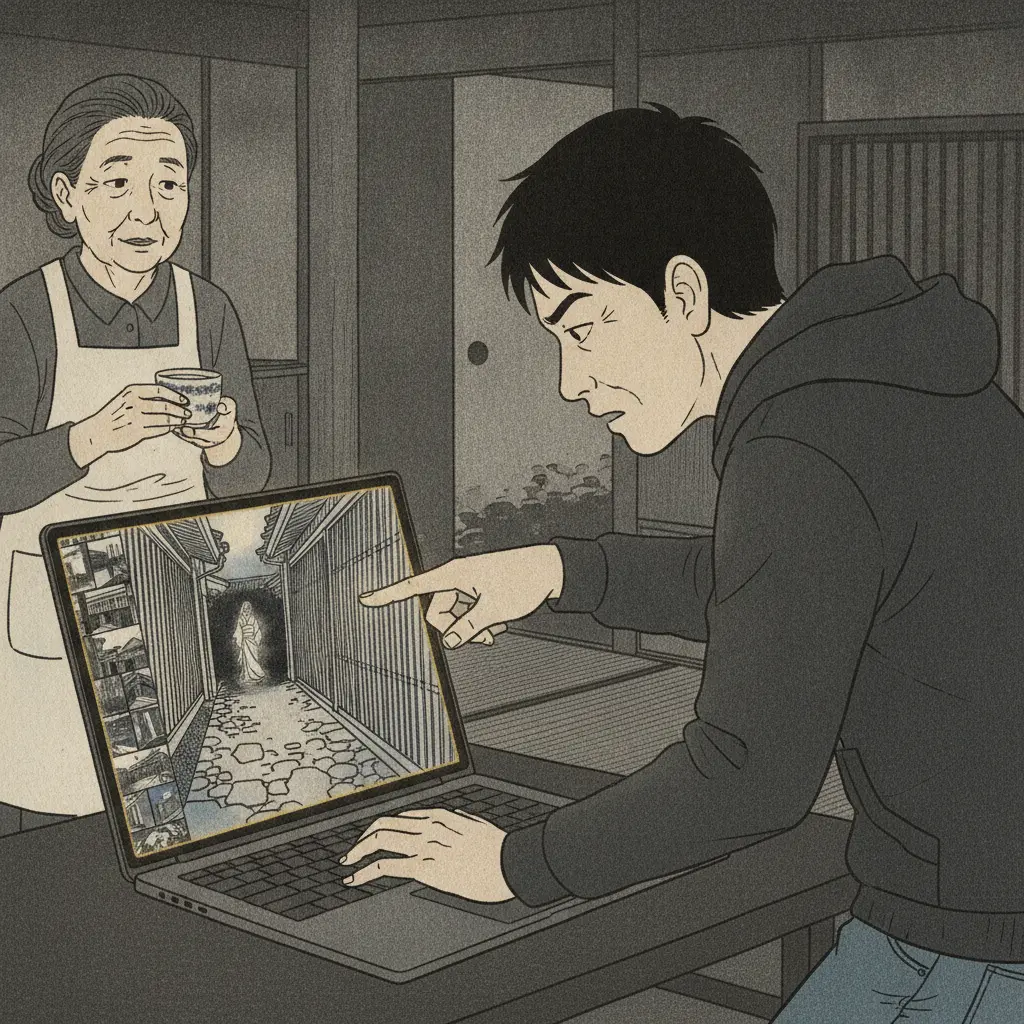
He returned to the inn in the early afternoon and reviewed the morning's images on his laptop. The Higashi Chaya district in morning light was beautiful. The slender vertical lines of latticed doors repeated themselves across the screen, and the irregular joints of the cobblestones gave the images depth. He went through them one by one, marking the ones that caught his attention. Then, in the corner of one frame, he noticed something. A shot taken at the far end of a lane — at the vanishing point of a row of latticed doors, something like a human shape stood in the shadows.
Less a figure than the outline of one. It seemed to dissolve into the shade of a latticed door, facing toward the camera. Yosuke enlarged the image. As the resolution increased, the outline grew clearer: a slender form in what appeared to be a white kimono. The face was too dark to make out, but the posture was unmistakably directed at him. The shot had been taken at seven fifteen in the morning, and had anyone been standing there, he would surely have noticed. He searched his other photographs of that lane, but the figure appeared in none of the frames taken before or after.
He continued sorting through the images as though trying to put the thing out of his mind, but by evening the outline had not left him. After dinner, he went out to walk the tea-house district at night, telling himself it was for a change of air. The Higashi Chaya district at night becomes an entirely different place. Lantern light falls across the cobblestones, and sometimes the sound of a shamisen drifts through a latticed door. There are few tourists, and the sound of footsteps seems to be swallowed by the stones. Yosuke walked slowly, taking a few night shots along the way.
Before long, he found himself standing in front of the latticed house he had seen from his window. He had not meant to go there, but his feet had carried him. The house looked older by night than it had by day. The wood of the lattice had gone nearly black, and the shadow it cast on the cobblestones was deeper than those of the houses around it. The second-floor window was dark as before, bare of curtains or any covering. There was no nameplate, no letterbox. No sign that anyone lived there. And yet, through the narrow gaps in the latticed door, something that looked like a faint light seemed to be leaking out.
It was not fluorescent, not the glow of a paper lantern — it was a wavering light, like a candle, but with a bluish cast. Yosuke raised his camera and pressed the shutter toward the gap in the door. He was not trying to identify the source of the light. There was simply an urge — he had to capture it. The sound of the shutter rang through the alley, and in that instant a face appeared in the second-floor window. A white face. With eyes. Yosuke stepped back instinctively; his heel caught on a joint in the cobblestones and he nearly fell. He steadied himself and looked up at the window again. There was nothing. The window was dark and still.
Back at the inn, he checked the image he had just taken. The light leaking through the latticed door was there. But when he looked at the second-floor window, nothing was captured in it. He told himself he was tired. The dwindling work back in Tokyo, the vague anxiety about the future — it was all producing an excess of sensitivity here, away from home. He settled on that explanation and went to bed early.
He dreamed. He was standing on the cobblestones of the Higashi Chaya district. It was night, and there was no light. He walked between rows of latticed doors, and each one stood slightly open. Through the gaps there was only darkness, but within that darkness something was present. He stopped, and from beyond the latticed doors came a sound — not a voice calling his name, but something like breathing. Many slow, measured breaths. He had the feeling that one of them was trying to shape itself into his name. He tried to run, but his feet were fixed to the cobblestones and would not move.
The next morning Yosuke woke drenched in sweat. The dream faded quickly, but something heavy remained in his chest. After breakfast, he asked the proprietress about the latticed house. She paused briefly in the act of wiping the teapot on her tray, then said quietly, "That house? It's been empty as long as anyone can remember. For a very long time now, no one has been allowed in. Or rather — no one goes in." When Yosuke told her what had happened the night before, she kept her eyes down and said only, "Is that so," and said nothing more.
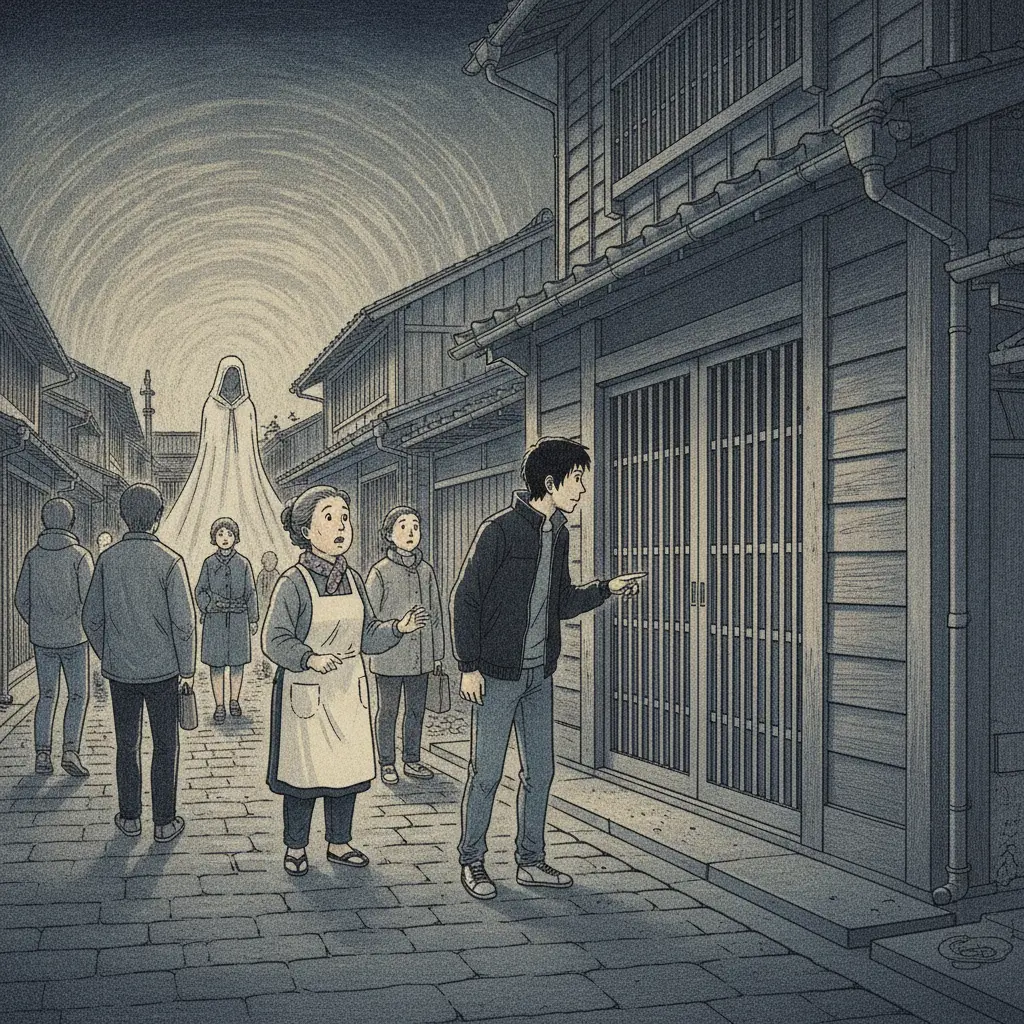
That afternoon, Yosuke made himself stand near the latticed house for a long time. Nothing happened in the daylight. The house was silent, the latticed door firmly shut. No light, no sound. Tourists passed by without so much as glancing at it, as though there were nothing there at all. Puzzled, he stopped a middle-aged woman tourist and asked, "Did you happen to notice that house?" She looked at him with a slightly baffled expression. "Which house?" she said. When he pointed, she said, "Isn't that just a wall?"
Yosuke stood frozen. Before him, unmistakably, was the latticed house — the blackened wooden lattice, the stone foundation, the dark second-floor window, all of it clearly visible. Yet to the tourist it appeared to be nothing more than a stone wall with an empty lot behind it. He raised his camera and pressed the shutter. The house appeared on the LCD screen. And yet, from the angle at which the woman was looking, there was indeed only a stone wall, and beyond it an empty space. Yosuke felt the ground shift beneath him, caught between two versions of what was there.
At dusk, Yosuke sat in his room and looked out over the alley again. On a whim, he reopened the morning's images from the day before. He enlarged the white figure in the depths of the lane, this time pushing the resolution to its maximum and stretching the face further than he had before. What he had taken for an overexposed blur resolved into distinct features. It was a woman's face. White as if powdered, with lips that were faintly, thinly red. And — Yosuke traced his finger across the screen — the woman was holding something. Something small and rectangular.
An old photograph. A small, black-and-white photograph. He enlarged the face of the person visible within the photograph the woman was holding. The pixels broke apart, noise crept in, and yet the outline remained just barely legible. The person in the photograph was Yosuke himself. Standing on cobblestones with a camera in hand, in a composition that might have been taken on this very trip.
Yosuke closed the screen. His hands were trembling. This was not a composite. This photograph had been taken that morning. No one else had touched it. And yet an old woman was holding a photograph of Yosuke as he was now. The order of time had been reversed. Or perhaps time had never flowed there at all, not from the beginning. He looked out the window. The latticed house at the end of the alley was visible. The second-floor window held no light. But for the first time that night, he noticed that the window was open, just slightly.
Yosuke set down his camera. He decided to go back to Tokyo. He would pack tonight and take the first train in the morning. The room was paid for in advance, so he only needed to let the proprietress know. He had made up his mind and was beginning to gather his things when he sensed something moving on the other side of the shoji screen. The inn's corridor was laid with bare boards, not flooring — boards that creaked underfoot. But what he was hearing now was not a creak. It was the sound of fabric dragging across tatami, a slow, trailing sound.
Yosuke held his breath. The sound in the corridor came to a stop just outside his room. There was a shadow on the other side of the shoji — a shape in the form of a person, visible through the paper. He could not make a sound. The shadow did not move. A minute passed, or perhaps five; his sense of time dissolved, and he could only watch. Then the shadow slowly tilted its head. As if to look at him, it turned its head ninety degrees to the side. It was not the way a human neck moves.
"Fujisaki-san," came a voice. The proprietress's voice. "Dinner is ready."
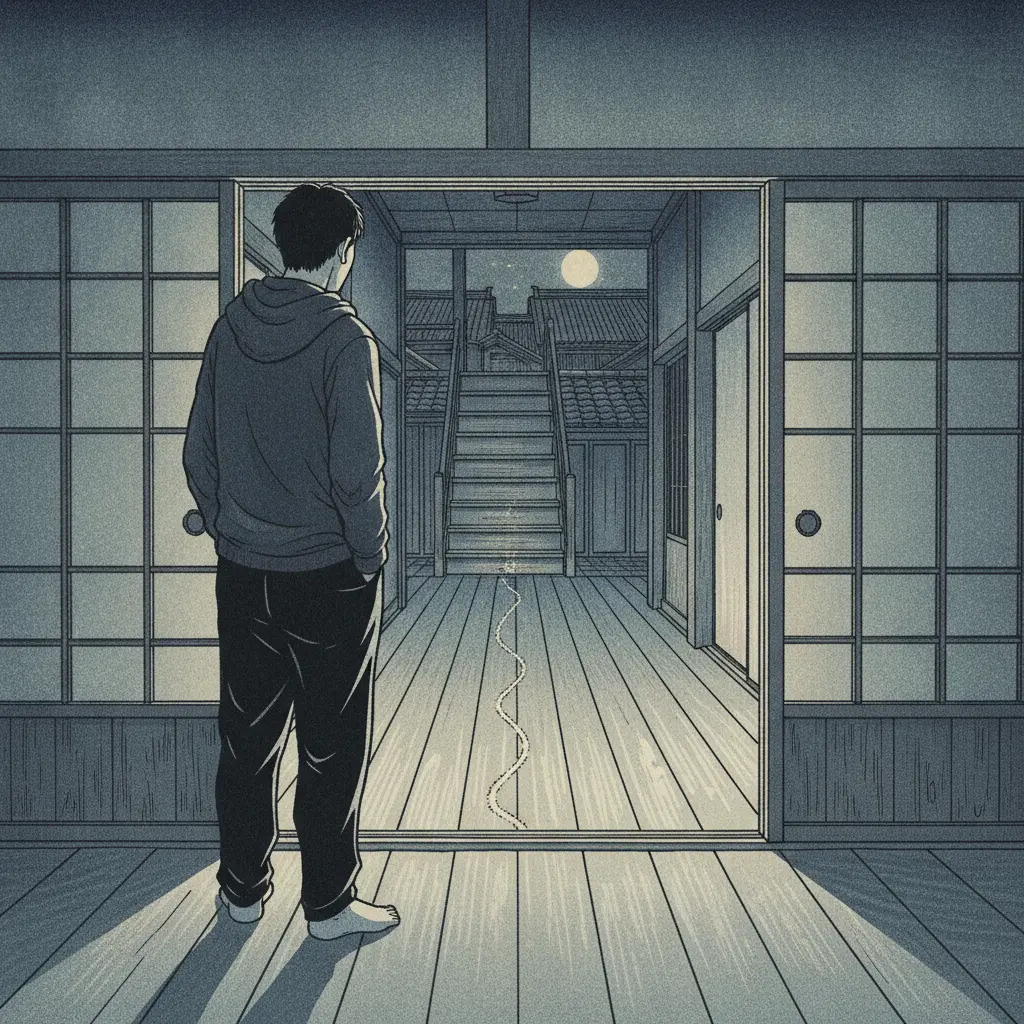
He opened the shoji. The corridor was empty. The bare wooden boards lay quiet, with only the staircase visible at the far end. Yosuke looked down. Along the boards, a faint trace of something white — like powder — had been drawn in a line. Not the print of a foot, but a single narrow streak, as if the hem of a kimono had been dragged across the floor, leading away toward the stairs.
Yosuke left the inn the following morning, one day ahead of schedule. The proprietress asked no questions as she saw him off. Only at the entrance did she say, "Please take care," and there was a weight in her voice that was not quite ordinary. Walking the cobblestone road toward the station, he turned back once. The latticed doors of the tea-house district stood in the morning light. There were still no tourists, and the cobblestones were wet with night dew. The latticed house was visible even in the morning light, as clearly as before. And the second-floor window was closed.
On the Shinkansen, Yosuke did not open his laptop. He returned to his Tokyo apartment, and about a week later he finally brought himself to sort through the photographs from Kanazawa. He searched for the image of the white figure in the depths of the lane, but could not find it. The file for that time and date was there in the folder, but when he opened it, it showed a different image — a close-up of the wood grain of a latticed door. He tried to reconstruct the face he had seen so clearly in his memory, but the details would not come. Only the white of the powdered skin and the thin red of the lips remained.
Some months later, a magazine publisher contacted him about a feature on the Higashi Chaya district. Yosuke declined. He took other work instead. But at night, from time to time, he found himself thinking about that alley. The slender vertical lines of the latticed doors. The shadows falling across the cobblestones. The wavering blue-white light. And above all, that small black-and-white photograph — the one the woman had been holding, with Yosuke himself inside it. When had it been taken? By whom? And was the woman still standing there now, in the darkness of that latticed house, holding the photograph?
One night, Yosuke found a roll of film at the back of a drawer — a roll he had apparently sent out for developing and then forgotten. He thought he must have used it up in the Higashi Chaya district. He thought he must have forgotten to pick it up. But Yosuke used only digital cameras. He had not brought a film camera to Kanazawa. And yet the film was there in the drawer, undeniably real. A thirty-six-exposure roll, in an old format.
Yosuke did not send the film to be developed.