

The Counting Woman
AI AI-generated fiction — text, and any narration or images. Unrelated to any real events, people, organizations, or places.
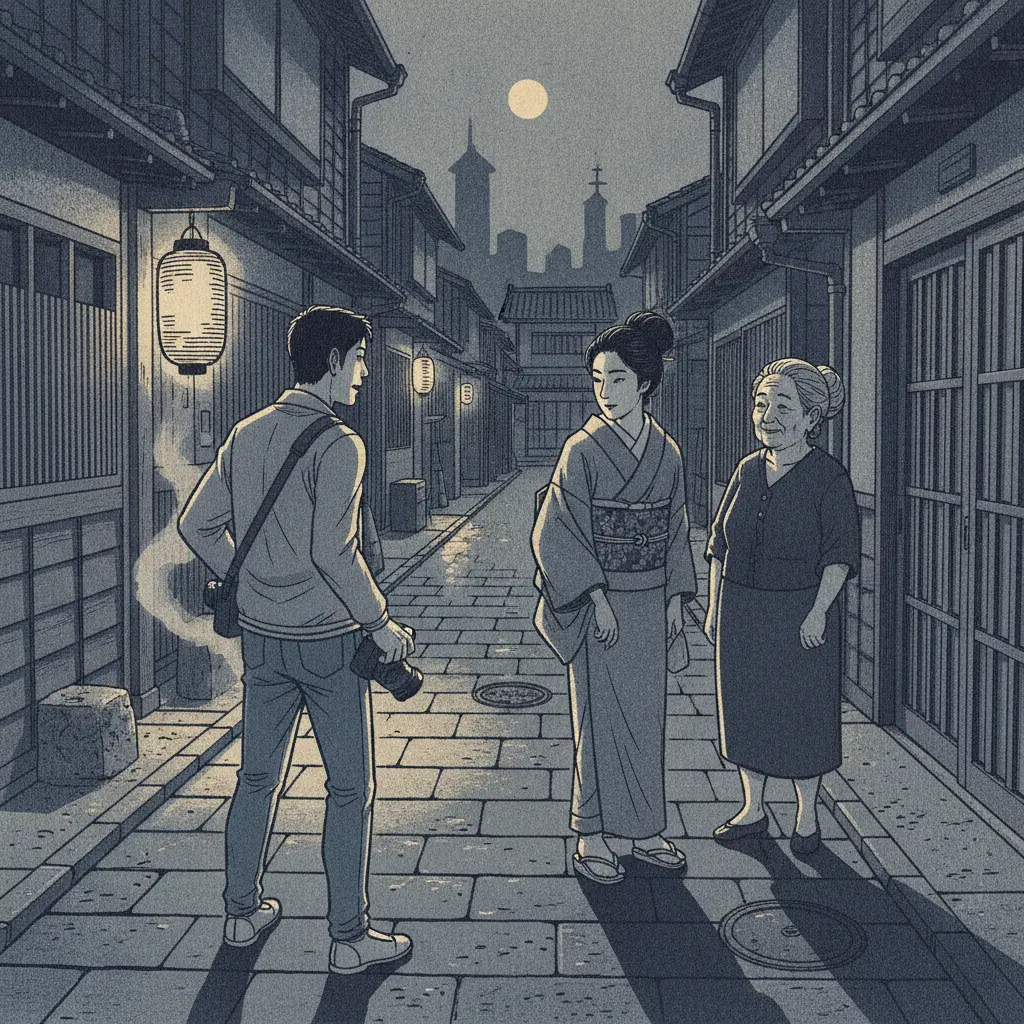
It was late October, three weeks after I had moved to Kyoto, when I first met her.
The back alleys of Gion are not the kind of place that appears in any travel guide. Step one or two lanes behind Hanamikoji, and the air changes immediately. The light from the streetlamps falls yellow against the cobblestones, reluctant even in daytime. The machiya townhouses, their latticed facades darkened with age, all seem to have grown old at the same rate, at the same pace. The noise of tourists vanishes as though it never existed, and the only sound is your own footsteps on the stones. I had begun walking that alley for the simplest of reasons: it was a shortcut. When I needed to reach the Kamo River from my lodgings, cutting through those back streets was the fastest way.
I made my living taking photographs. Nothing grand — architectural shots for the margins of magazines, landscape images for travel guides, that sort of quiet, unremarkable work. I had come to Kyoto to photograph its old townscapes. I rented a room for three months and spent every day walking with my camera. The back alleys of Gion were ideal subjects. The way light entered, the texture of the cobblestones, the precise angle at which the lattice shadows fell — all of it was beautiful in a way that seemed almost calculated. So I walked those lanes every day.
I first saw her at dusk.
At the far end of the alley stands a small jizo shrine — a stone structure barely a meter tall, housing a diminutive figure within. A thin thread of incense smoke always rose from it, and someone kept fresh flowers placed before it. I had photographed that shrine many times, but on that particular evening I noticed, for the first time, a figure standing before it.
A woman.
She stood with her back to me, dressed in a kimono of pale ink-grey. The obi at her waist was a deep navy, close to black. Her hair was swept up high, and her nape gleamed white, hovering in the fading light like something half-dissolved. My first thought was that she might be a maiko or geiko, but something about her was different. Maiko paint their faces white and wear elaborate floral kanzashi. This woman wore no adornment of any kind. She simply stood before the shrine in perfect stillness, gazing at something.
I raised my camera. I should have asked permission first, but the scene was so perfectly composed that my body moved before my mind could catch up. I had pressed the shutter three times when the woman turned around.
The moment I saw her face, I forgot to breathe.
She was beautiful. And yet something was wrong. Her eyes were not smiling. But it was more than that — her gaze did not seem to settle on me. She appeared to be looking at me while actually looking just past me, or through me, toward something far away. Her lips held the faint shape of a smile, but that too was strange. It was less a smile than something that had taken the form of one.
"Did you take my photograph?" she said.
Her voice was low and composed. She did not sound angry. She sounded as though she were simply confirming a fact.
"I'm sorry," I said. "I didn't ask. I'll delete them."
"No," she said. "You don't need to delete them. But —"
She tilted her head, just slightly.
"Am I in them?"
It struck me as an odd question — asking the photographer whether she had been captured. I checked the LCD screen on my camera. In all three images, her figure was visible from behind. In the second shot, caught mid-turn, a portion of her profile appeared.
"Yes," I said. "You're in them."
She said only, "Is that so," and turned back toward the shrine. It was as though she had lost all interest in me. I started to say something more, then stopped. The air around us had a weight to it that made further conversation feel impossible. I gave a small bow and walked away.
But all the way home, the back of my neck stayed cold. I told myself it was the October evening, that the temperature had simply dropped. I tried to believe that.
The following day, I walked the alley again.
The woman was not at the shrine. I assumed our meeting had been a chance encounter and moved to pass by. Then, from somewhere deeper in the alley, I heard a faint sound. Not the clack of wooden sandals — there were no footsteps at all, and yet something seemed to be drawing nearer. I turned around. There was no one. Only the cobblestones stretching away, the latticed facades on either side, and the yellow glow of a distant streetlamp.
I stood still for a few seconds, then quickened my pace.
Three days later, I met her again.
It was midday this time. As I walked the alley, I found the woman standing before one of the latticed doors. The same pale ink-grey kimono. The same near-black obi. The same swept-up hair. She stood with a stillness that made it seem as though she had been there for all three days without moving.
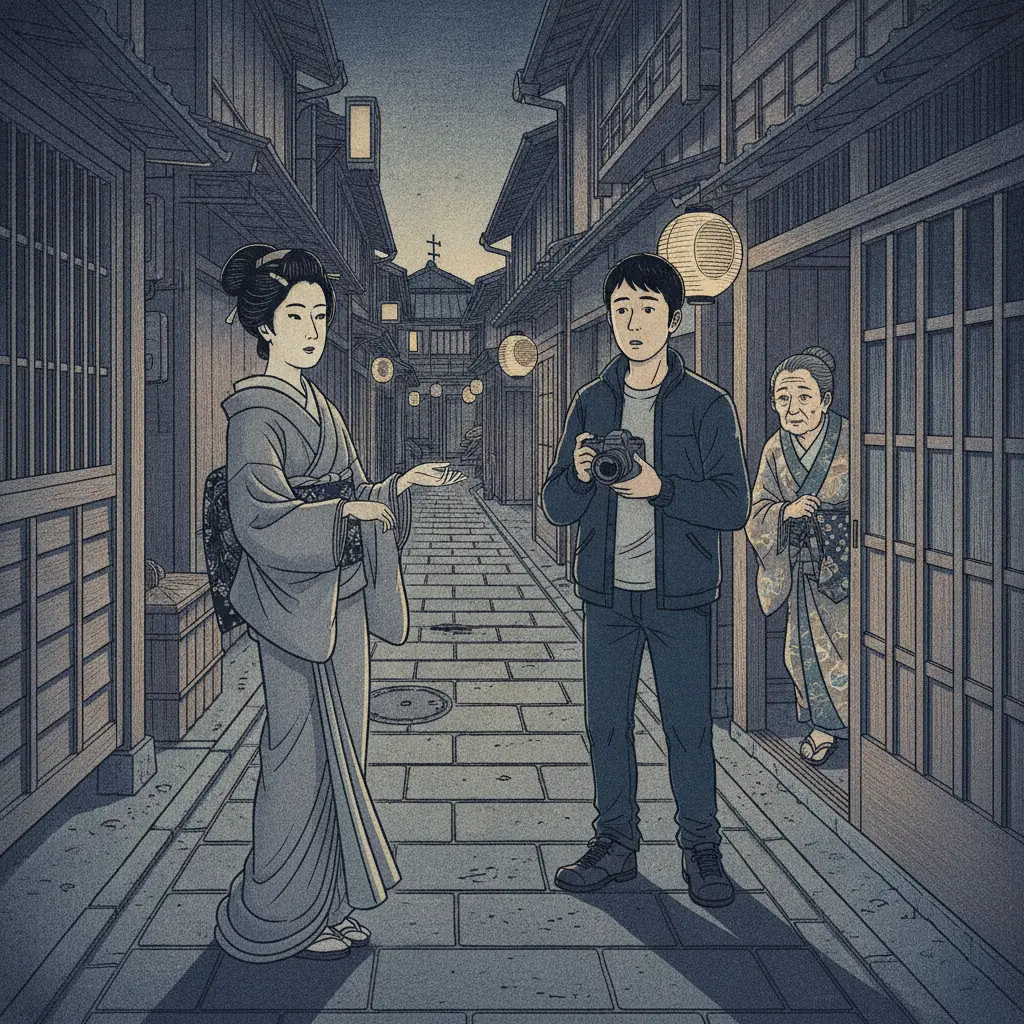
"You've come again," she said. It was neither a greeting nor an accusation — simply an observation.
"I walk this way often," I said. "I'm here to take photographs."
"I see."
"I came yesterday, too."
"I know."
I was mildly startled. I had not seen her yesterday. Had she been watching from somewhere?
"Do you live around here?" I asked.
She shook her head slowly. "It's less that I live here," she said, "and more that I am here."
I didn't fully understand what she meant, but I didn't feel inclined to press her. Instead, I asked something else.
"What were you doing at the shrine the other day?"
She paused before answering. "Counting," she said.
"Counting?"
"The people who pass through."
That was all she said. Then she slipped behind the latticed door and was gone. I heard no sound of it opening, no sound of it closing. She was simply there, and then she was not.
I returned to my lodgings and sorted through the day's photographs. I transferred three days' worth of images to my laptop and went through them one by one — the alley, the cobblestones, the latticed facades, the shrine. When I reached the three photographs of the woman, I stopped.
The image of her from behind. The image of her in partial profile. Both were unremarkable. But when I came to the third — the shot taken at the moment she had turned fully toward me — I leaned closer to the screen.
Her face was not there.
From the neck up, the image was wrong. Not blurred, exactly — it was more as though the light had bent strangely in that one spot, as though the air itself had warped. I told myself it was a camera malfunction, a trick of the light. But in the second photograph, the rest of her was rendered in sharp detail. Only that one region, in that one image, was absent.
I stared at the photograph for a long moment, then closed the file.
That night, I dreamed.
I was walking the back alley in Gion. In the dream it was night, and several of the streetlamps had gone dark. The cobblestones were wet, and my footsteps became the sound of water underfoot. When I reached the shrine, the woman was standing before it. With her back to me. As always. I tried to call out to her, but I had no voice. She began to turn, slowly, and I tried to see her face. But there was no face to see. Where a face should have been, there was only a dark and empty space.
I woke at three in the morning. The room was unnaturally quiet. Only the sound of my own breathing. From somewhere beyond the window, from the direction of the Kamo River, came the faint murmur of water. I lay staring at the ceiling for a while, then closed my eyes. Sleep would not come.
The following week, I asked my landlady about the back alley of Gion. She was a woman in her seventies, born and raised in Kyoto. If anyone would know something, I thought, it would be her.
"Near the shrine in the back alley," I said, "I keep seeing a woman in a kimono. She doesn't seem to be a geiko."
The old woman set down her teacup.
"A pale ink-grey kimono?" she said.
"Yes."
She was quiet for a moment. Then, in a measured voice, she spoke.
"There used to be an okiya in that area."
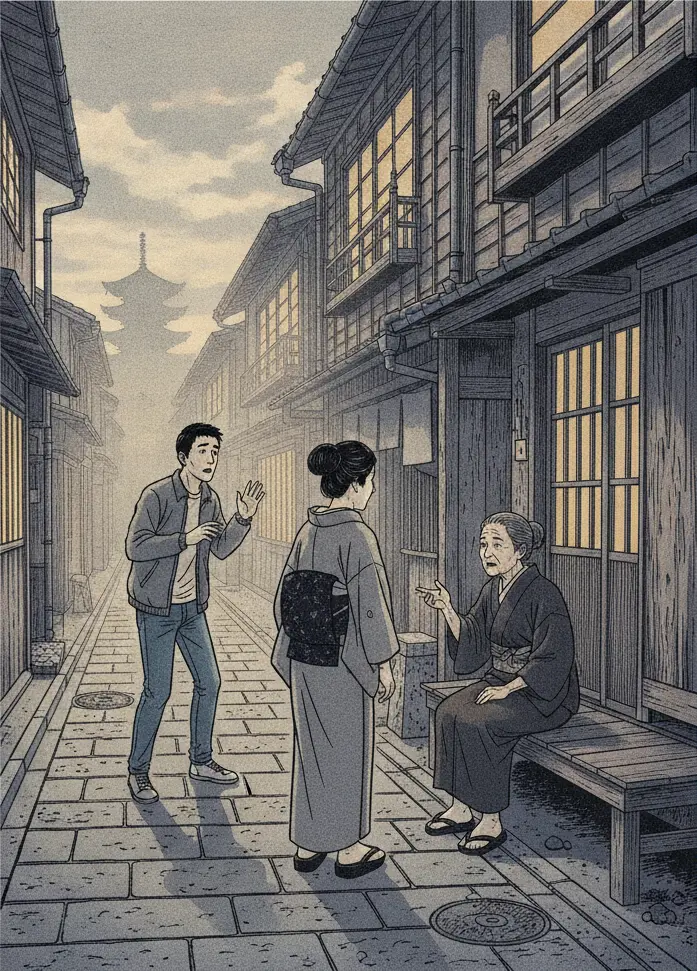
An okiya is the establishment that houses and manages geiko and maiko. Several still exist in Gion today, but the one she was describing belonged to the past.
"This would be from the Meiji era. There was a geiko there — extraordinarily beautiful, they say. Her name, if I recall, was Tsuyu. She was immensely popular with her patrons, called to the ozashiki banquet rooms every night. But one autumn, she simply vanished. The people at the okiya searched for her and found nothing. No one ever knew where she had gone, or why."
"And then?" I prompted.
"Not long after, stories began to circulate. People said they had seen a woman in that back alley. A woman in a pale ink-grey kimono, whose face could not be seen. They said that those who saw her would afterward suffer some misfortune."
The old woman paused. She watched me steadily — as though testing me, or perhaps worrying about me.
"What kind of misfortune?"
"It varied. Some fell ill. Some lost their livelihoods. But the most common thing people described was —"
She spoke slowly.
"That the numbers stopped adding up."
"The numbers?"
"The number of people around them. They would feel that someone had been added to their family, or that someone was missing. But nothing had actually changed. Only the feeling remained. That is what they said."
She said nothing more after that. I could not bring myself to ask anything further.
That evening, I walked the alley again. Perhaps I should not have. But my feet took me there regardless. I cannot explain why, not precisely. I only wanted to confirm something — though what exactly I needed to confirm, I could not have said.
The woman was at the shrine.
This time she was facing me. Standing directly toward me. The pale ink-grey kimono, the near-black obi, the hair swept high. On her face was that thing shaped like a smile.
"You've come again," she said.
"I've come again," I said.
"You don't need to come anymore," she said. I had never heard her speak quite like that before. It was not a command, and it was not consideration for my wellbeing. It was the tone of someone stating a plain fact — or perhaps delivering a prophecy.
"What do you mean?" I asked.
She did not answer. Instead, she turned slowly back toward the shrine and dissolved into the incense smoke, as though absorbed by it.
I stood rooted to the spot. Where she had been, only a thin white thread of smoke remained, rising perfectly straight through the cold autumn air. Nothing was left on the ground. No footprints — though of course the cobblestones would not hold them. Still, I stared at the stones.
I returned to my lodgings and packed my things. I had planned to stay three months, but I decided to leave early. When my landlady asked why, I could not give her a proper answer. I said only that I hadn't been feeling well. She said nothing. But as she saw me off, she said, "Take care of yourself." I did not know what weight those words were meant to carry.
A month has passed since I left Kyoto.
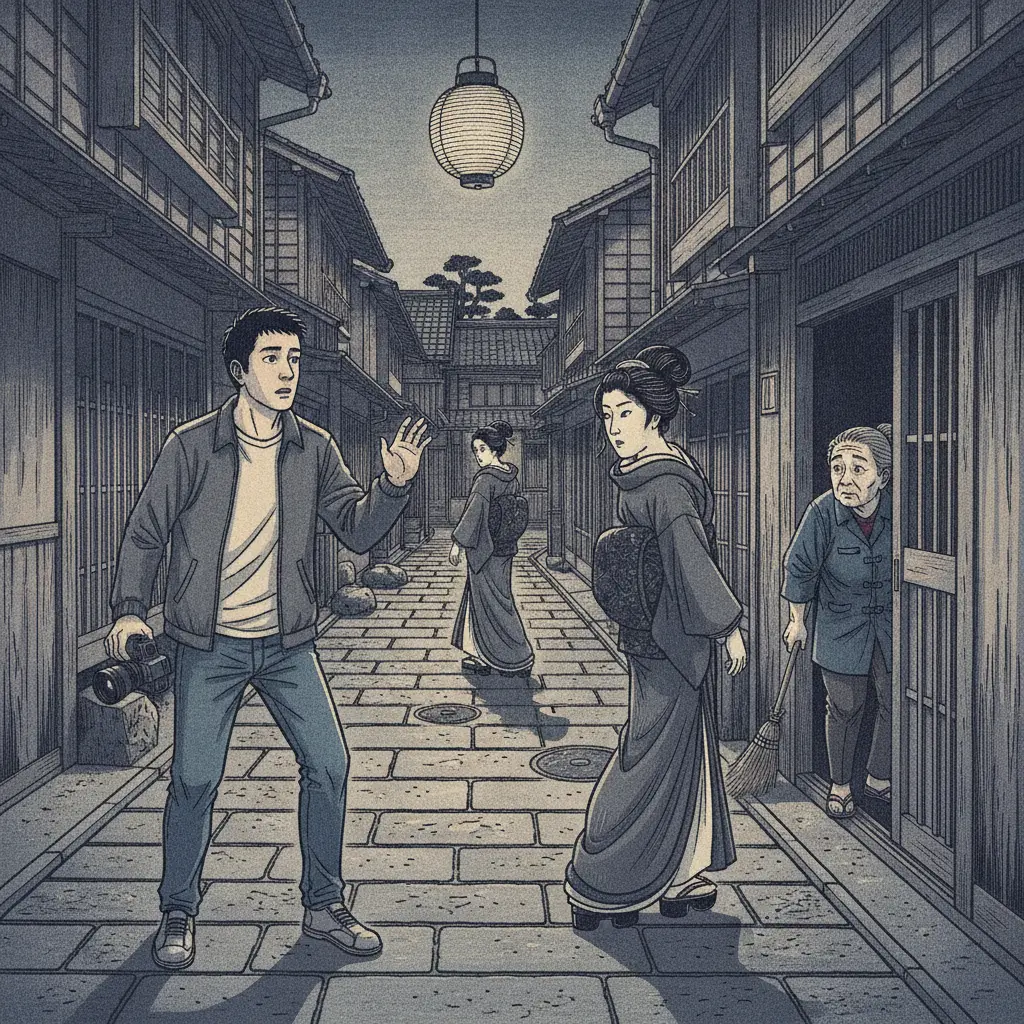
My work continues as normal. My health is fine. I have not told anyone what happened in that alley. No one would believe me, and besides, I cannot properly explain it myself — not even to myself.
There is only one thing that remains strange.
I have an older sister. She lives in Tokyo, and we see each other a few times a year. The week after I returned from Kyoto, she called. We agreed to meet, and recently we had lunch together at a coffee shop near a station in the city. The conversation flowed easily. We exchanged the usual small news of our lives and parted after about two hours.
On the train home, a thought came to me, unbidden.
My sister and I had entered the coffee shop together, talked together, and left together. That much was certain. But as we were leaving, I had the impression that there had been three cups on the table. I only remembered ordering two. Perhaps the server had brought an extra by mistake. I tried to tell myself that.
But the memory of that third cup will not leave me.
There was a lipstick mark on it. A pale ink-grey lipstick mark.
I thought about calling my sister to ask. Then I stopped myself. If I called, and she said, "There were three of us in that coffee shop, don't you remember" — or if she said, "There were only two of us, but I have the feeling someone else was there when we left" —
I don't think I could bear either answer.
So I did not call. I have no intention of calling.
What I do instead, every night before I sleep, is check the room. I turn on every light and look into every corner. There is nothing. There is never anything.
And yet I cannot stop checking. Because her voice is still lodged somewhere deep in my ears.
"I was counting the people who passed through."
That voice returns to me each night, and I turn the words over slowly in my mind. The woman who stood before the shrine, counting those who moved through the alley. Was she counting the living? Or was she counting something else entirely?
And if there is a purpose to the counting —
If there is a reason to count —
If, after counting, she does something —
I have no answer. I do not want one.
Tonight, as every night, I check the room. I close the windows, turn the locks, look into every corner. I try to sleep with the lights on.
And just before sleep takes me, there is always the same sensation.
That someone is in the room with me.
When I turn to look, there is nothing. Only the wall. Only the furniture. Nothing more.
Nothing more than that.
But tonight, in the instant before I turned — there was something. A presence.
The soft sound of fabric shifting.
Like the rustle of a kimono.