

Ichiyo Alley
AI AI-generated fiction — text, and any narration or images. Unrelated to any real events, people, organizations, or places.
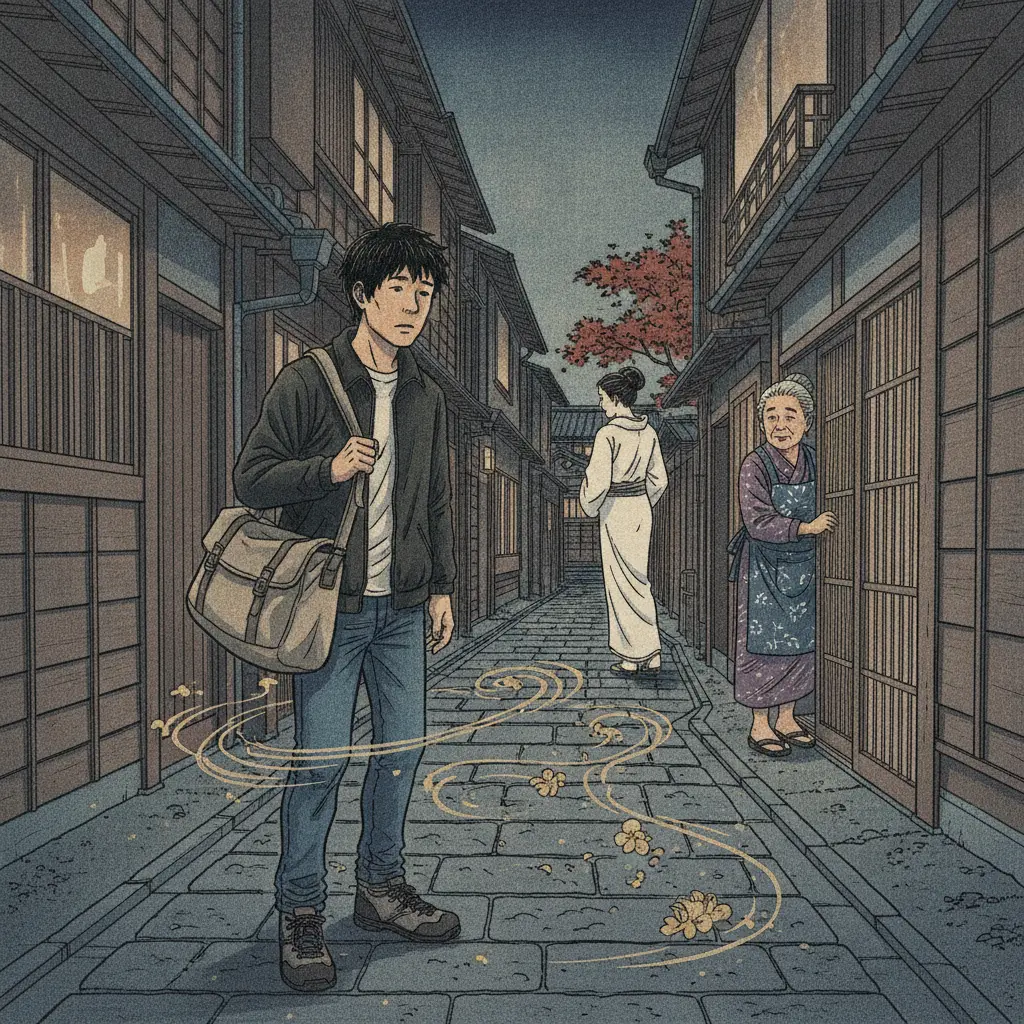
I arrived in Kyoto at dusk, at the end of October. Stepping off the bus at the Shijo-Kawaramachi terminal, I was met by a wind off the Kamo River that wrapped around me like the hem of a kimono. It carried the smell of late autumn — rotting leaves, incense, and the faint, fading sweetness of osmanthus. I had a week's worth of belongings stuffed into a shoulder bag, and I walked into the stone-paved lanes.
I was there for work. The assignment was simple enough: photograph and write about Kyoto's old townscape for a travel feature. My editor, Yoshizawa-san, had sent a memo saying to focus on the back streets of Gion, and on the map she had marked in red pen a narrow alley branching off Hanamikoji. "Tourists rarely go there," she had said. "It has the real atmosphere of Gion."
My lodgings were at a small inn converted from a machiya townhouse at the edge of Miyagawacho. When I stepped through the entrance, an elderly woman who seemed to be the proprietress appeared without a sound and led me down the corridor. At the corridor's end was a small courtyard garden where a moss-covered stone lantern stood in the dimness. My room was a corner room on the second floor, and through the latticed window I could look down onto a narrow lane. Several paper lanterns were lit along it, casting round orange shadows on the stone paving below. I watched the scene for a while, then opened my laptop on the desk and went over the schedule for the week.
I began work the following morning. I walked Hanamikoji, photographed the front of the Minami-za theatre, and passed through the torii gate of Yasaka Shrine. I decided to avoid the busy midday hours and instead walk the lanes in the early morning and at dusk. Gion in the morning was quiet and beautiful. Water had been sprinkled on the stone paving, and from behind latticed doors came the occasional sound of a shamisen. I recorded those moments carefully.
On the evening of the third day, I entered the alley for the first time. I walked south along Hanamikoji, descended a short flight of stone steps, and found myself at the entrance to a side lane. A rusted nameplate hung at the opening, its characters half-worn and unreadable. The alley was so narrow that stretching out both arms would have brought my hands to the walls on either side. Above, a sliver of sky was visible between the rooflines. The dusk sky had just begun to turn indigo, and that color was reflected in the puddles on the stone below.
Walking toward the far end of the alley, I quickly left behind the noise of the tourist district. What replaced it was only my own footsteps and the low drone of an exhaust fan somewhere in one of the houses. The buildings on either side were old, their latticed windows dark and shut. None of the houses had nameplates; the letterboxes were empty. There were traces of habitation — a single cloth hanging to dry under an eave, a half-dead chrysanthemum in a small pot — but they looked less like signs of life than remnants left behind after life had departed.
Somewhere near the middle of the alley, I had the feeling of being watched. It was not a chill down my spine but a roughening of the skin at the back of my neck, a slow prickling. I turned around. No one was there. Only the entrance to the alley behind me, and beyond it the distant, blurred glow of Hanamikoji's lanterns. I gave a small laugh, told myself that a professional writer had no business losing his nerve, and turned forward again.
That day's work ended without incident. The alley opened at the far end onto the grounds of a small shrine, from which I could make my way back toward Miyagawacho. The shrine's name was carved into a stone pillar, but moss had covered most of it; only the final character remained legible. It read "sha" — shrine. The grounds were deserted, and the offertory box before the hall of worship was old and weathered, but in front of it stood a fresh sprig of sakaki. Someone had been here recently, I thought.
On the fourth night, I entered the same alley again. It was past eight o'clock, and the only light came from the paper lanterns. I had my camera and intended to photograph the lane at night. I stopped at the rusted nameplate by the entrance and pressed the shutter. Checking the LCD screen, I found the characters had come out more clearly than I expected. I could read them: Ichiyo Yokocho — Ichiyo Alley.
As I walked, I took several photographs. The wet stone paving, the shadows of the latticed doors, the small lanterns under the eaves. Each time I raised the camera, the alley in the viewfinder seemed deeper than it was in reality, as though it extended somewhere far beyond what the eye could follow. I knew it was only an illusion, but each time it made my breath catch slightly.
Somewhere past the midpoint of the alley, I stopped. The feeling from the third day — the sense of being watched — had returned. This time it was more distinct. Not just my back, but the base of my skull and the nape of my neck grew slowly, suffusingly warm. I turned around slowly.
Near the entrance to the alley, in the darkness beyond the reach of the lanterns, a woman was standing.
She wore a white kimono. Or rather, it was less that her kimono was white and more that the woman herself appeared white. Her face was in shadow and I could not make it out clearly. But her posture was wrong. Her spine was too straight. A human back carries some natural looseness, some give — hers had none. She stood with the rigid verticality of a doll, as though a rod had been driven through her in place of a spine.
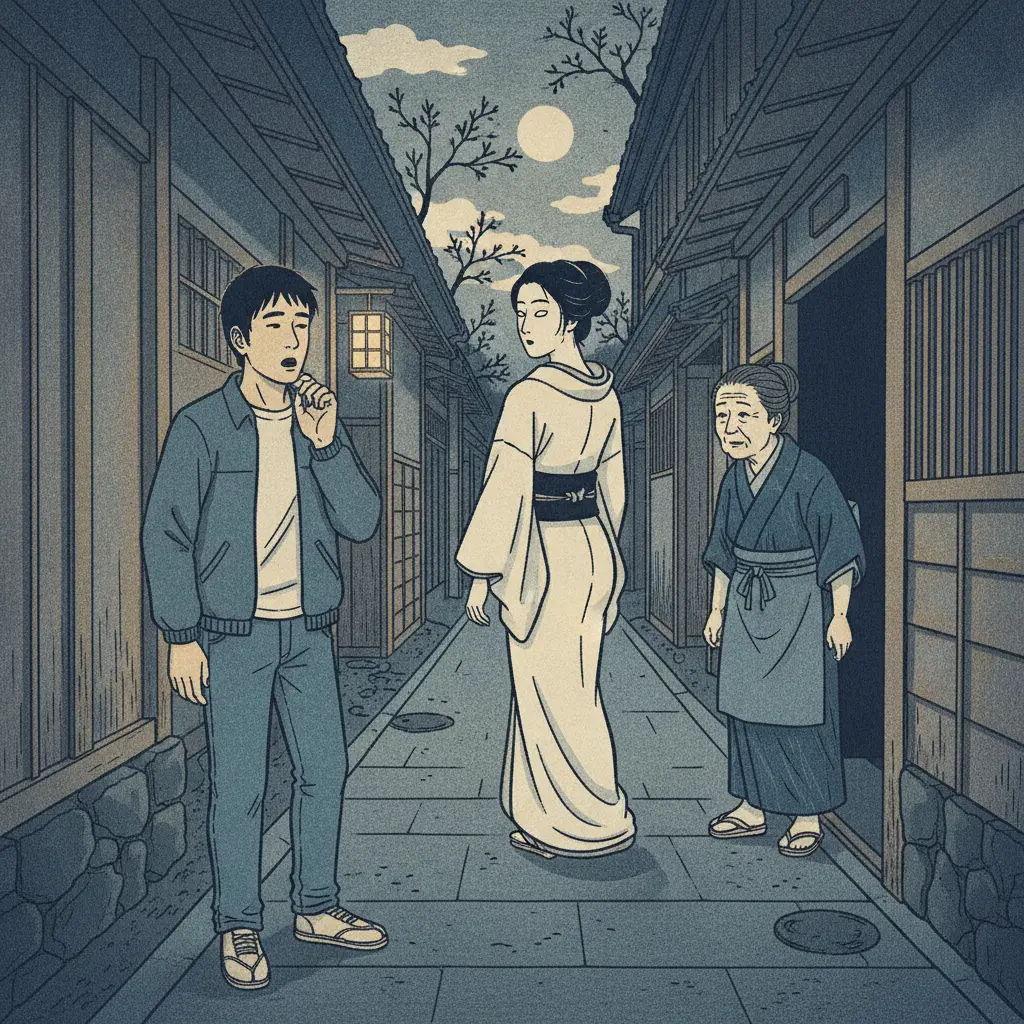
I tried to call out to her and found I could not. It was not that my voice failed me; it was that to introduce sound into that air felt wrong in a way I could not reason through. There was a resistance, wordless and instinctive, to breaking the silence. The woman appeared to be facing me, but she did not move. Three seconds passed, perhaps five. We stood facing each other like that.
Then she moved. Or perhaps disappeared is the more accurate word. She slipped sideways into the darkness of the alley, drawn smoothly away as though pulled from offstage. There was a latticed door there, and I told myself in that moment that she had simply gone inside — a person entering her home, nothing more. But there had been no sound of the door opening, and no sound of it closing.
Back at the inn that night, I lay awake for a long time. Outside the latticed window, the orange light of a lantern swayed, its glow stretching and contracting on the stone below. I lay in my futon with my eyes open, turning the image of the woman over and over in my mind. Each time I returned to it, something shifted slightly. At first I remembered her spine as simply straight; then a memory crept in that her head had been tilted to one side; then I corrected myself — no, her head had not been tilted. The memory refused to settle. Only one impression remained fixed, impossible to dismiss: I had the feeling that the woman's feet had not been resting on the stone paving.
On the morning of the fifth day, I asked the proprietress about Ichiyo Alley. She was pouring tea, and she was quiet for a moment — three seconds, perhaps — before she said, "Ah. That place." Her tone did not change. It was precisely because it did not change that I felt myself go slightly on guard.
"There used to be okiya along there," she said — the lodging houses for geiko and maiko. "Before the war. Hardly anyone lives there now."
I told her I had seen a woman there at night. The proprietress, still holding her teacup, looked at my face once. I could not read what was in her eyes. It was not surprise. Nor was it the resignation of someone thinking, not again. It was something else entirely, an expression for which I had no name.
"It would be better not to walk that alley at night."
That was all she said, and she closed the subject. I tried to ask a follow-up question, but she had already risen and disappeared down the corridor. At the corridor's end was the courtyard garden, and the stone lantern stood in its same place that morning as it always had.
That afternoon I went to the library. I found the shelves on local Kyoto history and read through materials on the changing history of the Gion flower district. The name Ichiyo Yokocho did not appear. But there was a record of an area near Miyagawacho where okiya had been concentrated before the war, and that area was referred to as Ichiyo-dori — Ichiyo Street. The material included an old map, and on that section of the map were several small marks. Beside the marks, written in pencil in someone else's hand, were four characters. They read: kuyo miry o — memorial rites not yet performed.
I had no way of knowing who had written it or when. The material showed no record of having been borrowed; it appeared no one had touched it in a long time. The edges of the pages had yellowed and the paper carried the smell of age. I copied the four characters into my notebook and left the library.
On the evening of the fifth day, I had not intended to return to Ichiyo Alley. But after dinner at the inn, after my bath, after I had turned off the light and lain down — I found that I wanted to go back. It was not that I decided to want it; it was more that I became aware I already did. I could not tell whether it was my own curiosity or something else drawing me there. I could not distinguish between the two.
At eleven o'clock I went out. About half the lanterns along Hanamikoji had already been extinguished, and there were no tourists. A single fallen leaf skittered in circles on the stone paving, pushed by the wind. I stood at the entrance to Ichiyo Alley and looked in. It was darker than the night before. One of the lanterns in the middle of the alley had gone out.
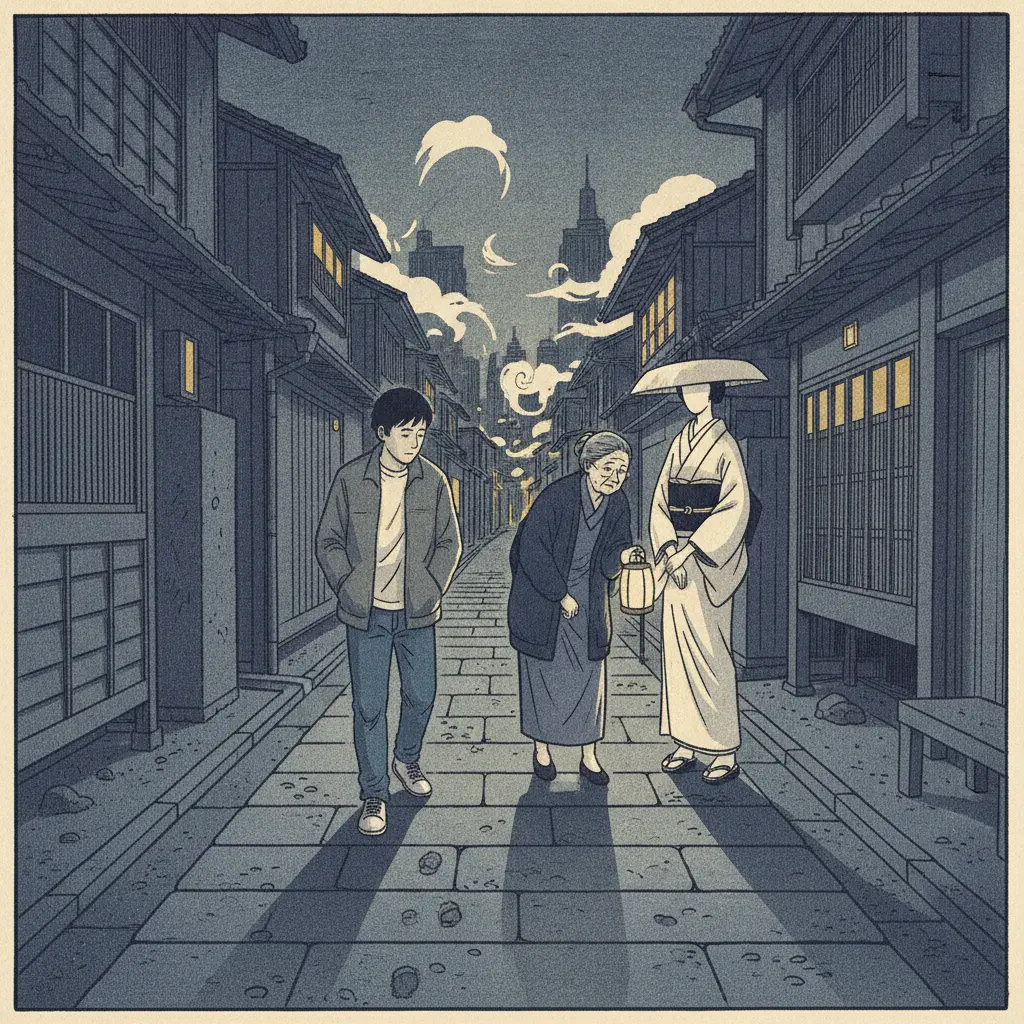
I entered. My footsteps rang against the stone. With each step further in, the sounds of Gion receded. The engine of a passing taxi, music from some establishment — all of it sank away as though swallowed by cotton. What remained was my own footsteps, my own breathing, and the cold of the stone paving transmitted up through the soles of my shoes.
When I reached the middle of the alley, I stopped.
It was the spot where the woman had stood the night before.
Tonight there was no one. But the air in that precise location was different. Not a difference in temperature — a difference in density. The air at that one point felt faintly heavier than the air around it, faintly more concentrated. I raised my camera and aimed the lens at that spot.
I pressed the shutter.
I checked the LCD screen.
My throat closed without a sound.
She was there.
The white-robed woman stood in the same place as the night before. But this time her face was visible. Not visible — rather, where her face should have been, there was nothing. I do not mean she was smooth-faced in the manner of a noppera-bo. The outline of a face was there. The shapes of eyes, nose, and mouth were present in outline. But what those features should have carried — expression — was absent. Not merely the absence of joy or grief or anger, but something more fundamental: the basic quality of a human face, the sense that something is there, was missing from hers. It was a face-shaped void.
I raised my eyes from the LCD screen. The alley was dark. There was no one.
I looked at the screen again. The woman was still there in the image.
Then I understood. The woman in the photograph was not facing me. She was facing behind me.
I turned around.
At the entrance to the alley — the opening that led back to Hanamikoji — someone was standing.
White kimono.
Not one figure. In the darkness of the entrance, white shapes overlapped one another: two, three, more. They did not move. They simply stood there, filling the entrance I had come through, pressing it closed from within.
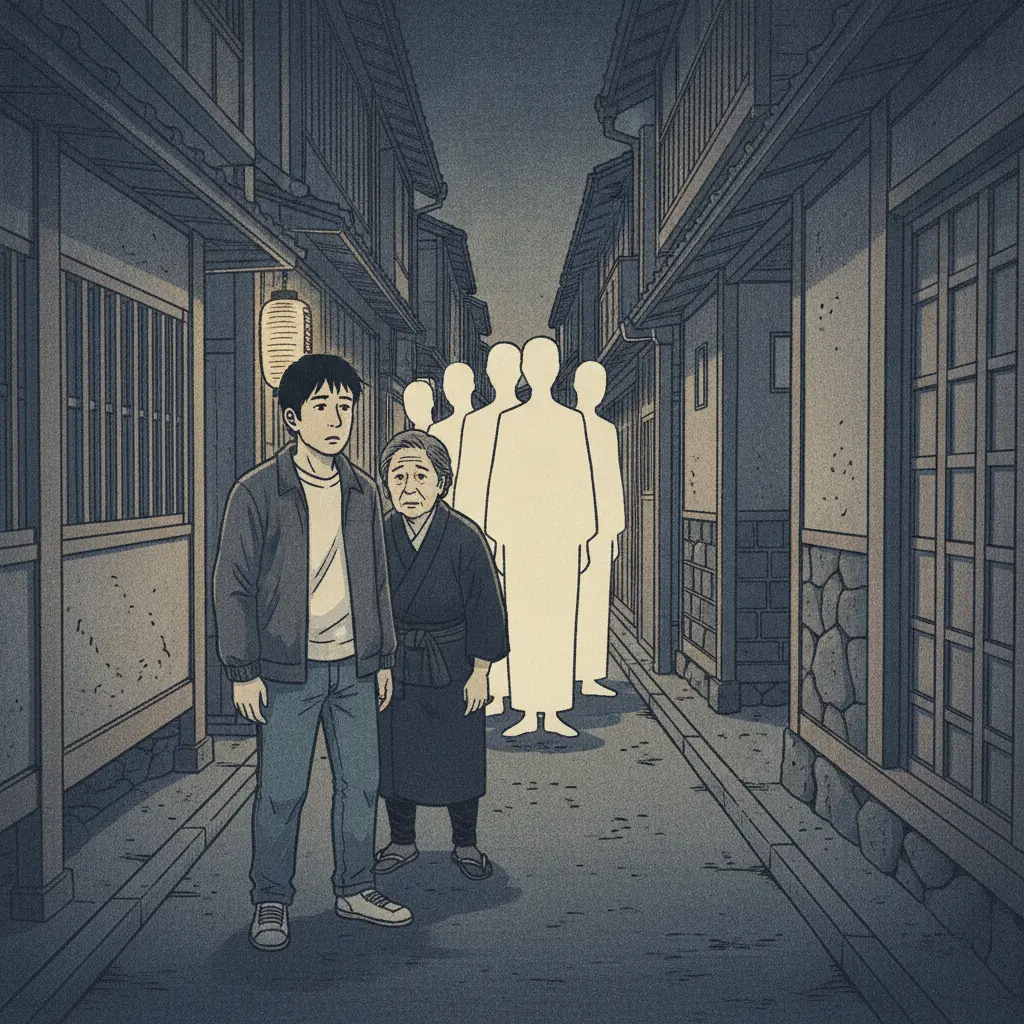
My legs would not move.
I turned to face forward. The far end of the alley — the exit leading to the shrine grounds — was still open. In the darkness I could see a thin light. A streetlamp, perhaps, or the lantern of the shrine. I walked. I did not look back as I walked. I knew that if I looked back I would not be able to move. My steps quickened, and then I was running. The sound of leather shoes on stone rang through the alley and came back to my ears, and each time it returned, I had the feeling there was one footstep too many.
I came out into the shrine grounds. I stood before the hall of worship and breathed hard, my shoulders heaving. The grounds were quiet; leaves moved in the wind. When I looked back, the alley's exit was dark and I could see nothing. Nothing had followed me.
The next morning I checked out of the inn. It was two days earlier than planned. The proprietress asked no questions. Only as she saw me off did she say, quietly, "Please take care." There was something in those words that had not been there when we first met. I cannot say precisely what it was. Only that it did not sound like a wish for safe travels — it sounded like a warning, specific and nameless, directed at something she knew and I did not.
Back in Tokyo, I sorted through the photographs I had taken. There were thirty-seven images from Ichiyo Alley. Among them was that one.
I tried to delete it. I made several attempts. But it was not that I failed to delete it — I did delete it. I moved it to the trash and emptied the trash. I confirmed it was gone. The file no longer exists.
Even so, when night comes and I lie down in the dark, a face-shaped void rises before me. It is always turned away from me, facing behind me. Quietly, only quietly, it watches whatever stands at my back.
Sometimes I turn around.
There is no one in the room.
But each time I turn, I feel the air move faintly — a slight current, as though someone has just shifted position. Whether it is the wind coming through a gap in the window frame, or something else, I no longer know. I no longer know, and tonight, as on every night, I reach over and turn off the light.