

The Embers of the Festival
AI AI-generated fiction — text, and any narration or images. Unrelated to any real events, people, organizations, or places.
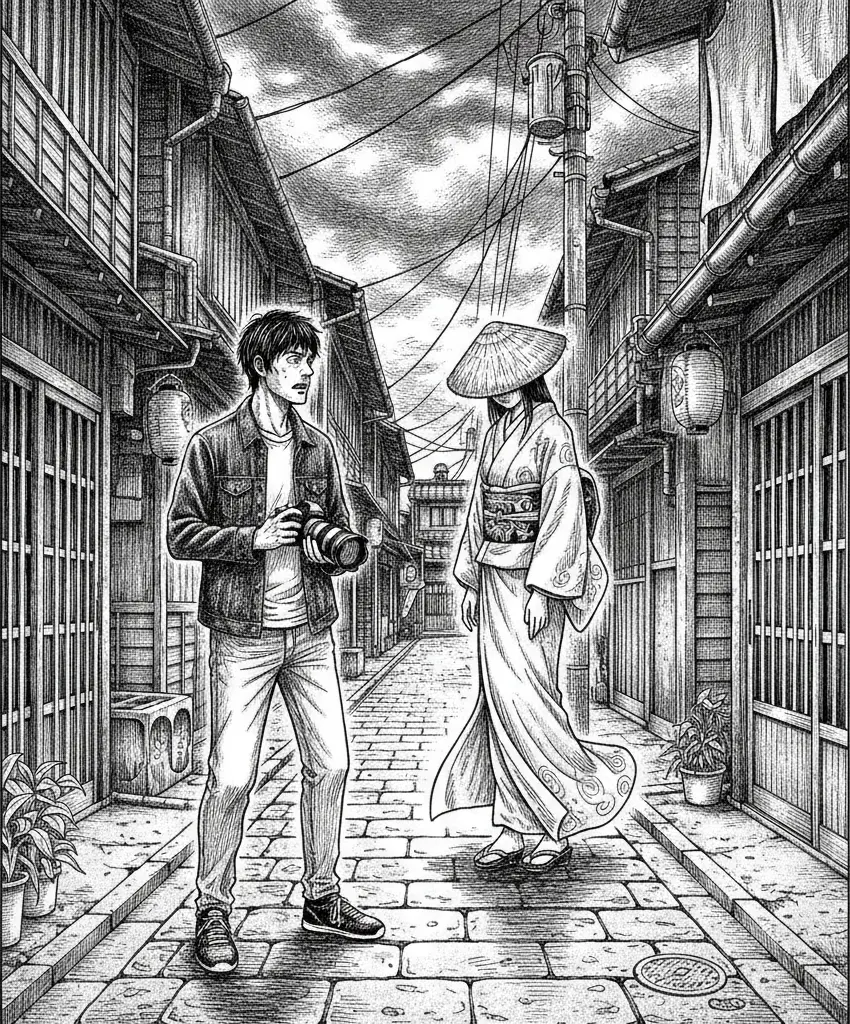
It had been three days since the latter procession of the Gion Festival ended, in the final stretch of July.
The floats had been dismantled, the crowds that had filled the streets had receded like a tide, and the back alley one block south of Shijo-dori had reclaimed its true face. The remnants of the festival still lodged in the gaps between the cobblestones — a broken sakaki leaf, sand ground underfoot, an obi cord someone had dropped — quietly drinking in the damp of the night.
Shingo Tanaka had come to Kyoto purely for work. As a freelance architectural photographer, he had been commissioned by a magazine to feature the machiya townhouse architecture of Gion. His deadline was after the Obon holiday in August. He planned to spend about a week there, carefully photographing the latticed facades, the bamboo dog-barriers, and the insect-cage windows of the back streets. His lodging was a small inn called Hatago Murasaki, two lanes east of Hanamikoji, a well-seasoned townhouse run single-handedly by its proprietress. Her name was Sumie Murakami (村上澄江), a slender-faced woman who appeared to be in her mid-sixties. On the night Shingo arrived, she told him, "This is an old house, so please don't be alarmed if you hear sounds in the night." Given his professional fondness for old buildings, Shingo took the remark in good faith.
The first day of shooting went smoothly.
During the morning hours when the raking light crept along the cobblestones, Shingo walked north along Hanamikoji and turned off onto a side street to photograph the row of willows along the Shirakawa canal. The canal ran high and murky in this season, but the way the willow branches trailed over the brownish current held a beauty that was somehow on the verge of rot. In the afternoon he entered Ishibei Koji and took close-up shots of the moss between the stepping stones and the weathered plaster of the walls. As dusk approached, paper lanterns began to glow in the lanes, and the sound of a shamisen drifted from a distant teahouse. With that music at the edge of his hearing, Shingo took his final frame of the day.
When he returned to the inn, Sumie had set out a tray: simmered tofu, grilled eggplant, and a single piece of hamo fish. Shingo ate in silence while reviewing the day's images. Every shot was satisfactory. Only one gave him pause — a photograph of a latticed door near the far end of Ishibei Koji, in which something had crept into the frame. Beyond the lattice, in the dim interior, there stood what appeared to be the outline of a person. On closer inspection it might have been nothing more than a refraction of light, or the shadow of some ornament. Shingo moved the image to a folder he labeled "to check," drank one beer, and went to sleep.
On the evening of the second day, something began to slip.
The shooting had gone well again, and on his way back to the inn Shingo wandered into a narrow alley on the western side of Hanamikoji, an unnamed passage that appeared on no map, hemmed in on both sides by wooden fences with just enough width for a single adult to pass. From somewhere deeper in the alley came a faint smell — sweet and heavy, something between incense and rotting flowers and sandalwood. Out of professional habit, Shingo raised his camera and pressed the shutter toward the far end of the passage.
Midway through the alley, he noticed a figure ahead of him.
A woman. She wore a white kimono. He could not make out the pattern at that distance, but the hem was long enough to drag along the ground, and yet her feet were entirely invisible. She stood with her back to him and did not move. Shingo stopped and tried to call out. What came from his throat was not the word "excuse me" but only breath. The woman's shoulders rose and fell, slowly, as though she were breathing very deeply.
Shingo lowered his camera and took a step back. At that moment the woman moved.
Not turning around — she moved forward. She passed directly into the wooden fence and disappeared. There was no door in the fence, no gap of any kind.
Shingo stood frozen for several seconds, then walked quickly out of the alley. Back at the inn he reviewed his photographs. In the shot he had taken toward the far end of the passage, a small white figure was visible. It was out of focus. Only a pale mass, standing in the center of the lane. Shingo moved his finger to delete the image, then stopped. He put it in the "to check" folder instead, and drank two beers.
On the evening of the third day, Shingo asked Sumie a question.
"Did anything happen in these alleyways, in the old days?"
Sumie was quiet for a moment, and her hands stilled over the dishes she was clearing from the tray.
"Gion is an old neighborhood," she said. "There are all kinds of stories."
"Such as?"
"It was a flower district," Sumie continued, without looking at him. "In the old days, there were all sorts of women here. Not all of them came willingly. If you go back to before the war, even more so."
"Before the war."
"I've heard that this inn, too, was used somewhat differently in those days." She cut herself off there. "The bath is free now," she said, and retreated to the kitchen.
That night, Shingo woke around one in the morning.

He had grown accustomed since the first night to the sounds of the old wooden structure contracting in the cool air, so that did not trouble him. But the sound coming from the corridor was different. Footsteps. Perhaps not quite footsteps. It was a sound of something dragging or sliding along the wooden floor of the hallway. It resembled the sound of a long hem being trailed across boards.
Shingo lay still inside his futon. The sound drew closer, and stopped in front of his room.
The sliding door rattled. Not a knock — a dry, resonant vibration, as though something had made contact with the door. Shingo held his breath. One second. Two. Five. The sound ceased. Presently the dragging noise receded and faded somewhere at the far end of the corridor.
The following morning, Shingo mentioned the sound in the hallway to Sumie. "It's an old house," she repeated. She was smiling, but her eyes were not. Shingo remembered she had said the same words on the very first night.
On the fourth day, Shinago made a conscious effort to avoid that alley.
He concentrated his shooting on the area north of Hanamikoji, near Nawate-dori — the outer wall of an old restaurant, the water stains soaked into the cobblestones, summer weeds pushing through the gaps in a stone wall. The work felt solid. But late in the afternoon, walking along the Shirakawa canal, he saw a white figure on the opposite bank.
This time it was moving. It came toward him through the shadows of the willows along the water's edge. The way it moved was wrong. The knees did not bend; it glided as though the ground were a smooth floor beneath it. Shingo stopped and narrowed his eyes. The figure merged with the trunk of a willow tree and was gone. He crossed the bridge to the far bank and checked the base of the willow. No one was there. Not a single sandal print in the earth.
Walking back to the inn, Shingo told himself he was tired. Lack of sleep, summer heat, the weight of the old town's atmosphere — his vision was misfiring. But when he returned to the inn and reviewed the day's photographs, he found, in the shot taken across the Shirakawa, a white figure in the shadow of the willow. It was distant and small, but it was there. Leaning slightly forward, moving toward him.
Shingo stared at the image for a long time. When he enlarged it, the area around the face was a white blur. No eyes, no nose, no mouth. Only a pale, featureless oval.
That night, Shingo locked the sliding door before he slept.
On the morning of the fifth day, he noticed something wrong when he stood before the washbasin to rinse his face.
Looking at his own reflection, he felt that something was off. It was not a matter of expression. It was not a matter of his features. It was simply that the figure in the mirror seemed to move a beat behind him. When Shingo tilted his head to the right, the reflection tilted to the right as well — but the timing was fractionally delayed. A fraction of a second, perhaps less. This happened three times in a row. On the fourth tilt, the reflection did not move at all.
Shingo looked away from the mirror, then looked again. His reflection was moving normally.
At breakfast, he asked Sumie: "Has anyone ever died in this inn?"
Sumie set down her teacup. "Why do you ask?"
"There's a sound in the corridor at night. Something walking."
"It's an old house."
"That's the third time you've said that."
Sumie looked at him. For the first time, directly. Her eyes had the quality of someone taking a measure of something, or arriving at a decision.

"Mr. Tanaka," she said, "when you finish your shooting today, could you come back a little earlier than usual? I have something to tell you."
When Shinago returned to the inn that evening, Sumie was seated in the altar room.
In front of the Buddhist altar, a row of small picture frames had been arranged. Shinago sat where she gestured and looked at the photographs. There were four, old black-and-white prints. Each showed a young woman. Wearing kimono, facing forward, with expressionless faces.
"These are the women who died in this house before the war," Sumie said. "Four of them. Illness, accident, and — one who took her own life. They all worked here."
Shinago looked at the photographs. When he reached the second from the right, a coldness moved down his spine.
It was not that the face matched the woman he had seen in the alley. It did not. But the kimono she wore — white with fine vertical stripes, the hem trailing long — was the same as the kimono of the woman in the alley.
"Mr. Tanaka, please listen." Sumie's voice was low. "The room you are staying in is the oldest room in this house. Someone died in that room as well. Every year, in the period just after the festival ends, guests who stay in that room say strange things."
"Strange things — meaning?"
"That they've seen something. In the corridor. In the alleyways. In the mirror." She paused. "Mr. Tanaka, please answer me honestly. Has anything appeared in your photographs?"
Shinago took out his camera and opened the "to check" folder. He showed her three images: the latticed door in Ishibei Koji, the white figure in the unnamed alley, the shadow beneath the willow on the far bank of the Shirakawa.
Sumie looked at the photographs. She was silent for a long time. Then she spoke.
"Mr. Tanaka, please leave tomorrow."
"But my work—"
"You can do your work elsewhere." Sumie's voice was gentle but immovable. "Staying long in that room during this time of year is not good. That is all."
That night, nothing happened.
No sound in the corridor, no vibration of the sliding door. Shinago slept until morning — a deep, dreamless sleep. When he woke, the camera he had left at his pillow was gone. He climbed out of the futon and looked around the room. The camera was in the corner. Not where he had placed it the night before.
Shinago picked up the camera and turned it on. He opened the "to check" folder.
The three photographs had been deleted.
In their place was a single photograph.
It was a picture of a room's interior. In the dim space, a futon had been laid out. Someone was sleeping in the futon. The person's face was not visible. But Shinago knew. It was his room. And the figure in the futon was himself.
He checked the image metadata. The time of capture was 3:17 a.m.

Shinago set the camera on the floor with trembling hands and breathed deeply. Then he slowly looked around the room. There was nothing unusual. An old chest of drawers, a small writing desk, morning light filtering through the shoji screen. Nothing out of place.
But in the corner of the room, he noticed a small stain on the tatami.
That stain had not been there yesterday.
Shinago packed his belongings quickly, thanked Sumie, and left the inn. Sumie bowed at the entrance and said, "Please take care." Her voice was slightly different from the voice one uses to see off a departing guest. It was the voice of someone who knows something and has decided not to say it.
On his way to Kyoto Station, Shinago stopped on Shijo Bridge and looked out at the Kamo River.
The summer Kamo ran wide, the willows on the far bank reflected in the surface. Standing with his hands on the railing, watching the current, he thought about the absence of dreams the night before — or perhaps, he thought, he had dreamed and simply could not remember. He recalled the smell he had noticed just before falling asleep: heavy and sweet, something between incense and rotting flowers and sandalwood.
Even on the bullet train, Shinago could not bring himself to turn the camera on. He kept it on his lap and left it there.
Three days after returning to Tokyo, he connected the camera to his laptop to send the image files to his editor. The "to check" folder was empty, as expected. But in a different folder he found a photograph he had no memory of taking.
It was a picture of an alley. The unnamed alley that appeared on no map — that narrow passage. It had been taken in daylight, and the far end was clearly visible. The photograph showed what lay on the other side of the wooden fence. There was no door in the fence, no gap. And yet beyond it, there was a small enclosed space.
Four women stood in that space.
Wearing white kimono, facing forward, with expressionless faces.
In the hand of the third woman from the left, there was a small rectangular object. Shinago enlarged the image to its maximum.
It was a camera. A black-bodied camera, the same as his own. The lens was pointed toward him.
Shinago looked away from the laptop screen and down at the camera in his hands. Then he looked at the screen again. The women in the image had not moved. All four of them simply stood there. Simply looked back at him.
Shinago closed the laptop.
The room went suddenly quiet.
The ticking of the wall clock. The hum of the refrigerator motor. And then — faintly, something sweet and heavy grazed his nostrils. A smell that was somewhere between incense and rotting flowers and sandalwood.
Shinago stood up and looked around the room. The windows were closed. The front door was locked.
The smell did not go away.