

The Mirror of the Dead
AI AI-generated fiction — text, and any narration or images. Unrelated to any real events, people, organizations, or places.

The surface of Lake Usori is always still, always mirror-flat. Even when the wind blows, no ripples form; even when rain falls, the sound seems to be swallowed whole. There is a strangeness to its quiet that defies explanation. The locals sometimes call it "the mirror of the dead" — though never in front of tourists.
Tanaka Seiichi arrived at Jizo-an, the lodging temple at the foot of Osorezan, on a weekday evening in late September. He worked at an editorial production company in Tokyo, and he had come alone, carrying years of accumulated exhaustion and the fact of his younger brother's death six months prior. If asked his purpose, he would have struggled to answer. No grief counselor had sent him here; he held no particular faith. He had simply heard, somewhere, that Osorezan was a place where the dead could be spoken to — and so he had come.
The temple lodging was an old wooden building, and the floorboards gave a low creak with every step. The woman who appeared at the front desk looked to be in her sixties. She said, "Mr. Tanaka, just yourself this evening?" and after that spoke almost nothing at all. His room was an eight-mat tatami space; through the window, a dark mountain slope breathed the faint reek of sulfur. Dinner was a tray of simmered mountain vegetables and tofu. Seiichi ate half of it, took his brother's photograph from his wallet, propped it on the pillow beside him, and lay down.
His brother's name was Masaki. He was twenty-nine years old when he fell from the fifth floor of his apartment building. Whether it was an accident or a choice, no one could say — there was no note, no witness, and the police left behind only the phrase "death by falling." Seiichi was thirty-six. He still believed, every day, that as an older brother he should have done something. Every night he remembered the evening Masaki had called, and he had not answered because he was at work.
On the following morning, Seiichi rose early and entered the temple grounds. Passing through the main gate of Bodaiji, he found the sulfur smell intensifying, the earth beneath his feet pale and dry. Pinwheels turned everywhere; strips of red cloth fluttered from thin poles. Small jizo statues stood atop stacked stones, each wearing a faded cap or bib. A handful of other visitors moved through the grounds, but all of them walked in silence. Something about this place made people lower their voices without thinking.
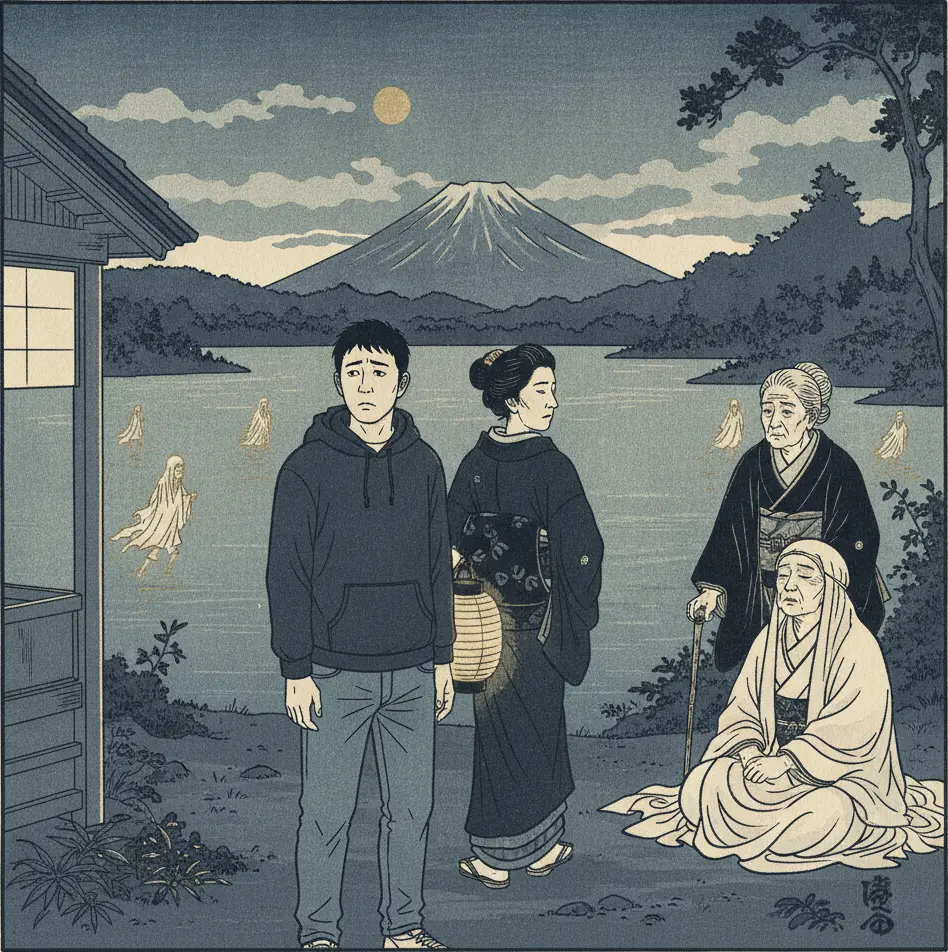
Seiichi walked to the shore of Lake Usori. The lake was exactly as still as he had been told. Milky-white water stretched away in every direction. A white sand beach ran along the bank, and its whiteness was unsettling — as though crushed bone had been spread across the ground rather than sand. He crouched and touched it. Fine-grained, cold, faintly damp. He murmured "Masaki," but the word dissolved into the sulfurous air and was gone.
That afternoon, walking along a narrow path at the edge of the grounds, Seiichi was addressed by an old woman. "Did you come to meet someone who has passed?" she said. She was somewhere between seventy and eighty — it was difficult to say — dressed in a black kimono and leaning on a cane. Seiichi was mildly startled. "Yes," he said, "more or less." The old woman nodded. "You can meet them here, sometimes. But if you call for them, make sure you send them back properly." Then she turned and walked on. The words were strange, but in this place they sounded entirely natural.
On the second night, Seiichi could not sleep. Something moved in the corridor of the lodging — not quite footsteps, more like the sound of something heavy being dragged slowly across the floor. He lay in his futon with his eyes open, staring at the ceiling. The sound continued for a while, then stopped. In the morning he went out into the hallway and found nothing. No marks on the floor, no sign of disturbance — only a single pinwheel lying toppled outside the window at the far end of the corridor. There had been no wind the night before.
On the third day, Seiichi returned to the shore of Lake Usori. The sky was overcast, and the far bank had disappeared into haze. He sat on the sand and watched the water for a long time, and then, in the mist across the lake, he saw something white. It appeared to be shaped like a person, but the distance made it impossible to be certain. He narrowed his eyes. The white shape was moving slowly — walking along the opposite bank, it seemed, perhaps moving in his direction — but the fog thickened, and it was gone.
When he returned to the lodging, the woman at the front desk said, "There is an itako visiting this evening. If you would like, I can arrange a time for you." Seiichi hesitated briefly, then said, "Please." Itako were supposed to come only during the Osorezan Grand Festival, but apparently private arrangements could sometimes be made.
The itako was an elderly woman named Tamae. She was in her seventies, with white cloth wound around her head, and her eyes appeared to see very little. They sat facing each other in one of the lodging's rooms, and Tamae began to chant, working her prayer beads between her fingers. Her voice was low, the words indistinct. Seiichi gave her Masaki's name and date of birth. Tamae continued to chant, and then, gradually, the quality of her voice changed.
"Nii-chan."
Seiichi's breath caught. The voice had changed — it was still Tamae's voice, and yet there was something different in its texture.
"I'm sorry for worrying you. But it's a good thing you didn't answer that call. If you had, I would have dragged you in with me."
Tears welled in Seiichi's eyes. "Masaki," he said aloud.
"I'm all right now. There's just one thing. That white shape — you saw it at the lake, didn't you. Don't follow it. That's not me."
Tamae's body trembled faintly, then went still. The old woman set down her beads. "It is finished," she said. Her voice was her own again.
Seiichi returned to his room and sat for a long time holding Masaki's photograph. He wept — face pressed into the futon, voice smothered in the fabric. It was the first time he had cried in six months.
On the morning of the fourth day, as he was preparing to leave, Seiichi decided to look at the lake one last time. He left his luggage in the room and walked to the beach in light clothes. The morning fog was thick; the mountains' edges bled into the sky. Standing at the water's edge, he noticed that the smell rising from the lake was slightly sweeter than sulfur. He breathed in deeply and said a silent farewell to Masaki.

Then he saw it — white, in the fog, near the opposite bank, just as before. But today the distance was different. It was much closer. Perhaps fifty meters away, at the water's edge, a white human-shaped thing was standing.
Seiichi's feet stopped.
The white shape did not move. It simply stood there. Its outline was slightly blurred by the mist. Something about its proportions was wrong — the arms perhaps too long, or the head perhaps too large — the kind of wrongness that registers before the mind can name it. Seiichi could not find words for exactly what was off.
The thought came: it might be Masaki's face. And in that instant, Seiichi took a step forward. The moment his foot touched the sand, Tamae's voice surfaced in the back of his mind. "Don't follow it. That's not me."
Seiichi stopped.
The white shape was still there. And then, slowly, it tilted its head. The gesture resembled the way a person might tilt their head in puzzlement — but the angle was too deep. The neck bent past any angle a human neck could reach.
Seiichi stepped back. The sand crunched softly beneath his feet. The white shape did not move, but it remained turned toward him, neck still at that impossible angle. Whether it had a face, the fog made impossible to tell — or perhaps it was not only the fog. The place where a face should have been seemed to have a different quality to it, a different texture from the rest.
Seiichi turned and walked quickly back toward the lodging. He fought the urge to run. Why he did not run, he could not explain afterward. There was only a certainty that if he ran, something would change. He did not look back. He left the sand, reached the stone path, came to the entrance of the lodging, and only then stopped and let out his breath.
He slid open the front door to find the woman from the front desk already standing there. "You're early," she said, and then looked at his face and moved her brow slightly. "Your color—" she began, and stopped.
"There was something at the lake," Seiichi said. "White. Shaped like a person."
The woman paused. "Around here, they appear sometimes. Those who were not called."
"Those who were not called?"
"When the departed come here, there are sometimes things that follow along with them," the woman said quietly. "They were not called, so they have no name, no fixed form. They simply exist here. If you don't speak to them or approach them, they do nothing. But—"
"But?"
"They pull," she said. "They pull things toward this side." She said nothing more.
Seiichi left Osorezan on the midday bus. He made his way to Mutsu City and took a series of buses and trains toward Aomori Station. Through the window, the Shimokita Peninsula lay calm in the autumn light. Rice paddies had turned gold, and apple trees hung heavy with fruit. Seiichi pressed his forehead against the glass and watched it pass.
On the train, Seiichi took out his phone. He wanted to look once more at his last exchange with Masaki. He opened the messaging app and scrolled through Masaki's conversation thread. The final message was one Seiichi had sent: "Think you can call tonight?" There had been no reply. Below it was a call record — Masaki's incoming call, the night Seiichi had not answered.
Seiichi stared at that record for a long time. He recalled Tamae's words. "If you had answered, I would have dragged you in with me."
He had been taking those words to mean that Masaki had been worried about him — that Masaki had not wanted to pull his brother down into the same grief.
But sitting in the rocking train, a different interpretation surfaced.
Masaki had fallen at eleven o'clock at night. The estimated time of death was thirty minutes after the call record.
If Seiichi had answered, he would have gone to Masaki's apartment that night.
He might have made it in time. Or.
Or he might have been there with him.
Seiichi had not answered, and Masaki had said that was a good thing. That much was true. But who had spoken those words — was it Masaki's soul, channeled through Tamae? Or was it a merciful lie, offered by an old woman to a brother who had spent six months drowning in regret?
Or had something from the white shore of the lake spoken to Seiichi through Tamae as its medium?
The train entered a tunnel and the window went dark. Seiichi saw his own face reflected in the glass. He looked tired. There were shadows beneath his eyes; his cheeks had hollowed slightly.
And then, behind his reflection in the dark glass, he thought he saw something.
He spun around.
The seats were empty. The car was sparsely occupied, and every passenger was facing forward.
The train came out of the tunnel and back into autumn light. In the distance, the mountain range stretching toward Lake Usori was just visible. Seiichi turned to face forward again.
Masaki's photograph was in his bag — the one he had been carrying in his wallet. He took out his wallet and looked at it. Masaki was smiling. It was a photo from the summer three years ago, the two of them at the sea.
Seiichi put the photo back and looked out the window.
At one point along the mountain ridge, he thought he saw something white.
Just for a moment — between the trees, a white human shape.
The train accelerated and the mountains slid away behind him. Seiichi narrowed his eyes, but there was nothing there anymore. Only trees, and sky, and the light of autumn.
When he arrived at Aomori Station, the sky was deepening into dusk. Seiichi stepped onto the platform and breathed in. The city air held no trace of sulfur.

That evening, waiting for the Shinkansen to Tokyo, Seiichi closed his eyes in the station waiting area. He was not sleepy, but behind his eyelids the white sand beach of Lake Usori appeared. White fog. White water. The thing with its tilted neck.
He opened his eyes. Across from him, an old woman had sat down. She wore a black kimono and held a cane across her knees. It was the same old woman who had spoken to him at the edge of the temple grounds.
Seiichi made a small sound.
The old woman looked at him and nodded quietly. "Were you able to come back?" she said.
"Yes," Seiichi answered. "I came back."
She nodded once more. Then she rose, took up her cane, and walked away into the crowd. She was gone almost immediately.
Seiichi stood and looked in the direction she had gone — toward the ticket gates. But there was no sign of her. For someone moving into a crowd, she had vanished far too quickly.
The Shinkansen announcement came over the speakers. Seiichi picked up his bag and walked to the gates.
He did not sleep once on the journey back to Tokyo. He watched the night scenery pass outside the window. He thought about Masaki. He thought about the phone call. He thought about the white shape and the impossible angle of its neck.
When he opened the door to his apartment, the air inside smelled of the same settled dust as it had for the past six months. Seiichi hung up his coat, set down his pack, took Masaki's photograph from his wallet, and placed it on the desk.
Masaki was smiling.
Seiichi looked at his face.
Behind Masaki in the photograph, a blue sea spread wide. It was the beach they had gone to together three years ago, that summer. Two sets of belongings were visible on the sand — a parasol, a half-drunk plastic bottle.
Seiichi had looked at this photograph many times. But now, for the first time, he noticed something.
Far back in the photograph, beyond the waterline, out over the sea, something white had been captured in the frame.
The focus was soft, so it was impossible to be certain. It might have been the white of a breaking wave. It might have been a trick of the light.
But it looked like the shape of a person.
Seiichi turned the photograph face-down on the desk.
The room was quiet.