

The Empty Spot on the 7:12
AI AI-generated fiction — text, and any narration or images. Unrelated to any real events, people, organizations, or places.
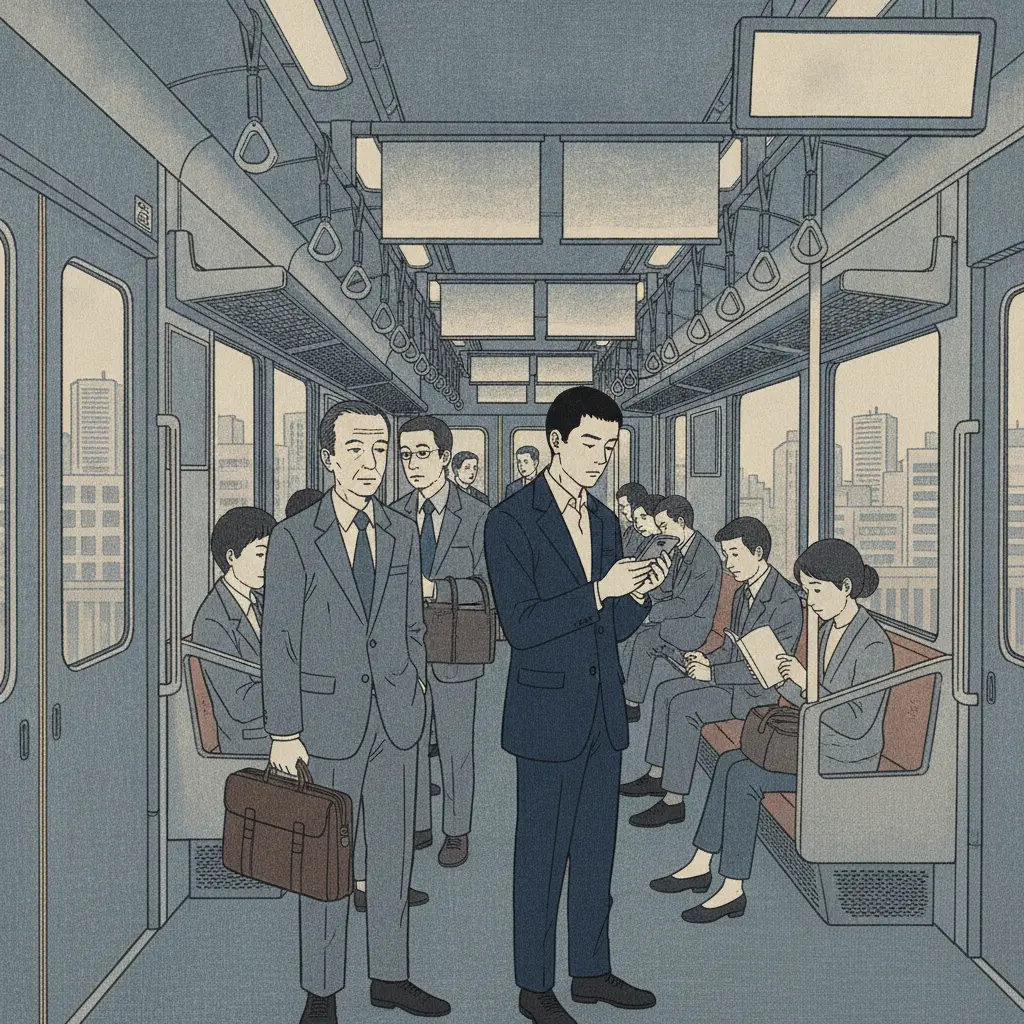
Every morning, Kashiwagi Yusuke boarded the 7:12 express. Ten years of the same routine. Forty minutes to the office, no transfers. On this particular line — crowded enough through the city centre — Car Three at this hour was never quite as packed as the rest, and more often than not a window seat or two sat empty. He would board at the same door, face the same direction, scroll through the morning news on his phone, and let the time pass. Unremarkable. Steady. A perfectly ordinary morning, repeated without variation.
He first noticed the man sometime in early spring. He couldn't recall the exact date. Only that the carriage heating was still running, and he remembered thinking it was a little too warm. The man looked to be somewhere in his forties — grey suit, dark brown briefcase — standing near the doors with one hand on the overhead rail. Nothing about him particularly stood out. If pressed, Kashiwagi might have said his eyes were narrow, and that his gaze seemed fixed on some distant, indeterminate point. He thought nothing of it, and got off at his stop as usual.
But the man was there again the next morning. Same spot, same posture. And the morning after that. Before long, without quite deciding to, Kashiwagi had filed him away as one of the regulars — those nameless strangers who inhabit the same train at the same hour, day after day, whose names and occupations you will never know. The city produces a strange, anonymous intimacy of this kind. One morning the man coughed, and Kashiwagi found himself thinking, absently, that he might have caught a cold. He said nothing, of course. But the man's presence had settled, quietly and without ceremony, into the fabric of his daily life.
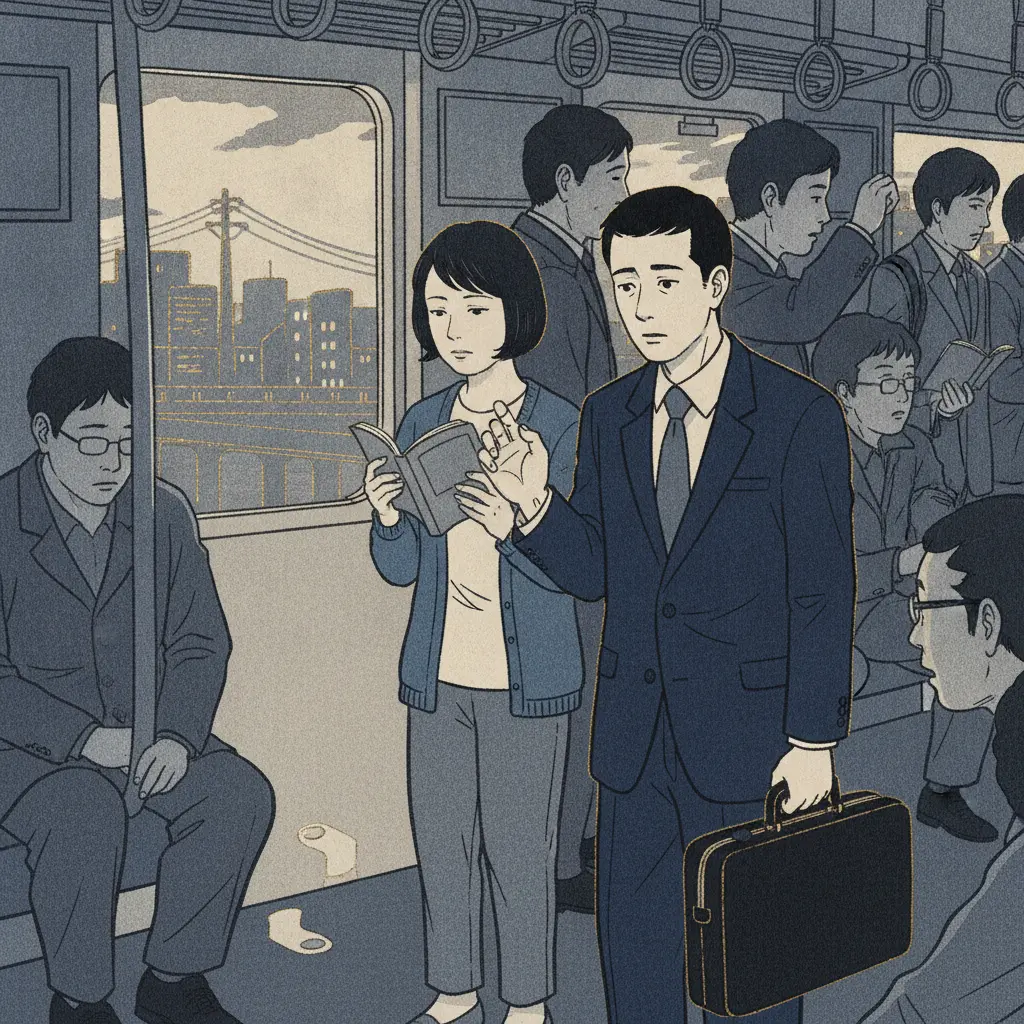
The man disappeared on the Monday after the rainy season broke. Kashiwagi boarded the 7:12 as always and glanced, without thinking, toward the spot where the man usually stood. It was empty. The next day, empty again. And the day after. He told himself the man had probably been transferred, changed his route. These things happen. And yet the vacancy nagged at him in a way he couldn't quite account for. Other passengers stood there now, or no one did — perfectly natural, perfectly ordinary — but to Kashiwagi, the air in that small patch of carriage seemed somehow thinner than the rest.
A week passed. He brought it up, almost casually, with Miyake, a colleague who took the same line. Miyake also rode this hour. "There was a man — grey suit, narrow eyes, always stood near the doors. You don't remember him?" Miyake thought for a moment, then shook his head. "Can't say I do. Was there someone like that?" It wasn't that he'd forgotten. It was more as though the premise of the question hadn't reached him at all. Kashiwagi felt a flicker of unease, then reminded himself that commuters rarely notice one another, and let the matter drop.
The unease didn't drop with it. That evening he went back through the photos on his phone. He rarely took pictures on the commute, but in March he'd photographed the cherry blossoms along the line — and that was roughly when he'd first noticed the man. He opened the photos. In the background of one, the interior of the carriage was faintly visible. He zoomed in. Near the doors, at the rail — someone was standing there, but the focus was soft, and what might have been a grey suit bled into the surrounding blur. No face. He pinched and stretched the image again and again, but the more he enlarged it, the more it dissolved, until there was nothing left that could be called evidence of anything.
The following week he made himself speak to another regular — a woman in her fifties who read a paperback every morning without fail. He chose his words carefully, tried to sound offhand. "There used to be someone who stood around here — I haven't seen him lately." The woman looked up from her book and glanced in the direction he indicated. "I'm afraid I can't think of anyone," she said, and returned to her page. He thanked her and turned to go. Without looking up, she added one more thing: "Though it is strange — that spot always feels a little cold. Even in summer."
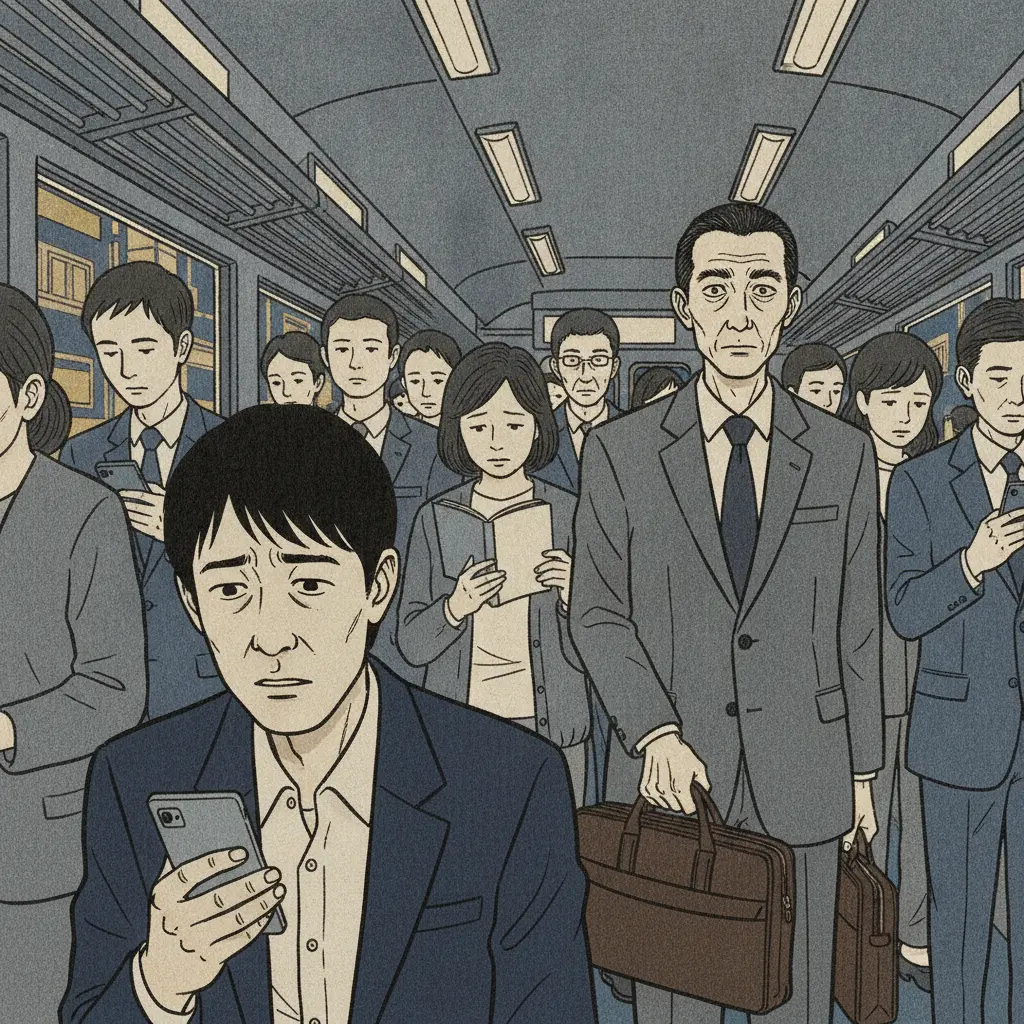
That night he searched his own social media, then other users' posts about the same line, the same hour. He found two. Spring posts. "That scary-looking guy in Car Three is there every single morning." "Something about that grey suit man — his eyes give me the creeps." He felt a wave of relief. His memory was sound. But when he clicked through to the accounts, both returned the same message: This account doesn't exist. Whether they had been deleted, or had never quite existed in the way he assumed, he couldn't say.
At the end of August he went to the railway company's service window. He wanted to ask about security footage — wanted someone to confirm that a particular passenger had ridden this train, week after week, from spring through summer. He stumbled over the explanation. There was no incident to report, no accident, no crime. He said only that he believed the same individual had boarded at this hour every day, and asked whether it might be possible to verify. The attendant was courteous and unambiguous: footage could not be released without a legitimate reason — an incident, an investigation. Kashiwagi did not use the word vanished. He had known, before he opened his mouth, that he couldn't. He knew how it would sound.
September came. He still rode the same train. The 7:12, Car Three. The spot where the man had stood always seemed fractionally emptier than the rest of the carriage — even on crowded mornings, people tended not to fill it. Perhaps he was imagining things. He tried to believe he was. Then one morning he looked up and the man was there. Grey suit, dark briefcase, one hand on the rail, eyes fixed on that same remote point. Kashiwagi's heart lurched. He could not have said, in that moment, whether what he was looking at was real.
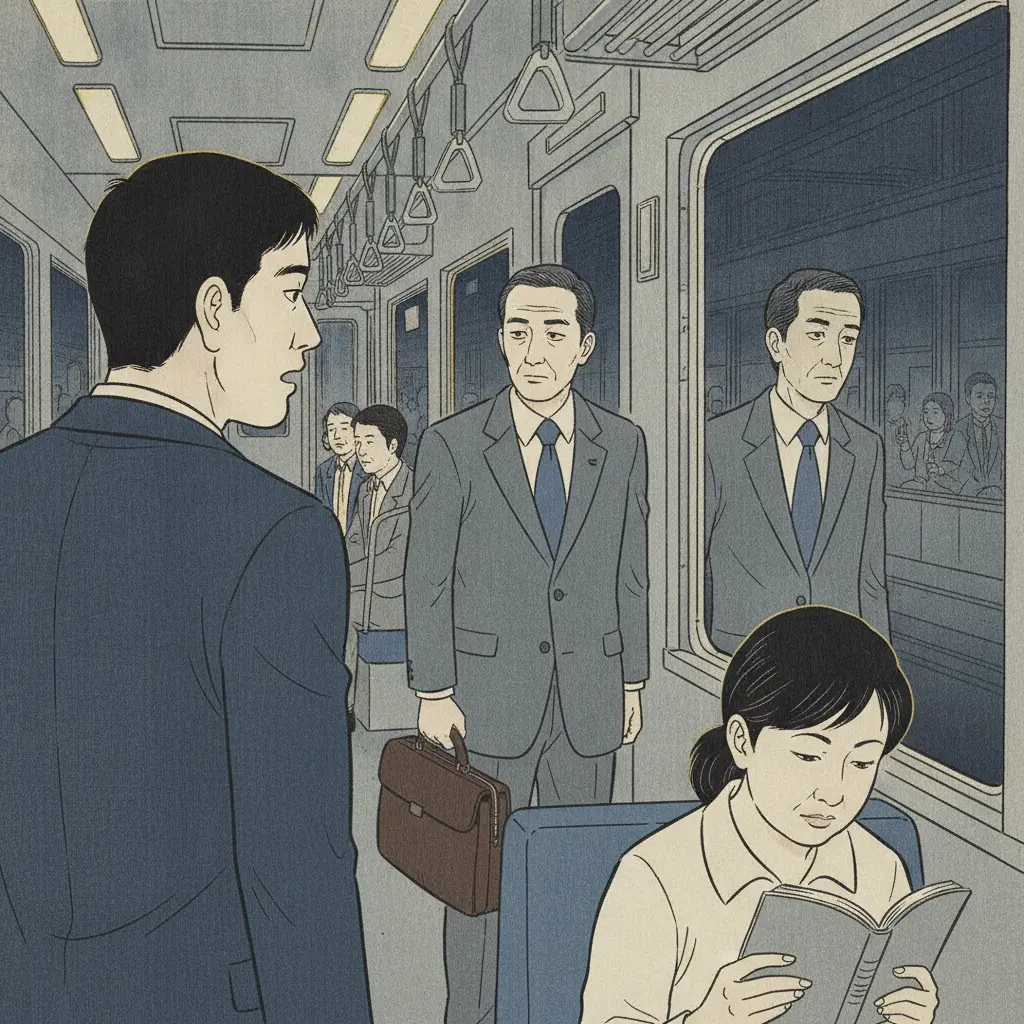
He moved toward the man slowly. He opened his mouth to speak. The man turned his head, just slightly. Their eyes met — or so Kashiwagi thought. Those narrow eyes seemed to be focused on a point just behind his face. The train entered a tunnel and the windows went black. For an instant Kashiwagi saw his own reflection staring back at him. Beside him, there was no one. When they came out the other side, the man was gone. The overhead rail swayed gently, held by no one.
Kashiwagi got off at the next stop. Two stations short of the office. He walked the rest of the way, and as he walked he counted the months — cherry blossoms when it started, the end of the rainy season when it stopped, and today, this reappearance. He was still counting when something made him stop in the middle of the pavement. He had never once seen the man's face clearly. All those mornings, all those months — and when he tried now to bring the face forward in his memory, there was nothing there. Even the narrow eyes, the one feature he'd been so certain of, he could no longer say whether he had truly seen them or simply imagined them into place, filling a blank with something that felt like detail.
The next morning, Kashiwagi boarded the 7:12. Habit is stronger than fear. He stepped into Car Three, took out his phone, and scrolled through the news. Someone was standing in the man's spot. Forties, roughly. Grey suit. Dark brown bag. Kashiwagi looked at the figure. Looked away. Looked back. The figure was staring at a fixed point somewhere in the middle distance. Kashiwagi found he no longer knew what he was seeing — whether this was the same man returned, or a different person entirely, or some residue his own memory had conjured and projected onto a stranger. The train ran on. The automated announcement named the next station. Kashiwagi lowered his eyes to the screen in his hand and said nothing.