

The Waiting Figure Behind the Vermilion Lattice
AI AI-generated fiction — text, and any narration or images. Unrelated to any real events, people, organizations, or places.
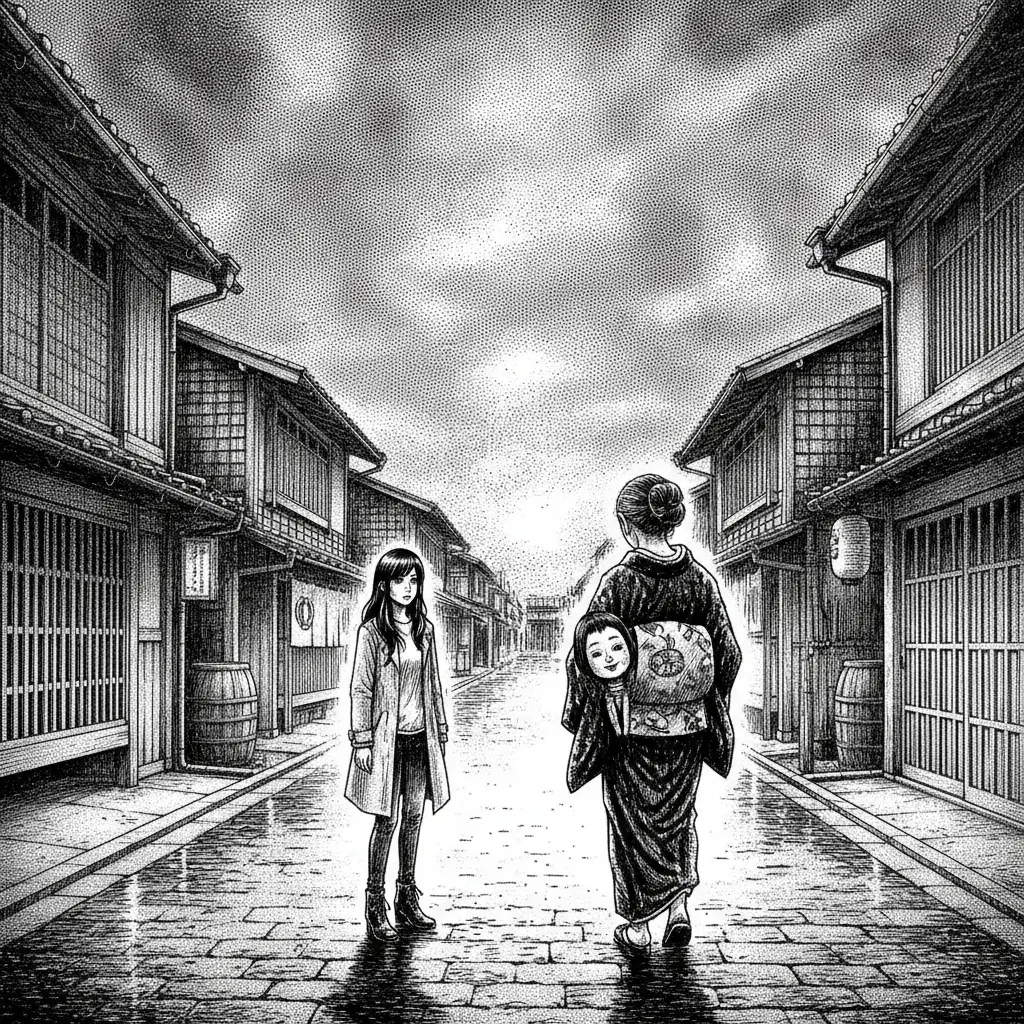
Matsumura Haruka could not quite remember when she had first fallen under the spell of that town. She might have said that something shifted the moment she stepped onto the cobblestones of the Higashi Chaya district on her first visit to Kanazawa. But whenever she tried to put that "something" into words, it dissolved, like a shape disappearing into fog.
The Higashi Chaya district lies close to the heart of Kanazawa, spreading along the banks of the Asano River — a teahouse quarter that has stood since the Edo period. Designated a Preservation District for Groups of Historic Buildings, its streets are lined with two-story machiya townhouses fronted by the slender, rust-red wooden lattices known as bengara-goshi. By day, tourists never ceased to flow through; the scent of matcha drifted everywhere, and sometimes the sound of a shamisen would drift from the depths of an alleyway. And yet Haruka always came to this district in the evening, or at night. The hour when the dying sun soaked into the grain of the lattice wood. The hour when the tourists receded. The hour when a faint mist began to rise from the cobblestones. Only in those hours, she felt with something close to certainty, did the town reveal its true self.
Haruka was not a photographer. She worked as a freelance editor in Tokyo, and every time her assignments brought her to Kanazawa, she made a point of stopping here once the work was done. The first time had been chance. The second, curiosity. By the third, she no longer needed a reason. She simply came. She would cross the Asano River Ohashi bridge, pass the willows swaying along the riverbank on her left, and come to stand at the cobblestone entrance to the district. And there, the dry, hollow ache she carried somewhere deep in her chest throughout her life in Tokyo would ease — just slightly, just barely.
On the last night of her fourth assignment in Kanazawa, at the end of July, Haruka made her way to the Higashi Chaya district as always. The air that evening was heavy, and the moon's reflection lay on the surface of the Asano River — blurred at the edges, trembling. Standing at the water's edge, Haruka turned to look upstream. Near the shadow of the bridge, something seemed to be standing. A dark mass in the shape of a person, leaning against the railing, gazing down at the river. But in the next instant, the bridge lamp swept its light across that shadow, and there was nothing there. The branches of a willow can look that way in the dark, Haruka told herself.
When she entered the cobblestone lane lined with latticed facades, something felt faintly different from usual. The quiet of the street was the same. Only it seemed as though one extra layer had been laid over that quiet — something without sound occupying a place where there should have been none. Haruka slowed her pace and moved past the row of latticed townhouses. Behind every lattice, a dim amber light seeped through. She thought she heard something like a shamisen in the distance, but when she strained to listen, there was nothing.
Deeper into the district, where the lane narrowed, there was a spot where Haruka always stopped. One of the old teahouse buildings, its bengara-goshi a shade darker than the others, with a small paper lantern hanging from the second-floor railing. She could never tell whether it was open during the day — it was a small shop of some kind, displaying old figurines and antique implements, somewhere between a curio dealer and a folk-craft seller. Haruka had never once gone inside. But every time she passed, she would stop and find herself staring into the dimness beyond the lattice. Tonight, her feet carried her there again.
As she stood before the shop, the lantern's flame stirred. There was no wind. Peering through the lattice into the interior, she noticed something she hadn't seen before: a faint light inside, where it was usually dark. A weak amber glow, like an andon lamp, illuminating a shelf at the back. On the shelf, old dolls were arranged. Haruka had known they were there, but tonight one of them seemed to have been moved from where she remembered it. Squinting through the lattice, she made out a Japanese doll seated at the end of the shelf, its white face turned toward her. Fine black brows and red lips were painted on that face, and the eyes were filled in with black. Those eyes were looking directly at Haruka.
Feeling watched by a doll's eyes is not unusual. A doll placed on a display shelf is crafted to face whoever stands before it, so that from any angle one feels observed. Haruka knew this. Even so, it took her a strangely long time to pull her gaze away from the doll on the other side of the lattice — as though her line of sight had become entangled in something, and would not come free. When she finally managed to look up, she caught her breath. Someone was standing beside the doll. There in front of the dim back shelf, a white-robed figure stood facing her.
Haruka took a step back. The cobblestones were cold through the soles of her shoes. The figure did not move. She narrowed her eyes and looked through the lattice. The hem of the robe pooled on the floor; dark hair hung forward over the face. The face itself was hidden. But something about the way the figure stood did not seem human. The bend of the knees was wrong. The angle of the ankles pointed in a direction that should not have been possible.
Haruka did not cry out. It was not that she couldn't — it was that some instinct told her she must not. That to call out to that figure would set something in motion; that to call out would be to acknowledge something. She backed away slowly and stepped out of the alley. When she reached the main cobblestone street, she saw a young couple, tourists by the look of them, walking some distance away, and only then did she let out her breath.
Back at her inn, Haruka turned the matter over in her mind. The figure in the back of the shop had most likely been a mannequin of some kind. In the dimness, she had mistaken a kimono-clad mannequin for a human shape. The wrongness of the knees was simply a trick of perspective, distorted by the dark. That was all. She settled on this explanation and tried to sleep — but when she closed her eyes, an image rose unbidden: the white figure beyond the lattice, knees bent the wrong way, moving slowly toward her. She opened her eyes again and again, staring at the white ceiling of her hotel room.
The next morning, Haruka was due to return to Tokyo. She packed her things, checked out, and set off toward the station. But her feet turned toward the Higashi Chaya district. Before she had quite realized it, she had crossed the Asano River Ohashi bridge. In the bright morning light, so unlike the night before, the latticed streetscape was tranquil and lovely. Tourists were beginning to gather; a vendor's voice called out over matcha soft-serve; the grain of the lattice wood caught the morning sun and glowed warmly.
She turned into that alley. In daylight, the old teahouse building was simply an old building. The lantern hung in place, but its flame was out. The interior beyond the lattice was dark, and she could make out the shelves inside. Haruka pressed her face close to the lattice and peered in. She found the doll on the shelf. The white-faced Japanese doll. Its eyes were turned toward her — seated in the same spot, facing the same direction as the night before. There was no figure. Only the doll.
Then, from beyond the lattice, a voice came.
"Would you like to come in?"
A low woman's voice. Haruka straightened and looked into the interior. From the depths of the shelving, a small elderly woman emerged. Her white hair was gathered at the back; she wore a deep indigo kimono. Her face was deeply lined, her eyes narrow, and they were fixed on Haruka.
Haruka had been about to say no. But the old woman had already drawn the lattice door open, parting the narrow entrance. Haruka stepped inside — she could not have said why.
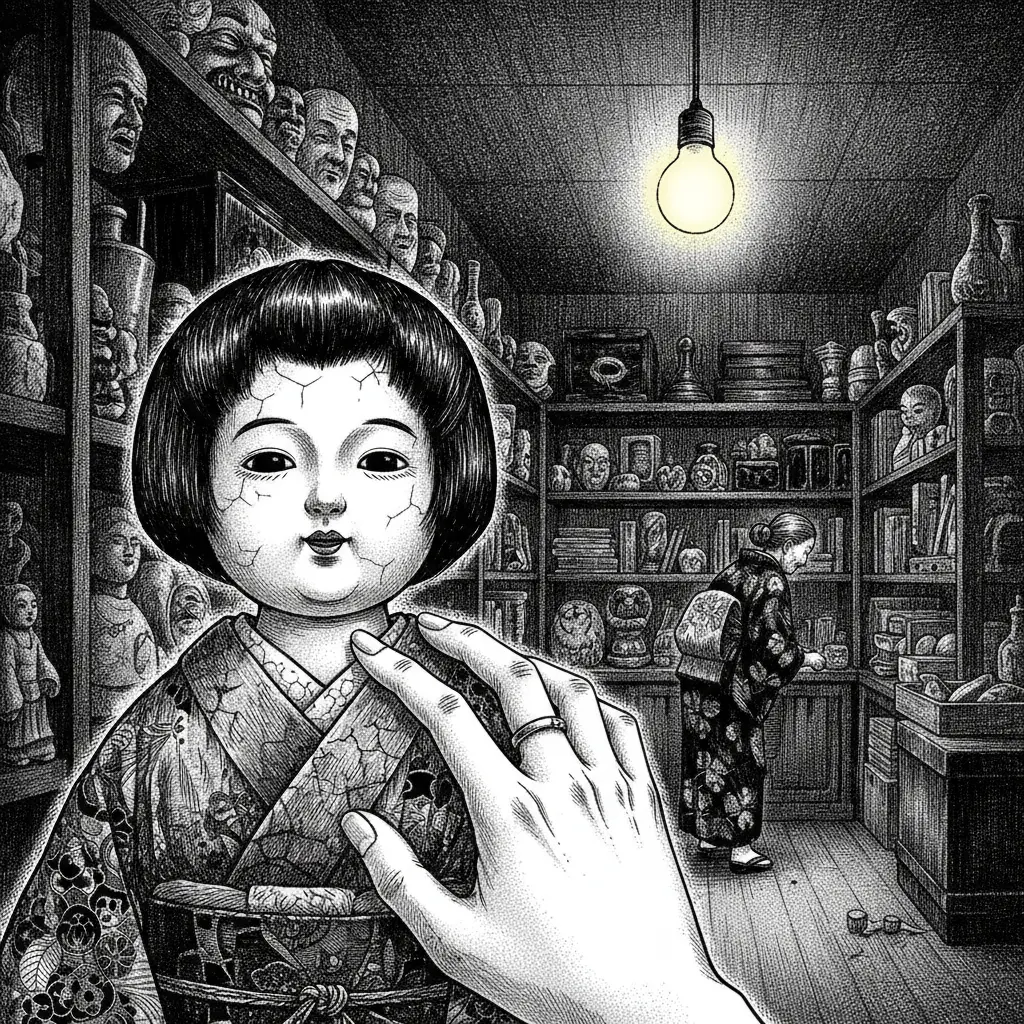
The shop was cramped. The ceiling was low; shelves lined every wall, crowded with old dolls, masks, ceramics, and lacquerware. In place of an andon lamp, a single small electric bulb now hung from the ceiling, casting a yellow light. The old woman watched Haruka enter, then slid the lattice door shut and retreated to the back of the shelves. Haruka moved along the displays until she was standing before the white-faced doll she had seen the night before.
"That one interests you?"
The old woman spoke. Haruka answered without turning around. "I passed by here last night. I was looking at this doll, and I thought I saw a figure standing in the back."
Silence.
"You saw it?"
Something in the old woman's tone shifted, almost imperceptibly. Whether it was surprise or confirmation, Haruka could not tell.
"It may have been my imagination," Haruka said.
"It may have been," the old woman said. "But," she continued, "this child carries something that only certain people can see."
Haruka looked at the doll's face. White face, fine brows, red lips, black eyes. Those eyes were looking straight at her, as they always did.
"Where did this doll come from?" Haruka asked.
"It came floating down from upstream on the Asano River," the old woman said. "Long ago. Decades ago, someone pulled it from the water, and we've been keeping it here ever since — thinking the owner would come. But no one ever has."
"Keeping it — you mean—"
"This child has somewhere she wants to return to. But she cannot get back there. So she waits here."
The old woman's voice held no emotion. It was flat — not so much an explanation as a recitation of fact. Haruka looked away from the doll and toward the old woman. She was standing at the back of the shelves, holding some small vessel in her hands, polishing it. She was not looking at Haruka.
Haruka bought the doll. Later, no matter how she turned it over in her mind, she could not say why. The old woman named a price; Haruka opened her purse; the doll was wrapped in thin paper and placed in a small wooden box. As she handed the box to Haruka, the old woman said only: "Please keep her put away at night." She gave no reason. Haruka did not ask for one.
Back in Tokyo, Haruka set the box on her desk. She opened it, unwrapped the thin paper, and the white-faced doll appeared. She placed it on the shelf in her room. The pattern of the old kimono was beautiful, the features of the face rendered with care — looking at it properly now, it was quite a refined piece. Perhaps too austere for a souvenir from Kanazawa, but not unpleasant. With that thought, Haruka turned away from the doll.
That night, the dreams began.
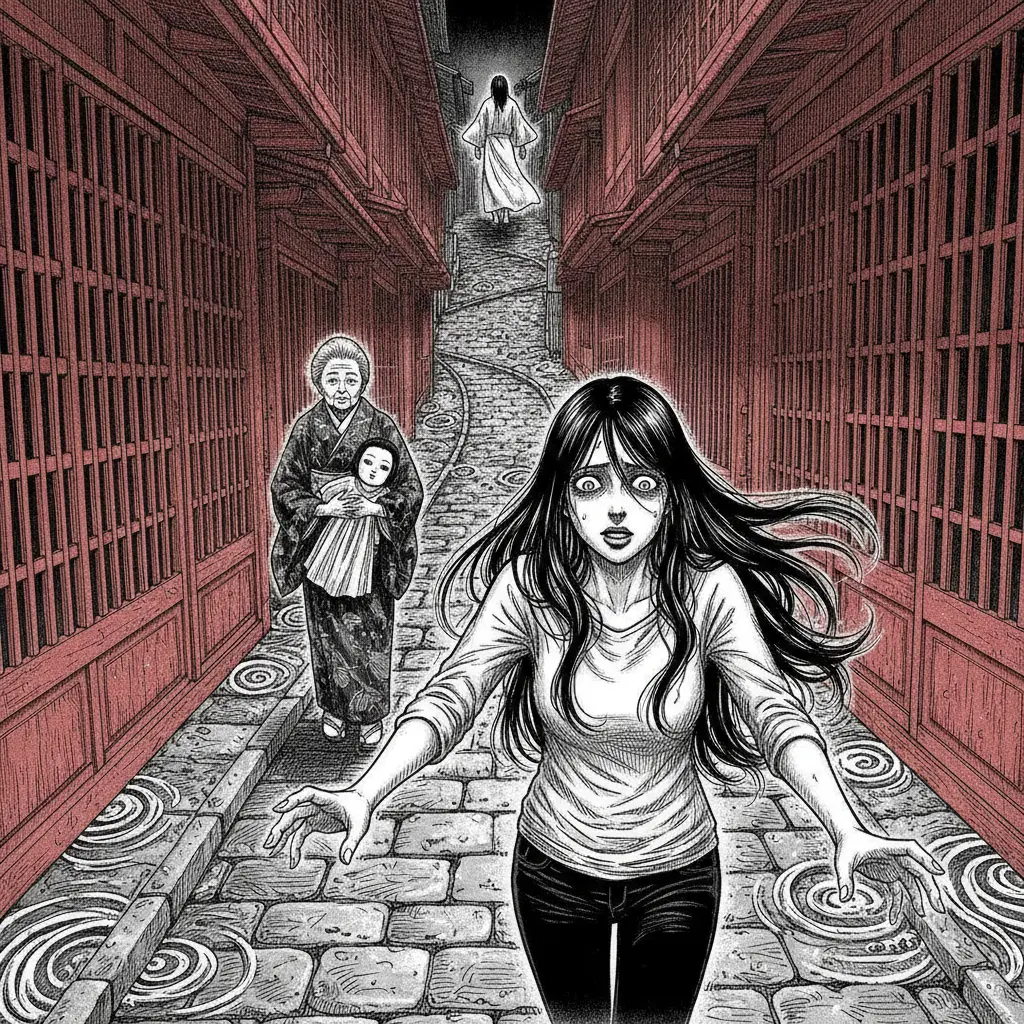
In the dreams, Haruka was always in the Higashi Chaya district. Night cobblestones, the row of bengara-goshi lattices, the sound of the Asano River. The dream-district was slightly wrong — subtly, persistently wrong. There were too many lattices. The alleys went too deep. The river was too close. And in every dream, Haruka was searching for someone. She did not know who, yet the urgency of the search was absolute, and she walked on and on through the latticed streets. Then, each time, she would find a white-robed figure at the far end of an alley. The figure had its back to her and would not turn around. When Haruka drew closer, the figure receded — toward the river, toward the growing sound of water.
A week passed, then two. Every night in the dream, Haruka walked the same alley. And every night, the white figure was a little closer. More precisely: it was not that Haruka was drawing nearer — the figure itself was drawing nearer to her. What had begun as a shape at the far end of the alley had, over the course of these repeated dreams, come to stand just behind her. One night, Haruka turned around in the dream. The white-robed figure was there. Its face was still hidden behind the fall of black hair. But this time, the figure had extended one arm toward her. A thin, white hand, reaching in Haruka's direction.
Haruka woke. The room was dark. The doll on the shelf was visible. Moonlight fell across its white face. The black eyes gleamed.
The next morning, Haruka put the doll back in its box. She remembered what the old woman had said. Please keep her put away at night. She had not done so. She closed the lid and pushed the box to the back of the shelf. That night, she did not dream.
But the following morning, the doll that she had placed in the box was back on the shelf. The box remained closed, pushed to the back where she had left it. Only the doll was out — seated in the same spot as the night before, facing the same direction. Facing her.
Haruka resolved to go back to Kanazawa and return the doll. But work piled up, and a week went by. Throughout that week, the doll was outside its box every morning. The dreams continued every night. The white figure in the dream was no longer standing behind her. It was beside her — close enough that their shoulders nearly touched, standing side by side.
She was able to get to Kanazawa ten days later. She took an afternoon bullet train, went directly to the Higashi Chaya district, and stood before the alley as the day was fading. The lantern was lit.
She drew open the lattice door. The old woman was inside. She looked at Haruka and narrowed her eyes, just slightly. She did not appear surprised.
"I've come to return her," Haruka said, and held out the wooden box.
The old woman took the box and set it on the shelf. She lifted the lid. Inside, wrapped in thin paper, was the doll. The old woman gently folded back the paper and looked at the doll's face. Then she looked at Haruka.
"Did you see it?" the old woman asked.
"Every night, in my dreams," Haruka answered. "A white-robed figure."
The old woman nodded. "Is that so," she said. "But that was not this child."
Haruka stopped breathing.
"This child came drifting here because she was searching for someone. But the one she searches for is already beneath the river. That is why she cannot go back." The old woman spoke with her eyes on the doll's face. "What appeared in your dreams was the other one."
The room went quiet. Haruka could not immediately grasp what the old woman was saying. The doll was searching for someone. That someone was beneath the river. And what had come to Haruka in her dreams was not the doll, but that someone.
"Why did it come to me?" Haruka said.
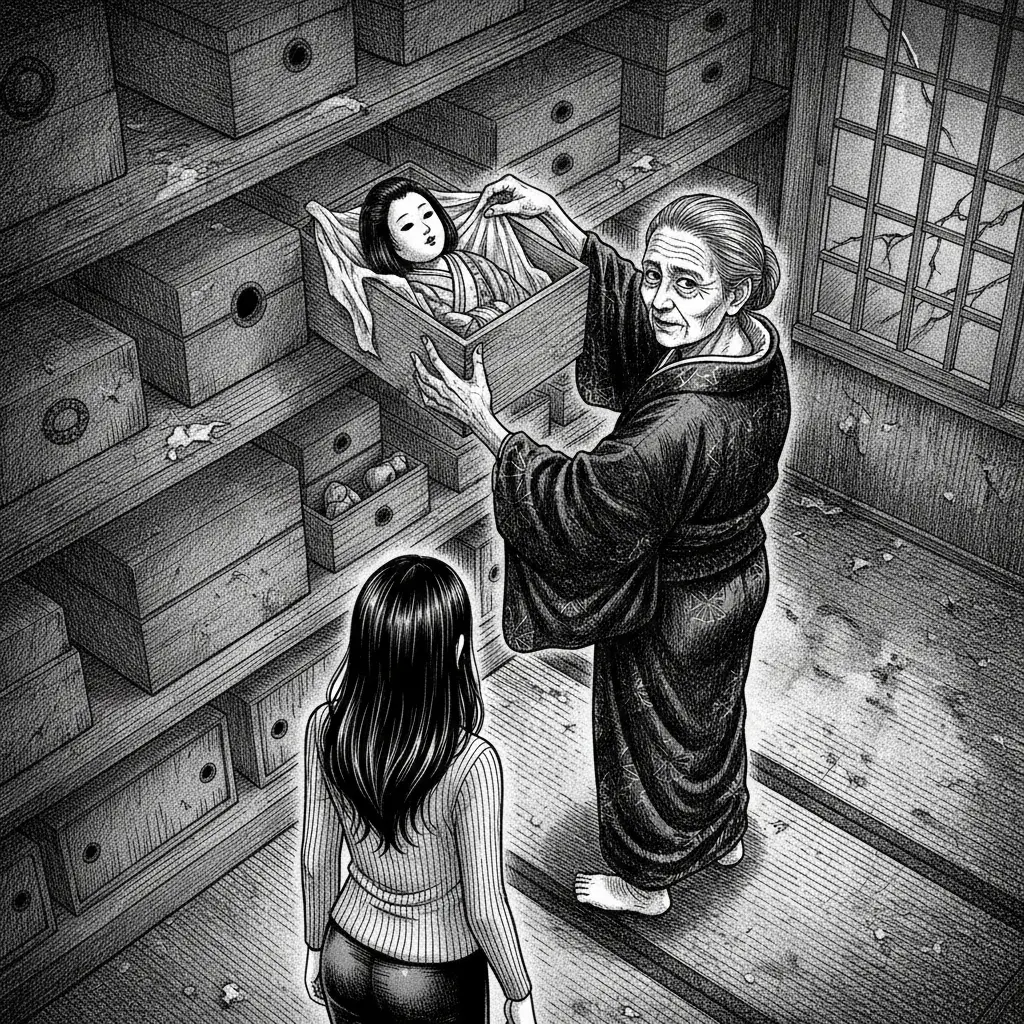
The old woman did not answer. She folded the thin paper back over the doll and closed the lid of the box. She returned it to the shelf. Then she looked at Haruka.
"You came to this district many times," the old woman said. "Always from evening into night. You crossed the bridge, walked along the river, and came here. The same path, at the same hour."
Haruka said nothing.
"When you walk the same path at the same hour, you leave a mark on the path. In this district, especially."
The old woman said nothing more, and withdrew to the back of the shop. Haruka was left alone among the shelves. Dolls and masks watched her from every direction. The lamp's light wavered. There was no wind.
Haruka stepped out of the shop. She stood on the cobblestones. The light of dusk was staining the lattices. She could hear the Asano River. She looked down the alley. There was no white figure.
She walked toward the bridge. She stood on the Asano River Ohashi and looked down at the water. The surface caught the evening sun and shone in a reddish gold. The current was gentle. She rested her hands on the railing.
In that moment, she noticed.
The railing was cold. On a July evening, when the cobblestones and the lattice wood still held the warmth of the afternoon sun, the railing alone carried the chill of deep night. Haruka lifted her hands. She looked at the river. Her own face was reflected in the water.
But there was a second face in the water. As though someone were standing beside her. Haruka looked up. There was no one else on the bridge.
She looked at the water again. The second face was still there. Black hair, white face, eyes looking up at her.
Haruka stepped back from the bridge and walked toward the station. She walked quickly. She did not look back. The sound of the Asano River followed her from behind. Within that sound, she thought she could hear something else — something like footsteps on cobblestones, and yet slightly out of rhythm with her own. A second set of footsteps, offset by just a beat.
Haruka did not look back.
She returned to Tokyo and looked at the shelf. The doll was gone. The wooden box was gone. The shelf was simply empty. Haruka let out a breath. She tried to tell herself it was over.
That night, for the first time in a long while, she did not dream.
But when she woke in the morning, there was a single black hair lying on the pillow beside her head. It was not hers. Haruka's hair was dyed brown. This one was jet black, and long, and it gleamed as though it were wet.